2009 Half Dollar Error List with Pictures

A half dollar can show copper across one whole side when its outer metal layer is missing. A 1974-D example sold for $432 at Heritage in March 2023.
That older sale helps put 2009 half dollar errors into perspective. The four types below have estimated values of $20–$500, using comparable coins and a price guide rather than recorded 2009 sales.
Read on to learn the difference between missing metal, missing design, and a dent made during stamping.
1. 2009 Kennedy Half Dollar Clipped Planchet Error (Estimated Up to $200)
A curved gap in the edge can begin before a coin has any design. Metal discs, called blanks or planchets, are punched from long strips of metal.
If one punch overlaps a previous hole, the new blank has a piece missing. Punching near the strip’s uneven end can produce a different-shaped gap.
This is a clipped planchet. The rim opposite the gap may also be weak because the incomplete blank did not form evenly.
Clipping is reported for 2009 everyday-use half dollars. That report does not identify a particular mint or individual coin.
Estimated Value
An estimated $25–$200 covers small through more noticeable clips. For comparison, a 1993-D curved-clip Kennedy graded ANACS MS64 sold for $34.74 including fees at Pristine Auction in August 2025.
That was a 1993 coin, not a 2009 sale. A large missing section, attractive surfaces, and confirmation by a grading service can support a higher price.
A small clip on a worn coin belongs nearer the lower end.
How to Identify
Turn the coin over. A genuine clip should make sense on the front, back, and exposed edge, not just in one photograph.
Use a 10× magnifier to look for saw lines, sharp burrs, or a squeezed border. These can show that someone cut or crushed a finished coin.
Check an accessible coin on a digital scale against the normal 11.34 grams. Missing metal reduces weight, but the loss depends on the gap’s size.
Calipers may still measure the normal 30.6 millimeters across an undamaged part of the coin. Look for weakness on the rim opposite the gap too; it supports the clip explanation, but it cannot prove the error by itself.
2. 2009 Kennedy Half Dollar Struck-Through Error (Estimated Up to $300)
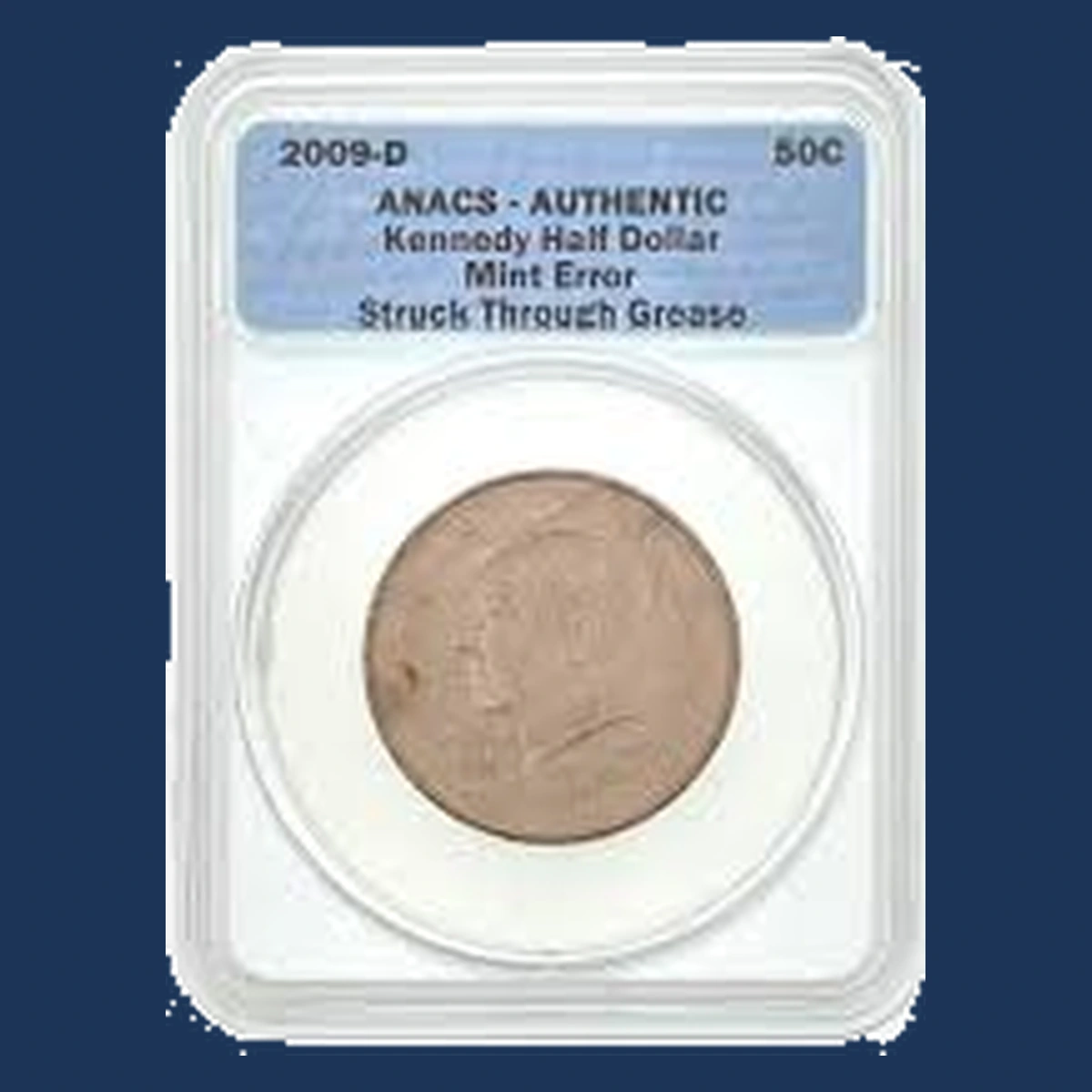
A letter may fade away while nearby details stay sharp. Grease or another object can block the design as the coin is stamped.
The steel stamping tool is called a die. Grease can fill a recessed part of that tool, while a solid object can leave a depression in the coin beneath it.
Both effects are called struck-through errors. Their appearance varies with what blocked the design and how much space it covered.
The 2009 error listing reports this type without naming a mint, a particular coin, or the material involved.
Estimated Value
A 1989-P Kennedy with grease-blocked detail sold for $36 at Heritage in March 2023. It was graded ANACS MS63, meaning unworn but with noticeable marks.
That older coin helps support an estimated $20–$300 range for 2009 examples. Faint missing letters belong nearer the lower end.
A large, clear impression can bring more. The upper end suits an obvious obstruction mark with readable surrounding detail and appealing surfaces.
How to Identify
Place a normal 2009 half dollar beside the coin. Find exactly where a clear letter or design should continue into the weak area.
Angle a lamp across that boundary and inspect it with a 10× magnifier. Grinding often leaves parallel scratches; ordinary wear also flattens other exposed high points, rather than just one protected patch.
A depression may preserve its original surface inside, while grease can leave detail absent without a deep hole. Neither appearance alone identifies the material that caused it.
Use a digital scale and calipers when safely accessible: normal weight is 11.34 grams and width about 30.6 millimeters. Check the edge grooves for damage as well; normal measurements support the comparison but do not prove the error.
3. 2009 Kennedy Half Dollar Indent Error (Estimated Up to $400)
Imagine two blanks partly overlapping under the stamping tools. The upper disc blocks part of the lower one and presses a hollow area into it.
That hollow is called an indent. Its curved outline may follow the edge of the overlapping blank, and the covered area lacks the normal design.
An already stamped coin can leave a different result: a sunken, backward image called a brockage. A plain indent has no such copied design.
For a possible 2009 indent, the key question is whether the hollow formed during stamping. An ordinary dent is not enough.
Estimated Value
The January 2025 Mint Error News guide gives $150–$400 for indents on layered-metal Kennedy half dollars. Its examples range from lightly worn to unworn, with smaller and larger areas affected.
Use that as an estimated comparison for a 2009 coin, not a recorded 2009 auction result. A broad, clearly shaped hollow is usually easier to see and more appealing than a small mark at the rim, although condition still matters.
How to Identify
Study the design inside the hollow first. A plain indent should not contain a backward copy of the other coin’s lettering or portrait.
Now inspect its border under a 10× magnifier. The surrounding design should fit a blank blocking the strike, rather than show already formed letters smashed by a later blow.
Photograph the corresponding area on the other side as well. Tool marks or an isolated patch of crushed detail can point to damage after the coin left the Mint.
Record weight and width with a digital scale and calipers when safely accessible, comparing with 11.34 grams and 30.6 millimeters. Check the edge grooves too; a rounded hollow needs a consistent stamping pattern, not merely the right shape.
4. 2009 Kennedy Half Dollar Missing Clad Layer Error (Estimated Up to $500)
A copper stripe along the edge is normal. Most 2009 half dollars have a copper center covered by two silver-gray outer layers made of copper and nickel.
If one outer layer separates before stamping, the design can be pressed directly into the copper underneath. One side then looks copper-colored while the other remains silver-gray, and the coin weighs less.
This is a missing clad layer error; clad means layered metal. It does not apply to the 90% silver Proof, a different version specially made for collectors.
Brown staining alone does not show that a layer is missing.
Estimated Value
A 1974-D Kennedy missing its front outer layer sold for $432 at Heritage in March 2023. NGC graded it MS64, and it weighed 9.34 grams.
That different-year sale supports an estimated $100–$500 range for a genuine 2009 example. How much layer is missing, surface damage, and remaining original shine affect the comparison; a normal coin that has simply turned brown does not receive the same added value.
How to Identify
Does the weight agree with the color? A digital scale can help separate an absent layer from a brown stain when the coin is safely accessible.
Compare with 11.34 grams for the normal layered-metal coin. The 90% silver collector Proof weighs 12.50 grams and is a different issue.
Under a 10× magnifier, follow the copper-colored side into the edge, then examine the remaining layer on the back. Chemical treatment can change color or remove metal, so the stamped surfaces must also look original.
Use calipers to compare the width with 30.6 millimeters and inspect the edge grooves for filing. Copper color, lower weight, and a genuinely absent edge layer should tell the same story.
Conclusion
A gap at the edge, a weak letter, a round hollow, and a copper-colored side call for different checks. Keep clear photographs of both sides and the edge, then add weight and width when the coin is safely accessible.
The estimated $20–$500 range uses other Kennedy sales and an indent guide. A special collector finish alone is not an error, and a promising mark still needs to fit how coins are made.