1991 Quarter Error List with Pictures

An upright portrait does not guarantee an upright eagle after you turn the coin over. One Philadelphia example with that mismatch sold for $94 in December 2025.
Other 1991 quarter errors change the lettering, surface, or shape instead. Estimated values in this guide extend from $2 to $500.
Compare both faces as you work through the pictures; the relationship between them often explains what happened better than one close-up.
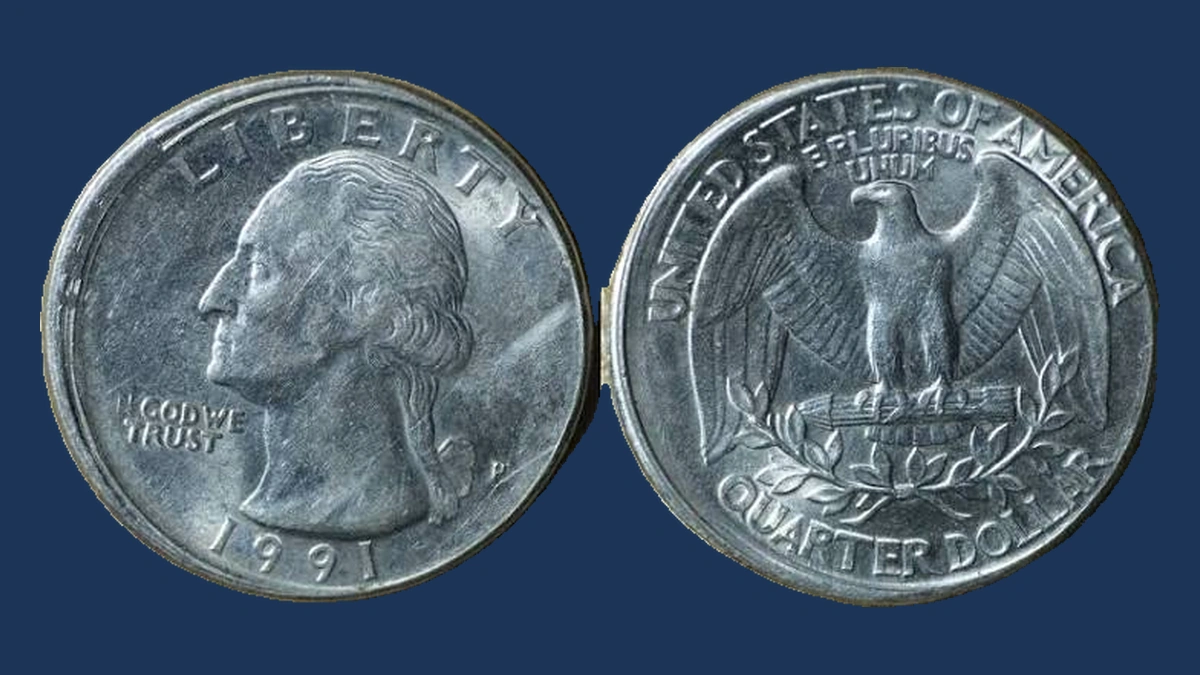
1. 1991 Washington Quarter Misaligned Die
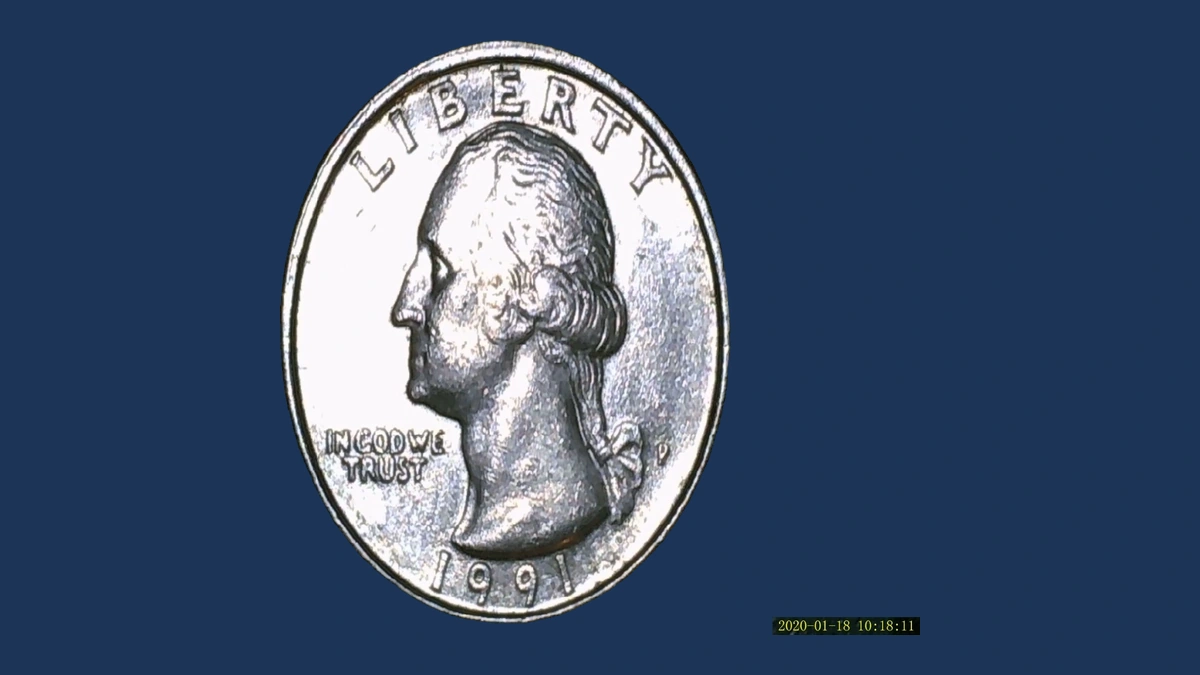
LIBERTY may sit beside a wider border on one side of the coin than the other. If the eagle remains centered, the two faces tell you that one stamping tool shifted sideways.
That tool is called a die. A sideways movement produces a misaligned-die error rather than moving the entire blank out of the press.
A Philadelphia example is reported for 1991. The useful clue is the difference between its front and back.
A rotation changes the direction a design points; this error changes where it sits.
Estimated Value
A modest sideways shift has an estimated value of $2 to $75. Small differences in border width usually sit at the inexpensive end.
More obvious movement attracts attention when the lettering approaches or meets the rim. A clean, unworn surface makes that relationship easier to judge.
The price assumes a genuine shift of one tool. A photograph taken at an angle can exaggerate uneven borders without showing any mint error in the coin itself.
How to Identify
Place the coin flat and photograph each face straight on. Avoid a camera angle that makes the circle look oval.
Measure the visible space between LIBERTY and the rim at several points in the image. Then make the same kind of comparison around the eagle’s side.
Uneven spacing on the front, paired with a centered back, supports a sideways tool shift. Similar blank crescents on both faces call for an off-center-strike comparison instead.
Check the rim where the front design comes closest to it. A later edge hit often leaves a dent, folded metal, or damaged lettering.
Keep the two photographs together: one face alone cannot show the alignment difference that defines this error.
2. 1991 Washington Quarter Curved Clip
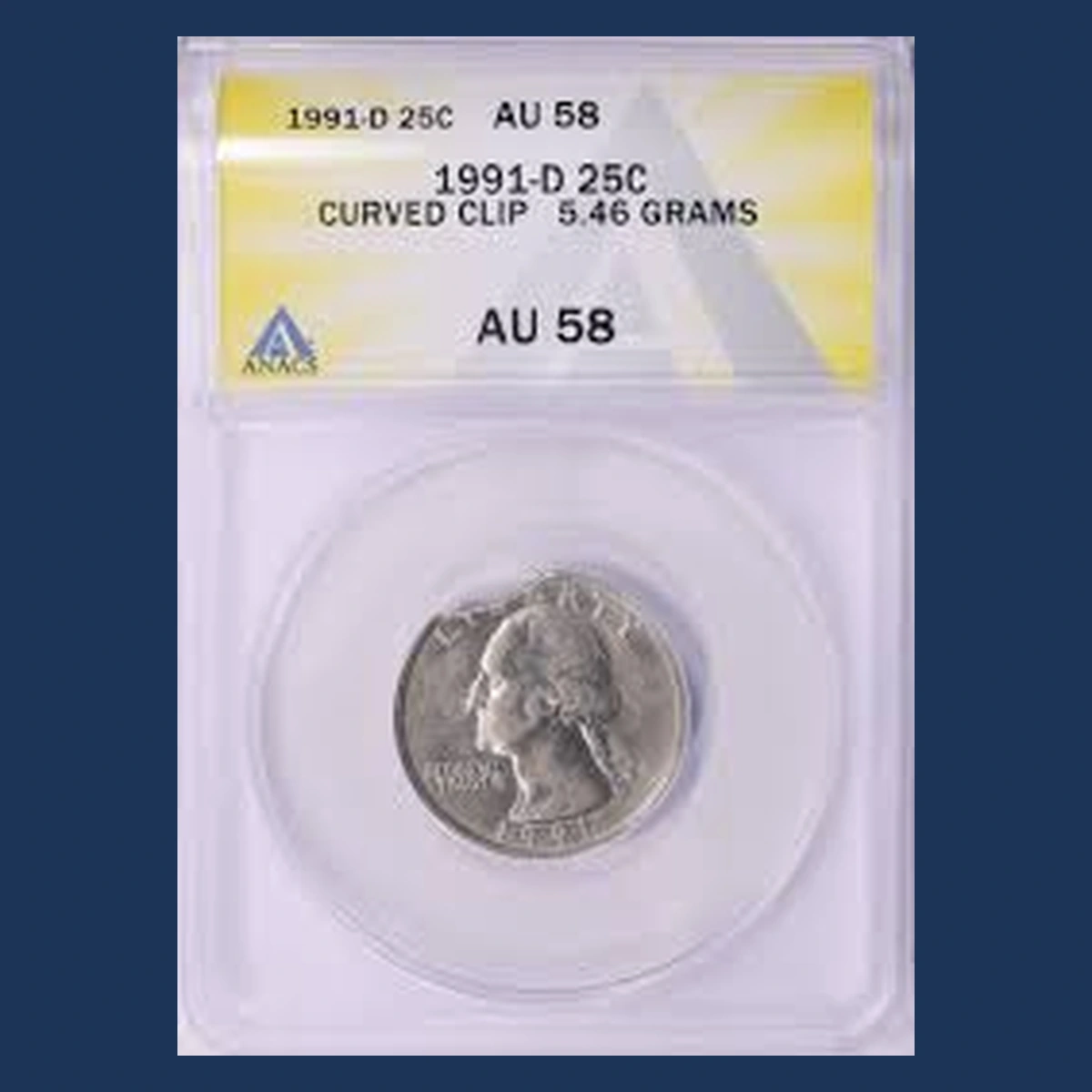
A smooth inward curve interrupts the outer edge on these quarters. The missing metal was absent from the blank before the portrait and eagle were struck.
When a round punch overlaps an earlier hole in the metal strip, it produces an incomplete blank. The curved gap can survive all the later minting steps.
The Rippere Collection includes a Philadelphia example weighing 5.36 grams and a Denver example weighing 5.46 grams. Their different weights belong to separate coins.
Neither should be pictured as a quarter missing an entire outer layer.
Estimated Value
An estimated $10 to $100 suits small genuine curved clips on 1991 quarters. The Philadelphia and Denver collection listings establish examples, but their weights do not establish prices.
For a broader comparison, a 1995-P quarter with a clip and an additional unfinished cut sold for $159 in July 2022. That more complex coin had two visible blank-making features.
A simple clip should be judged on its own size, condition, and readable date rather than inheriting that combination price.
How to Identify
The weights offer a useful check without setting a target for every clip. A loose ordinary 1991 quarter normally weighs 5.67 grams; a missing section should reduce that total.
Compare the gap with the surviving rim. The rim may weaken near the gap or on the opposite side because the incomplete blank did not form normally.
With a magnifier, follow the design as it approaches the missing section. It should flow toward an existing opening rather than end at fresh file cuts.
A clean-looking curved cut can be made after minting, so shape alone is insufficient. Preserve close photographs of the gap’s edge and both adjoining faces before seeking an expert opinion.
3. 1991 Washington Quarter Doubled Dies
Extra outlines are reported around LIBERTY on the front and UNITED or DOLLAR on the back of 1991 quarters. A separate Denver back-doubling report is also illustrated in a year guide.
A true doubled die carries repeated details in the stamping tool itself. Those details pass onto the coin during an ordinary strike.
That differs from striking the coin twice. It also differs from flat, shelf-like doubling caused by movement during striking.
The reported locations are starting points for examination, not proof that every thick letter is a valuable variety.
Estimated Value
For confirmed minor doubled-die examples, a working estimate is $10 to $150. The upper end requires clear repeated details that a buyer can recognize and match.
Faint thickening with no rounded extra outline belongs at the cautious end of the comparison. Ordinary machine doubling does not earn a doubled-die premium.
These estimates concern the reported 1991 types. They should not be replaced by prices for the better-known, separately identified 1995-S collector variety.
How to Identify
Choose one letter with a visible corner and enlarge it under a 10× magnifier. A split corner or rounded secondary outline is more useful than a letter that merely looks thick.
Follow the extra outline into neighboring letters. Genuine repeated detail should form a consistent pattern rather than appearing wherever light reflects most strongly.
On the front, concentrate on LIBERTY; on the back, examine UNITED and DOLLAR. Keep the Denver report separate from coins whose mint and finish have not been established.
Compare a normal quarter under the same lighting to spot flat machine-doubled shelves. Before paying a premium, obtain a specialist match for the actual face and mint you have, not just a similar-looking enlarged letter.
4. 1991 Washington Quarter Lamination
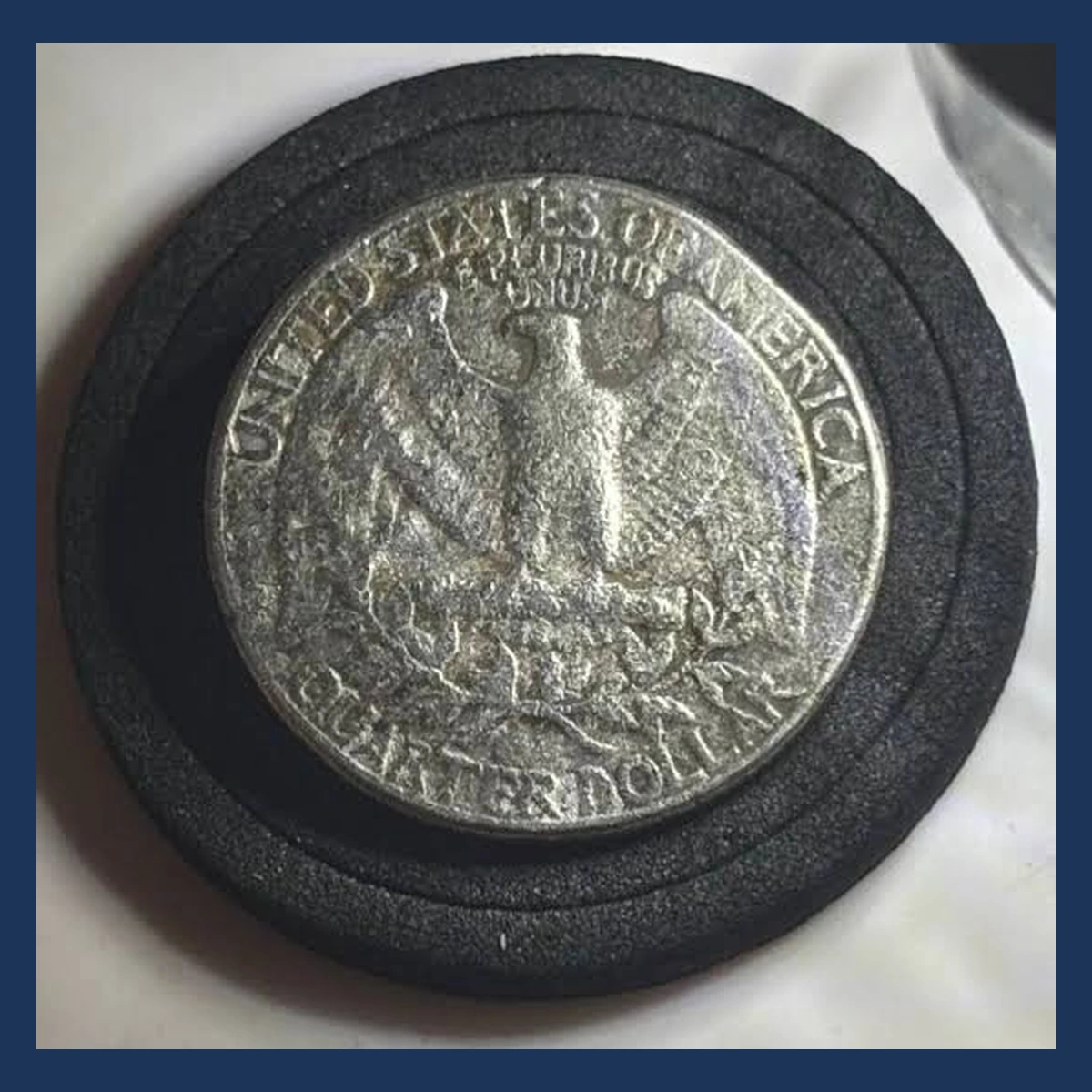
A thin flap or a shallow patch of missing metal can form when the coin metal separates along a weak area. Collectors call this a lamination error.
The separation can begin before the strike or open afterward. Surviving design on a loose flap may help explain that sequence.
Lamination is reported for 1991 quarters without a fixed mint or location. A local peel does not automatically mean that the entire outer clad layer is gone.
The surface boundary and remaining metal are more useful than the word “peeling” alone.
Estimated Value
Small genuine laminations have an estimated range of $10 to $150. A tiny flake on a heavily worn coin usually attracts less interest than a larger visible split.
An attached flap can be especially useful for showing how the metal separated. Removing it can reduce both the evidence and the appeal.
The estimate assumes a fault in the original coin metal. Scraped plating, corrosion, or a surface deliberately peeled after minting requires a different assessment.
How to Identify
Do not lift a flap to see underneath it. Place the coin in a holder that protects the raised metal from pressure.
Photograph the broken boundary with light coming from the side. Look for a thin sheet or layered break rather than a deep gouge with metal pushed up beside it.
If part of the design survives on the flap, compare it with the surrounding image. That relationship can help an expert judge when the layer opened.
A local surface split may leave the coin close to normal weight, so weighing is less decisive than examining the break. If an entire face is copper-colored, compare the missing-clad-layer category as well before treating it as a small lamination.
5. 1991 Washington Quarter Improper Annealing
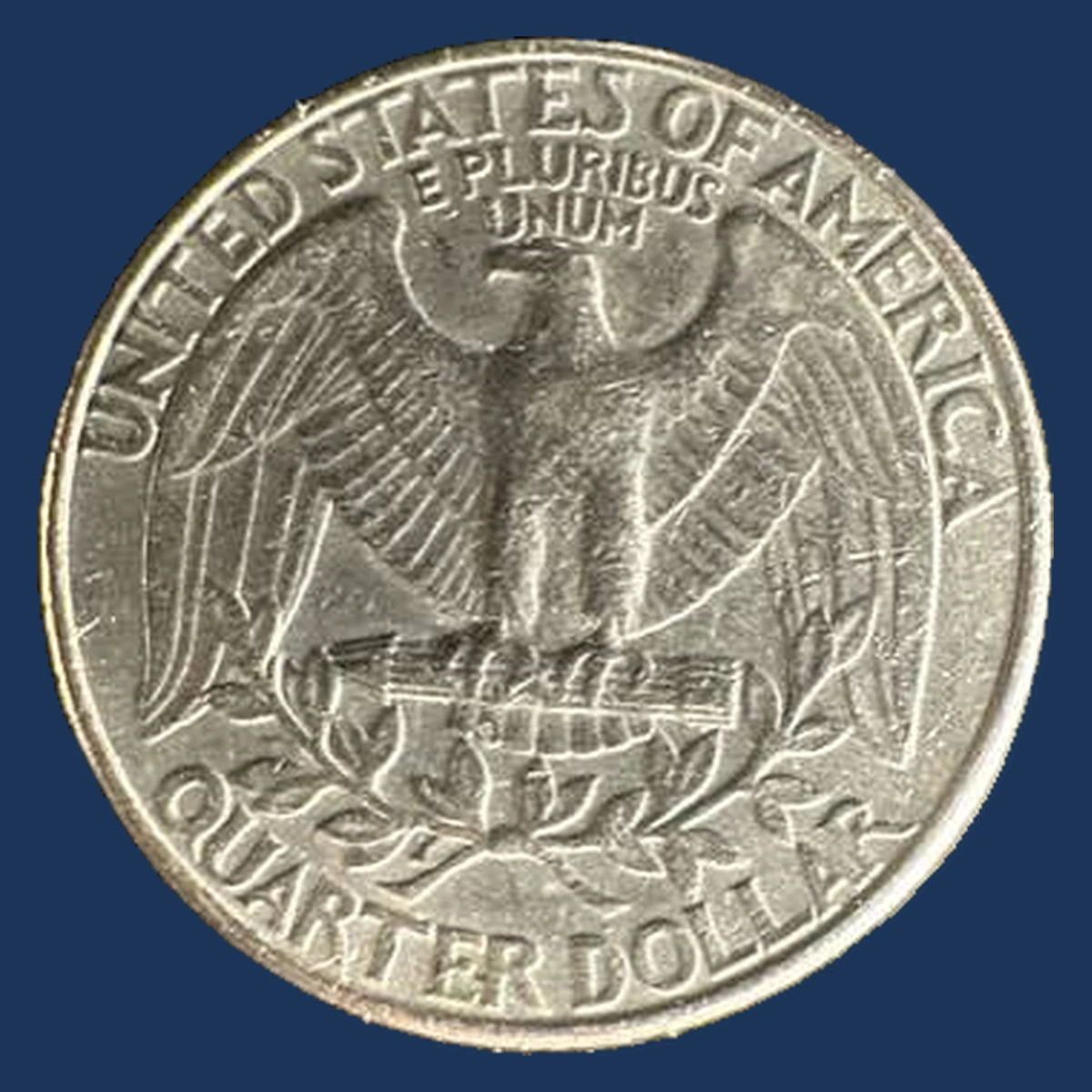
A dark or unusually colored surface may originate while blanks are heated to soften them before striking. This heating step is called annealing.
Problems during that treatment can affect the surface color or texture. Improper annealing is reported among 1991 quarter errors, although color alone cannot establish the cause.
Ordinary toning, chemicals, added plating, and later heating can produce similar appearances. The portrait and eagle must be examined along with the color.
An unusually brown quarter is therefore a candidate for closer inspection, not automatically a heat-treatment error.
Estimated Value
An estimated range of $20 to $200 applies to an authenticated 1991 annealing error. A clear, unusual surface with attractive remaining detail can support the higher end.
Dark patches alone are less persuasive than a consistent surface that an expert accepts as mint-made. Cleaning can remove evidence without improving the coin’s value.
The estimate is for the minting fault, not for ordinary tarnish. A treated or plated quarter should not be priced from this range.
How to Identify
Leave the color untouched. Wiping, polishing, or using a chemical cleaner may remove the surface that an examiner needs to study.
Under neutral white light, compare the color across open areas, raised lettering, and the edge. Change the light angle to check whether the appearance comes from the metal or a reflection.
Look for coating buildup in protected recesses, exposed scratches beneath a later layer, or a burned-looking surface. These can point toward treatment after minting.
Photographs are useful records, but they cannot always separate mint heating from later alteration. Ask an error specialist to assess the surface itself before assigning the annealing name or paying the estimated premium.
6. 1991 Washington Quarter Broadstrike
A complete design surrounded by extra spread-out metal points toward a broadstrike. The blank was stamped without full support from the ring that normally controls its edge.
That ring also forms the quarter’s edge grooves. When it fails to contain the metal, the coin can spread outward instead of keeping its usual outline.
The 1991 broadstrike report does not identify a specific mint or measured diameter. The defining relationship remains useful: extra expansion outside the design, rather than a large blank crescent paired with missing lettering.
Estimated Value
A working estimate for an ordinary 1991 broadstrike is $40 to $200. As a nearby-year comparison, a Denver 1995 example graded MS62 was listed at a $63 March 2023 sale.
That comparison supports modest values for a small, single broadstrike. A wider spread with clean surfaces can be more desirable.
The amount of expansion and survival of the design matter more than the absence of edge grooves alone. A worn smooth edge is not enough.
How to Identify
First decide whether the entire design fits on the metal. Missing large sections of the portrait or lettering alongside a blank crescent suggests an off-center strike instead.
For a loose candidate, compare its diameter with a normal quarter of about 24.3 millimeters. Record both its widest and narrowest points because the expansion may be uneven.
Inspect the extra border and edge together. The metal should spread naturally beyond the design where normal ring support was absent.
Later hammering usually flattens already-struck letters or leaves impact marks. Simple edge wear also fails to explain a wider band of newly spread metal around a complete design.
7. 1991 Washington Quarter Rotated Dies
The front can look normal while the back points in an unexpected direction. A rotated-die error changes the angle between the two designs without necessarily shifting either one away from the center.
A Philadelphia 1991 quarter with this error was graded NGC AU58. That grade means nearly unworn, with slight wear on the highest points.
The auction description did not give an angle. It should not be labeled 90 degrees or 180 degrees from an unsupported estimate.
A correctly controlled flip is essential because a sideways turn creates a different result.
Estimated Value
The Philadelphia AU58 example sold for $94 on December 22, 2025. For genuine 1991 rotations, an estimated range is $20 to $250.
A small deviation tends to draw less interest than a large, easily demonstrated rotation. Surface condition and readable detail also affect the price.
The $94 result belongs to that particular nearly unworn coin. It does not establish a value for every possible angle, and it should not be advertised as a documented 180-degree example.
How to Identify
Hold Washington upright, with the date at the bottom. Flip the coin from top to bottom around a horizontal axis without turning it sideways.
The eagle should now be upright. If it tilts, repeat the movement while keeping the same top and bottom points fixed.
Photograph the sequence or use a simple holder that lets you preserve the axis. Two separately rotated photographs cannot prove the relationship between the designs.
For a slabbed coin, keep it sealed and turn the whole holder while watching whether the coin itself moves. A loose coin inside a holder can spoil the test.
Record the direction and amount actually observed rather than assigning the auctioned example an angle its description never supplied.
8. 1991 Washington Quarter Off-Center Strike
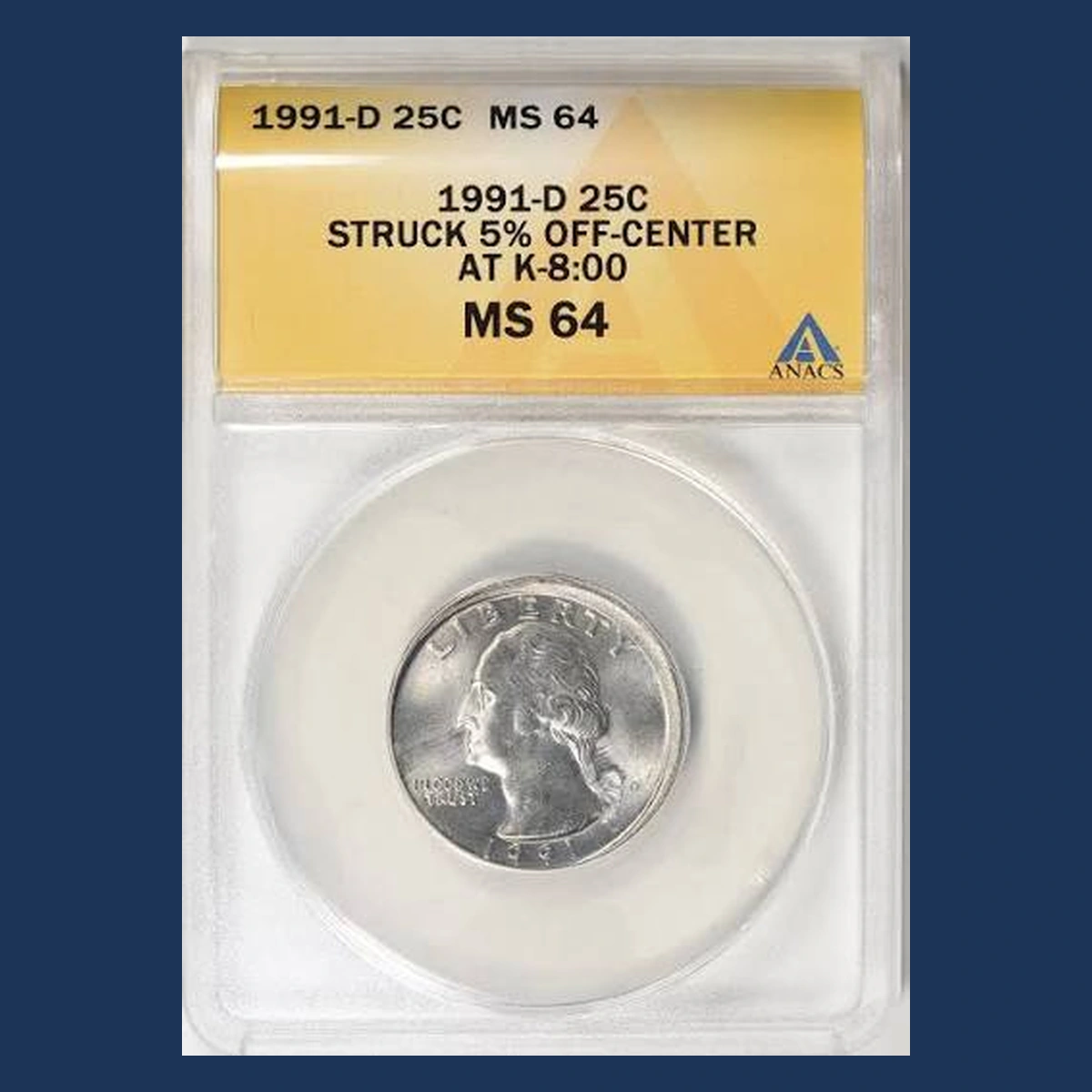
This Philadelphia quarter has a displaced design and a blank crescent because part of the blank missed the stamping tools. Its reported shift is about 20% toward 1 o’clock.
The coin was graded ANACS MS64, meaning unworn with some marks. It sold in a lot with a different 1994-P off-center quarter.
The two coins should not share one grade or one year. Nor does the lot’s price belong entirely to the 1991 example.
Its visible relationship between struck and blank metal is the useful identification feature.
Estimated Value
The two-coin lot brought $71 in January 2022. That total included both the 1991-P MS64 and the separate 1994-P MS60 quarter.
For an individual 1991 off-center quarter, an estimated range is $25 to $300. A readable date and clear blank crescent improve its appeal.
Wear, damage, and an awkwardly lost date can reduce value even when the shift is larger. Compare whole coins rather than treating the percentage as a price formula.
How to Identify
Use a full-coin view to find both the date and P before enlarging the blank area. On a 1991 quarter, those details are on Washington’s side, not the eagle’s.
Compare the two faces to see where the stamping stopped. The blank crescent should make sense on both sides because part of the blank lay beyond both tools.
For the cataloged example, look for the approximately 20% shift toward 1 o’clock. The unstruck crescent still contains metal; it is not a missing chunk.
A clip leaves an inward gap instead. If the other face stays centered, compare a shifted stamping tool rather than assuming the whole blank moved.
9. 1991 Washington Quarter Die Attrition
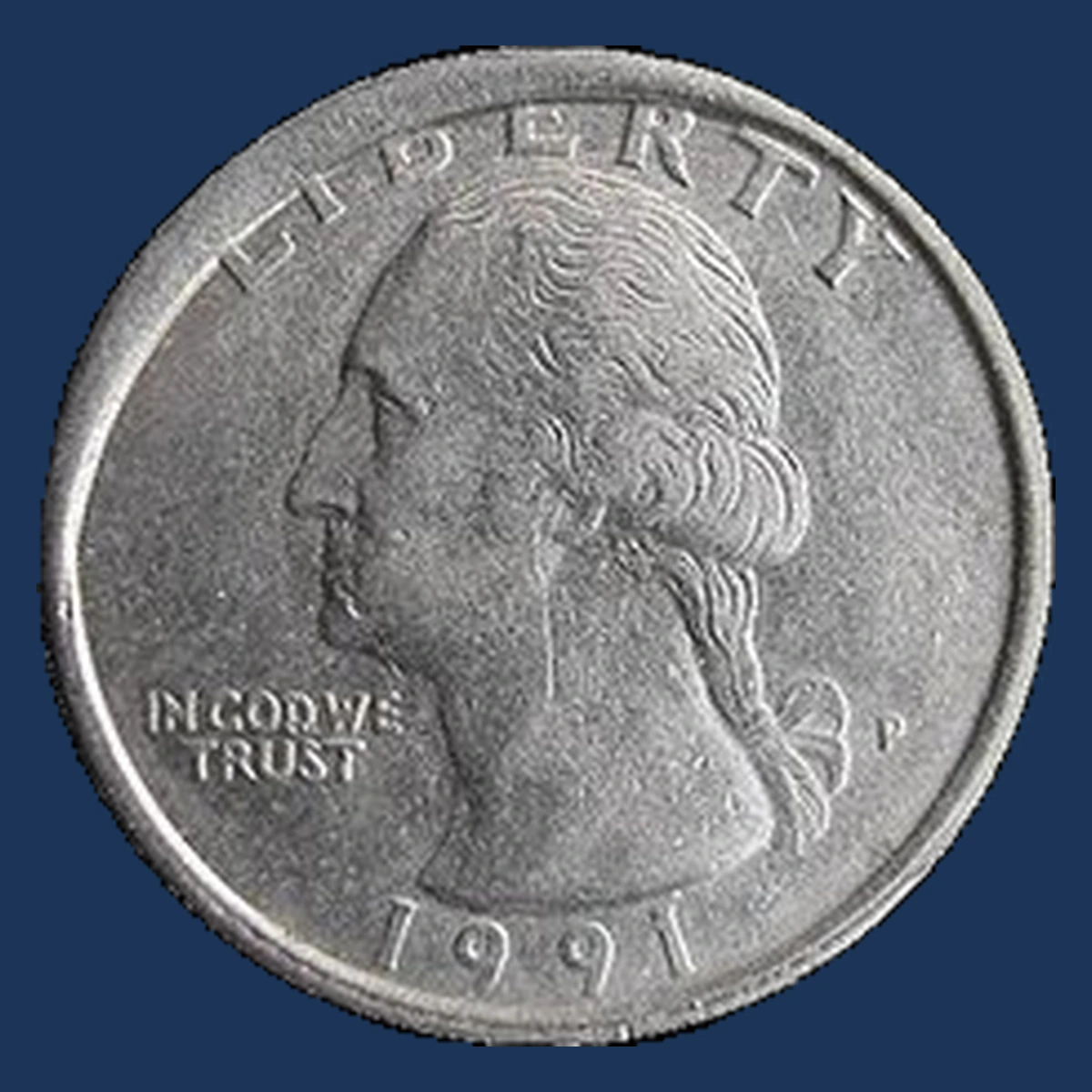
Part of LIBERTY disappears into a smooth crescent near the upper-left rim on two examined Philadelphia quarters. The affected stamping tools had lost metal around their outer edges.
This damage is called die attrition. It develops when a shifted tool repeatedly hits the entrance to the edge-forming ring.
After the tool returns to the center, its worn-away edge can no longer stamp that part of the design. A smooth area replaces the missing detail.
The two 1991 examples came from different tool pairs, not two proven stages of one tool’s wear.
Estimated Value
An estimated $50 to $500 covers recognizable 1991-P attrition errors, with size and clarity driving the comparison. A narrow affected crescent belongs nearer the lower end.
A broad smooth area that visibly cuts off LIBERTY offers a stronger display of the mechanism. Buyers must still separate it from later grinding or ordinary misalignment.
This range is an estimate for the error, not a published sale of either examined coin. Better remaining detail can make the contrast especially clear.
How to Identify
Compare the missing portions of LIBERTY with the rest of the front. Ordinary circulation wear lowers exposed high points more broadly; it does not neatly explain one smooth edge crescent.
Check for scratches, tool marks, or a flattened rim that could indicate later grinding. The area needs to fit a loss of detail during striking, not removal of a finished design.
Mike Diamond’s two illustrated examples show the upper-left location. Use each as a separate comparison rather than arranging them as a proven before-and-after sequence.
The remaining design can be centered even though the tool’s earlier sideways movement caused the damage. Do not require the finished coin to retain a current sideways shift.
10. 1991 Washington Quarter Missing Clad Layer
A missing outer layer can leave a copper-colored face on an otherwise silver-colored quarter. The copper center remains, but one of its copper-nickel coverings is absent.
This error is reported for 1991 without a confirmed face or mint in the year list. It should not automatically be illustrated as a Denver front-layer example.
All regular 1991 quarters used clad metal, including the S Proof collector issue. There was no standard silver Proof quarter that year.
A copper stripe visible only along the ordinary edge is normal and does not show a missing layer.
Estimated Value
For a genuine whole-face missing-layer example, an estimated range is $100 to $500. A related 1995-D front-layer coin sold for $149 in July 2022.
That later coin weighed 4.6 grams; its weight and sale belong to 1995, not to an unidentified 1991 specimen. It serves as a same-design comparison.
Sharp struck detail on the exposed copper is desirable. Heavy corrosion, cleaning, or scratches can make both the appearance and the identification less convincing.
How to Identify
Compare the suspicious face with the edge under magnification. A missing layer should expose a real change in the metal structure, rather than only a brown stain.
For a loose quarter, weigh it against the normal 5.67-gram standard. Significant layer loss should reduce weight.
Acid or grinding can also remove metal, so a low reading alone proves little. Inspect the copper surface for surviving stamped letters and design.
Check whether the opposite face retains its outer layer. Never scratch the surface to test its color.
Photograph the layer boundary and natural struck detail for an expert. Those views provide useful evidence without leaving a fresh test mark.
11. 1991 Washington Quarter Struck Through Grease or a Feeder Finger
Material between the blank and stamping tool can prevent part of the design from forming. Grease packed into a tool’s recessed details may leave weak or missing letters.
A hard object leaves a different clue: a distinct depression where it blocked the strike. A Denver 1991 example is reported as struck through a feeder finger, part of the machinery that moves blanks.
The suggested feeder-finger mark has steep walls. Its exact position is not established here.
A deep dent alone cannot identify that particular machine part, just as every weak letter is not proof of grease.
Estimated Value
Estimated values are $5 to $75 for minor grease-filled details and $75 to $500 for a clear hard-object impression. The stronger range assumes a genuine mint-made depression.
The size and visibility of the affected area matter. A barely weak letter generally attracts less interest than a sharply defined obstruction mark.
A specific feeder-finger identification needs more than depth. The impression’s shape and surrounding struck metal should support that cause before a buyer pays for the name.
How to Identify
For weak lettering, compare nearby details at a similar height. If the portrait, rim, and surrounding letters are also heavily worn, wear may explain the missing detail.
Grease filling a recessed letter can prevent that letter from forming while leaving nearby areas sharper. The missing letter’s location should be documented on the actual coin.
A hard-object depression needs a different examination. Tilt it under side lighting to see the walls and how the normal design stops at its boundary.
Look for displaced lips, fresh scratches, or crushed neighboring details that suggest a later impact. Do not call the object a feeder finger solely because the depression is deep.
Preserve front, back, and close-up photographs so the proposed obstruction can be judged against the entire strike.
Conclusion
Look beyond a single odd letter on a 1991 quarter. Comparing the front, back, and edge helps separate shifted tools, damaged blanks, and material that blocked the strike.
Estimated values range from $2 to $500, with small alignment errors near the bottom and stronger combinations higher. The $94 rotated-coin sale provides one actual comparison.
Protect fragile surfaces, keep auction lot totals separate, and match the visible feature before assigning a value.