1823 Dime Error List with Pictures

Every known genuine 1823 dime has a 3 punched over an earlier 2. An XF40 Large Es example with CAC approval sold for $900 in April 2025.
These 1823 dime errors include that date feature and separate coins struck twice. Estimated values for circulated examples range from $100 to $5,000.
Read on to distinguish the small extra date strokes from the much larger traces of a second blow.
1823 Capped Bust Dime 3-over-2 Overdate (Estimated Up to $1,500)
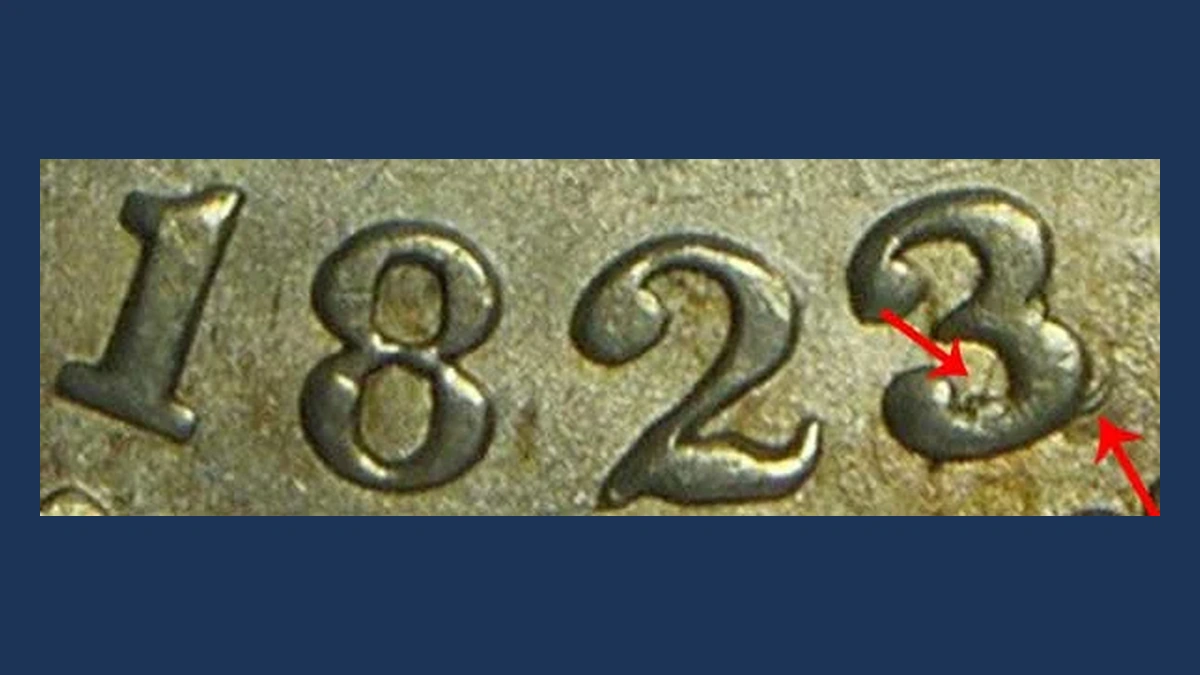
Small remains of a 2 sit beneath the final 3 in the date. The engraver changed the numeral in the die, the steel tool used to stamp coins.
All known 1823 dimes belong to this 1823/2 issue. There is no separate plain-date production beside it.
Some backs have small E letters and others have larger ones. Collectors call these Small Es and Large Es, but both have the same kind of overdate.
Wear can make the underlying hook or foot hard to see. Look at its expected position under the 3, not an unrelated mark elsewhere in the date.
Estimated Value
Collectible circulated 1823/2 dimes are estimated at $100–$1,500. A PCGS VF25 Large Es sold for $312 in April 2025, while a less-worn XF40 with CAC approval brought $900 that month.
Those whole-coin prices already include the overdate, because it belongs to the entire year’s issue. There is no ordinary plain-date price plus a standard overdate fee.
Coins with no circulation wear need separate comparisons. Their condition can put them beyond this working range.
How to Identify
Place a magnifier over the lower-right part of the final 3 and compare it with the documented 3-over-2 date. Move the light until the earlier hook or foot becomes clear.
An original raised stroke differs from a scratch cut into the surface. No second portrait is needed to identify an overdate.
A scale and calipers compare the normal dime with 2.70 grams and about 19 mm. It is roughly 89.2% silver, with a grooved edge.
The Small Es or Large Es back helps identify the variety, but does not create another error. Begin with the recognizable earlier 2 beneath the final 3.
1823 Capped Bust Dime Double Strike with Off-Center First Impression (Estimated Up to $5,000)
An extra row of tiny rim teeth can reveal an earlier strike beneath the main design. Specialist Louis Scuderi described several 1823/2 Small Es examples with this overlapping evidence.
Their first strike was off center. A later blow covered much of it, leaving only parts of the older design visible.
One example sold by Bowers in 2002 was described as about 40% off center toward 1 o’clock on its first blow. A separate Heritage example had a 45% first-strike shift.
The second coin does not borrow the first coin’s direction. Each surviving design must explain its own two blows.
Estimated Value
Clear circulated double strikes are estimated at $800–$5,000. Reported Good and Very Good examples show that collectors can still recognize the strike history on heavily worn coins.
For comparison, an 1802 JR-3 double strike graded PCGS Fair 2 sold for $3,450 in 2008. That is a different date and tool pairing, not a sale of the 1823 examples.
Readable overlapping details drive interest. Two blows do not mean that two separate coin values should be added.
How to Identify
A thick final date digit is not enough, since ordinary 1823 dimes already have the overdate. Use a magnifier to find an earlier row of rim teeth or a recognizable design crossing beneath the later impression.
Photograph both faces and inspect the edge for trimming or damage. The normal silver-alloy dime starts near 2.70 grams and 19 mm, checked with a scale and calipers.
Use correctly identified photographs from the specialist account to compare the surviving designs on both faces. Begin with connected remains of an earlier design beneath the main strike, then match that particular coin’s direction and displacement.
Conclusion
Estimated circulated values range from $100 to $5,000, covering ordinary 1823/2 dimes through clear double strikes. The overdate belongs to the year’s issue, while repeated striking adds a different feature.
Find the earlier 2 under the 3, then look elsewhere for overlapping designs or an extra row of rim teeth. Keep each double-struck example’s direction and percentage separate.
Wear and the clarity of those surviving details should guide the price comparison.