1834 Dime Error List with Pictures

A raised lump joined to the rim can mark a broken stamping tool. On 1834 dimes, reported examples appear near the date or on the back.
This 1834 Capped Bust dime error list uses estimated values of $100–$3,500. A regular JR-5 graded MS61 sold for $1,080 in July 2025, providing a condition comparison rather than a confirmed error sale.
Read on to compare each lump with its nearby design.
1834 Capped Bust Dime Rim Cuds (Estimated Up to $3,500)
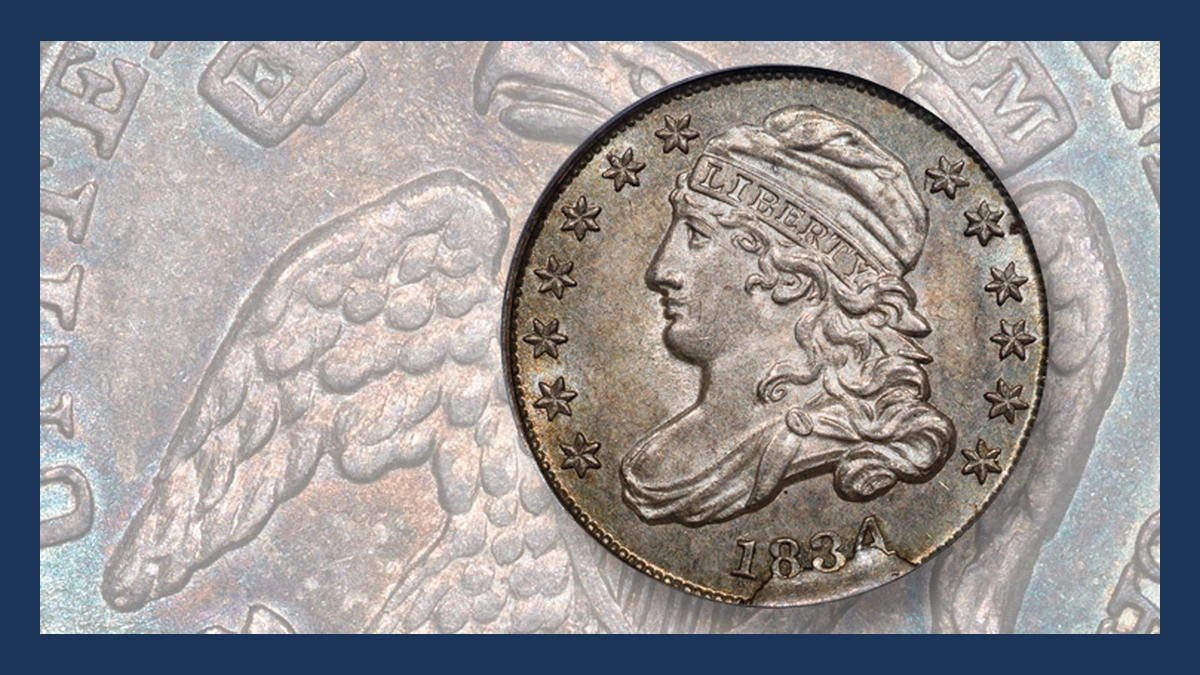
A raised lump that joins the rim is called a cud. It forms when an edge piece breaks from the die, the steel stamping tool.
Silver fills the opening instead of receiving the missing design. The resulting lump stays connected to the coin’s outer border.
Reported JR-4 examples have a back-side break above IT in UNITED. JR-5 places it near the date, while JR-6 has several back-side breaks.
These labels identify different tool combinations. A collector also lists JR-2, without a precise location; the normal size of the date’s 4 is not itself an error.
Estimated Value
Estimate $100–$3,500 for worn through lower-grade unworn examples. Clearer, larger breaks may attract more collector interest.
A JR-5 graded PCGS MS61 sold for $1,080 in July 2025. That unworn but noticeably marked coin was not specifically identified as a cud example.
A better-preserved 1831 retained-cud coin sold for $8,812.50 in 2013. Its different date and MS65 condition place it outside this working range, rather than setting every 1834 cud’s value.
How to Identify
Choose the correct area before enlarging it: above IT for JR-4 or near the date for JR-5. For JR-6, compare the separate breaks with its own full-back picture.
The John Reich Collectors Society photographs provide examples. Use a magnifier to check whether the raised lump joins the original rim.
Added solder or a crushed edge may leave a boundary unlike naturally struck metal. Examine both sides and the edge grooves for later damage.
Use a scale against about 2.70 g and calipers against 18.5 mm, allowing for wear. Keep the nearby letters or date visible in close-ups.
The useful match is the rim-connected lump and its exact position beside the surviving design.
Conclusion
An estimated $100–$3,500 covers the circulated through lower-grade unworn examples discussed here. Condition and the particular break both affect the whole coin’s value.
Look for a raised lump joined to the original rim, then match its position beside the date or letters. Separate examples have separate patterns, and an ordinary date style or damaged edge should not be mistaken for a broken stamping tool.