1864 Dime Error List with Pictures

A specially made 1864 Proof dime sold for $3,596.01 in January 2016. Tiny flaws in its letters helped identify the tools that made it.
This 1864 Liberty Seated dime error list covers those letter flaws and faint marks left after stamping tools collided. Estimated whole-coin values run from $500 to $8,000.
Read on to see which details belong to Philadelphia coins and how to separate collector Proofs from ordinary circulation strikes.
1864 Liberty Seated Dime Clashed Dies (Estimated Up to $6,000)
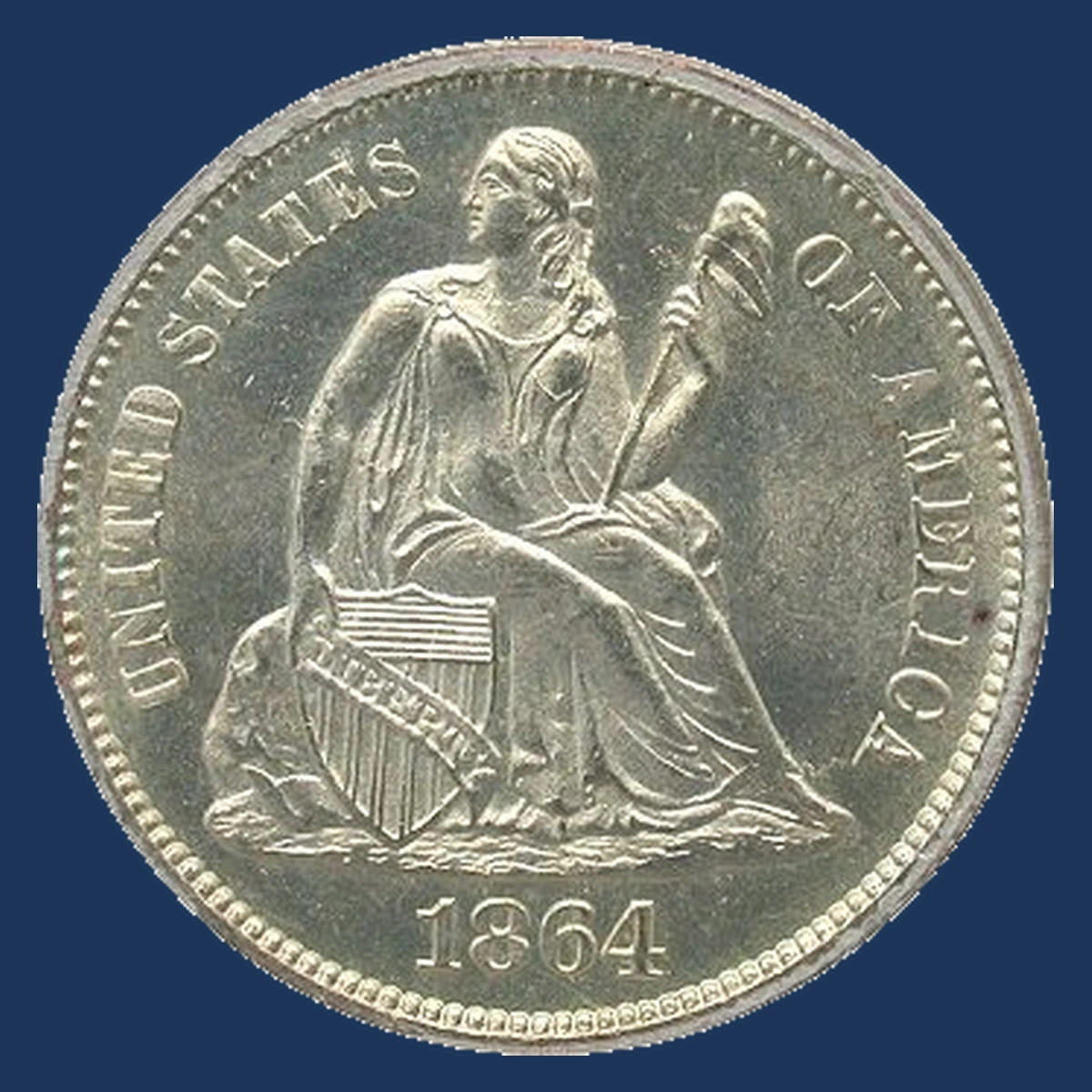
Faint parts of an unwanted picture can appear beside the normal design. They come from dies, the steel stamping tools, striking each other when no coin is between them.
The collision leaves marks on the tools, which can transfer to later coins. Collectors call this a die clash.
The 1864 variety called F-102a was struck after its tools had already made Proof coins for collectors. Both tools clashed during their later use for circulation coins.
The earlier Proof version, F-102, shares small letter flaws but does not automatically carry those later clash marks.
Estimated Value
An F-102a with visible clash marks has an estimated whole-coin value of $700–$6,000. An unworn NGC MS64 example sold for $2,760 in September 2019.
A worn PCGS F12 CAC circulation coin brought $1,560 in August 2025, without an identified clash variety. It gives a same-year condition comparison.
The price includes the entire dime, not just its extra marks. Wear, cleaning, and the strength of those marks affect where a coin fits.
How to Identify
First check that the coin has no S mintmark on the back. These Philadelphia features should not be transferred to an 1864-S dime.
Compare both faces with the illustrated F-102a dime under a 10× magnifier. Look for faint extra picture details in the same positions.
Use changing light to separate shallow struck marks from scratches cut into the surface. The flaws in E, I, and M help match the stamping tools, but are not themselves clash images.
Check about 2.49 grams with a scale and 17.9 mm with calipers, allowing for wear. Inspect the grooves around the edge for damage.
For a quick check, match the extra picture traces on both faces to the illustrated circulation coin.
1864 Liberty Seated Dime Letter Die Defects (Estimated Up to $8,000)
Small bumps and lines within letters can help identify the exact tools used to make a dime. These repeated flaws are different from scratches added after minting.
On F-101 Proofs, check F in OF, E in UNITED, E in AMERICA, and the back-side M’s lower-left diagonal. Proofs are specially made collector coins.
The F-102 Proof and F-102a circulation coins have a different group of marks on the back. Look below E in ONE, across the lower I in DIME, and along M’s left diagonal.
The F numbers name these different varieties.
Estimated Value
Allow an estimated $500–$8,000 for the whole coin, depending on finish and condition. The small flaws mainly identify its variety rather than adding a large separate error premium.
An F-102 Proof graded NGC PR67 Cameo sold for $3,596.01 in January 2016. Cameo describes contrast between the picture and background.
The F-102a circulation coin graded MS64 brought $2,760 in 2019. Compare Proofs and circulation pieces within their own condition groups instead of assuming every Proof costs more.
How to Identify
Begin on the back with ONE DIME. Under a magnifier, check the E, I, and M together against a labeled F-102 or F-102a photograph.
For F-101, also compare the front-side F and E flaws listed above. One small bump alone is not enough, since dirt or a contact mark may look similar.
Tilt the coin under a lamp to check the shape and position of each flaw. Avoid rubbing a Proof’s delicate surface.
A normal 90% silver dime weighs about 2.49 grams and measures 17.9 mm. Use a scale and calipers, then check the grooves around the edge.
For a quick check, match all the listed letter flaws to a photograph of the same Proof or circulation variety.
Conclusion
The estimated $500–$8,000 range covers complete 1864 dimes with very different finishes and conditions. Small letter flaws identify the tools, while extra picture traces show where those tools later clashed.
Compare the full set of marks rather than one bright spot. Keep Proof and circulation examples separate, avoid rubbing their surfaces, and remember that much of the price comes from the underlying coin’s condition.