1875 Dime Error List with Pictures

An 1875-S dime with an extensively cracked back sold for $18,300 in May 2026. Its MS67 grade describes exceptional unworn condition, which contributed strongly to the price.
This 1875 dime error list covers eight categories with estimated whole-coin values of $25–$20,000. Extra digits, tilted designs, and raised breaks each leave different clues.
Start with the mint letter and its position, then compare the actual feature and condition with the examples below.
1. 1875 Liberty Seated Dime Die Clash (Estimated Up to $800)
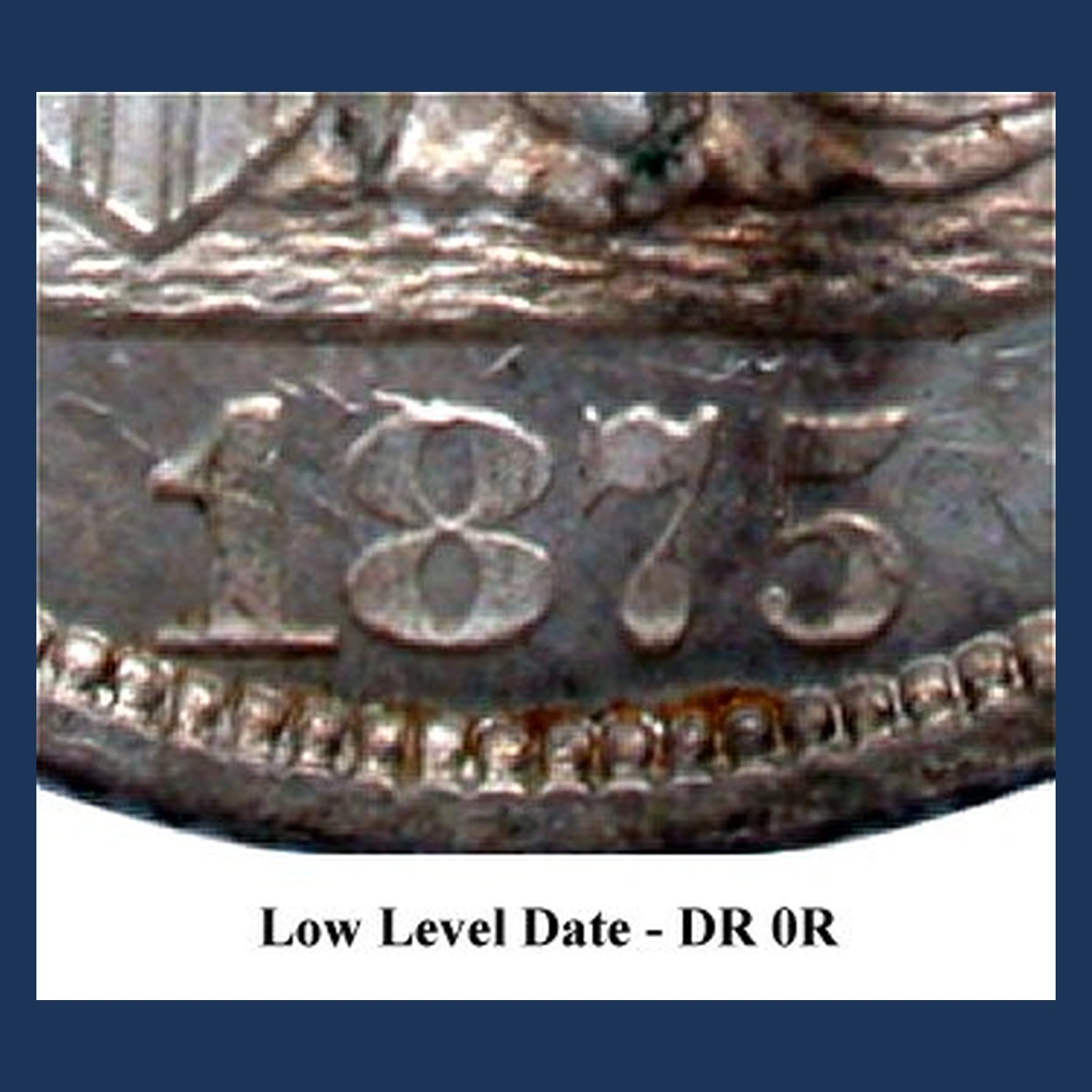
Faint extra shapes on both sides of Philadelphia F-107 are clash marks. They formed after the dies, the steel tools that stamp coins, met without a blank between them.
The tools picked up parts of the opposite design and passed those traces onto later coins. That differs from pressing marks into a finished dime.
F-107 also has misplaced date pieces and right-wreath cracks. Those separate features can coexist on the same coin.
Another Philadelphia report places clash traces beside the date. A nearby line should be compared with the opposite design before being called another numeral.
Estimated Value
The estimated whole-coin range is $25–$800 for worn through lower unworn Philadelphia examples. Clear transferred shapes matter more than simply counting extra lines.
A PCGS XF45 F-107 with the related misplaced-date identification sold for $93.48 in 2025. XF45 means noticeable wear with much detail remaining.
That result prices the complete variety rather than the clash alone. When date remnants, cracks, and clash marks belong to one coin, assess them together instead of adding their full estimates.
How to Identify
Compare an extra line with a photograph of the opposite side, using a 10× magnifier on the coin itself. The shape should fit part of that other design.
On F-107, check the date remnants and right-wreath cracks as supporting details. Neither one proves that every nearby line is a clash.
For traces beside the date, distinguish a borrowed design shape from a numeral fragment. Scratches can also pass through that area.
Check an accessible Philadelphia dime with a scale and calipers against 2.50 g and 17.9 mm. It is 90% silver and has edge grooves.
The useful match is a recognizable piece of the opposite design in the correct place, with both sides fitting the same example.
2. 1875 Liberty Seated Dime Misplaced Date (Estimated Up to $1,200)
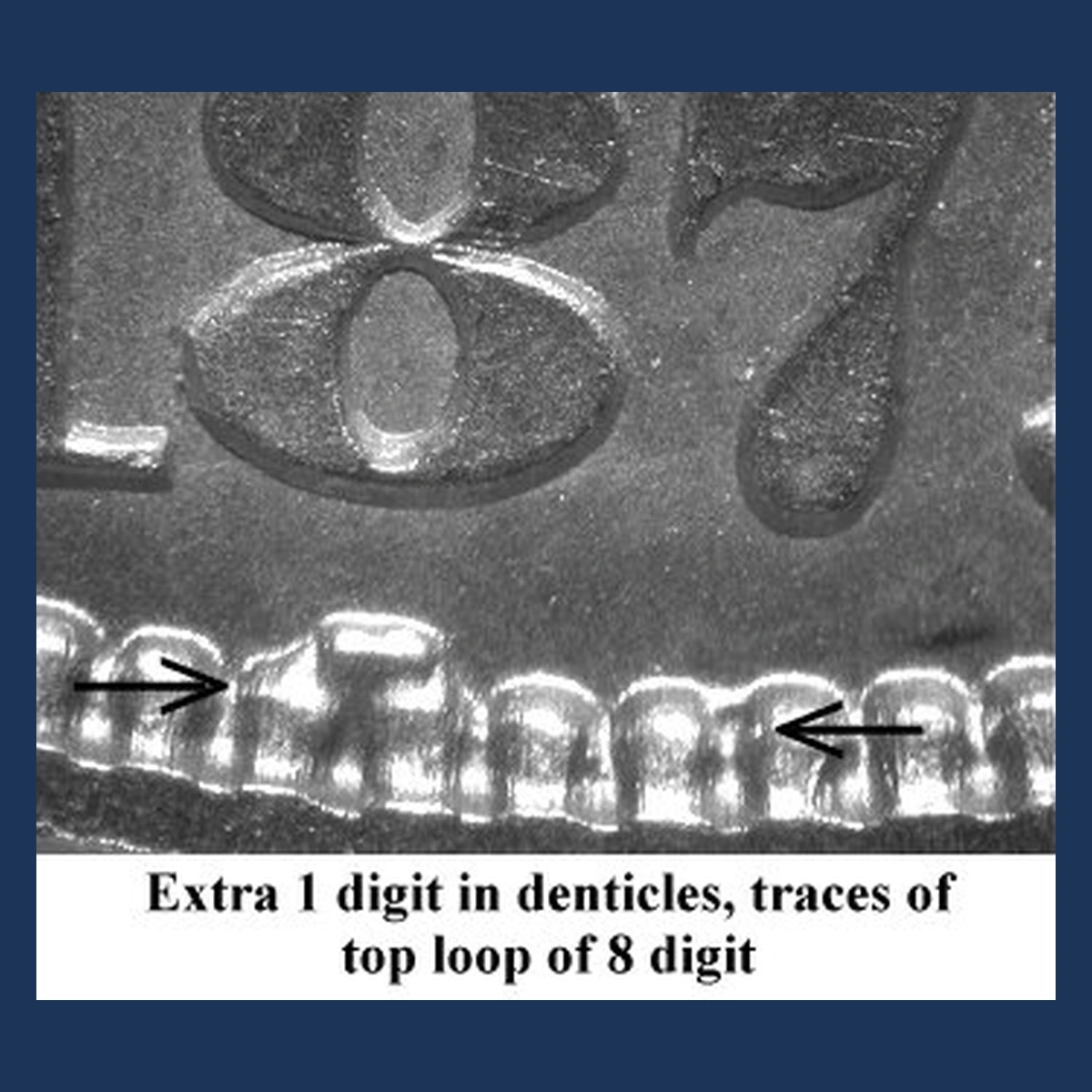
The top of an extra 1 appears below the date’s 8 on F-107. A trace of an 8’s upper loop sits below 7 among the small border teeth, called denticles.
The date punch entered the stamping tool outside its intended position. Those stray pieces survived after the normal date was added.
Another Philadelphia example has a misplaced 5 in Liberty’s base instead. Its location needs a different picture comparison.
F-107 and FS-301 are names for the same familiar variety. Its clash marks and cracks can accompany the extra digits, but they do not change where those digits were placed.
Estimated Value
GreatCollections records $93.48 for PCGS XF45 in November 2025 and about $61 for F12 that June. F12 has heavier wear.
The estimated whole-coin range is $40–$1,200, from worn through lower unworn examples. The upper end assumes stronger preservation, rather than simply a catalog number.
The separate misplaced 5 needs its own condition comparison. Its clarity and collector demand should not be assumed identical to the extra digits below 1875.
How to Identify
Keep the normal date and the border teeth below it in one close picture. Use a 10× magnifier below 8 for the top of 1 and below 7 for the loop trace.
Compare both shapes with F-107, rather than counting normal border teeth as pieces of numbers. Move the light to make their raised outlines easier to see.
For the separate misplaced 5, inspect Liberty’s base above the date. Do not search for it at the F-107 border positions.
Use a scale and calipers when safely accessible against 2.50 g and 17.9 mm. Inspect the edge grooves of the 90% silver dime.
The strongest F-107 match combines the extra 1 and the 8-loop trace in their correct positions beneath the complete date.
3. 1875-S Liberty Seated Dime Rotated Reverse (Estimated Up to $1,500)
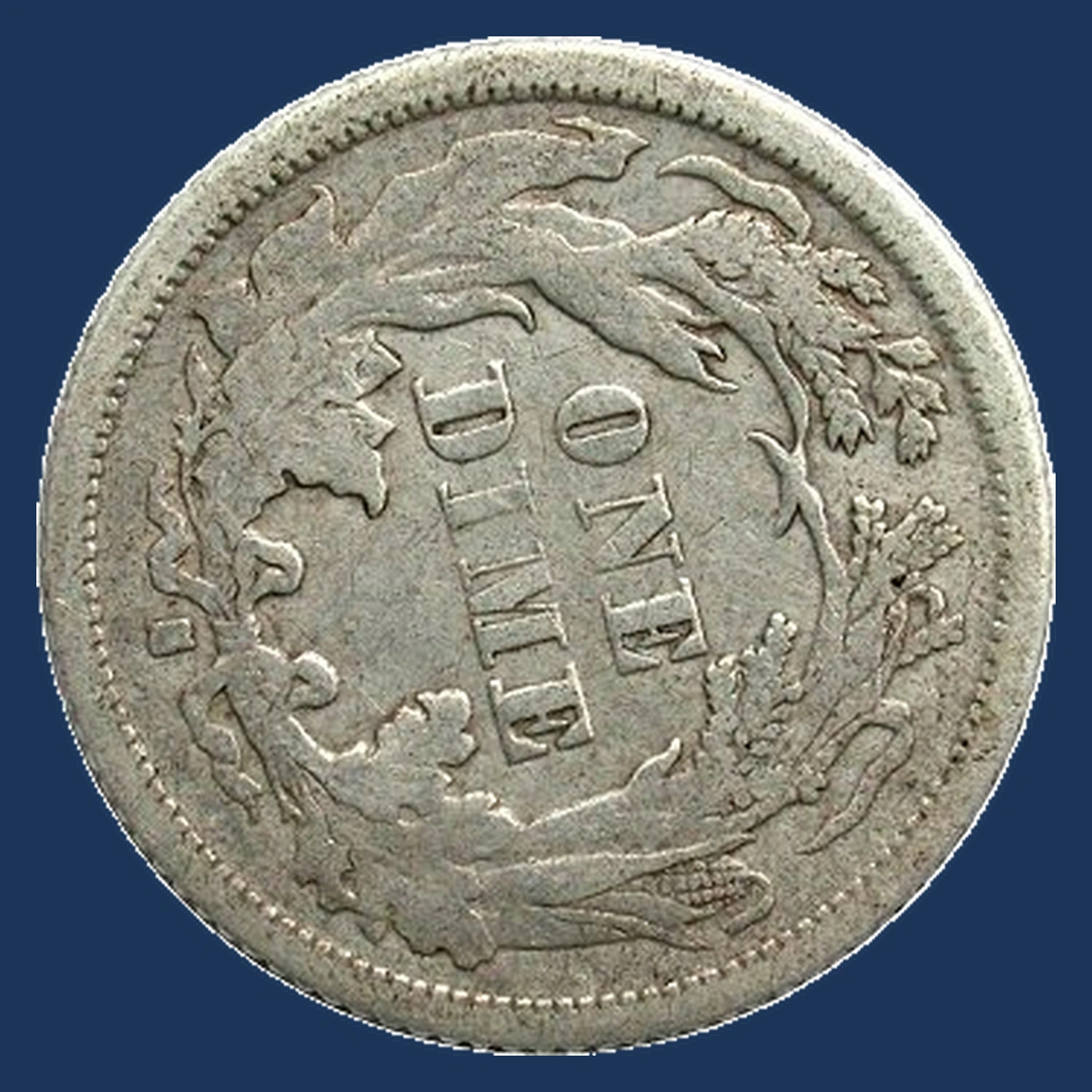
A substantial leftward lean appears on two San Francisco examples with the S below the wreath. F-109 is recorded at 50 degrees, while F-118a is recorded at 80 degrees.
Those angles belong to different tool pairings. They are not two possible estimates to choose between for any 1875-S dime.
Rotation describes the direction of one stamping tool relative to the other. A coin can keep both complete, centered pictures even when they face different directions.
Check the mint-letter position and the actual turn together. An S inside the wreath or a slanted photograph does not establish these below-wreath examples.
Estimated Value
The estimated whole-coin range is $100–$1,500 for worn through lightly worn examples with the reported substantial rotations. No auction price is assigned to F-109 or F-118a here.
The 80-degree angle is larger, but condition can outweigh that difference. A clear repeatable turn helps show what the coin actually does.
Compare coins of the same denomination, mint, and condition before deciding on a price. A large angle alone does not outweigh heavy wear or damaged surfaces.
How to Identify
Hold the front upright against a vertical guide and flip the holder from top to bottom. Keep the coin from spinning sideways.
The back should normally end upright. Measure its remaining leftward lean with a protractor, then repeat the turn.
Confirm the S below the wreath before comparing with F-109 at 50 degrees or F-118a at 80 degrees. Separate pictures straightened independently cannot preserve this evidence.
Use a 10× magnifier to inspect the edge grooves for a seam. When safely accessible, compare scale and caliper readings with 2.50 g and 17.9 mm for this 90% silver dime.
The same measured leftward lean after repeated controlled turns is the key result, with the correct below-wreath mint letter also visible.
4. 1875 Liberty Seated Dime Cud and Retained Die Break (Estimated Up to $3,000)
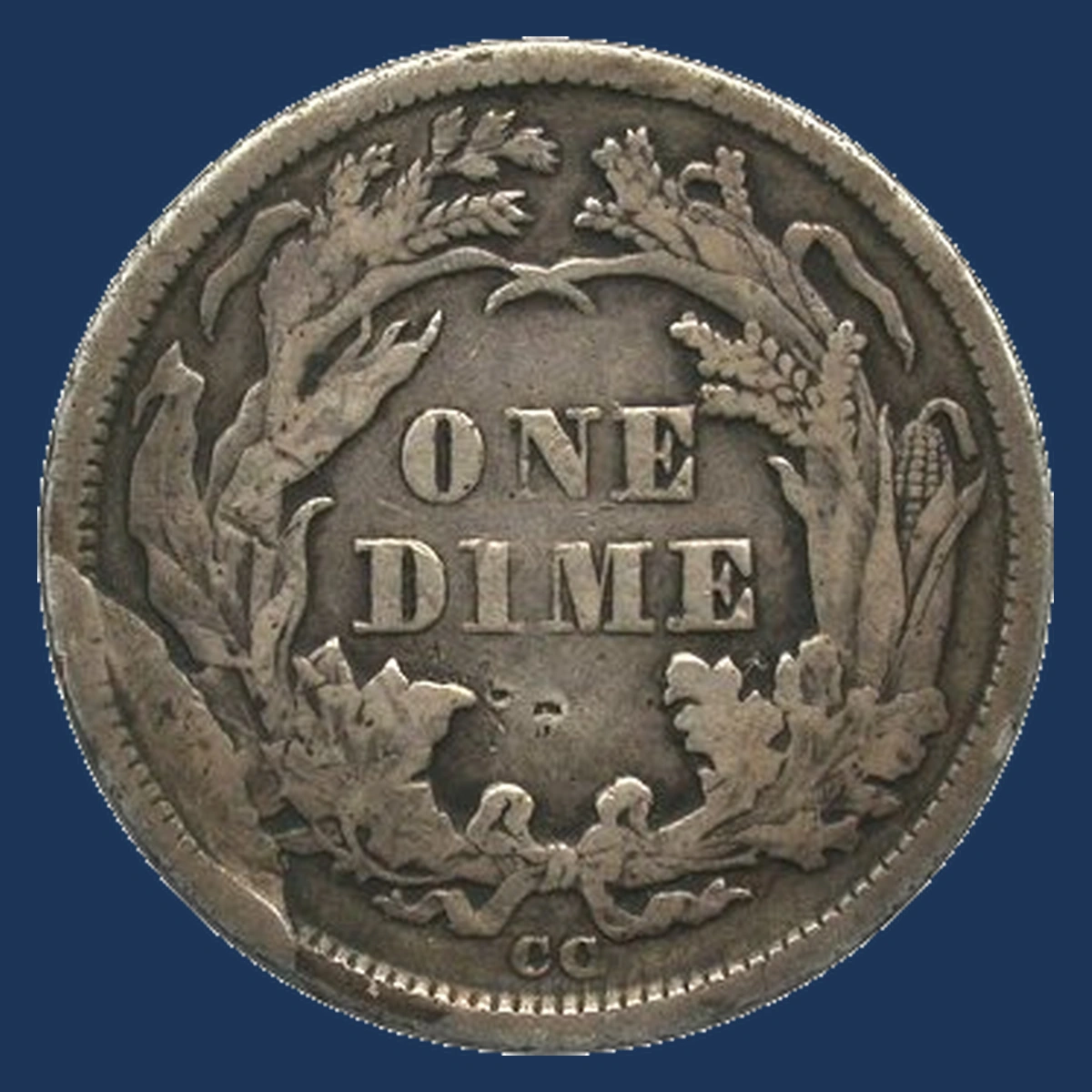
A broken tool piece can stay in place and stamp part of its design. This retained break leaves a step inside a rim-connected area.
Carson City examples with CC inside the wreath have back sections around 8:30–9:30 and 3:30–5:00. Below-wreath CC examples include front breaks below the date and a lower-left back cud.
San Francisco has an inside-wreath S example with a back cud at six o’clock. These are separate coins.
If the piece falls away, the raised rim-connected lump is called a cud. A narrow crack alone does not establish either larger break.
Estimated Value
The estimated whole-coin range is $150–$3,000 for worn through lightly worn CC and S examples. Size, mint-letter position, and surface quality affect the comparison.
A subtle shifted section and a large raised lump may attract different demand. These estimates do not represent newly recorded auction sales for the pictured examples.
Damage elsewhere still matters. A specialist name or a large-looking break should not place an altered coin at the top of the range automatically.
How to Identify
Find whether CC or S sits inside or below the wreath before choosing a picture. Compare the correct clock position with the specialist examples.
Use low light and a 10× magnifier to look for a step across the boundary. Remaining design inside it can show that the tool fragment stayed in place.
A raised patch lacking normal detail may instead reflect a piece that fell away. A later rim dent or folded lip needs another explanation.
Check an accessible coin with a scale and calipers against 2.50 g and 17.9 mm. Inspect the edge grooves of the 90% silver dime.
The matching rim section and changed level provide the useful evidence, rather than a long crack alone.
5. 1875 Liberty Seated Dime Repunched Date (Estimated Up to $3,500)
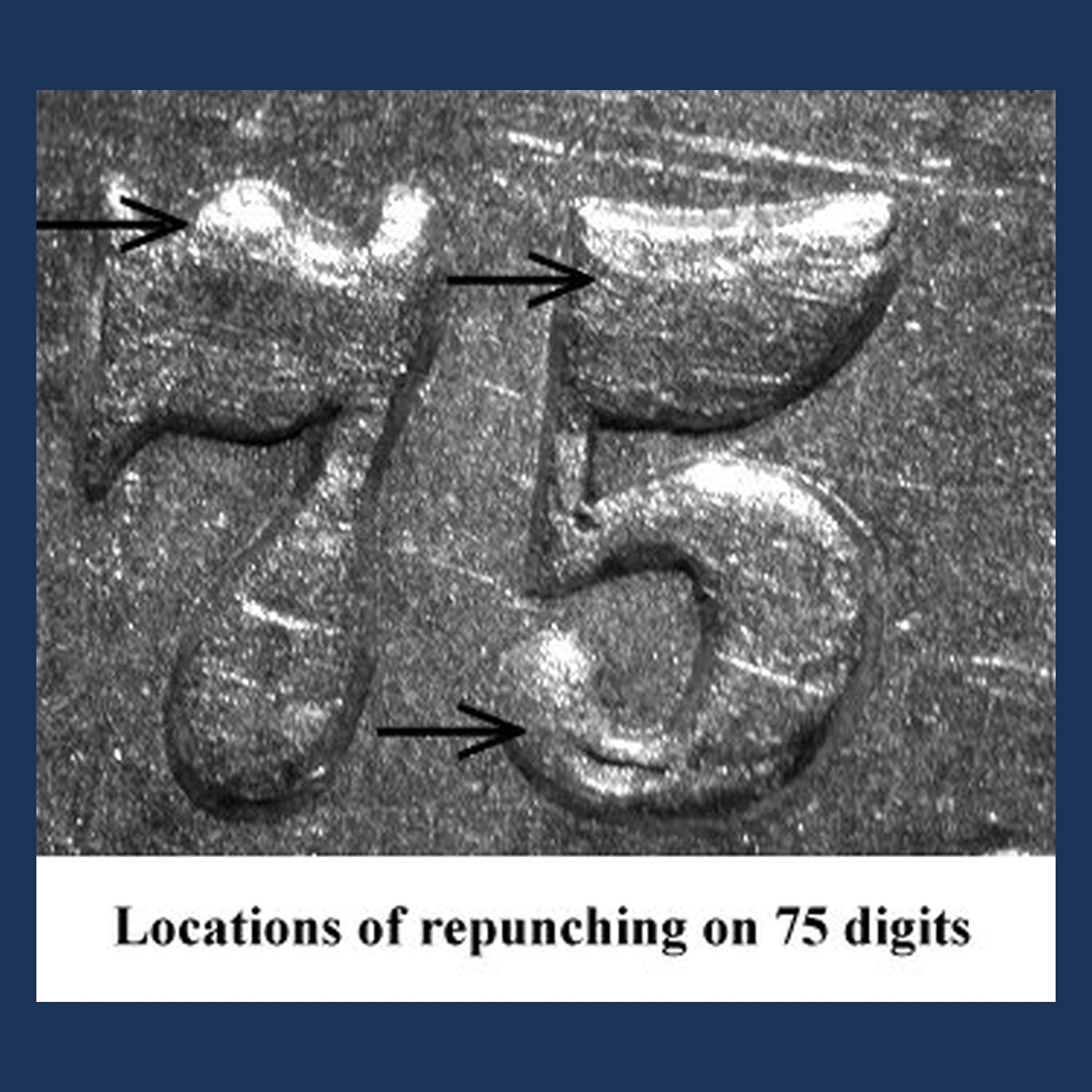
Look closely at the date. Some Philadelphia dimes have small pieces of a second numeral beside the main one.
The date punch entered the steel tool more than once, leaving an earlier impression behind. Each coin made with that tool then received the same extra lines.
Proofs are specially made collector coins. One Proof variety, called F-101, has repeated parts of 1 and 5.
Dimes made for everyday use show other combinations, including 18 and 75. Those differences matter when choosing a matching photograph; a shiny surface alone does not identify the Proof.
Estimated Value
Estimated values run from $30–$900 for worn examples through lower-grade unworn coins made for everyday use. Lower-to-middle-grade Proof examples have a separate estimated range of $400–$3,500.
These are estimates, not recorded sales of the exact varieties. Worn F-107 misplaced-date dimes sold around $61–$93 in 2025.
Those sales offer a nearby comparison. They concern a different date mistake and cannot establish the value of a Proof.
How to Identify
First decide whether the coin is a Proof or an everyday issue. A bright surface is not enough; compare the complete coin with a verified example of the same kind.
Use a 10× magnifier to study the date. On Proof F-101, inspect 1 and 5 for pieces of an earlier numeral.
Other varieties may show repeated parts of 18 or 75 instead. Scratches cut into the surface, while a genuine extra numeral should stand above it.
An ordinary example contains 90% silver, weighs 2.50 grams, and measures 17.9 mm across. Check safely accessible coins with a scale and calipers, and inspect the edge grooves.
The useful match is the same extra curve in the same position beside the same digit.
6. 1875 Liberty Seated Dime Doubled Die Reverse (Estimated Up to $3,500)
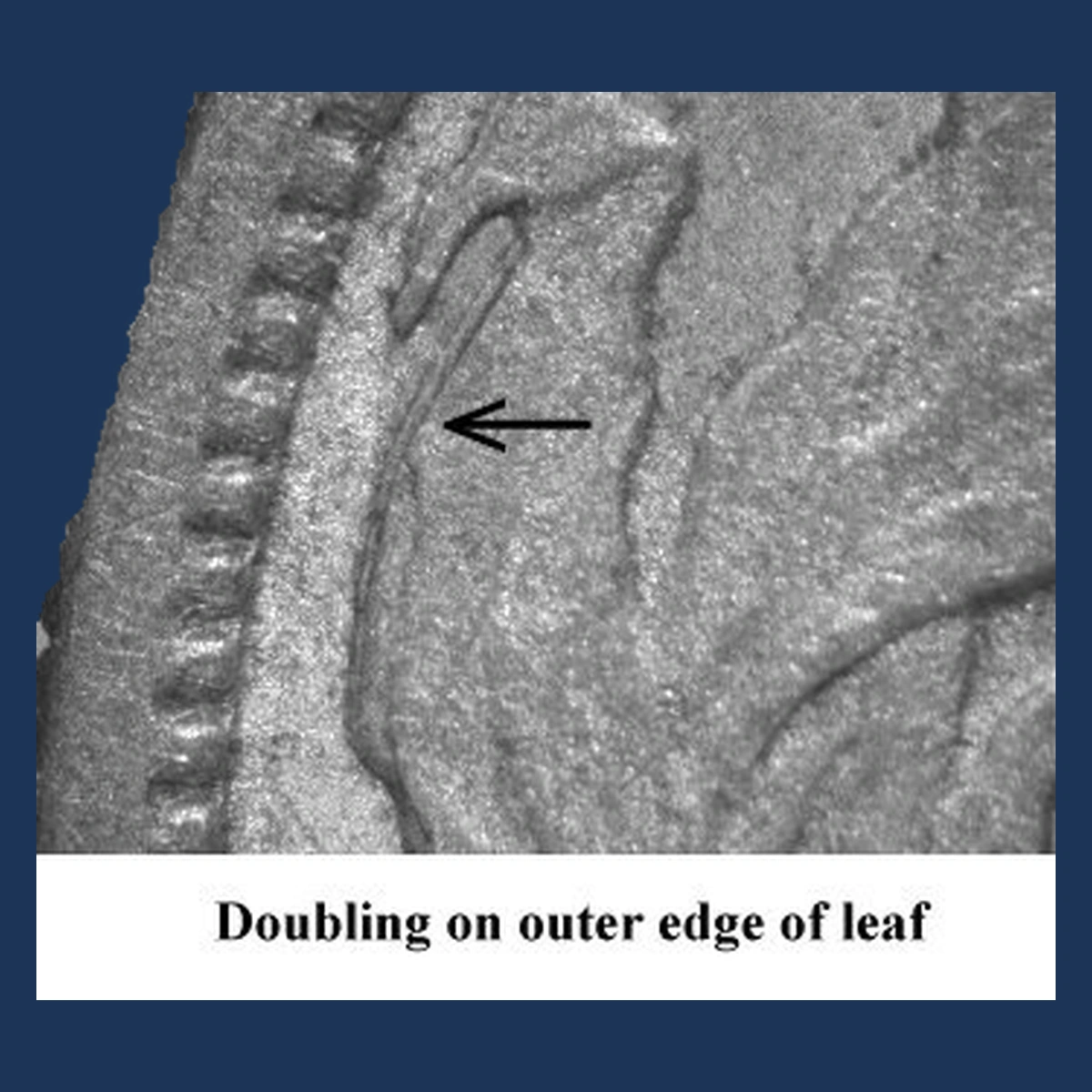
The back can hold the extra design instead of the date. A doubled die forms when the design is copied onto a stamping tool in slightly different positions.
That tool then stamps the doubled picture onto coins. This is different from striking a coin twice.
On the F-101 Proof, examine the O in ONE. The F-117 everyday issue has doubling on the left side of the wreath instead.
These are separate examples. F-117 may also have faint marks from the two stamping tools hitting each other, but those marks have a different cause.
Estimated Value
Allow an estimated $50–$1,000 for worn through lower-grade unworn examples made for everyday use. For lower-to-middle-grade Proofs, the estimated range is $400–$3,500.
The Proof can also have a repunched date. Both features belong to one coin, so their listed ranges should not be added.
No sale of these exact doubled-back examples sets these ranges. Surface quality, wear, and a clear match to the variety guide the estimate.
How to Identify
A Proof with the repeated 1 and 5 deserves a look at the back too. Use a magnifier on the O in ONE and compare its outline with a verified F-101 photograph.
For an everyday F-117 dime, move to the left wreath instead. Look for a second raised outline, rather than a thin, flat shelf beside the design.
Faint shapes from the opposite face can be clash marks. They do not automatically make every nearby line part of the doubling.
Use a scale and calipers when the coin is safely accessible. The normal figures are 2.50 grams and 17.9 mm, with 90% silver and grooves around the edge.
Match the O or wreath to its own example; the two locations are not interchangeable.
7. 1875 Liberty Seated Dime Off-Center Strike (Estimated Up to $5,000)
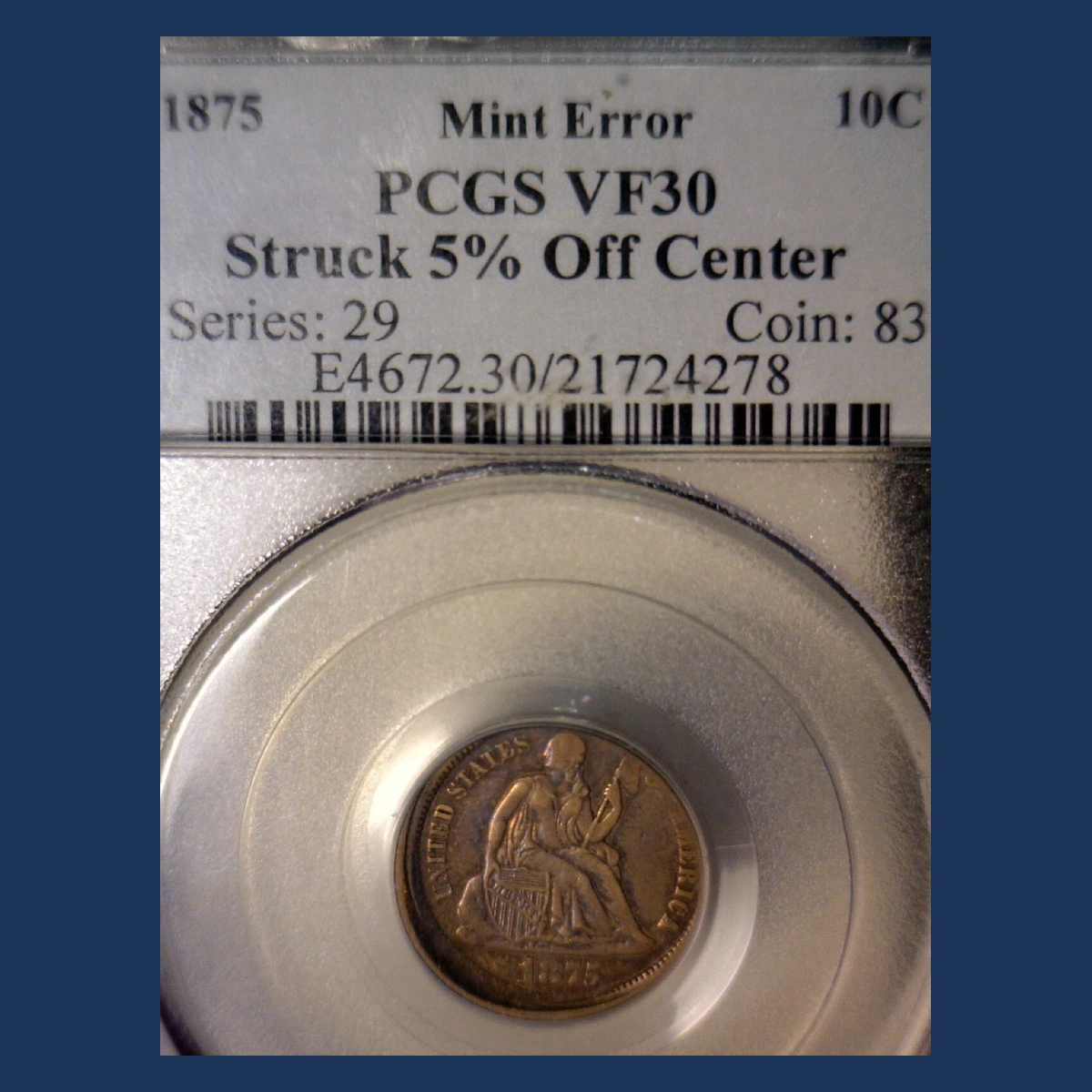
A blank that sits partly outside the striking position receives only part of the design. One side of the finished coin can remain bare while the opposite side loses letters or other details.
An 1875-CC example is cataloged as 10% off center, graded XF45, meaning worn with strong detail remaining. Its CC sits above the wreath bow.
A separate dealer example has a lower XF40 grade and a strike toward nine o’clock. Reports also include Philadelphia and below-bow CC pieces, but their details differ; these should not be treated as the same coin.
Estimated Value
Estimated prices are $400–$2,000 for Philadelphia examples and $800–$5,000 for Carson City examples with wear or slight wear. The cataloged XF45 coin has no quoted sale price in this comparison.
A different coin offers a useful guide: a 1907-D Barber dime sold for $1,207.50 on September 11, 2004. It was 20% off center and graded AU55, with slight wear.
That sale concerns another year and design.
How to Identify
Find the date and mint letters before judging how much design is missing. On the cataloged XF45 example, CC sits above the wreath bow; that position is normal for the variety.
The separate XF40 coin points toward nine o’clock. Do not use its direction to identify the XF45 piece.
Use a magnifier along the boundary between the struck picture and bare metal. Grinding can remove a design, but it also leaves damaged surfaces rather than an untouched blank area.
Normal specifications are 90% silver, 2.50 grams, 17.9 mm, and edge grooves. A scale and calipers help check safely accessible examples, although an off-center strike may distort the shape.
Look for missing design opposite a genuine unstruck area, with no signs of metal being scraped away.
8. 1875 Liberty Seated Dime Die Cracks and Shattered Dies (Estimated Up to $20,000)
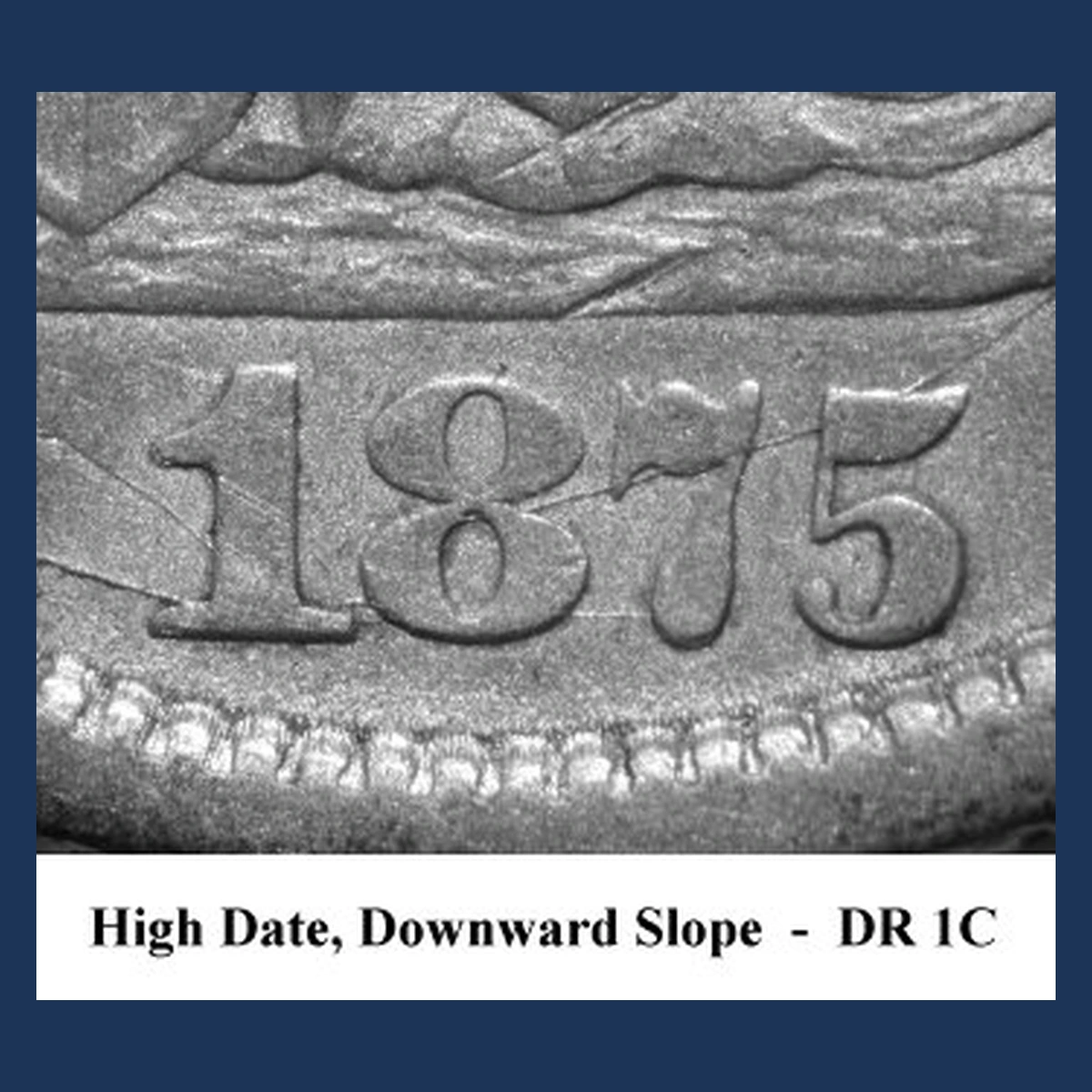
A broken stamping tool can leave a web of raised lines on a coin. Collectors sometimes call this a shattered die, but the tool cracked, not the finished dime.
The 1875-S F-105a is a striking example. It has S above the bow and an extensive network of cracks on the back.
Other 1875 dimes show different patterns: Philadelphia date and wreath cracks, ring-like lines on Carson City fronts, and San Francisco wreath or ribbon cracks. A network alone does not prove that a piece of the tool shifted or fell out.
Estimated Value
A superb 1875-S F-105a sold for $18,300 on May 1, 2026. Its MS67 grade means exceptional unworn condition; CAC also approved its quality.
An estimated $15,000–$20,000 suits that exceptional level. More ordinary worn or slightly worn cracked examples across the mints have an estimated $30–$1,500 range.
The auction price covers the whole high-quality coin. It is not the amount added by cracks alone.
How to Identify
Start with the mint letter and its position. F-105a has S above the bow, so a different mint or location needs a different comparison.
Follow the raised lines across the back under a 10× magnifier. The broken first S of STATES and O of OF provide useful extra checks for this variety.
A scratch usually cuts downward. Change the light angle to see whether each line stands above the surface.
Check the edge grooves, then use a scale and calipers if safely accessible. Normal specifications are 2.50 grams, 17.9 mm, and 90% silver.
For F-105a, compare the entire crack network and the two damaged letters together; one isolated line will not establish the match.
Conclusion
The estimated 1875 dime ranges run from $25 for modest examples to $20,000 for an exceptional cracked coin. Start by finding the mint letters and their position around the wreath.
Next, inspect the date and follow any raised lines. Several features may share one coin, so compare its complete condition and appearance before choosing a price range.