1955 Dime Error List with Pictures

A light dime can be worth weighing. A 1955-S dime struck on a thin blank weighed 2.1 grams and sold for $107 in October 2021.
Other 1955 dime errors show missing pieces, a raised line above Roosevelt’s head, or a second mintmark. Some doubled-looking details are common and add no special premium.
The estimated ranges below run from $10–$750, including ordinary coin values for common doubling. Read on to see which marks deserve a closer look.
1. 1955-S Roosevelt Dime Hot Lips Abrasion Doubling (Coin Value Up to $100)
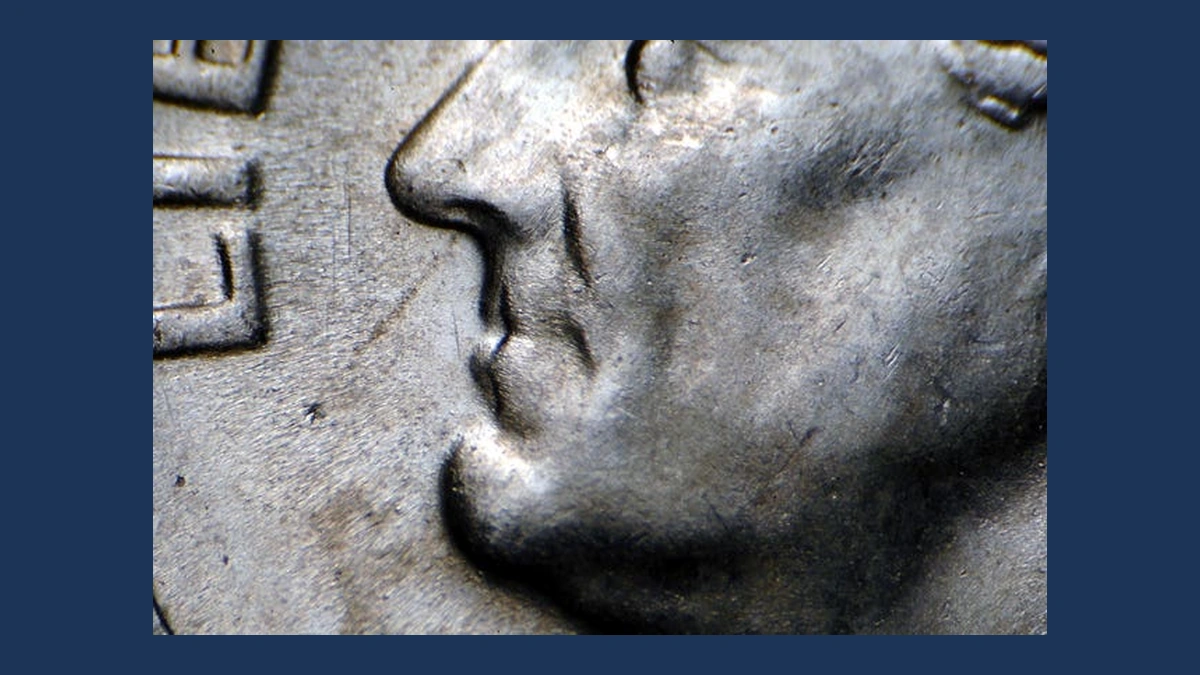
Roosevelt appears to have an extra lip on some 1955-S dimes. Collectors call this Hot Lips, but the name does not make it a rare doubled die.
Wexler’s catalog explains that polishing the die caused the effect. A die is the steel tool that stamps the coin design.
Polishing changed the edge of the mouth in that tool. Coins struck afterward picked up the extra raised outline.
An older doubled-die listing was removed after this correction. The visible feature remains, but its cause is different from doubling created when a die receives its design.
Estimated Value
Use an estimated $10–$100 for ordinary worn through modest unworn examples. This is the value of the coin itself, without an added Hot Lips premium.
Wexler reports no established extra value for this polishing effect. An older $100–$500 doubled-die range should therefore not be applied just because the mouth looks doubled.
An unusually well-preserved coin can still bring more. In that case, its condition or sharp torch detail explains the higher price.
How to Identify
The S sits left of the torch base on the back. This is an everyday San Francisco dime, not a specially made collector Proof.
Enlarge the mouth with a 10× magnifier and compare its extra lip outline with Wexler’s polishing example. Include the fine lines nearby rather than relying on a tight crop of the mouth.
A normal silver dime weighs 2.50 grams and measures 17.9 mm. Check safely accessible examples with a scale and calipers, and inspect the grooves around the edge.
Do not rub the surface to expose a clearer line. The lip shape together with nearby polishing marks explains this appearance more directly than an extra-looking outline alone.
2. 1955 Roosevelt Dime Horned Die Crack (Estimated Up to $100)
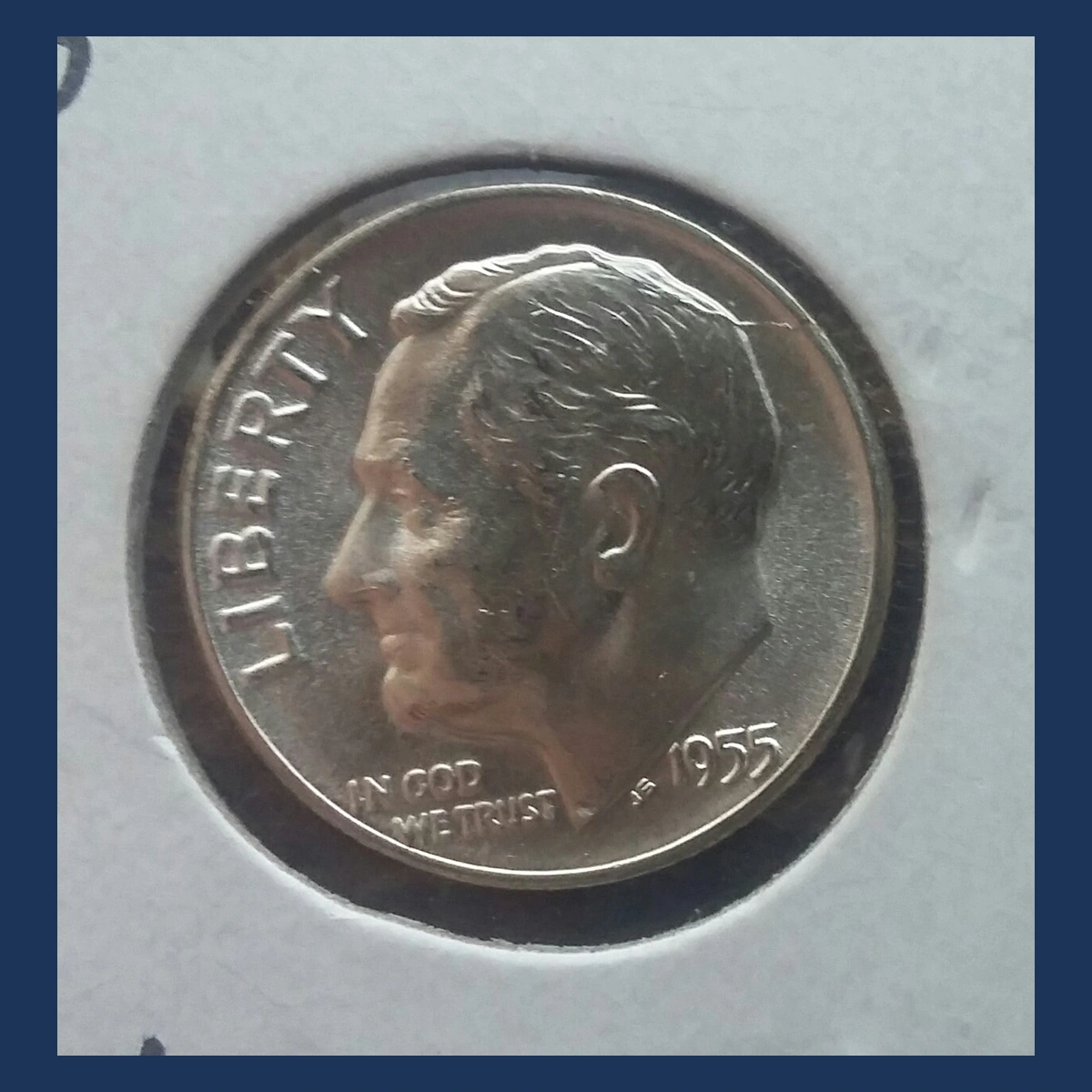
A thin raised line can make Roosevelt look as though he has a horn. The reported Philadelphia example has a line from the rim near two o’clock to the top of his head.
The line formed when a die cracked. Silver entered that narrow opening during the strike and left a raised ridge on the coin.
An older Jim’s Coins catalog described an unworn example with this route. The horn is simply a nickname for its appearance.
A scratch is different: it cuts into a finished coin instead of adding a raised line.
Estimated Value
Estimate $15–$100 for visible examples, from worn coins to attractive ordinary unworn pieces. A clear line joining the rim and head is easier to see and more appealing than a faint trace.
The old catalog showed a $3.50 minimum bid. It did not report a completed sale.
The range here is an estimate based on similar minor silver-dime cracks. Good surfaces help, but the horn nickname alone does not place a worn coin at the top.
How to Identify
The catalog’s route runs from the rim near two o’clock to the top of Roosevelt’s head. Keep both endpoints in a full-front photograph.
Place a light low across the coin and use a 10× magnifier. A crack should form a raised ridge; a scratch cuts into the finished surface.
Changing the light helps separate that ridge from normal hair and nearby scratches. The catalog describes an unworn example, but another coin with the same crack may have wear.
When safely accessible, use a scale and calipers against 2.50 grams and 17.9 mm, then inspect the edge grooves. Follow the continuous raised line from rim to head to match the reported horn.
3. Reported 1955 Roosevelt Dime Reverse Die Chip (Estimated Up to $150)
Look near the E and S of STATES for a small raised lump. A year guide reports this feature on the back of a 1955 dime.
Such a lump can form when a tiny piece breaks from the die. Silver fills the new gap and leaves extra raised metal on each coin struck afterward.
Collectors call this a die chip. A larger break that reaches the rim is often called a cud.
The reported feature has no confirmed rim connection. It should therefore be checked as a chip near the letters, not assumed to be a large cud.
Estimated Value
The reported guide range is $25–$150 for smaller breaks on the back. Treat it as an estimated price for the whole coin, not a recorded auction sale.
A clearly visible lump that changes part of a letter is more appealing than a tiny speck. Better condition can also raise the price.
A small chip does not earn the same premium as a large break along the rim. The upper estimate needs a clear feature and an attractive coin.
How to Identify
Include the rim beside STATES in the first photograph. It shows whether the raised metal stays near the letters or reaches the edge.
Use a 10× magnifier on E and S. A genuine chip belongs to the struck surface, while dirt or solder may cover letters that remain intact beneath it.
A hit can also push metal upward, so look for a nearby dent. Check the opposite face and edge for related damage.
Normal specifications are 2.50 grams and 17.9 mm, with grooves around the edge. Use a scale and calipers when safely accessible.
The useful distinction is raised struck metal near E and S, with its actual rim relationship visible rather than assumed.
4. 1955-S Roosevelt Dime Repunched Mintmark (Estimated Up to $200)
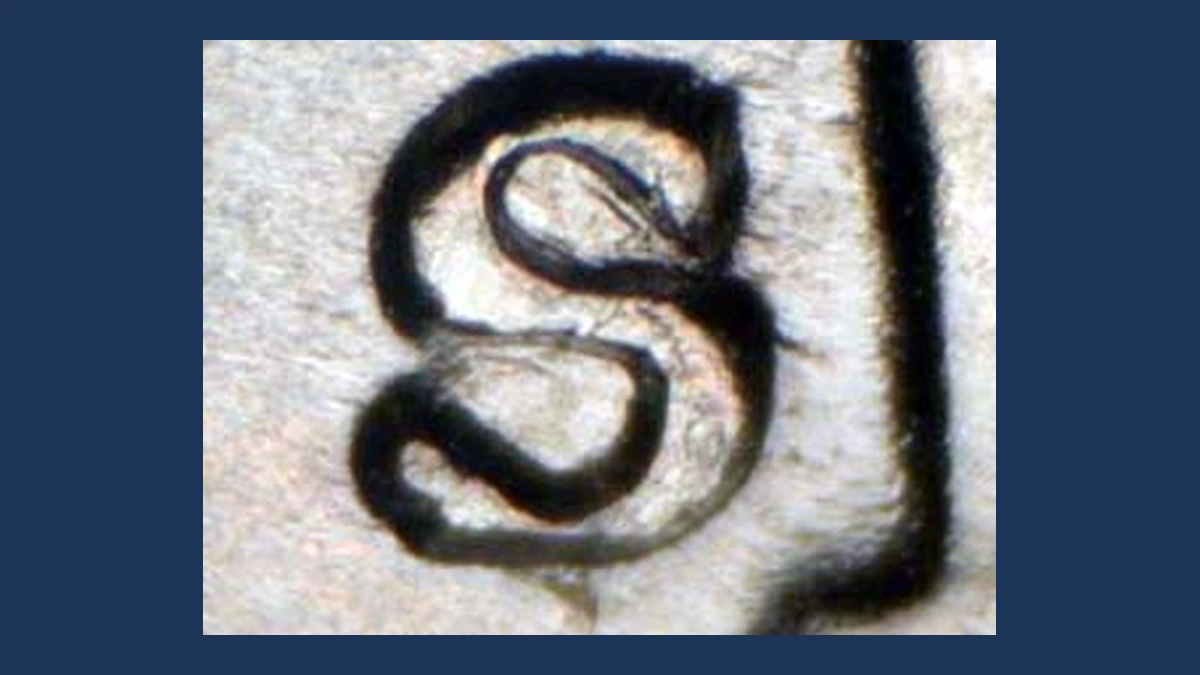
A second S can peek out from beneath the main mintmark on a 1955-S dime. This is called a repunched mintmark: the letter was punched into the die more than once.
Workers added mintmarks by hand at the time. If the second punch landed slightly away from the first, parts of both letters could remain.
One older catalog describes the extra S below and to the left. That is the southwest direction shown for that example.
Another catalog also lists an S/S coin. Its extra letter should not be assumed to point the same way.
Estimated Value
Estimate $20–$75 for correctly identified worn examples and $75–$200 for clearer, attractive unworn coins. These are comparisons with similar minor silver-Roosevelt mintmark varieties.
The old southwest S/S listing had a $3.50 minimum bid. That amount does not tell us its final sale price.
A clear second letter is the main attraction. A worn coin with only a faint trace should not receive the same allowance as a sharp example with clean surfaces.
How to Identify
Find the mint letter left of the torch base on the back. Compare its shape with a normal 1955-S before enlarging the suspected extra stroke.
For the southwest example, use a 10× magnifier below and left of the main S. The extra curve should form part of another S rather than a random bump.
Other repunched S examples may point differently. Match each with its own photograph instead of applying one direction to every coin.
Check safely accessible examples with a scale and calipers against 2.50 grams and 17.9 mm. Inspect the edge grooves too.
The matching earlier S curve below-left of the main letter identifies the reported southwest example most directly.
5. 1955 Roosevelt Dime Master-Die Doubling and Reported Reverse Doubling (Comparison Range Up to $300)
Many 1955 dimes show extra outlines on LIBERTY, the motto, or Roosevelt’s lips. These details came from a master die, an early tool used to make later coin-making tools.
The same doubling could therefore reach many dies. Wexler describes it on Philadelphia, Denver, San Francisco, and Philadelphia Proof coins.
This common feature does not identify one rare die. A separate year-guide report points to doubling on the E of E PLURIBUS UNUM on the back.
That reverse feature needs its own match. It is not the same as the common front-side doubling or polished Hot Lips.
Estimated Value
For ordinary coins showing only common master-die doubling, estimate $10–$150 according to mint, condition, and finish. No special rarity premium is included for that widespread feature.
A separately confirmed reverse doubled die has a conditional estimated range of $50–$300, based on similar minor silver-dime varieties. A thick-looking E alone does not establish one.
These ranges cover ordinary examples. Exceptional Proof surfaces or very high grades can affect the coin’s value for other reasons.
How to Identify
Compare the front with several normal 1955 dimes. Similar extra outlines appearing on many examples can be the common master-die feature, rather than a rare discovery.
For the separate reverse report, use a 10× magnifier on the E in E PLURIBUS UNUM. Look for a raised extra outline and compare it with a properly identified example; a flat shelf can have another cause.
Keep regular coins and mirrorlike Proofs separate when comparing surfaces. Their normal silver weight and diameter are the same: 2.50 g and 17.9 mm.
Use a scale and calipers when safely accessible, and check the grooved edge. Common doubling on the front cannot prove that an unusual mark on the back is a doubled die.
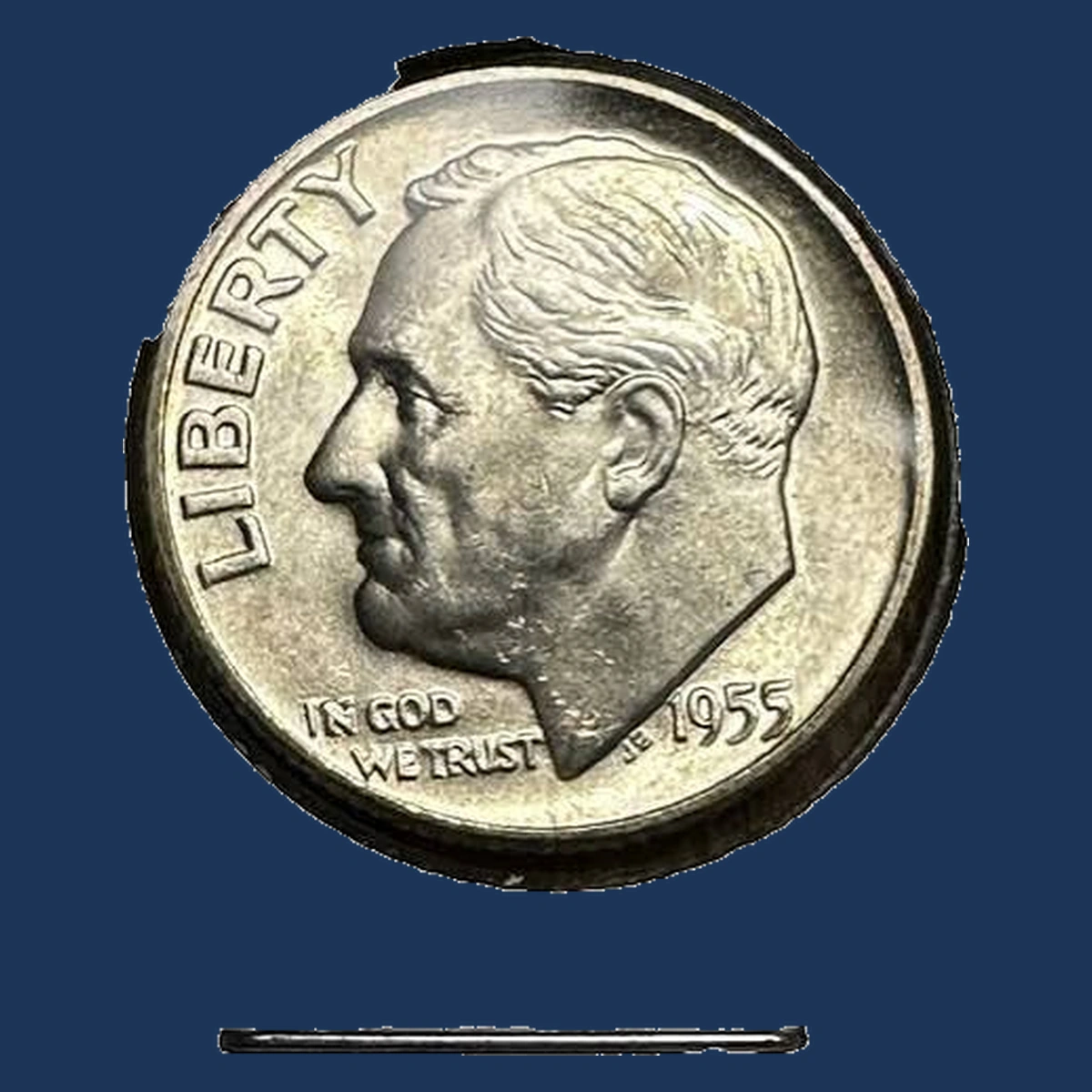
6. 1955-S Roosevelt Dime Double Clip (Estimated Up to $350)
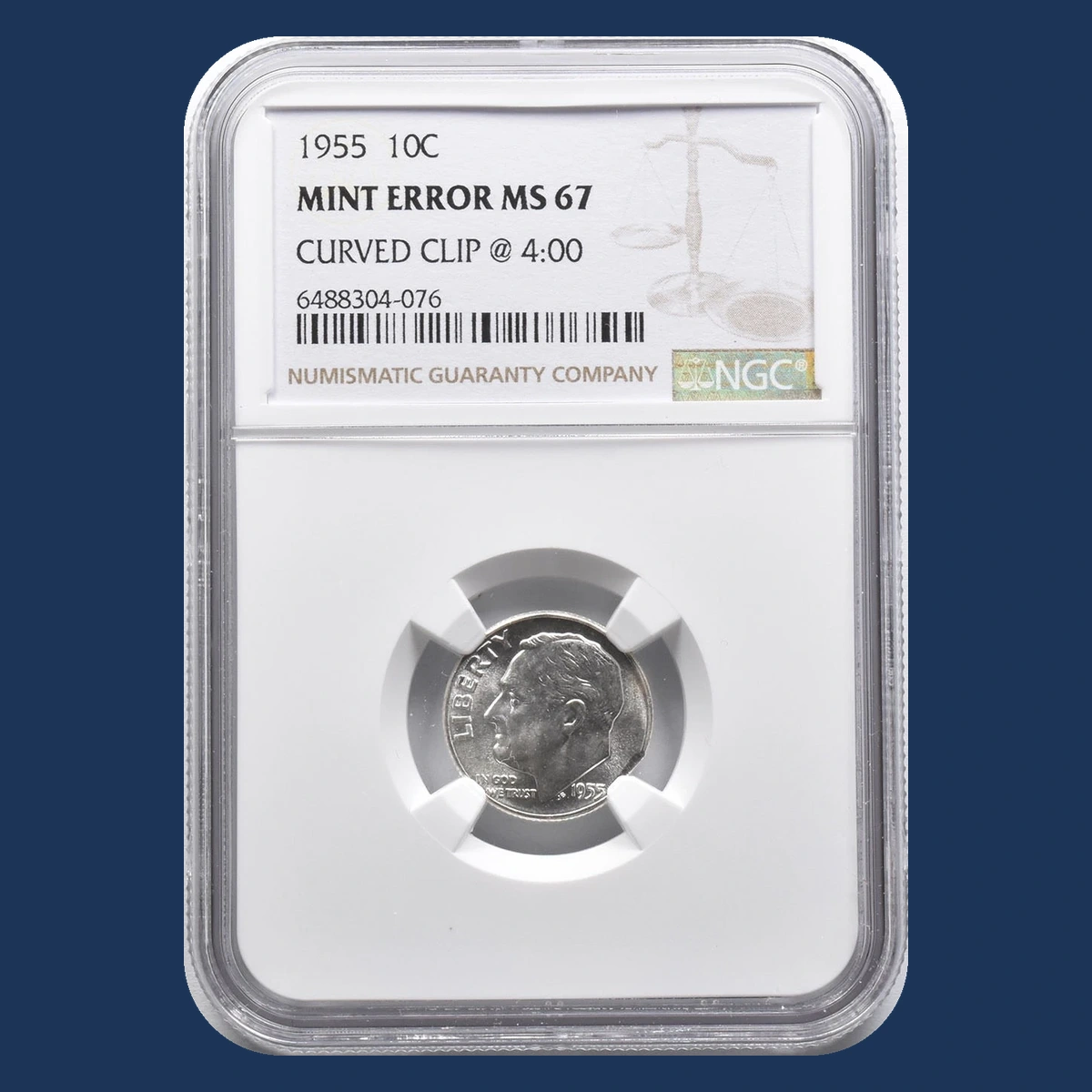
This 1955-S dime has two missing sections around its edge. Both gaps were present in the blank before the coin was struck.
The GreatCollections example weighs 2.43 grams and was graded ANACS MS63. That grade describes an unworn coin with visible marks.
A double clip describes the two gaps on one coin. It does not mean two coins were joined together or that the dime received two strikes.
The gaps can change how nearby metal flows and how the rim forms. Their combined shape matters more than simply counting two missing pieces.
Estimated Value
Estimate $75–$350 for genuine double clips in attractive worn through lower unworn condition. The ANACS MS63 example has no public sale amount used here.
For comparison, a 1947-S ten-percent curved clip graded NGC MS66 sold for $104 in December 2024. It has a different date, grade, and clip shape.
Two gaps do not double that price. Buyers judge the complete coin, including the strength of the error and its surfaces.
How to Identify
The listed 2.43 grams is only slightly below the normal 2.50 grams. A scale can check safely accessible coins, but that small difference cannot show when the metal disappeared.
Examine both gaps with a 10× magnifier. Look for struck metal flowing around their boundaries, then check for related rim weakness.
A later cut may leave tool marks or crush an already finished edge. Two missing sections alone do not prove a double clip.
Use calipers across an intact span against 17.9 mm and inspect the surviving edge grooves. Keep a sealed coin in its holder and use its recorded weight.
Natural strike changes at both gaps, rather than their number alone, provide the useful double-clip match.
7. 1955-S Roosevelt Dime Struck on Thin Planchet (Estimated Up to $500)
One 1955-S dime weighs just 1.9 grams instead of the normal 2.50 grams. Heritage describes it as struck on a thin planchet, meaning the metal blank was too thin.
That coin was graded NGC MS66, exceptionally well-preserved and unworn. A separate MS64 example, unworn with some marks, weighs 2.1 grams.
Their weights belong to different specimens. The lighter coin should not be confused with the one that sold for $107.
A thin blank gives the dies less metal to press into the design. Some details may look weak, though low weight alone does not prove this error.
Estimated Value
The NGC MS64 example weighing 2.1 grams sold for $107 on October 6, 2021 at Heritage. Estimate $100–$500 for genuine thin-planchet examples.
The separate MS66 coin weighs 1.9 grams, but no sale price is used here for it. Its higher grade and lower weight may attract buyers.
They do not create a fixed price increase. Compare condition, weight, and the visible effect of the thin blank before choosing a value within the range.
How to Identify
A scale reading well below 2.50 grams needs an explanation. The two recorded coins weigh 1.9 grams and 2.1 grams, and their measurements must stay separate.
When safely accessible, use calipers to compare thickness at several points and diameter against 17.9 mm. A thin blank need not have a wedge shape.
Under a 10× magnifier, inspect both faces and the edge grooves for filing or chemical damage. Those changes can also remove metal after minting.
Confirm the date and S, and compare a sealed coin with its recorded measurements rather than opening the holder.
Reduced original thickness, normal-looking struck surfaces, and no evidence of later metal removal together support a thin blank.
8. Reported 1955 Roosevelt Dime Off-Center Strike (Estimated Up to $750)
An off-center dime has part of its design missing and an area of untouched blank metal. The blank sat out of position when the dies struck it.
The design should be displaced on both sides. If only one side is shifted, the problem may instead be the position of one die.
Off-center strikes are reported for 1955, but this report does not identify one certified coin with a stated mint or percentage. The visible shape must be checked on each example.
An uneven border alone is not enough. Look for both missing design and a genuine blank margin.
Estimated Value
Estimate $100–$300 for modest worn off-center examples with a readable date. A larger error or better-preserved coin can fit an estimated $300–$750 range.
These are comparisons with silver-Roosevelt errors, not recorded prices for a specific 1955 sale. A known 1947-S fifteen-percent off-center dime offers a related example, but not a sale amount.
The estimates cover regular coins. They do not include the much different market for rare Proof striking errors.
How to Identify
Keep the entire outline and readable date in photographs of both faces. A close-up of the bare crescent alone hides where the picture is missing.
With a 10× magnifier, compare the displaced designs. If the complete pictures remain on a wider coin, a broadstrike may explain the shape instead.
The normal blank weighs 2.50 grams and measures 17.9 mm. Use a scale and calipers when safely accessible, allowing for changes in outline from the strike.
Inspect the edge grooves and bare margin for cuts or filing. A missed mint-letter area does not prove Philadelphia origin.
Matching incomplete designs beside untouched metal on both faces provide the direct off-center check; a missing segment cut away later does not.
Conclusion
Start with what you can see or measure: a raised horn, two missing pieces, or an unusually light dime. Each points to a different minting problem.
Estimated values range from $10 for ordinary coins with common doubling to $750 for stronger off-center errors. The $107 thin-planchet sale is one useful comparison; Hot Lips and widespread master-die doubling should not receive a rare doubled-die premium simply because they look unusual.