1990 Dime Error List with Pictures

Two readable 1990 dates survived when a Lincoln cent design was struck over a finished Philadelphia dime. The resulting coin sold for $1,092.50 in April 2006.
Other entries in this 1990 dime error list need a closer look at the edge, ear, or missing design. Their estimated values span $10–$3,000, from small striking faults to overlapping denominations.
Use the descriptions below to separate missing metal from missing detail and compare each example with the right price range.
1. 1990 Roosevelt Dime Doubled Die Obverse
An extra outline at Roosevelt’s ear is the feature to examine on the reported 1990-D example. The front of a coin is also called its obverse.
A doubled die means the stamping tool itself carries a doubled design. Coins made by that tool can repeat the same extra detail.
The ear example described in the year guide was not independently certified there. An enlarged photograph can reveal a promising outline, but a flat ledge caused during striking is a different effect and usually has little added value.
Estimated Value
Minor, confirmed doubling of this kind has an estimated range of $15–$100. That range is based on comparable modern dime features and applies only when the ear detail is identified as genuine die doubling.
Separation that remains visible under ordinary magnification is more appealing than a vague shadow. An unworn coin also preserves the feature better, while a scratched ear or flattened outline gives buyers less reason to pay extra.
How to Identify
Keep the coin level while moving a lamp around Roosevelt’s ear. A second rounded outline should remain in the same place, while a highlight can move or disappear.
At 10× magnification, compare the ear with an ordinary 1990-D dime rather than a coin from another design. Examine nearby details for flattening, scratches, or a sideways smear.
Check the D mint letter as well as the date. A scale and calipers should place this clad dime near 2.268 g and 17.91 mm, but those measurements do not establish doubling.
Photograph the feature from more than one lighting angle. A matching, separated ear outline is more useful than simply enlarging one bright edge.
2. 1990 Roosevelt Dime Curved Clipped Blank
A curved gap can begin before a dime has any design. The blanking punch overlaps a hole already cut in the metal strip, leaving part of the new round blank missing.
The incomplete blank can still pass through the press and receive the coin design. Its edge may resemble a small bite.
Curved clips are reported for 1990 dimes, although the available year listing does not identify a particular mint or clip position. The important distinction is an original missing section, rather than a notch cut into a finished coin.
Estimated Value
Estimate $15–$100 for a genuine 1990 curved clip, depending on its size, condition, and visibility. This range covers ordinary clad dimes with a clearly identifiable missing section and original surfaces around the gap.
A clear gap with natural edges displays better than a tiny notch. Very worn or corroded examples bring less, and a seller’s claim of a large percentage should agree with the actual missing metal.
How to Identify
A clip should reduce weight, so record a loose coin on a 0.01 g scale before measuring the gap. An intact 1990 dime normally weighs 2.268 g and measures 17.91 mm across with calipers.
Look along the curved edge with a 10× magnifier. Smooth transitions into the struck faces differ from sharp saw marks or a surface filed flat after minting.
The rim opposite the gap may be weak because the incomplete blank behaved differently during rim preparation. Its absence does not automatically reject a clip.
Inspect both ends of the missing section for displaced burrs. Check a graded coin through its holder rather than opening it, and judge the original edge surfaces instead of the bite shape alone.
3. 1990 Roosevelt Dime Partial Collar Strike
The edge, rather than the portrait, reveals this mistake. One part has the normal grooves, while another part spreads outward and creates a step.
The collar is the metal ring that controls a coin’s diameter and forms its grooved edge. A partial collar strike happens when the blank does not sit fully within that ring.
A 1990-P dime graded ICG MS63, meaning unworn with visible contact marks, appeared in a GreatCollections auction. The distinctive edge step is more useful for recognizing this error than the numerical grade.
Estimated Value
A reasonable estimate is $20–$125 for a clear 1990-P partial collar strike. An unworn coin can preserve the small edge details better, making it easier to see how the blank spread during striking.
A strong step and a clean transition between grooved and smooth metal make the error easier to display. Minor steps can be overlooked, while dents or rolled edges make an otherwise interesting coin less attractive to collectors.
How to Identify
Stand a loose coin on its edge in a soft support and photograph it from the side. Rotate it gently to follow the boundary between the narrow grooved section and the expanded smooth section.
Use a 10× magnifier to check whether the grooves end consistently along that step, rather than being crushed by later impacts. Calipers help compare the narrower portion with the usual 17.91 mm diameter.
A scale should read near the normal 2.268 g because this error spreads metal without removing it. For a sealed example, use the holder photographs; a continuous struck step is more convincing than a dented or folded rim.
4. 1990 Roosevelt Dime Broadstrike
Extra metal surrounding a complete design can make a dime look oversized. The blank spread freely because the collar did not contain it during striking.
This produces a broadstrike, often with a smooth or irregular outer edge instead of normal grooves. The central picture can remain sharp.
A 1990-P broadstrike graded ANACS MS64 was sold in a two-coin group. Its partner was a 2005-P dime missing a reverse outer layer; that other coin’s low weight and copper-colored back are not features of the 1990 broadstrike.
Estimated Value
Allow an estimated $20–$150 for an ordinary 1990 broadstrike. The MS64 example shared an $89 March 2023 auction lot with the separate 2005-P missing-layer dime, so $89 is a group total.
Spread that is easy to see can attract more interest than a barely enlarged edge. The portrait, lettering, and original surfaces still matter, and severe scratches may outweigh the appeal of an unusually wide blank.
How to Identify
Read the outside lettering all the way around both faces. A broadstrike keeps the intended design on the metal, even if one side has a much wider empty border.
Place a normal dime beside it, then use calipers to compare the outline with 17.91 mm. The original clad blank should still be close to 2.268 g on a scale.
Inspect the enlarged area under a 10× magnifier. A naturally struck surface differs from the rough, flattened metal produced by hammering a normal coin wider.
Do not borrow a partner coin’s measurements from a group sale. For the 1990 example, the complete outer lettering and outward spread are the features to match.
5. 1990 Roosevelt Dime Struck-Through Grease or Debris
A letter can fade or disappear even while nearby details remain sharp. Material between the stamping tool and blank prevented the normal design from reaching the metal.
Soft grease may leave a shallow, weak area. A firmer piece of debris can leave a more definite depression.
Both kinds of interruption appear in the year’s general error listing, without a specific object being identified for a particular coin. The marks do not need to affect both faces, and their shape depends on what blocked the strike rather than one fixed pattern.
Estimated Value
Small, clear examples can be estimated at $10–$150. The lower end suits modest missing detail, while a larger, well-defined impression can bring more if the surrounding design remains attractive.
This range compares ordinary modern clad dime strike-throughs. A faint letter caused by circulation wear does not qualify.
Naming a specific object without a recognizable impression does not increase the value. Buyers need visible evidence of an interrupted strike.
How to Identify
Compare the weak area with the highest parts of Roosevelt’s portrait. If all raised details are worn down together, circulation is a simpler explanation than one local obstruction.
Use a 10× magnifier and side lighting to see whether the surface is smoothly struck or cut by a later impact. A sharp dent with pushed-up metal around it needs special caution.
Turn the coin over. An unaffected reverse is possible, so there is no requirement for matching weak patches on both faces.
For a loose coin, a scale and calipers should show roughly the normal 2.268 g and 17.91 mm. Match the missing detail to a struck surface, rather than assuming every shallow area held grease.
6. 1990 Roosevelt Dime Off-Center Strike
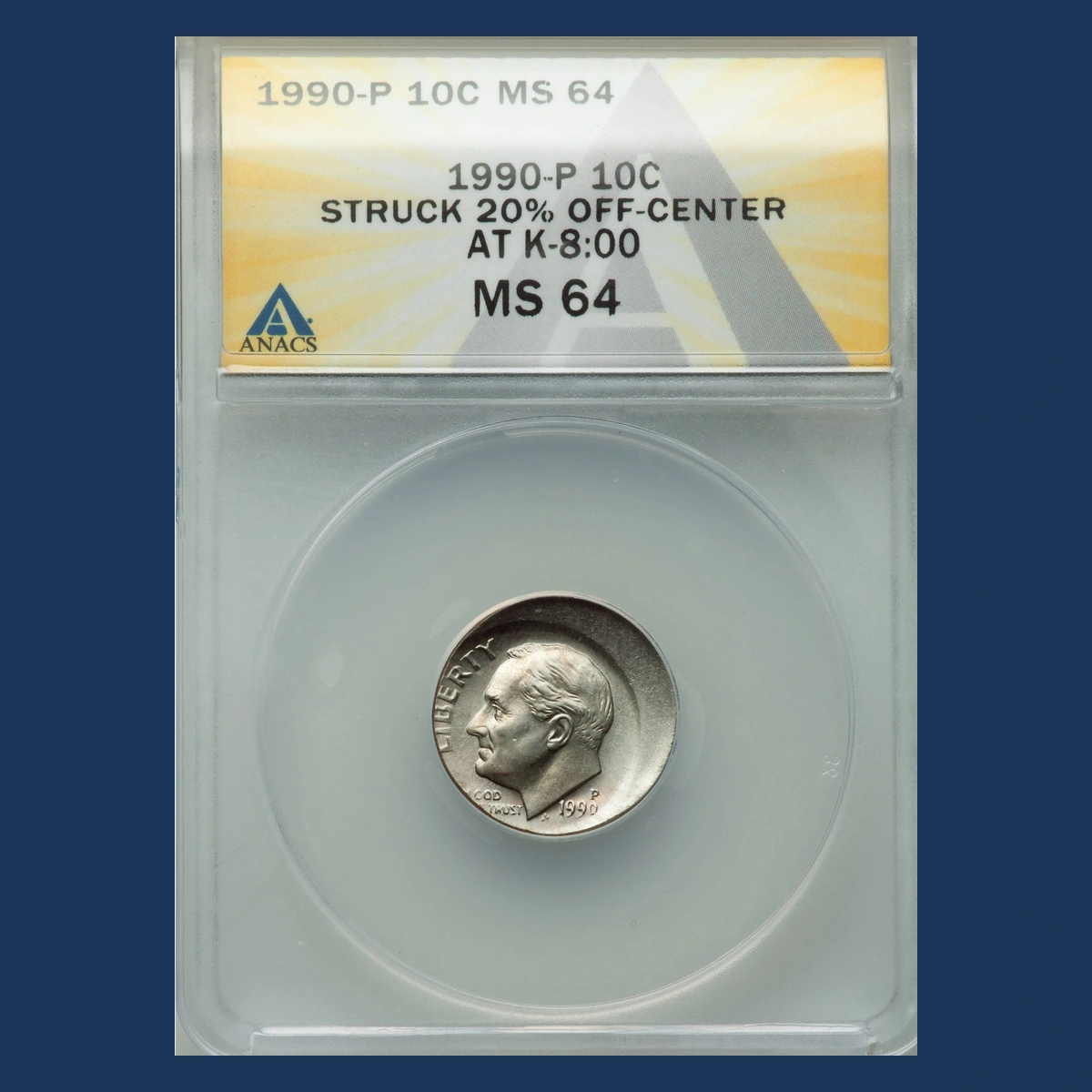
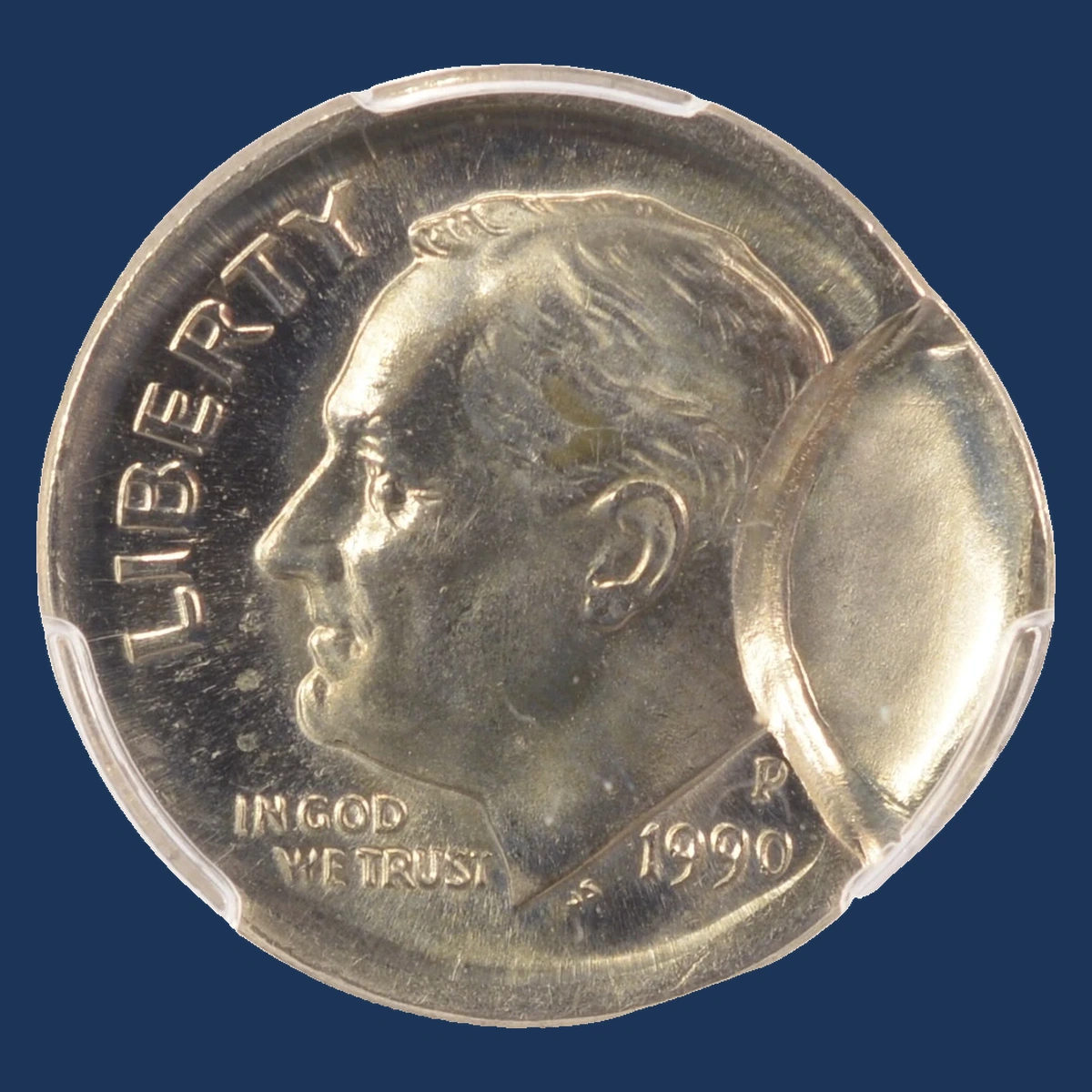
Part of the design runs beyond the metal while an untouched crescent remains on the opposite side. The blank was not centered between the two stamping tools.
Denver off-center dimes are listed for 1990. An older dealer description gives one example as 55% off-center toward one o’clock, with no circulation wear.
That detailed description belongs to one coin, rather than a pattern shared by every Denver error. As the shift increases, more design can disappear, making a complete date especially helpful when identifying an unusually shaped piece.
Estimated Value
Use an estimated range of $25–$200 for clear, dated 1990 off-center dimes. A separate Philadelphia coin struck 30% off-center sold for $69 in August 2011, providing a same-year comparison rather than a Denver result.
A readable date and a striking blank crescent often matter more than a precise percentage. Deep scratches, damage in the empty area, and an almost lost date can all reduce what collectors will pay.
How to Identify
Read the surviving date before focusing on the amount of blank metal. If the last digit is gone, the coin cannot be assigned to 1990 merely because its shape resembles a listed example.
Check the D mint letter through a 10× magnifier and photograph both faces. Both designs should agree with the off-center position, rather than only one face showing a narrow rim.
The clad blank begins at 2.268 g and 17.91 mm, which a scale and calipers can use as reference points. Striking can distort the outline, but an unstruck crescent should still be physically present.
Follow the design to where it runs off the edge opposite that crescent.
7. 1990 Roosevelt Dime Broadstrike on a Straight-Clipped Blank
One side of this dime ends in a straight missing section, while the remaining metal spreads unusually wide. The coin combines an incomplete blank with a broadstrike.
A straight clip can form when the blanking punch reaches a straight edge of the metal strip. Later striking outside normal collar restraint expands the metal that remains.
The documented 1990-P coin weighs 2 g and was graded NGC MS65, an unworn grade with relatively few marks. Its low weight fits missing metal, rather than proving that the coin has lost an outer layer.
Estimated Value
This combined 1990-P error sold for $74 in July 2021. An estimated range of $50–$250 covers similar pieces with visible straight clipping and outward spread.
The two features share one total value. Clear original edges, a full readable date, and an attractive surface support the stronger end.
Grinding or later bending can sharply reduce appeal, even when part of the original Mint error remains recognizable.
How to Identify
Measure a loose example’s weight before interpreting its copper-colored edge: the documented coin is 2 g, compared with the ordinary 2.268 g. Calipers can also show spread beyond portions of the normal 17.91 mm outline.
Next examine the straight boundary under a 10× magnifier. Look for natural struck transitions at its ends, rather than parallel file marks or fresh metal from a later cut.
The broadstruck portion should show metal that expanded around the design without the normal collar restraint. Keep a graded coin sealed, and use photographs to follow where the straight missing edge meets the outward-spreading struck surface; that junction ties the two features together.
8. 1990 Roosevelt Dime Missing Clad Layer
Copper showing across one face can mean an outer layer was absent when the dime was struck. Normal clad dimes have a copper center covered by two copper-nickel layers.
Loss of one outer layer leaves a lighter coin and exposes the center beneath the design. The opposite face may retain its usual silver color.
This error is reported in 1990 year guides without a specific certified example being identified there. A copper-toned surface alone is insufficient, because staining and chemical treatment can change color without creating the same original structure.
Estimated Value
Estimate $50–$300 for a genuine, identified 1990 missing-layer dime. For comparison, a 1995-P dime missing its full front layer brought $75 in July 2022; that is a different year.
A clear exposed face with intact design is easier to sell than a stained or damaged surface. The amount of missing metal and the quality of authentication matter, so the estimate does not apply to every brown dime.
How to Identify
Begin at the edge, where the normal copper center sits between two lighter outer layers. A 10× magnifier can show whether one outer layer is actually absent or simply discolored.
Compare both faces without polishing them. Exposed copper should still carry struck design, while scraping or chemical damage can leave roughness that cuts through the original surface.
Weigh a loose coin with a 0.01 g scale. Its reading should be below the normal 2.268 g if an entire outer layer is missing.
Calipers supply the usual 17.91 mm size reference. A normal 1990-S Proof, a specially made collector coin, is also clad rather than silver.
Look for the missing layer at the edge together with struck copper on the affected face.
9. 1990 Roosevelt Dime Off-Center Strike with a Blank Reverse
Only a small part of the front design remains on this strongly displaced dime. The corresponding reverse did not receive its normal design because another object blocked contact during the strike.
A dealer catalog describes the 1990-P example as 70% off-center toward 10:30, with an uniface reverse. Uniface simply means that one side lacks the expected struck design.
The combination differs from a normal off-center dime, which receives designs on both sides of its struck area. It also differs from a coin whose reverse was ground smooth after leaving the Mint.
Estimated Value
An estimated $50–$350 is suitable for comparable dated examples with a clearly blocked reverse. The original dealer listing had a $22 minimum bid, which was an opening requirement rather than a recorded sale.
Buyers can see two effects at once: the displaced front and the absent reverse design. Better date visibility, clean untouched metal, and a clear boundary around the struck area strengthen the price, while later abrasion reduces it.
How to Identify
Photograph the front and back in the same orientation so the struck areas can be compared. The reverse should lack normal design where the front received its displaced impression.
View that reverse under a 10× magnifier with the lamp held low. Grinding lines, an unnaturally thin section, or a polished depression suggest design was removed later.
The 1990-P date and mint letter identify the example. A scale can compare a loose coin with the normal 2.268 g, while calipers record its shape against the usual 17.91 mm diameter.
Do not assume the blocking object’s material from the blank area. Match the missing reverse impression specifically to the region struck on the front.
10. 1990 Roosevelt Dime Double Strike with an Off-Center Second Blow
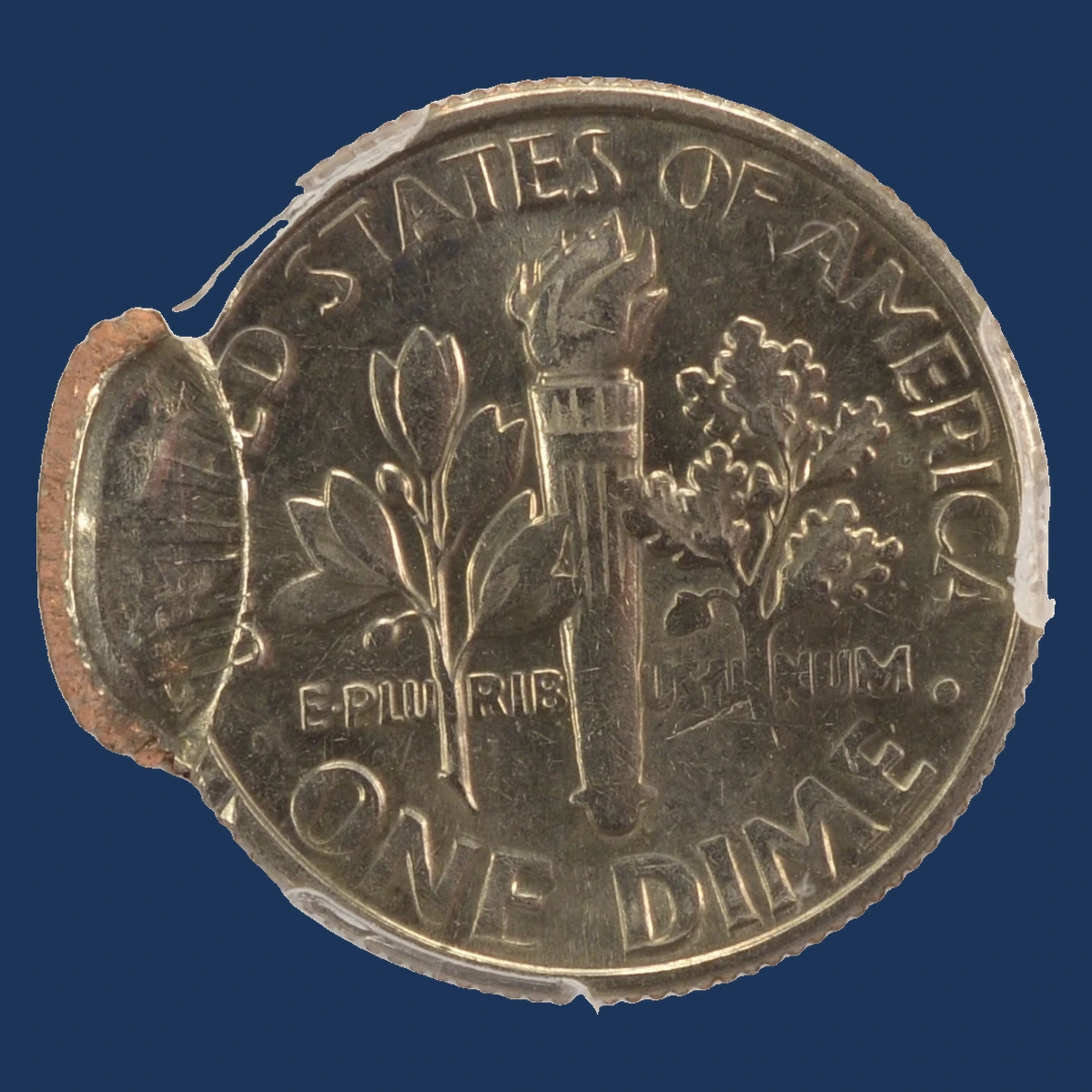
Two dates and two P mint letters survive on the listed 1990-P double strike. The coin moved after its first blow and received another strike 75% off-center.
The second blow was also uniface, meaning an obstruction prevented normal design on one side of that strike. These effects belong to the same striking event.
The dealer described the coin as unworn. Its displaced second design is much larger than a doubled ear from a doubled die.
An entire coin moved between blows, instead of a stamping tool carrying one small repeated detail.
Estimated Value
Estimate $100–$600 for similar dated, double-struck dimes with a blocked second impression. A useful comparison is the 1995-P double strike with a 75% off-center second blow and front indentation, sold for $124 in July 2022.
That comparison has a different year and additional features. Clear repeated dates and mint letters help explain the 1990 coin’s sequence, while confused overlap or damage can lower its appeal despite the dramatic shape.
How to Identify
Locate the two dates and P mint letters before tracing the larger portrait outlines. These readable landmarks help separate distinct strikes from random dents or stretched metal.
Photograph both faces, keeping a graded coin in its holder. Use a 10× magnifier to follow each impression across the first design.
The blocked side needs attention too. The second blow should not have produced a normal matching impression there.
Weigh a loose coin against the ordinary 2.268 g standard to check for metal cut away after minting. Calipers record the distorted outline in relation to a normal 17.91 mm dime.
Follow the second date and mint letter to the displaced edge to connect them with the later blow.
11. 1990 Roosevelt Dime Capped-Die Strike and Clashed-Cap Impression
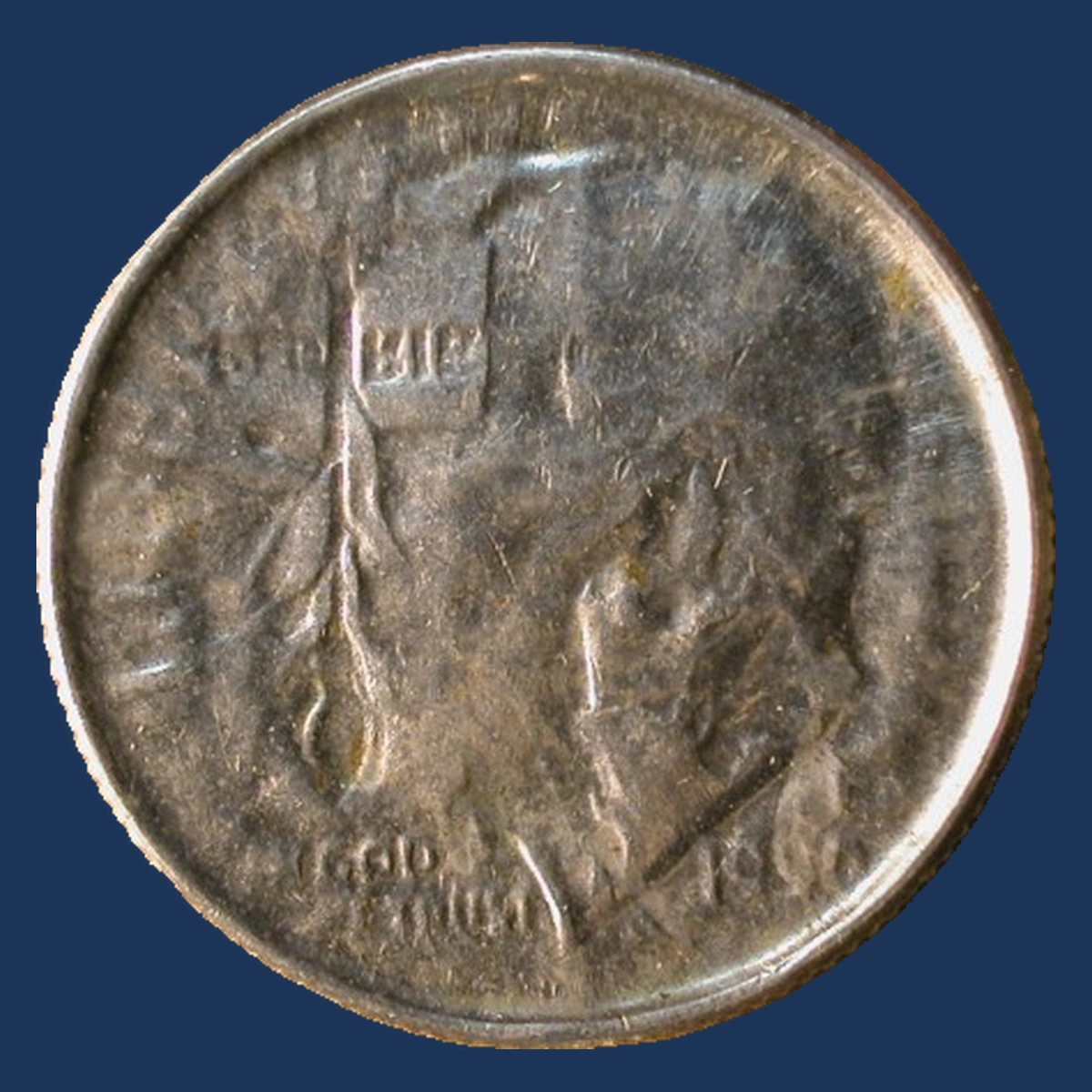
A faint Roosevelt portrait can sit beside sunken, backward reverse details. On the documented 1990-P example, a stuck coin covered the front stamping tool like a cap.
That thin cap hit the reverse tool, picked up fresh design, and pressed it into the next blank. Roosevelt’s portrait also showed through the cap as a raised ghost.
This is a clashed-cap strike, explained by Error-Ref. A separate dealer listing suggests a simpler capped-die strike, but conflicting holder details prevent treating that candidate as an established second certified example.
Estimated Value
A clearly identified clashed-cap impression is estimated at $200–$1,000. The combination of a strong raised ghost and distinct backward, sunken detail is more informative than a generally blurred face.
A simpler confirmed capped-die strike would fit a separate estimated $75–$300 range. These are comparison-based values for modern dime cap impressions, not reported sales of the two 1990 listings; an unresolved dealer title alone does not establish the higher value.
How to Identify
Tilt the coin under side lighting and separate raised features from sunken ones. On the Error-Ref example, Roosevelt forms a raised ghost while reverse details appear backward and pressed into the front.
Use a 10× magnifier and compare those details with the illustrated clashed-cap dime. The backward image has not expanded widely across the face.
This is the coin struck beneath a cap, rather than the cap itself. A simple weak portrait does not establish the more unusual clash sequence.
A scale and calipers provide the ordinary 2.268 g and 17.91 mm references for loose examples. For sealed coins, inspect photographs for the raised portrait beside the compact, sunken mirror-image details.
12. 1990 Roosevelt Dime Overstruck with a Cent Design
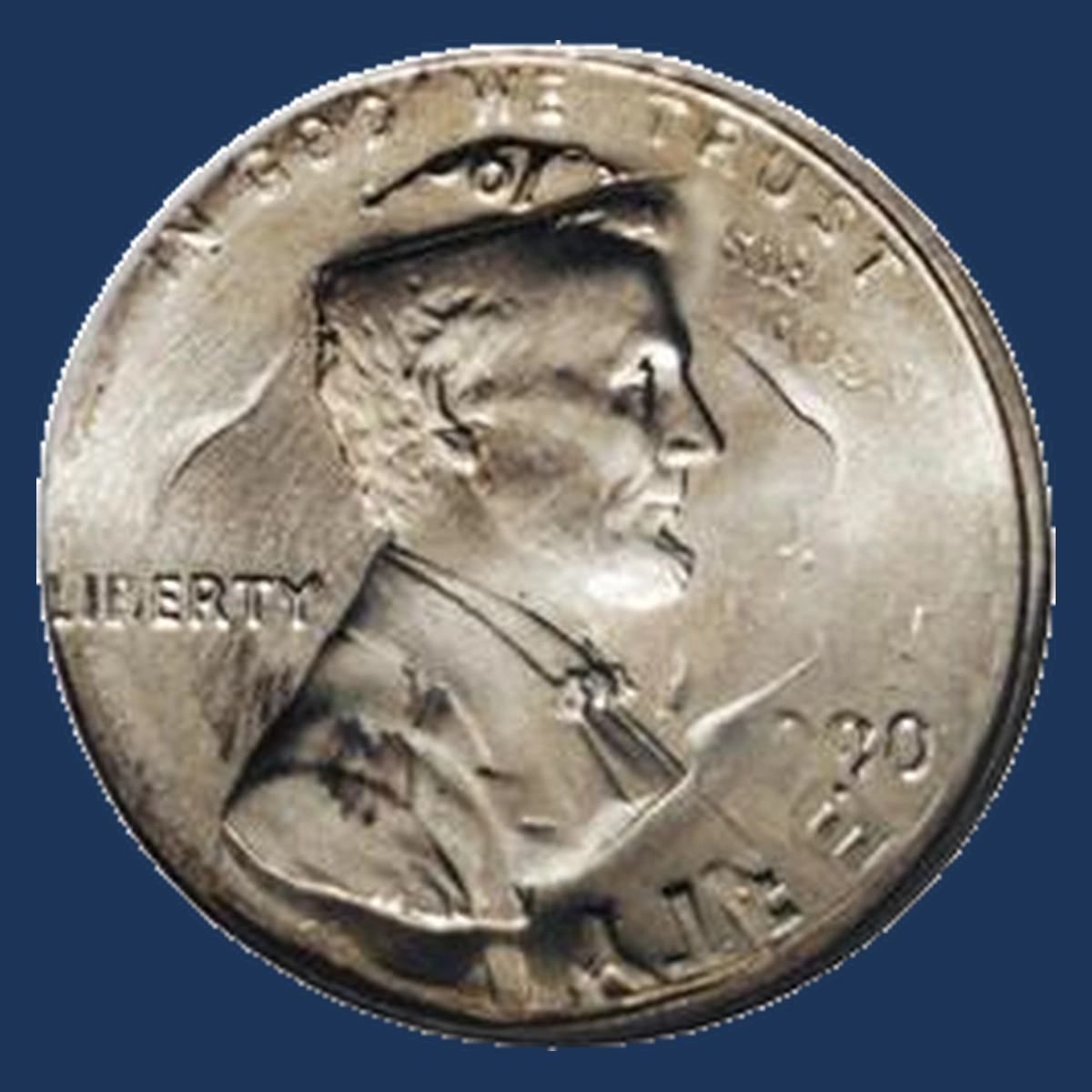
Roosevelt and Lincoln share this piece because it passed through two different coin presses. A finished 1990-P dime received another strike from 1990 Lincoln cent tools.
Both dates and the dime’s P mint letter remain readable on the documented example. Roosevelt’s portrait lies nearly upside down relative to Lincoln’s.
The underlying object was already a coin, so this differs from using a blank meant for another denomination. The new blow partly flattened the dime design but left enough underneath to reveal the mistake and establish the order of the strikes.
Estimated Value
The NGC MS67 example sold for $1,092.50 on April 29, 2006 at Heritage. MS67 describes an unworn coin with very few visible marks.
An estimated range of $1,000–$3,000 reflects comparable readable cent-over-dime combinations. Both dates and the surviving P letter make this example especially easy to understand.
Scratches or barely visible underlying details can weaken demand. A well-preserved, clearly identified piece remains an unusual display coin.
How to Identify
Try reading the two dates independently, turning the coin as needed. Then find the P mint letter beside the older dime design, using a 10× magnifier.
The original auction description notes that Roosevelt is nearly inverted relative to Lincoln. Match the portraits and lettering as complete designs rather than treating every crossing line as another strike.
A scale should relate to the starting dime standard of 2.268 g, not the 2.50 g cent standard. Calipers can compare the outline with the original 17.91 mm dime size, although the second strike may spread the coin.
Leave a certified example sealed and trace where the newer cent design flattens the older dime details.
Conclusion
These 1990 dime errors carry estimated values of $10–$3,000, with the documented cent-over-dime sale providing a $1,092.50 example. Some of the best clues are much smaller than that unusual overlapping design.
Check a stepped edge from the side, a clip from both faces, and doubled details under changing light. Keep combined errors together when valuing one coin, and distinguish confirmed examples from similar-looking damage before paying a premium.