1907 Nickel Error List with Pictures

The unusual copper color of a 1907 Liberty nickel can matter more than a tiny mark in its date. A nickel struck on a cent blank sold for $7,475 in January 2006 and appeared again at $5,280 in April 2020.
The 1907 nickel errors below also include a repunched date, missing blank metal, and several striking faults. Their estimated ranges extend from $10 to $8,000.
Check the specific clues before deciding which price range fits your coin.
1. 1907 Liberty Nickel Lamination
A long line across the back can mark metal separating inside the blank. The owner of one 1907 Liberty nickel describes a lamination running almost from rim to rim.
Lamination means a surface layer has loosened along a weak seam in the alloy. It can stay attached, lift slightly, or leave a rough area after a piece falls away.
The report does not establish a coin separated into two complete halves. A raised line from a cracked stamping tool or a scratch across the finished coin would be a different fault, despite a similar length.
Estimated Value
Estimate $10–$150 for an ordinary 1907 nickel with a recognizable surface lamination. The owner’s reported rim-to-rim example is not accompanied by a completed sale used here.
For a same-series comparison, a heavily worn 1911 Liberty nickel with front lamination sold for $51 in January 2023. Its date, affected face, and condition differ from the reported 1907 coin.
A long seam need not mean a large premium if little metal lifts or the rest of the coin is heavily worn.
How to Identify
Look across the back at low light before following the entire line. Under a 10× magnifier, decide whether it opens into the metal, rises as a ridge, or cuts through the surface.
An opening beneath a flap supports lamination; a raised solid line can come from a damaged stamping tool. Do not probe the seam to make that distinction.
If the coin is loose, a scale and calipers can record the usual 5 grams and about 21.2 millimeters. Inspect the plain edge where the long line reaches it.
Check whether original design survives on any lifted metal. Photograph the whole back and the seam’s ends so a near-rim-to-rim separation is not mistaken for a complete split through the coin.
2. 1907 Liberty Nickel Repunched Date
The first 1 and the 9 carry the important clues on this repunched date. Extra traces appear below the 1 and to the right of its upright stroke.
The 9 has two earlier outlines below its middle and lower portions. These remnants formed when the date was punched repeatedly into the die, the steel tool that stamps the coin.
NGC recognizes the variety as 1907/19/9. The name describes overlapping numerals, not three different dates on a finished coin, and ordinary wear or a flat shelf beside a numeral cannot establish the same pattern.
Estimated Value
An estimated $20–$200 covers identifiable worn through ordinary unworn examples of this date pattern. A published specialist guide listed roughly $20–$140 across several grades, providing a historical guide rather than actual auction results.
The clear placement of the earlier numeral outlines matters more than a generally thick date. Better preservation can make the small traces easier to see.
This is a whole-coin estimate. Heavy wear that hides the earlier numeral fragments generally keeps the coin near the lower end.
How to Identify
Place an upright date photograph beside the recognized NGC variety before concentrating on one mark. For a loose coin, record the normal 5 grams and approximately 21.2 millimeters with a scale and calipers, and inspect the plain edge.
Use a 10× magnifier on the bottom of the 1 and along the right side of its upright. Then locate the two earlier curved traces below the middle and lower portions of the 9.
Those parts need to match one pattern, not a collection of unrelated nicks. Change the light to distinguish raised numeral remnants from flat shelves or cuts that merely sit near the same digits.
3. 1907 Liberty Nickel Straight Clip
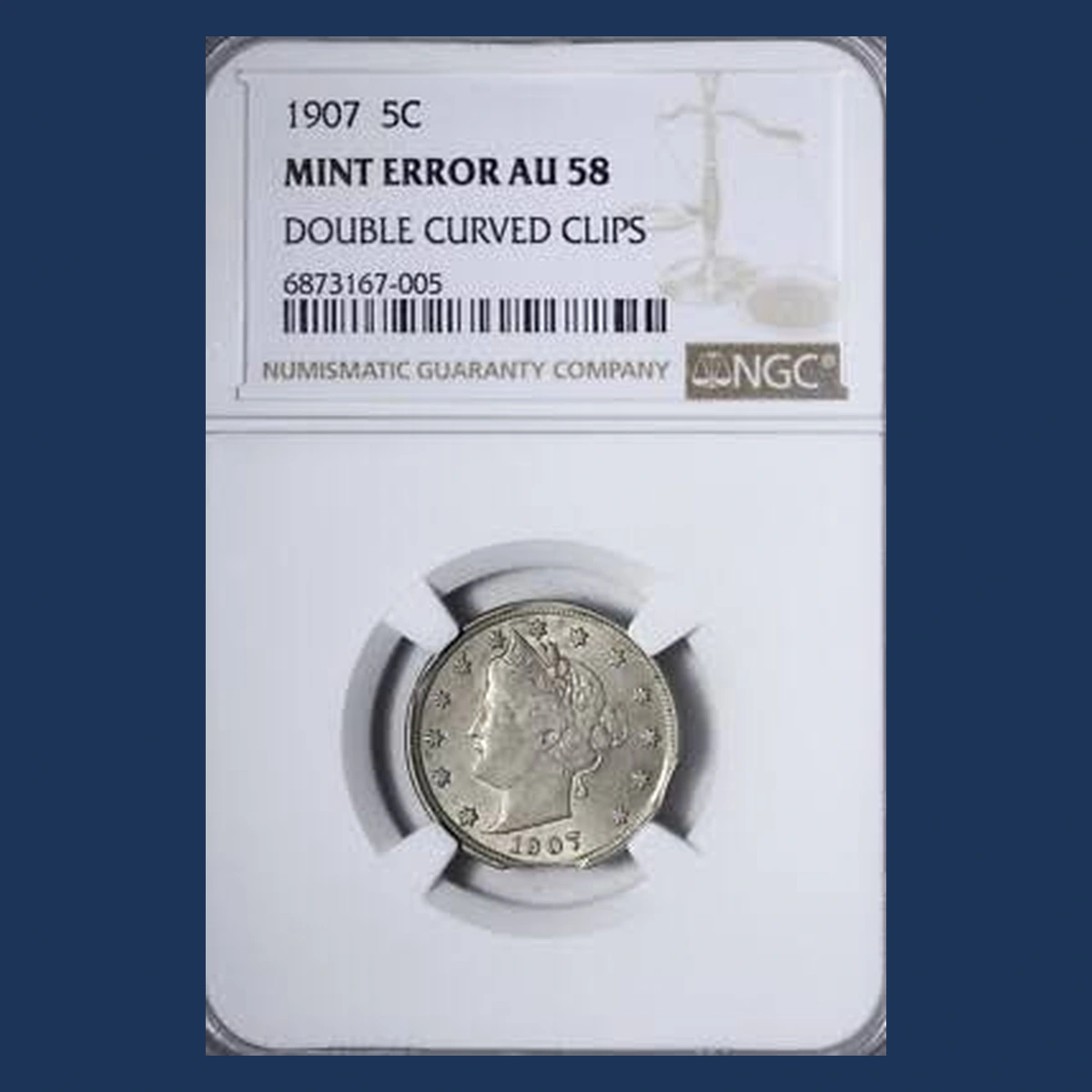
A straight missing section can come from the end or edge of the metal strip used to punch blanks. The incomplete piece receives the coin design after the shortage already exists.
One listed 1907 example weighs 4.28 grams and is graded ANACS MS60 Details. It is unworn but has a condition problem noted by the grading service.
A separate Stack’s Bowers catalog describes a 12% straight end clip graded MS62. The weight and percentage belong to different records, so they should not be combined into measurements of a single coin.
Estimated Value
For a genuine 1907 straight clip, estimate $50–$450 across worn and attractive unworn examples. Clear original surfaces along the gap help a coin reach the higher part of that range.
The 4.28-gram coin has a Details grade, so its condition problem must be considered alongside the clip. Its early bidding figure is not a completed sale.
A 1911 Liberty nickel with two curved clips was offered at $195. That different-year comparison was an asking price for a cleaned coin.
How to Identify
The listed 4.28 grams gives one concrete starting point. Weigh a loose candidate with a scale against the normal 5 grams, but do not expect every straight clip to weigh exactly 4.28.
Use calipers across the intact outline against the usual 21.2 millimeters. Examine the remaining plain edge and the straight gap through a 10× magnifier.
At each end of the shortage, look for metal shaped by striking rather than a saw cut or filed flat. A straight boundary alone cannot tell you when the metal disappeared.
The separate 12% specimen needs its own comparison photograph. Keep its percentage apart from the measured-weight example when describing the coin or choosing a value.
4. 1907 Liberty Nickel Broadstrike
A broadstrike gives the coin extra room to spread because the collar fails to contain the metal properly. The collar is the ring around the blank that normally controls the diameter.
A dealer lists a 1907 Liberty nickel broadstrike graded NGC G6, meaning heavily worn. Its enlarged outline should still retain the complete design rather than losing part of it off one side.
The normal Liberty nickel already has a plain edge. A smooth edge therefore proves nothing unusual by itself; it is the spread beyond normal dimensions and the remaining design that identify this error.
Estimated Value
The dealer-listed G6 broadstrike was offered at $195. That is an asking price for a worn coin rather than an auction result.
An estimated $100–$750 covers identifiable 1907 broadstrikes across different wear and expansion. Better surfaces and a more obvious spread can support a higher price.
Coins with flattened design from circulation belong near the worn comparison. A large, clearly struck example with less wear should be compared with better-preserved pieces instead of using the same $195 figure.
How to Identify
Follow the outside lettering around both faces before measuring the coin. If the design is complete, an expanded margin may support broadstriking; design lost beyond the blank needs an off-center check.
Calipers can compare a loose coin in several directions with the standard 21.2-millimeter diameter. A scale checks whether its weight remains near the usual 5 grams.
Inspect the plain edge through a 10× magnifier for hammering, filing, or an attached rim. The dealer’s 1907 broadstrike is a worn comparison, so judge its expanded shape separately from the flattened details caused by circulation.
Look for struck surface continuing into the spread area rather than a later alteration merely enlarging the outline.
5. 1907 Liberty Nickel Very Weak Strike
The centers can look almost worn away even when a coin never circulated. The cataloged 1907 example has very weak central design while its open areas retain original mint shine.
NGC described it as a die-adjustment strike, a label often used for a very weak strike associated with press settings. Weak design alone, however, cannot prove an intentional adjustment test.
The useful visible contrast is between poorly formed central detail and unworn surrounding metal. A coin polished flat or worn through years of use can also lose detail, but those processes leave different surface evidence.
Estimated Value
An estimated $100–$1,000 suits an unusually weak 1907 strike with unworn surfaces supporting the description. Severe weakness that contrasts clearly with original mint shine can attract more interest.
The 2009 catalog identifies an NGC Mint State example, meaning no circulation wear. Its label does not supply an auction price used in this estimate.
An ordinary worn nickel with flat centers belongs outside the range. Scratches or cleaning can also reduce the appeal of a genuine weak strike.
How to Identify
Tilt the coin under a moving light and examine the open areas for original mint shine.
The cataloged example’s contrast between that surface and weak centers is more useful than faint detail alone.
Use a 10× magnifier to look for wear, smoothing, or fine abrasive lines across the highest areas. Those can explain a flat design without an unusual strike.
A loose normal coin should be near 5 grams and 21.2 millimeters when checked with a scale and calipers. The edge is plain.
Compare both centers rather than one weak letter. Preserve the catalog’s die-adjustment label as the description of that particular NGC coin, while judging any new candidate from its surfaces instead of assuming the Mint’s intention.
6. 1907 Liberty Nickel Off-Center Strike
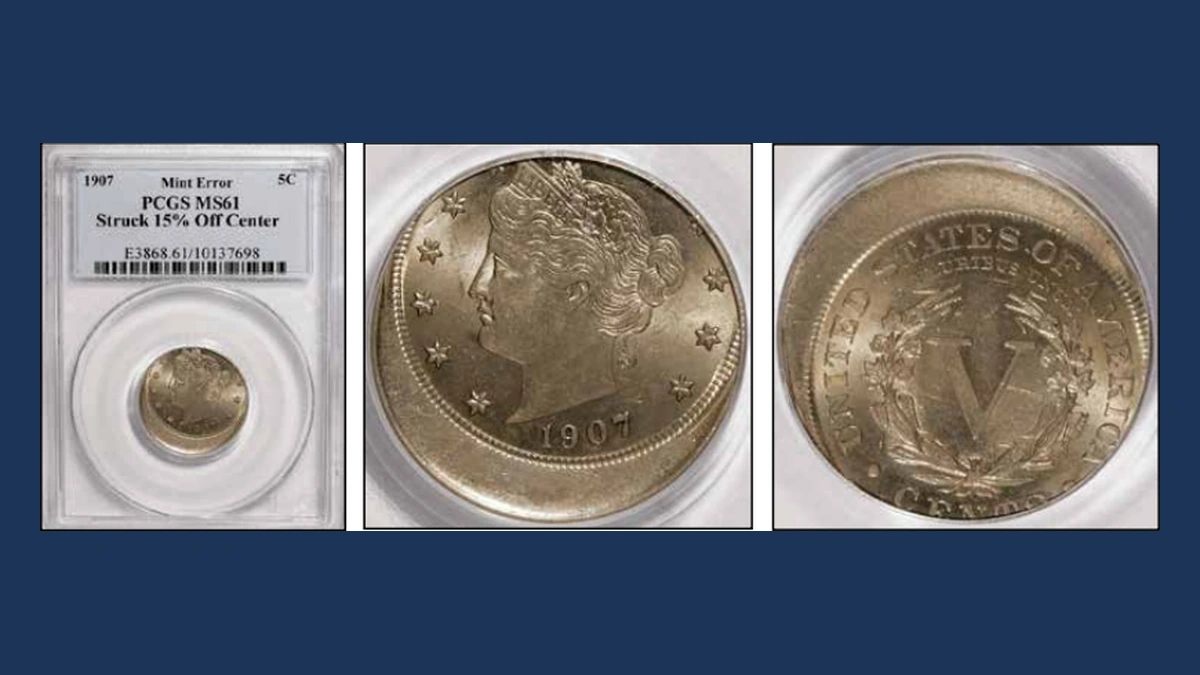
An off-center strike leaves some untouched blank metal opposite design that misses the coin. A 1907 example described as 20% off-center was cataloged in PCGS MS63, an unworn grade with some marks.
Another example is 35% off-center in XF45, showing wear while retaining much detail. The different percentages and grades belong to different coins.
The blank was misplaced between the stamping tools, so they could not fit the entire design onto it. This differs from an enlarged broadstrike that still carries a complete design, even when its outer margin is uneven.
Estimated Value
Estimate $100–$1,500 for ordinary dated 1907 off-center nickels across worn and unworn condition. The amount of missing design and the remaining date both influence collector interest.
The two cataloged examples have no sale amounts assigned here. A 1911 Liberty nickel struck 10% off-center sold for $155.25 in March 2003, providing a same-series, different-year comparison.
That coin was described as VF20 without certification. Its result should not be transferred unchanged to either the MS63 or XF45 1907 example.
How to Identify
Record the complete outline with photographs of both faces before enlarging the date. Mark where untouched blank metal sits opposite design that runs beyond the edge.
For a loose coin, a scale checks against 5 grams and calipers against the normal 21.2-millimeter diameter. Its weight may remain near normal because the design moved without a piece being cut away.
Use a 10× magnifier on the plain edge and the boundary of the strike. Look for cutting or hammering that could create a misleading outline.
Match the coin with the 20% or 35% example only when its actual shape agrees. A percentage in a catalog does not establish a clock direction, and a full date is more useful than a guessed position.
7. 1907 Liberty Nickel Double Strike
A second strike can leave another portrait, date, or part of the back design displaced across a coin. The documented 1907 example was described as double struck toward 9 o’clock.
The historical catalog specifies that both faces were struck by the coin-making tools. That matters because a second coin pressing against one face can produce a different kind of impression.
The two strikes belong to one nickel that remained in, or returned to, the striking area. This is not the small repeated numeral pattern of a repunched date, which begins in the stamping tool itself.
Estimated Value
The historical 1984 catalog offered the 1907 double strike at $650. That was a dealer price then, not a current quotation or a sale result.
A working estimate of $500–$4,000 covers recognizable 1907 double strikes across different preservation and displacement. Strong separation between the two designs can make an example more desirable.
The reported 9-o’clock coin has no precise offset percentage assigned here. Its two visible strikes should be priced as one coin rather than two separate errors.
How to Identify
Orient the front upright and locate the second strike toward 9 o’clock. Before enlarging it, record a loose coin’s weight and outline with a scale and calipers against the normal 5 grams and 21.2 millimeters.
The usual edge is plain. Under a 10× magnifier, follow older design where the later impression overlaps it, then find the related second design on the back.
The historical listing specifies tool-struck design on both faces rather than a mirror-image impression made by another coin. A repeat confined to the same tiny parts of the 1 and 9 belongs to the repunched-date comparison instead of proving another strike.
8. 1907 Liberty Nickel Struck on a Cent Planchet
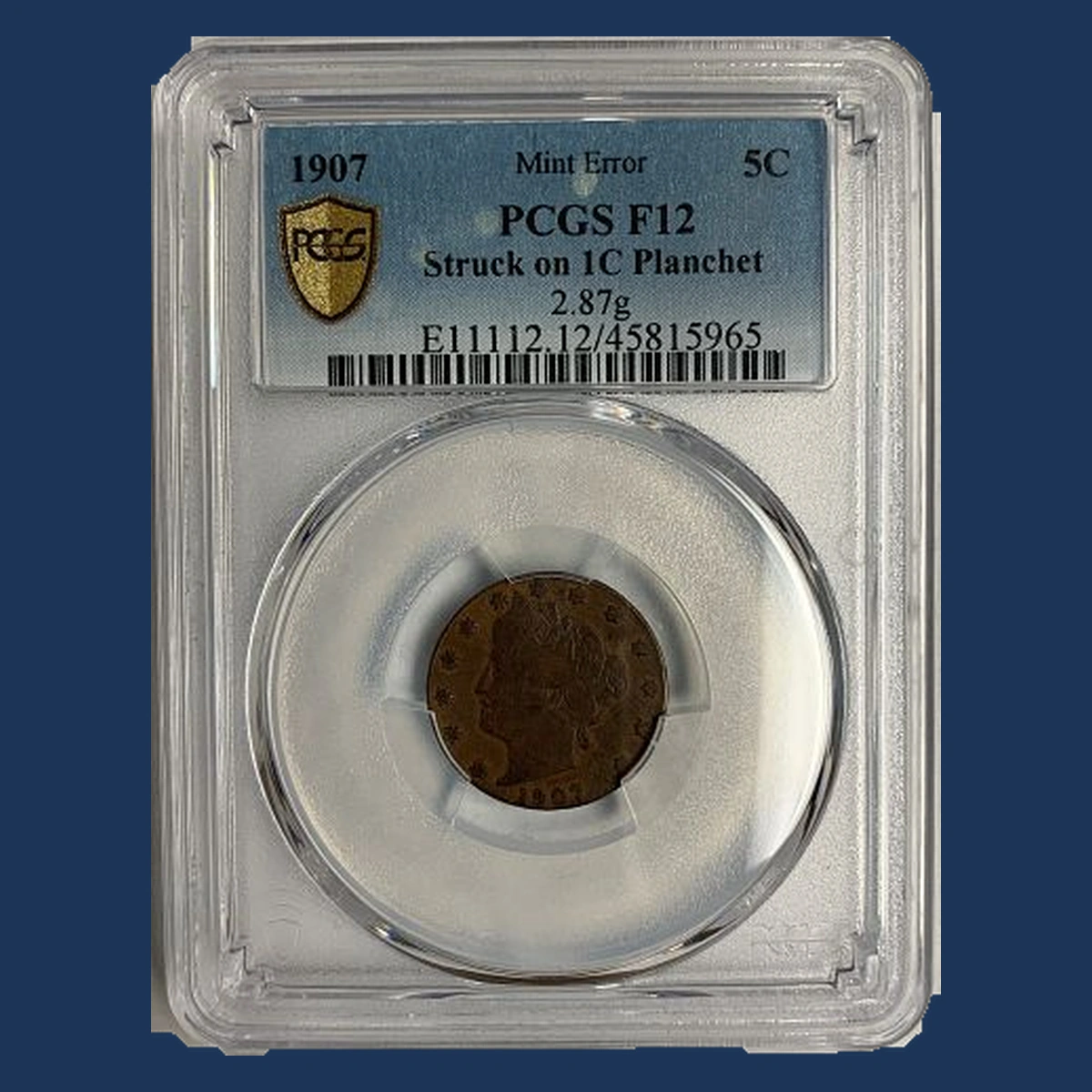
Parts of UNITED and CENTS run beyond the edge of the known 1907 wrong-blank nickel. The five-cent design was stamped on a smaller copper-alloy blank intended for a cent.
Heritage describes the coin as slightly uncentered and chocolate-brown, graded PCGS AU58. That grade means only slight wear remains on an otherwise well-preserved coin.
The smaller blank explains why the larger nickel design does not fit fully. A brown normal-size nickel is not enough: its color could come from toning or later treatment, while the genuine error needs the correct physical metal and size relationship.
Estimated Value
The AU58 cent-blank nickel sold for $5,280 on April 24, 2020. Its earlier Heritage appearance brought $7,475 on January 7, 2006.
Those are different sales of the documented coin, not proof that its price rises steadily. An estimated $2,000–$8,000 covers identifiable examples with varying condition and surface quality.
The range concerns a genuine copper-alloy cent blank carrying a nickel design. A chemically browned ordinary nickel cannot use the same comparison.
How to Identify
Compare the size of the five-cent design with the available metal, especially where UNITED and CENTS approach the edge. The known specimen is slightly uncentered, with parts of those words missing.
A loose copper cent blank normally starts around 3.11 grams and 19 millimeters, compared with a nickel’s 5 grams and 21.2 millimeters. Use a scale and calipers, allowing for spreading during the strike.
These are standard blank figures, not a claimed measured weight of the AU58 coin. Inspect the plain edge and surfaces through a 10× magnifier for coating, tooling, or trimming.
Confirm the metal and match the whole coin to its certification photographs. Copper color helps direct the investigation, but it does not replace the smaller-blank relationship or the material check.
Conclusion
The extra traces in the 1 and 9 belong to a repeat-punched date, while a displaced second design belongs to a double strike. Keep those two causes separate even though both can look doubled.
Estimated values run from $10–$8,000, with the cent-blank nickel providing the largest actual sales discussed here. Small laminations and minor date varieties occupy the lower ranges.
Check the complete coin before pricing an isolated mark, and leave fragile metal untouched.