1974 Nickel Error List with Pictures

Lincoln’s Memorial columns can hide across Jefferson’s jaw when a finished cent receives a nickel design. One 1974 example sold for $5,040 in January 2023.
This 1974 Jefferson Nickel error list also covers misplaced designs, incomplete blanks, and broken stamping tools. Estimated values range from $5–$7,500.
Begin with what you can see: extra images, missing metal, or an unusual outline. The comparisons below explain what each feature means.
1. 1974 Jefferson Nickel Misaligned Front Design
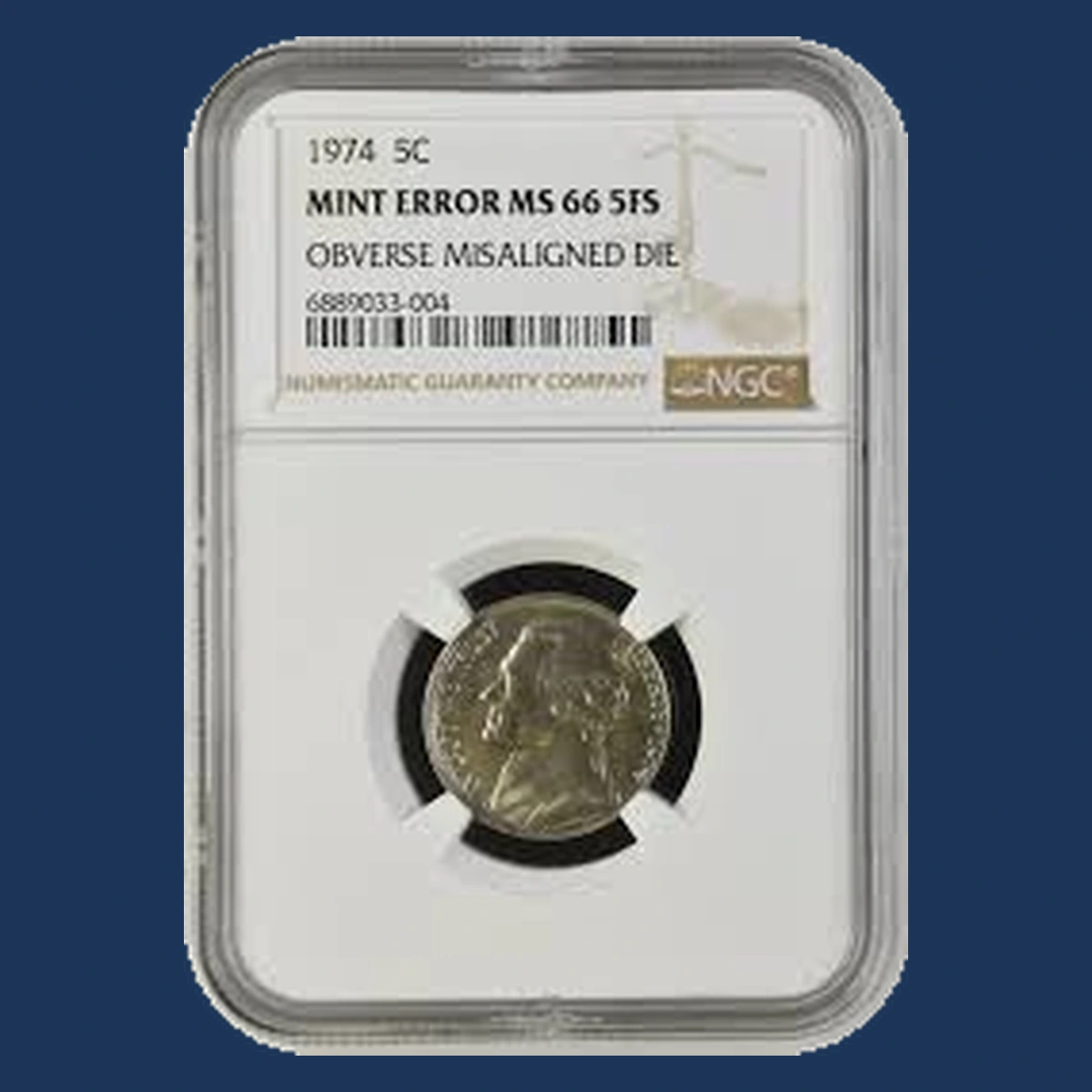
The two faces need not move together. On a 1974-D nickel graded PCGS AU58, the front design sits six percent away from its intended position while the back stays centered.
This happens when one die, the steel stamping tool, is out of alignment. It differs from an off-center strike caused by the entire blank sitting in the wrong place.
AU58 means very slight wear remains on the highest details. The offset belongs to this particular Denver example and should not be copied onto every nickel with an uneven rim.
Estimated Value
The documented six-percent example sold for $84 in December 2024. An estimated $15–$150 covers modest genuine examples with readable dates and original surfaces.
The amount of displacement and preservation influence the comparison. A tiny difference in rim width can attract much less interest than a clearly shifted portrait.
That auction price concerns the Denver coin with one misplaced face. It does not price a two-sided off-center strike or a rim flattened after minting.
How to Identify
Compare the border around Jefferson with the border around Monticello, keeping both photographs upright. The Denver example shifts the front alone, so a similar displacement on both faces would need another explanation.
Use a 10× magnifier along the outer letters to see whether the whole front design moved together. A crushed rim can change the border without moving the portrait and lettering as one image.
Check the plain edge for squeezing or filing, then measure a loose coin with a scale and calipers against 5 grams and 21.21 millimeters. Keep the date and D visible as you compare the shifted front with the normally centered back.
2. 1974 Jefferson Nickel Repunched Mintmark
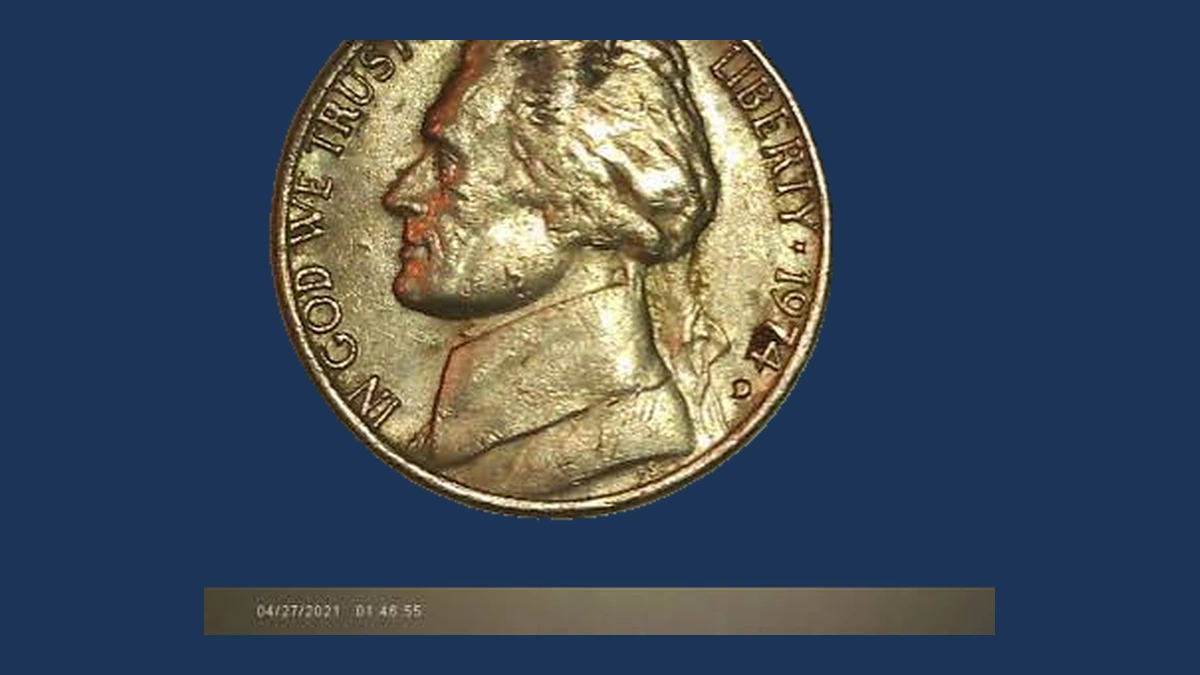
A small extra curve beside a mint letter can begin when the letter is punched into the stamping tool more than once. Part of an earlier impression remains beside the finished letter.
This is a repunched mintmark. It is reported in 1974 nickel lists, but the identification requires a nickel-specific letter pattern rather than a similar date on another denomination.
Philadelphia nickels of this year normally have no P. Denver uses D, while S identifies specially made collector Proofs, so the three issues should not be treated as interchangeable mintmark examples.
Estimated Value
Use an estimated $10–$200 for a genuine, matched repunched mintmark of this reported year. Clear overlapping letter shapes and original surfaces support the upper part of this working range.
Minor Jefferson mintmark varieties provide the comparison; no specific 1974 sale sets the amount here. A normal D or S does not earn that premium by itself.
An identification number borrowed from a Lincoln cent cannot establish a nickel variety or justify its price.
How to Identify
The small mint letter is below the date on the front. No P is normal on a Philadelphia nickel, so an empty mint-letter position is not this error.
Inspect the complete D or S with a 10× magnifier, including both ends of any extra curve. A fragment should fit another impression of that same letter.
Compare with a confirmed nickel example of the same year and mint. A Lincoln cent has a different mintmark pattern even when its date matches.
On a loose coin, use a scale and calipers against the normal 5 grams and 21.21 millimeters. Examine the plain edge and nearby date for alteration.
Move the lamp to the other side of the letter. The extra metal should remain visible after glare and shadows change.
3. 1974 Jefferson Nickel Doubled Design
A doubled die is a stamping tool made with repeated design details. Coins struck from it receive those extra outlines without needing a second trip through the press.
This type is reported for 1974-D nickels. A useful identification must connect several repeated details on the actual coin, rather than naming a variety from one thick-looking letter.
Doubling caused by movement during striking has a different origin. It often leaves flat shelves beside letters, while ordinary wear or a worn tool can blur the design without creating a clearly separated second outline.
Estimated Value
For an identified Denver doubled design, estimate $15–$250, depending on visibility and condition. This is a working comparison with modest Jefferson doubled dies, not a recorded sale of a named 1974 variety.
Several matching extra outlines are more useful than a single thick numeral. A worn coin with blurred letters belongs at a different level from a clear unworn example.
The normal date and mint value is included; the estimate is not added automatically to every Denver nickel.
How to Identify
Place a normal 1974-D nickel beside the candidate and compare the same design details under a 10× magnifier. Do not assume that the date or building must be doubled; find the actual repeated outlines first.
Follow each suspect outline into nearby affected details and check whether they share a consistent direction. A scale and calipers establish the expected 5-gram weight and 21.21-millimeter size of a loose coin, but do not prove doubling.
Compare the raised edges with a confirmed example, including the D and the affected face in photographs. Flat shelves that shave away part of a letter differ from matching extra outlines already present on the stamping tool.
4. 1974 Jefferson Nickel Detail Blocked during Striking
Something between the blank and a stamping tool can interrupt the design. Grease may weaken detail, while a solid object can leave a more distinct depression.
Collectors describe the result as a struck-through error. The foreign material prevents part of the tool from reaching the coin metal normally.
The 1974 reports do not identify one fixed material or location. A missing letter needs examination of its surrounding surface.
A scratch, worn area, or polished patch can also remove detail. Those changes happen after the coin leaves the mint.
Estimated Value
Allow an estimated $10–$300 for an original local struck-through feature, with depth, size, and remaining design guiding the comparison. Small weak areas usually sit below large, clear impressions.
For context, a 1986-P nickel with a deep front impression sold for $204 in June 2023. That different-year result supports the general range, not a price for a particular 1974 coin.
The comparison does not establish what material caused the 1974 feature or where it must appear.
How to Identify
Look across the high points of both faces before examining the weak patch. Similar flattening across Jefferson and Monticello can simply be wear.
Now tilt the affected area beneath a lamp. A local interruption beside sharp details deserves closer inspection.
Use a 10× magnifier at the boundary to look for scraping or metal pushed up by a later blow. Original blocked detail should fit the surrounding struck surface.
A scale and calipers compare a loose nickel with 5 grams and 21.21 millimeters. Inspect the plain edge for crushing that also affected the faces.
Keep the neighboring letters in the photograph. They show whether the change is local, while a close crop of an empty patch can hide the most useful evidence.
5. 1974 Jefferson Nickel Broadstrike
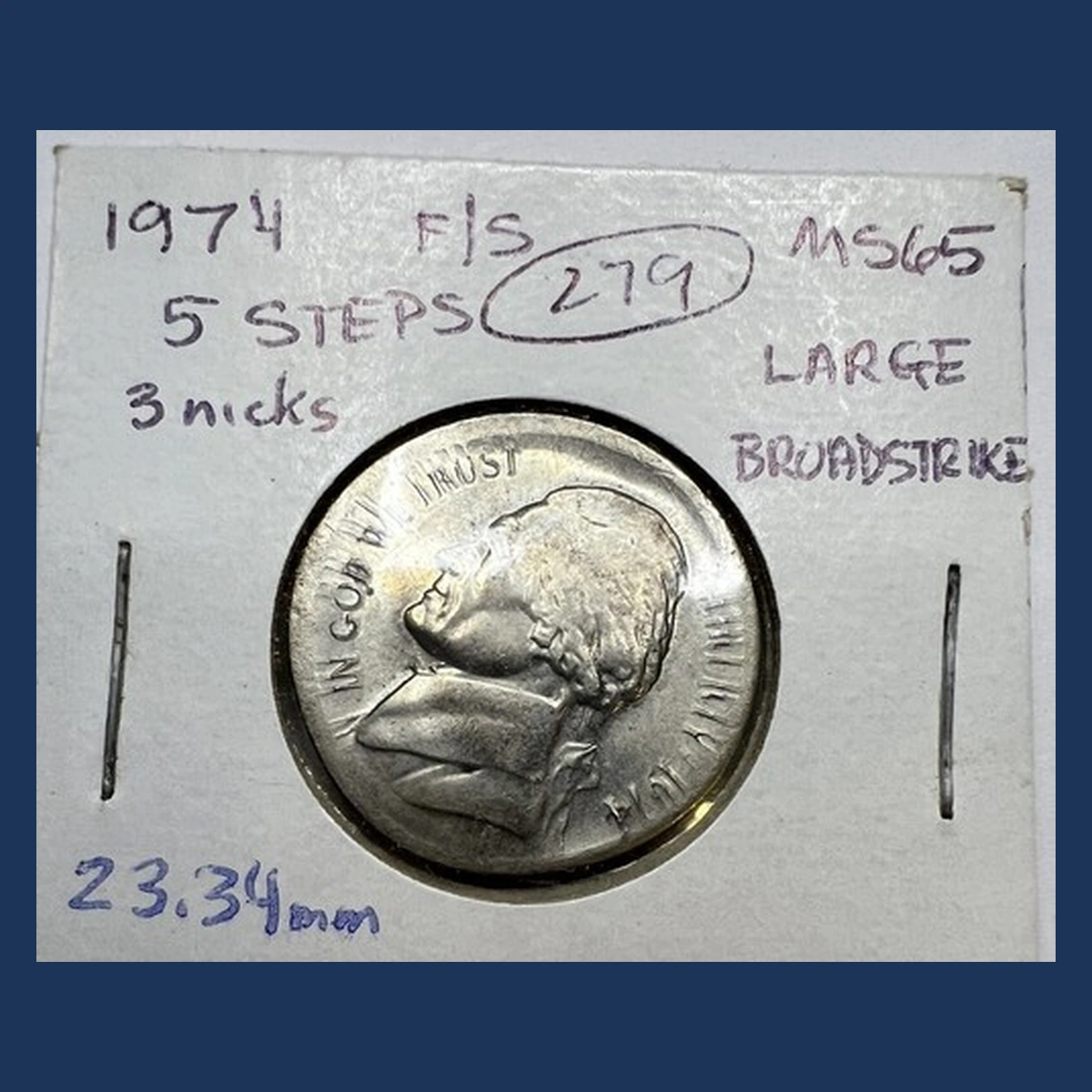
A broadstrike can look larger without losing the outside letters. The metal spread outward because the collar, a steel ring that controls the coin’s diameter, did not contain it normally.
The full design remains on the expanded blank. That makes it different from an off-center strike, where part of the design falls beyond the metal.
A Philadelphia 1974 example was graded PCGS MS64, meaning no circulation wear but some visible marks. Its absence of a P is normal for the year and is unrelated to the enlarged outline.
Estimated Value
The recorded PCGS MS64 broadstrike brought $24 in August 2021. Estimate $20–$350 across genuine examples with differing expansion and preservation.
The modest auction result shows that an obvious error does not always bring a large price. A stronger shape or cleaner surface can change demand, but size alone cannot guarantee the upper estimate.
Later hammering can also widen a nickel. Such damage does not receive the same mint-error range, even when the resulting coin looks dramatic.
How to Identify
Follow the entire outer inscription before judging the outline. A genuine broadstrike keeps the design on the metal, although the border may be wider on one side.
Measure a loose coin in several directions with calipers against the usual 21.21 millimeters, then weigh it against 5 grams. Expansion changes shape without necessarily removing metal.
With a 10× magnifier, examine the plain edge and expanded border for rolling marks, crushed letters, or later hammering. Compare the surviving date and mint-letter area with the Philadelphia example.
No P is expected on this coin. Look for a complete design surrounded by naturally spread metal, rather than a flattened portrait within a widened disk.
6. 1974 Jefferson Nickel Defective Blank
A flaw in the starting metal can survive after the nickel design is stamped onto it. The unfinished disk is called a planchet, or simply a blank.
A 1974 Philadelphia coin was graded NGC MS61 and described as struck on a defective planchet. That grade indicates an unworn coin with noticeable marks.
It appeared with a 1943-P partial-collar error and a 1963 ragged clip. Those are separate coins with their own flaws.
The 1974 piece needs its own examination. Its defect may affect the surface or edge without matching the other coins’ shapes.
Estimated Value
Use an estimated $20–$400 for a genuine defective-blank example, depending on the visible flaw and preservation. Small original surface defects sit below more substantial, clearly identifiable failures.
The three-coin group containing the 1974 MS61 piece sold for $89 in July 2021. That is a combined price for three different errors, not an individual 1974 result.
The estimate requires a flaw present during production. Corrosion or a gouge added later should be priced as damage instead.
How to Identify
Examine the boundary of the actual flaw under a 10× magnifier, using light from the side. Look at whether nearby letters formed across already defective metal or were cut apart after the design was struck.
Record a loose coin’s weight on a scale and diameter with calipers against the usual 5 grams and 21.21 millimeters. An unusual reading needs to be considered with the visible flaw, not treated as proof by itself.
Check the plain edge for trimming, added material, or corrosion, then photograph the defect with both complete faces. The label identifies a defective blank, but the coin’s own surface must show the problem rather than borrow another auction coin’s shape.
7. 1974 Jefferson Nickel Blank Split before Striking
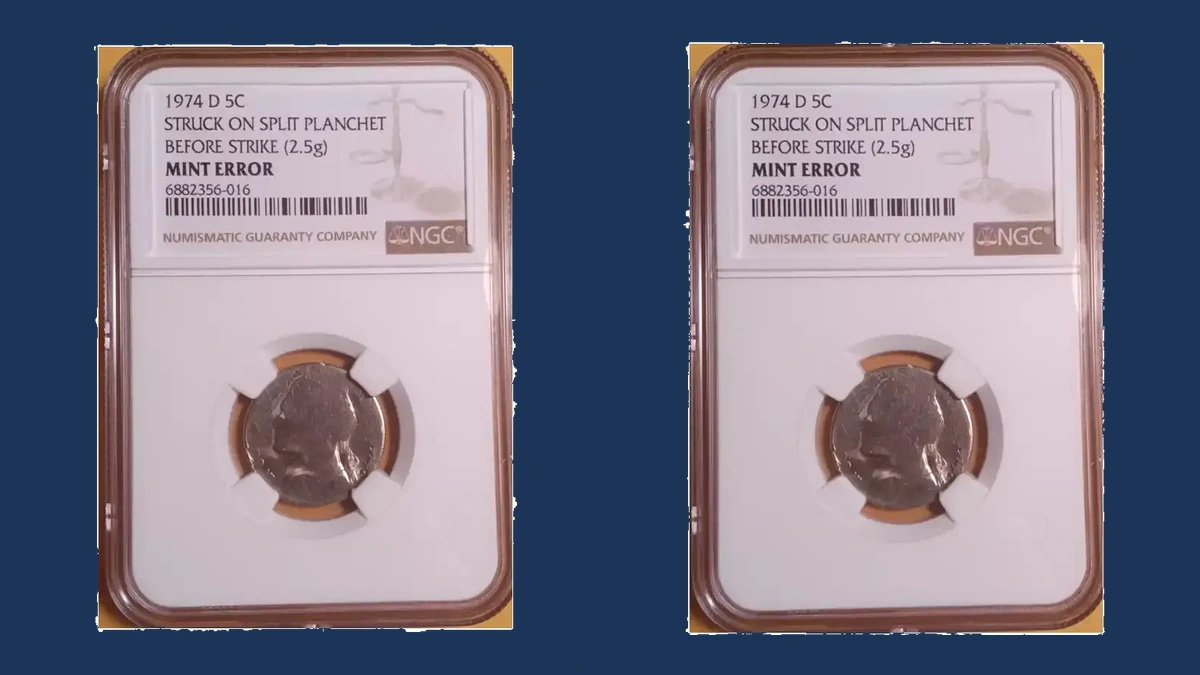
A blank can separate into thinner layers before reaching the press. One of those layers may still receive a nickel design even though it contains much less metal than usual.
Two recorded 1974-D examples weigh 2.56 grams and 2.7 grams. They are separate pieces, not two measurements of the same coin or a documented matching pair.
Their auction group also contained a 1981-P nickel. Its MS62 grade and 3.67-gram weight belong to that later coin, while the two Denver pieces were described as NGC-certified split-before-striking errors without numerical grades.
Estimated Value
An estimated $75–$500 covers individual 1974-D split-before-striking examples with recognizable designs. Thinness, the visible separation surface, and preservation all influence the comparison.
The two recorded Denver pieces sold with a 1981-P error for $207 in September 2010. This was the price of all three coins together.
Neither the full total nor one-third of it establishes a single Denver coin’s price. The 2.56-gram and 2.7-gram pieces should each be compared on their own features.
How to Identify
Compare the thickness with a normal nickel before weighing it. A split blank should be thinner because only part of the original metal reached the press.
Use a scale to compare a loose example with 5 grams. Keep the recorded 2.56-gram and 2.7-gram pieces separate.
Under a 10× magnifier, look for a design struck over the rougher surface exposed by the earlier split. The design’s relationship to that surface helps establish when separation happened.
Calipers can check the diameter against 21.21 millimeters. Inspect the plain edge for grinding marks that would explain later thinning.
A finished coin split afterward exposes metal that never received the final design. Here, look for struck details formed on the thin layer after it had already separated.
8. 1974 Jefferson Nickel Cracked and Broken Stamping Tools
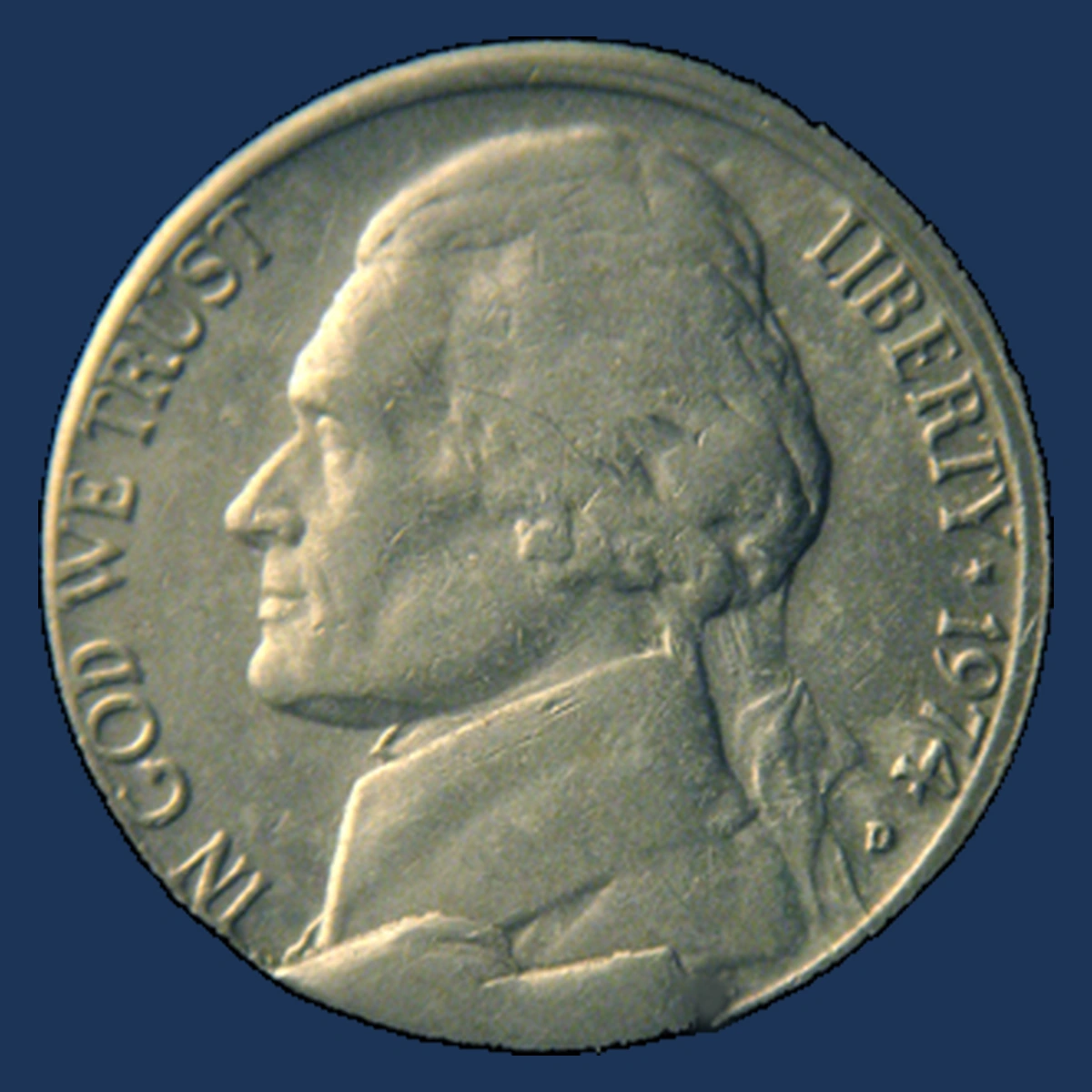
A fine crack in the stamping tool leaves a raised line on the coin. When a piece of the tool breaks away at the edge, the coin can receive a larger raised patch called a cud.
Six Denver cud patterns include patches below the shoulder, beside the lower motto, and above the head near LIBERTY. Their positions and outlines belong to different examples.
The largest described top patch spans much of the upper rim. A faint raised crack can precede a larger break, but a small crack does not always grow into a cud.
Estimated Value
For modest raised cracks, estimate $5–$50; clearer rim-connected cuds can fall around $30–$600. Size, surviving portrait detail, and preservation affect the whole-coin value.
A 1982-P cud graded PCGS MS65 sold for $84 in August 2021, providing a different-year comparison for a smaller break. It does not price all six Denver patterns alike.
An added lump or dented rim is a later alteration and does not qualify merely because it occupies a similar position.
How to Identify
Choose the matching Denver pattern before inspecting the break: these examples place lumps below, beside, or above the portrait. Keep the coin upright and use a 10× magnifier to trace the boundary where normal design meets raised metal.
Follow a larger patch to the rim, then inspect the adjacent plain edge for an impact or an added-metal seam. A scale and calipers can still show close to 5 grams and 21.21 millimeters, because the broken tool lost metal, not the nickel.
For a narrow line, move the lamp to check whether its center rises above the surface. A recessed cut or a displaced rim is different from a raised impression made by a cracked tool.
9. 1974 Jefferson Nickel Off-Center Strike
The blank can enter the press far enough sideways that much of the design misses it. The resulting nickel combines an untouched area with an incomplete struck image.
A 1974 Philadelphia example is described as forty percent off center toward eleven o’clock. ANACS graded it MS65, indicating an unworn coin with relatively few marks.
The shift affects both faces because the whole blank was misplaced. This is different from the Denver six-percent example with only the front tool out of alignment, and different again from a complete design inside an expanded broadstrike.
Estimated Value
The forty-percent ANACS MS65 example sold for $67 in January 2022. Estimate $30–$650 for genuine dated examples across different shifts and preservation.
The recorded result is modest despite the large displacement. A percentage describes the error’s geometry rather than a fixed price scale.
Buyers also consider readable identification, original surfaces, and the overall shape. A spectacular shift that removes the year should not automatically be priced above a smaller one retaining its date.
How to Identify
Read the surviving year before estimating the unstruck portion. A Philadelphia 1974 nickel normally lacks P, but an absent mintmark area alone cannot prove where an unidentified coin was made.
Turn the coin over and compare the boundary between struck and untouched metal. Both faces should agree with the same displaced blank.
Use a scale to compare a loose coin with the usual 5 grams. No part of the metal has to be missing simply because part of the design is missing.
Calipers can record its shape against 21.21 millimeters. Under a 10× magnifier, inspect the plain edge and unused area for grinding that removed a finished design.
10. 1974 Jefferson Nickel Struck on a Cent Blank
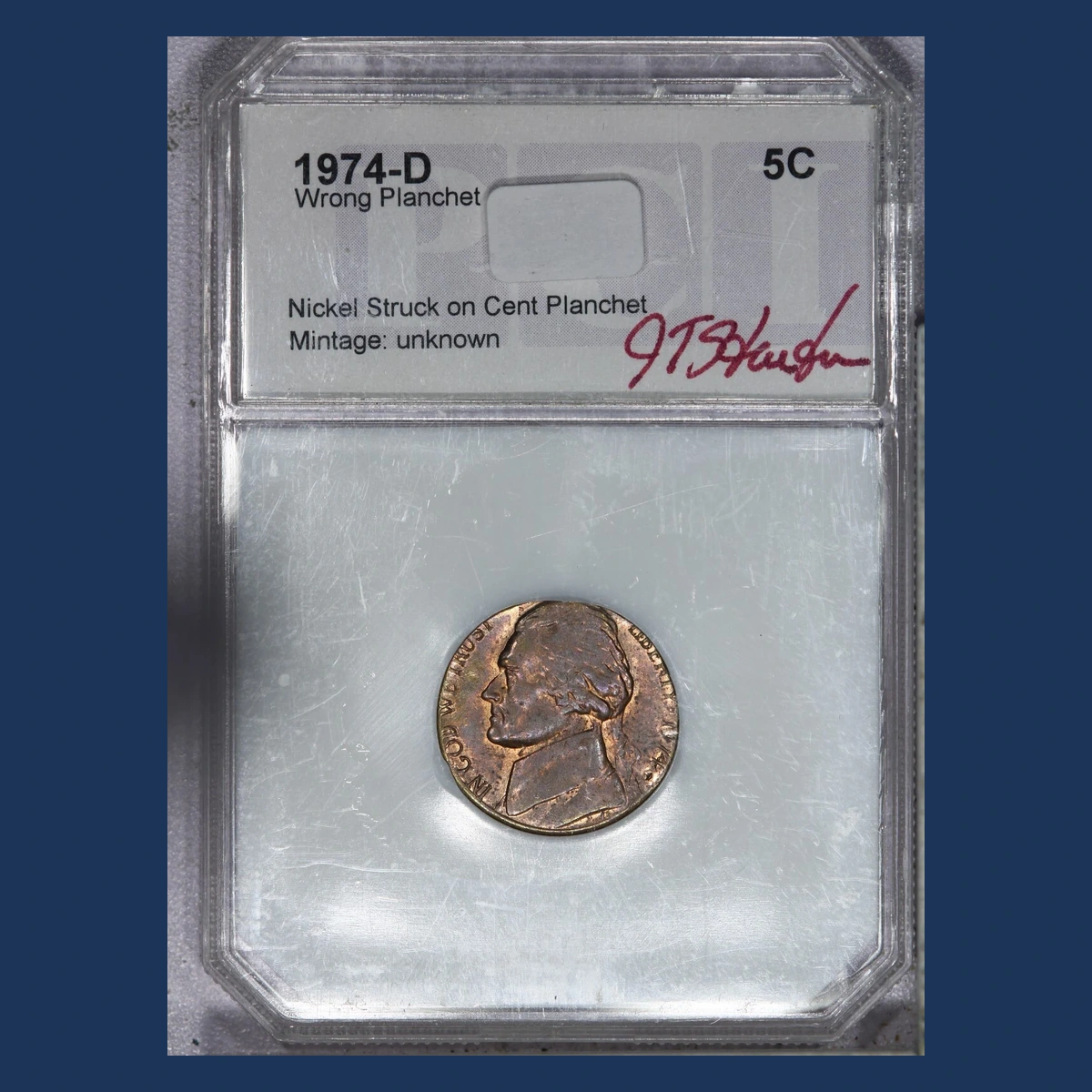
Jefferson’s portrait can appear on a copper disk intended for a cent. The smaller blank cannot hold all the nickel’s outer design, and its color differs from the usual gray alloy.
A Denver example graded NGC MS64 Red and Brown weighs 3.06 grams. Philadelphia examples include an MS66 Red and Brown coin and a separate MS62 Brown piece weighing 3.1 grams.
These are unused cent blanks struck by nickel tools. They should show the nickel design without remnants of an earlier Lincoln portrait, which would indicate a different, double-denomination error.
Estimated Value
The Denver MS64 Red and Brown example sold for $270 in January 2022. Another Denver MS64 Red and Brown coin brought $204 in September 2019.
Estimate $150–$900 across identified copper-blank examples, comparing mint, preservation, and readable date. The better-preserved Philadelphia coin should not inherit a Denver result simply because both use cent metal.
Brown toning alone is not the error. A plated normal-weight nickel lacks the smaller original copper blank required for this range.
How to Identify
Weigh a loose candidate before relying on its color. A period copper cent blank normally starts near 3.11 grams, compared with 5 grams for a nickel.
The Denver coin’s actual 3.06 grams and Philadelphia coin’s actual 3.1 grams are separate measurements. Use calipers against the cent’s starting 19.05-millimeter size and the nickel’s 21.21 millimeters, allowing for spreading.
Inspect cropped outer letters and the plain edge through a 10× magnifier. Natural truncation differs from fresh trimming, while plating can leave a full-size nickel copper-colored.
Look for any older Lincoln or Memorial design. If recognizable cent details lie underneath Jefferson, the coin belongs to the overstruck-cent section rather than this unused-blank group.
11. 1974 Jefferson Nickel Struck on a Dime Blank
A pale nickel can be much too light because it was struck on a blank intended for a dime. The smaller disk leaves insufficient room for the full five-cent design.
The recorded Philadelphia 1974 example weighs 2.33 grams and was graded NGC AU58. That grade describes very slight wear on the highest details.
A normal dime of this period uses a copper core between outer copper-nickel layers. The example is a wrong-blank strike, so it does not require a surviving Roosevelt portrait or torch from a previously finished dime underneath Jefferson.
Estimated Value
The 2.33-gram AU58 example sold for $299 in January 2011. For identifiable 1974 nickel-on-dime-blank errors, estimate $200–$1,000, allowing for wear and the surviving design.
A clean, well-centered date helps establish the year even when outside lettering is lost. Later scratches or tooling reduce the usefulness of a stronger-grade comparison.
This range concerns the correct smaller layered-metal blank. A filed-down nickel does not become a wrong-denomination error merely by reaching a similar weight.
How to Identify
The auctioned coin’s 2.33 grams is an actual measurement. Compare it with the normal dime standard of about 2.27 grams and the nickel’s 5 grams, without requiring every genuine example to weigh identically.
For a loose coin, a scale and calipers help compare its size with 17.91 millimeters for a dime and 21.21 millimeters for a nickel. Striking may spread the smaller disk.
Examine the edge and cropped lettering under a 10× magnifier. Copper at the edge may support layered metal, but the complete weight, size, and design evidence must agree.
Check for trimming or squeezed impressions. A small coin showing only nickel designs fits an unused blank, whereas an earlier dime design would require a different explanation.
12. 1974 Jefferson Nickel Struck on a Foreign Blank
A Denver nickel was cataloged as struck on a blank intended for foreign coinage. NGC graded it AU58 Red and Brown, describing light wear and copper-colored surfaces.
The blank’s intended country and denomination are not established by that description. Calling it a particular foreign coin would require additional metal and size evidence.
This category concerns the starting disk, not a foreign design already visible underneath Jefferson. A normal nickel can also change color through staining or plating.
The unusual metal and size must fit the claimed blank. Color alone cannot establish what coin it was intended to become.
Estimated Value
The documented foreign-blank coin sold for $201.25 in August 2009. Use an estimated $200–$1,200 for comparable identified examples, with preservation and the strength of the blank attribution affecting value.
The auction result belongs to the lightly worn copper-colored Denver coin. It does not establish a price for every possible foreign alloy or denomination.
A generic five-gram specification in a nickel catalog is not a measured weight for this unusual blank and should not support a separate premium.
How to Identify
Read the original label before trying to name a country from the coin’s color. The documented Denver example identifies a foreign blank without naming its intended denomination.
Weigh a loose candidate with a scale and measure it with calipers. Compare those results with a normal nickel’s 5 grams and 21.21 millimeters.
Those nickel figures are reference standards, not measurements of the foreign blank. Professional metal testing may be needed to identify its alloy.
With a 10× magnifier, inspect the edge for plating, trimming, and the way the nickel design reaches the boundary. Keep the date and D visible in the same photographs.
Look for a struck design that fits the unusual metal and size. A copper color without that supporting evidence is not enough.
13. 1974 Jefferson Nickel Clipped Planchet
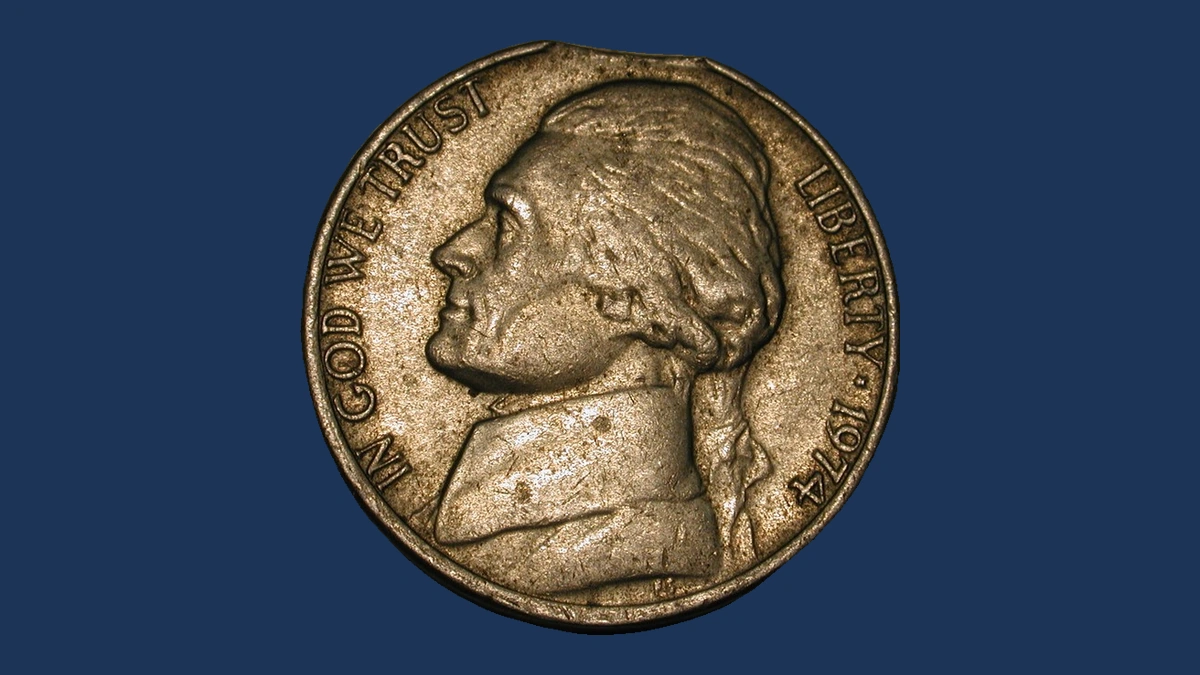
An incomplete disk can still receive a nickel design. This is a clipped planchet, and the missing metal may form a curve, a straight edge, or several gaps.
Philadelphia examples include two curved clips, a fifty-percent straight clip, and three clips on a 2.8-gram coin. On that triple-clipped piece, fifty percent describes its largest opening rather than every opening.
An elliptical example has an oval outline from the blank-making process. These shapes belong to one missing-metal family, but their different weights and gaps should stay attached to their own photographs.
Estimated Value
Estimate $20–$1,500 across modest clips through unusually shaped, well-preserved examples. The double-curved MS66 coin brought $132 in July 2021, while a separate fifty-percent straight-clip MS66 brought $109 in the same auction.
The elliptical PCGS MS64 example sold for $780 in July 2022. Its different outline helps explain why a simple missing-metal percentage cannot set the price.
All figures concern complete individual coins. Three gaps on one nickel do not produce three separate full error prices.
How to Identify
Begin with the actual outline: two curved gaps, a straight missing section, or an oval blank require different comparisons. Under a 10× magnifier, examine where each opening meets the rim and letters for metal formed around an incomplete blank.
Weigh a loose coin against 5 grams and use calipers on intact spans against the usual 21.21 millimeters. The triple-clipped 2.8-gram coin and the twenty-percent straight clip weighing 4.2 grams are separate examples, so keep their measurements apart.
Inspect the otherwise plain edge for saw marks, and check whether a curved opening has a weak opposite rim. That weakness can help, but the original edge and nearby struck details must also fit the claimed missing-metal shape.
14. 1974 Jefferson Nickel Matched Error Pair
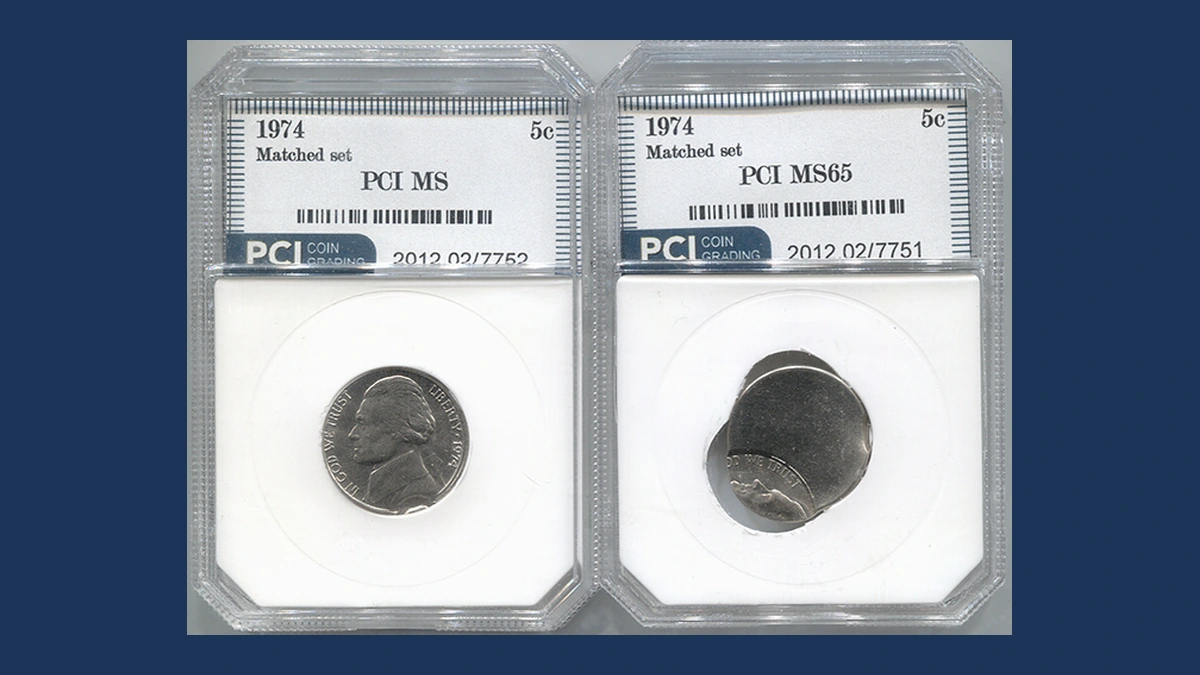
Two error coins can preserve the same manufacturing accident. Collectors call a connected group a matched set or mated pair when their shapes or impressions explain that relationship.
A dealer listed a 1974 Jefferson Nickel matched set in a PCI MS65 holder. The listing title alone does not establish whether the pieces were struck together, separated from one blank, or connected another way.
The important feature is the physical match between them. Two unrelated nickels placed beside each other do not become a matched error simply because their dates or grades agree.
Estimated Value
For a genuine connected pair with clear original features, use a working estimated $300–$3,500 for the complete set. The exact mechanism and strength of the match determine which comparison fits.
A 1941 pair with a backward transferred portrait sold for $2,760 in August 2010. That different-year example shows the value of a visible two-coin relationship without establishing the same mechanism for 1974.
The range is for both pieces together, not an amount to charge for each coin.
How to Identify
Keep the two pieces together in their existing holder. Use enlarged photographs or a 10× magnifier to compare both faces and the edges without pressing the coins against each other.
Look for a specific relationship: matching fracture boundaries or an impression that fits the other piece. A shared date or similar color cannot establish that connection.
If the pieces are already loose, a scale and calipers can record each weight and size. An ordinary nickel starts at 5 grams and 21.21 millimeters, but the correct combined expectation depends on whether one or two original blanks were involved.
Have the relationship identified before choosing a comparable price. Preserve the full label with photographs of both coins so their identity remains connected.
15. 1974 Jefferson Nickel Repeated Strikes and Two Different Dates
A coin that stays in or returns to the press can receive another design. One reported 1974 type has a second blow ninety percent off center, leaving most of that later design beyond the metal.
A separate example carries a 1974 design over a finished 1973 nickel. It flipped over before the later strike, placing remnants of the old portrait on the new back.
Both are repeated-strike errors, but the two-date coin remained inside the surrounding collar ring. It is a nickel over another nickel, not a combination of two different denominations.
Estimated Value
The mint set containing the 1974-over-1973 nickel sold for $1,897.50 in August 1997. That result covers the offered set, with the unusual two-date nickel as its featured error.
Estimate $1,000–$5,000 for a confirmed comparable two-date example. For an ordinary-metal 1974 double strike with a large off-center second blow, use a separate $100–$600 range.
The two-date sale does not assign the same premium to every repeated strike, and ninety percent is not a price multiplier.
How to Identify
For the two-date coin, begin beside the final M in UNUM on the back. A remnant of the earlier 3 lies to its right.
Use a 10× magnifier to follow other old design details beneath the new image. The reversed face arrangement should fit a coin that flipped before receiving its 1974 strike.
For a large off-center second blow, instead locate where a recognizable later design crosses the first. These are different inspection routes, not features required together.
A scale and calipers can compare a loose nickel with 5 grams and 21.21 millimeters. Inspect the plain edge for squeezing that could create false impressions.
The older design must belong to the same struck metal. Two dates in photographs are useful only when their overlapping features support the actual sequence.
16. 1974 Jefferson Nickel Struck over a Finished Lincoln Cent
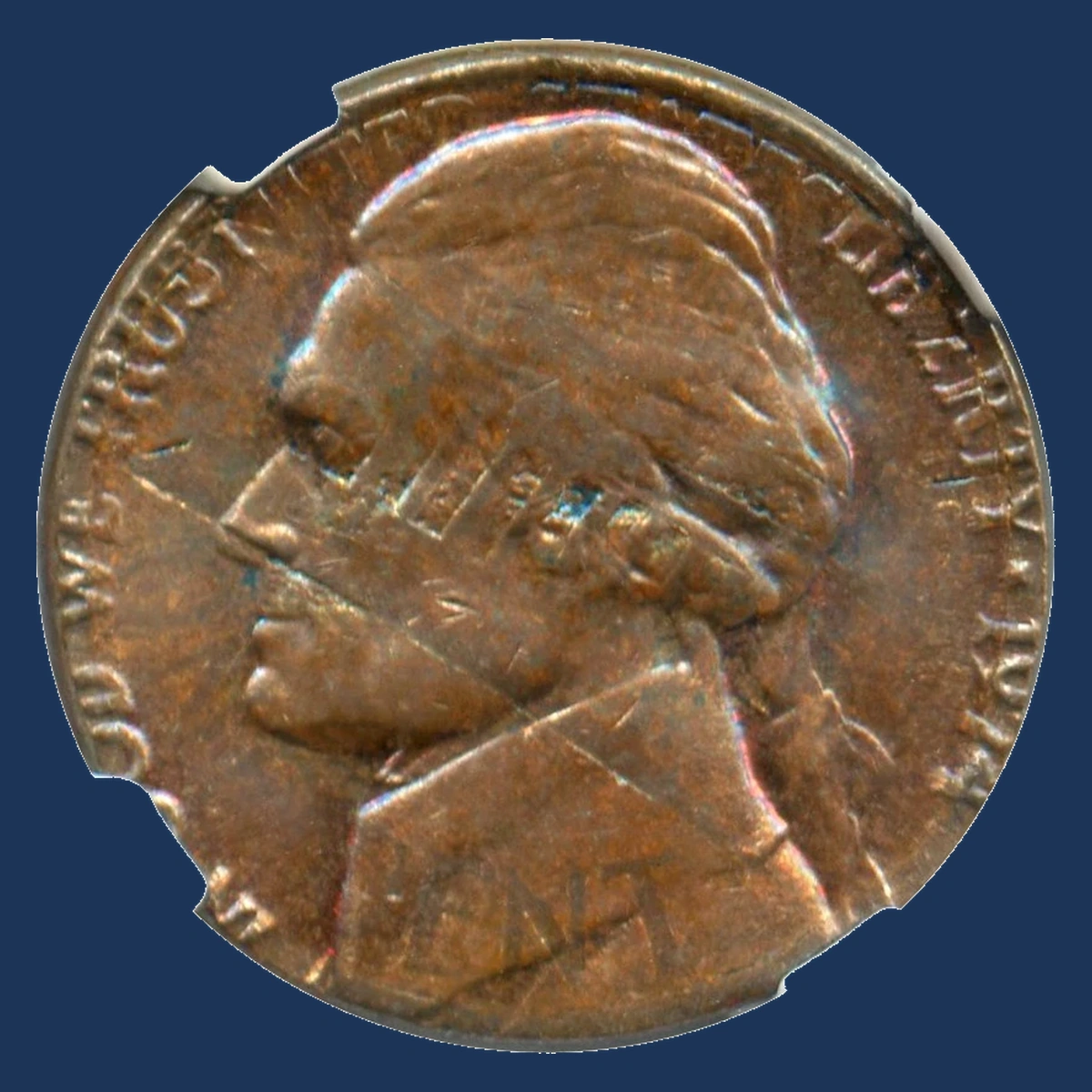
Lincoln Memorial columns cross Jefferson’s jaw on this unusual coin. The disk had already become a 1974 Lincoln cent before it received a nickel design.
On the new back, Lincoln’s beard and bowtie point downward near Monticello’s steps. Parts of the older cent lettering also survive.
The NGC MS65 Red and Brown coin retains the lower part of the nickel date and a faint cent date near the back’s bottom edge. These two sets of designs establish a double denomination, rather than a nickel struck on an unused copper blank.
Estimated Value
This MS65 Red and Brown example sold for $5,040 in January 2023. Estimate $1,500–$7,500 for comparable genuine examples, depending on preservation and how clearly both designs remain.
The same specimen appeared in a 2010 auction, so those records should not be counted as two different discoveries. Its condition and readable overlapping designs contributed to one whole-coin price.
A copper blank carrying only Jefferson’s design belongs to the less complex wrong-blank category.
How to Identify
Find the Memorial columns across Jefferson’s jaw with a 10× magnifier, then inspect Monticello’s steps for Lincoln’s downward-pointing beard and bowtie. These specific remnants should cross the nickel design as parts of the same struck metal, rather than form a sunken mirror impression.
For a loose candidate, use a scale to compare its weight with a copper cent’s usual 3.11 grams and a nickel’s 5 grams. Calipers compare the starting diameters of 19.05 and 21.21 millimeters; these are standards, not recorded measurements for this specimen.
Inspect the edge for joins or trimming and follow the two surviving dates in the photographs. Look for the older cent design beneath the later nickel details, not a separate object pressed onto the surface.
Conclusion
The estimated $5–$7,500 range covers very different 1974 nickel errors. A small raised crack, an oval blank, and a nickel stamped over a finished cent need different comparisons.
Check the complete design before choosing a name. A small copper coin with no older Lincoln details is different from one showing both denominations.
Keep paired pieces and loose layers intact, and use each recorded weight with its own specimen.