1992 Nickel Error List with Pictures

A copper-colored 1992 nickel can have more than one explanation. Some changed color during blank preparation; one Philadelphia coin actually carries its nickel design over an already struck Lincoln cent.
That overstrike sold for $630 in November 2020. This 1992 nickel error list covers estimated values from $10 to $2,000, including misplaced designs, raised breaks, and metal defects.
Read the examples below to distinguish color from composition and match each visible feature with the process that made it.
1. 1992 Jefferson Nickel Detail Blocked during Striking
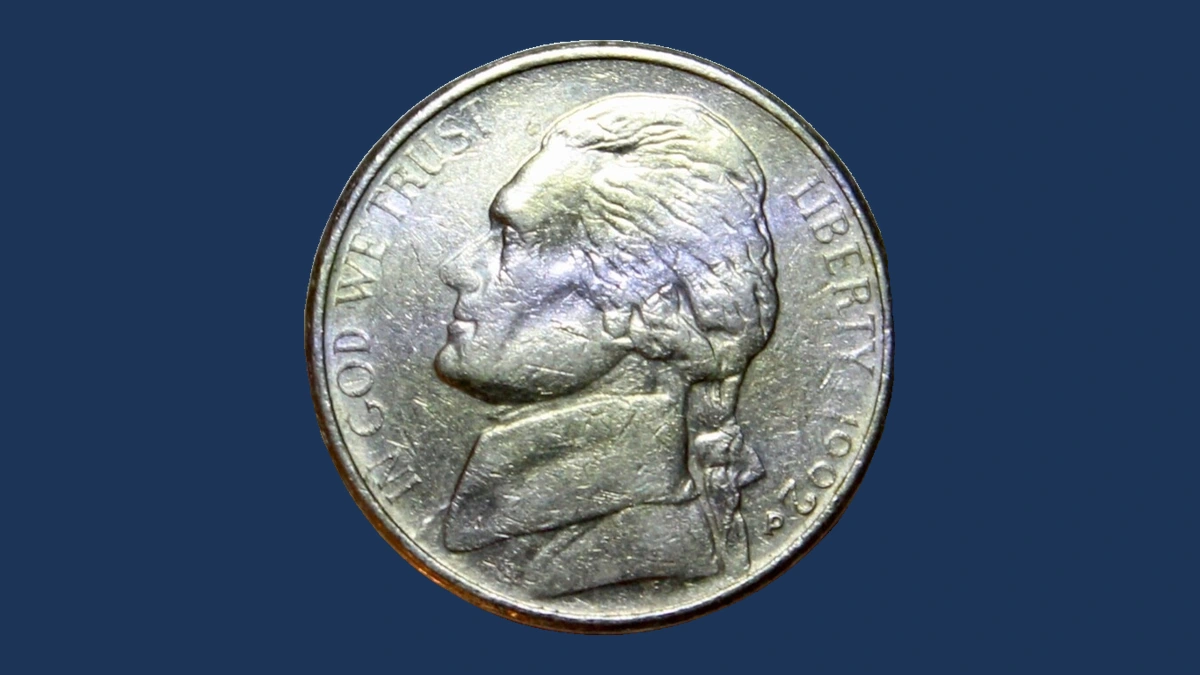
A small patch of missing detail can begin with material caught between the blank and the stamping tool. The tool, called a die, cannot impress its full design through that obstruction.
Year guides include struck-through errors for 1992 and describe grease as one possible cause. They do not establish a mint letter or a specific certified specimen for every example.
A local depression or weak patch therefore needs to be judged from its own surface.
The missing detail alone cannot identify the material that blocked the strike, and general circulation wear can look similar.
Estimated Value
Estimate $10–$75 for small, genuine blocked areas and $75–$250 for stronger examples on attractive coins. These are estimated values for the reported 1992 type.
For comparison, a 2000-P nickel struck through an obstruction on the front sold for $84 in February 2015. Its year and affected area differ.
A smooth patch created by polishing or wear does not earn the same premium simply because some of the original design has disappeared.
How to Identify
Compare the weakest area with the coin’s highest exposed details. If those high points are equally smooth, wear may explain the appearance without anything blocking the original strike.
Use a 10× magnifier to examine where weak detail meets sharp detail. Scraping lines or a polished hollow can reveal metal removed after minting.
A normal loose nickel weighs 5 grams and measures 21.21 millimeters; record these comparisons with a scale and calipers. Include its plain edge in photographs if the weak patch reaches the border.
Look at the opposite face before assigning a cause. Keep the description tied to the visible interruption rather than naming grease, cloth, or another material that the coin does not establish.
2. 1992 Jefferson Nickel Repeated Detail on the Building Side
An extra outline on MONTICELLO or FIVE CENTS can come from a doubled design in the stamping tool. Collectors call a tool with repeated back-side detail a doubled die reverse, often shortened to DDR.
The year reports mention lettering and the area around the building. They do not establish one mint letter for all of those claims.
This kind of doubling is prepared in the tool before a coin is struck. It does not require the finished nickel to receive two blows.
A flat shelf created by movement during striking has a different cause.
Estimated Value
For a genuine, identifiable doubled back design, estimate $20–$100 on circulated 1992 nickels and $100–$300 on attractive unworn examples. Strong separated detail generally attracts more interest than a faint extra edge.
These are estimated ranges for the reported type, not a sale price for a named 1992 variety. A catalog match matters before applying them.
Machine-made flat shelves, glare, and damage should not be valued as doubled-tool detail merely because lettering looks wide.
How to Identify
A wider-looking letter can be glare rather than doubled design, so first move the light across MONTICELLO while using a 10× magnifier. Keep nearby normal letters in view as a comparison for the thickness of the main strokes.
Photograph the solid repeated feature straight on and compare it with an attributed example before assigning a variety name. The year reports do not establish one pattern shared by every mint, and a flat ledge may have another cause.
For a loose coin, use a scale and calipers to compare the normal 5 grams and 21.21 millimeters, then inspect the plain edge. Those checks establish basic identity; a specific doubled design still needs its own visual match.
3. 1992 Jefferson Nickel A Complete Design on a Wider Disk
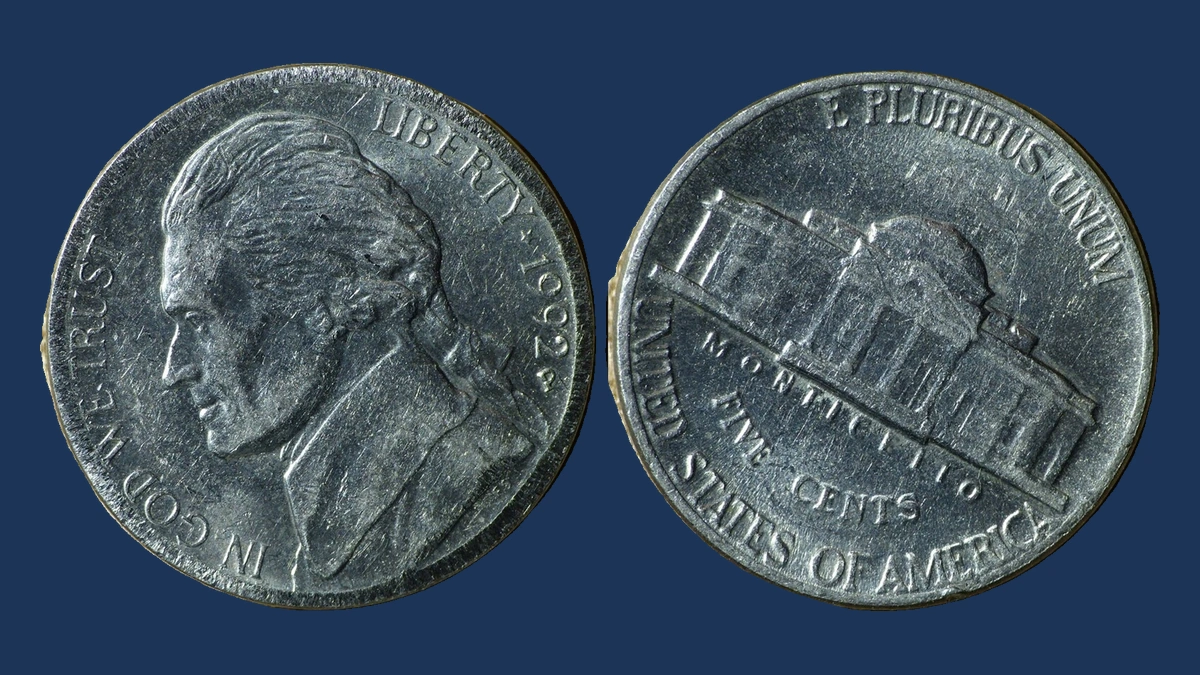
The collar normally holds a nickel’s edge in place while the tools squeeze the design into the blank. If that ring fails to restrain the metal, the disk can spread wider than usual.
This is called a broadstrike. The year guide lists the type without establishing a specific mint letter or a single specimen’s dimensions.
The complete design should remain on the expanded disk. A large unstruck crescent with missing outer design instead suggests an off-center strike.
A plain edge is normal on a nickel and does not prove that the collar failed.
Estimated Value
Estimate $25–$125 for straightforward broadstrikes and $125–$300 for strong, attractive expansion. These are whole-coin estimates for the 1992 type reported in the year guide.
A same-design 2000-P broadstrike sold for $51 in July 2022, providing a different-year comparison. Its exact shape and preservation need not match a 1992 find.
An ordinary nickel flattened after minting belongs outside these ranges even if its diameter has become larger.
How to Identify
Calipers can reveal expansion that is hard to judge in a photograph. Record a loose coin’s width in two directions against the normal 21.21 millimeters.
Then weigh it on a scale against 5 grams. A wider disk with ordinary weight suggests spreading, but does not yet establish when it happened.
Inspect every outer inscription through a 10× magnifier. A simple broadstrike should keep the complete design on the metal.
Look closely at the high points and plain edge for hammer marks or later flattening. Those marks can cross a portrait that was already fully formed.
An uneven border alone is not enough. If outer design is missing opposite a large unstruck crescent, reconsider the object as an off-center strike rather than unrestricted expansion.
4. 1992 Jefferson Nickel A Raised Patch from Broken Steel
A chunk of missing steel in a stamping tool leaves room for coin metal to rise during the blow. The resulting patch can stand above the nearby design.
A Philadelphia example was cataloged as a major die break and graded ANACS AU50, meaning visible wear but much remaining detail. The description does not identify a clock position.
A large break that joins the coin’s rim is commonly called a cud. An interior raised patch needs to be described according to its actual position.
Added solder or a damaged rim can imitate a mound without being a mint-made break.
Estimated Value
The 1992-P major-break nickel sold for $26 in August 2021. Its AU50 grade reflects a circulated coin rather than a flawless specimen.
Estimate $20–$100 for clear worn examples and $100–$350 for especially strong breaks on attractive coins. A larger raised feature can be easier to recognize, but condition still matters.
The word “major” is a description of the defect, not a guarantee of an expensive sale.
How to Identify
A lump added to a normal coin can resemble a raised mint error. Inspect the boundary through a 10× magnifier before deciding that steel was missing from the stamping tool.
Look for normal design disappearing into the raised patch. Added material may instead cover an already completed surface or reveal an attachment line.
Weigh a loose coin against 5 grams and use calipers to compare its width with 21.21 millimeters. Inspect the plain edge beside the lump for crushing.
A later impact can push rim metal onto the face. Follow that disturbed area to see whether it explains the mound.
Only call the break a cud if the raised patch connects with the rim. The cataloged coin has no published clock position to use as a shortcut.
5. 1992 Jefferson Nickel A Gap in the Blank
A missing curved section can originate when the Mint punches a blank too close to an earlier opening in the metal strip. The incomplete disk may still enter the press and receive a design.
The 1992 year guide lists clipped blanks without establishing a mint letter or one precise gap shape. Each example needs its own edge examination.
Weakness sometimes appears on the opposite rim, but that clue is not present on every genuine clip.
A smooth-looking gap alone is not decisive: cutting or filing a finished nickel can also remove part of the disk.
Estimated Value
For a genuine 1992 clipped blank, estimate $25–$150, with strong, attractive examples reaching an estimated $150–$400. The shape, missing area, and preservation all affect the comparison.
A 1997-P nickel with a twenty-percent curved clip sold for $124 in March 2025. That different-year example offers a market comparison, not proof of a sale for the 1992 report.
The price assumes an original incomplete blank rather than later cutting.
How to Identify
Begin at one end of the gap and follow the original rim toward it through a 10× magnifier. Photograph both ends and the edge inside the missing section.
Cutting grooves or a sharp slice through finished design point toward later alteration. An opposite weak rim can support a clipped-blank explanation, but its absence does not automatically rule one out.
Weigh a loose coin on a scale against the normal 5 grams. A missing piece should reduce the weight; measure an intact span with calipers against the usual 21.21 millimeters.
Compare the plain outer edge with the gap’s surface. Avoid assigning a percentage from appearance alone, especially when wear or damage has changed the remaining boundary.
6. 1992 Jefferson Nickel A Layer Separating inside the Metal
A thin layer can separate inside a coin’s metal and lift from the surface. This defect is called lamination and may leave an attached flap or a shallow opening.
A 1992 year guide reports the type but describes the nickel’s construction incorrectly. Ordinary 1992 nickels are solid copper-nickel alloy, not a copper core covered with nickel plating.
The report therefore does not establish a missing plated layer. A genuine example would need an internal separation in the alloy itself.
Corrosion, scraped metal, and copper-rich surface material from heating are other possibilities to distinguish.
Estimated Value
For a genuine 1992 lamination within the alloy, estimate $20–$100 for modest examples and $100–$400 for a clear, appealing separation. These conditional ranges apply after the physical defect is correctly identified.
They are not a recorded sale or certification of the year guide’s example. The attached flap and amount of design affected matter more than a peeling appearance alone.
Added coatings and ordinary surface damage do not qualify as missing layers of this solid-alloy coin.
How to Identify
An attached flap can break off with very little handling. Photograph it before turning the coin repeatedly, and never pull it back to expose more metal.
Use a 10× magnifier and side lighting to inspect the opening. Determine whether the split travels within the alloy or only beneath a coating on the surface.
If a loose coin can be handled safely, weigh it against the normal 5 grams. Missing metal can lower the reading, while an attached flap may leave it close to normal.
Measure an intact span with calipers against 21.21 millimeters and inspect the plain edge without touching fragile areas. Do not squeeze the flap.
A brittle copper-rich surface may result from heating during blank preparation instead. The position of the separation matters more than its copper color.
7. 1992 Jefferson Nickel A Copper-Rich Surface from Heating
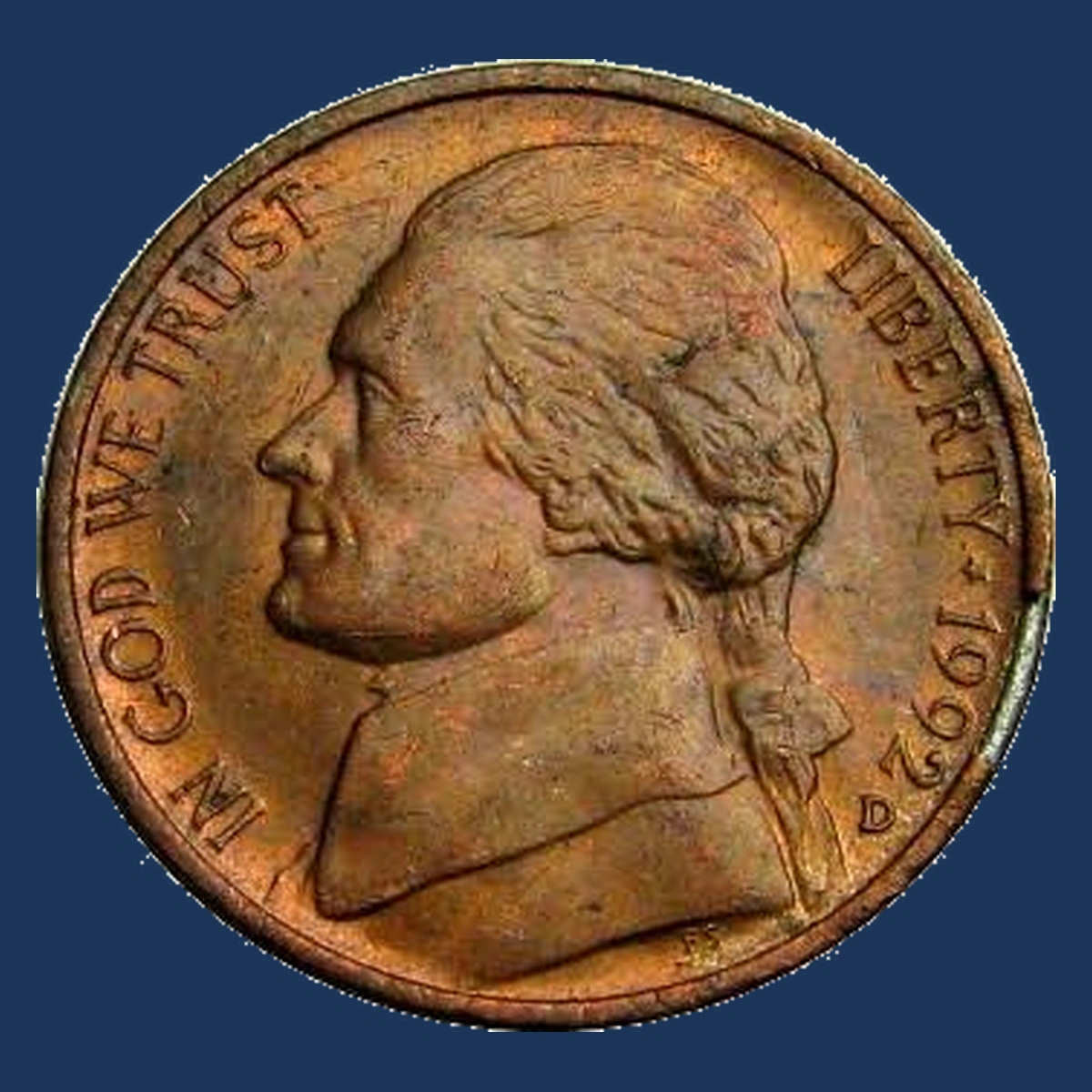
The 1992-D example illustrated by Error-Ref has an unusual copper-rich surface on both faces. Copper moved toward the outside of the blank during a problem in the heating process.
This preparation step is called annealing. Excessive heat or unsuitable furnace conditions can change the surface, and exposure to oxygen can darken the copper-rich material.
The original nickel still began as a copper-nickel alloy. It was not an ordinary plated coin whose outer nickel layer disappeared.
Because later heating and chemical exposure can also change color, a brown or reddish surface is only a starting clue.
Estimated Value
Estimate $40–$150 for genuine circulated heating errors and $150–$500 for attractive unworn examples with a clear abnormal surface. These are estimated ranges for the 1992-D type.
A different-design 2005-D Bison nickel with improper annealing sold for $119 in December 2022. That sale provides a comparison rather than a transaction for the illustrated 1992 coin.
The cause must be established; environmental discoloration does not become a mint error merely because both faces look dark.
How to Identify
Compare both faces before describing a nickel as copper-plated or missing a layer. Error-Ref’s 1992-D example shows copper-rich oxidized material on each side, produced during blank preparation.
A loose normal nickel weighs 5 grams and measures 21.21 millimeters. Use a scale and calipers to separate ordinary-size discoloration from a substantially smaller, lighter cent-based error.
Inspect the plain edge and the surface through a 10× magnifier without scraping the coating. Record where the unusual material lies and whether the original design remains beneath it.
Color matching alone will not separate Mint heating from later heat or chemicals. Professional assessment of the surface and its relationship to the strike is needed for that distinction.
8. 1992 Jefferson Nickel A Tilted Back after Turning the Coin
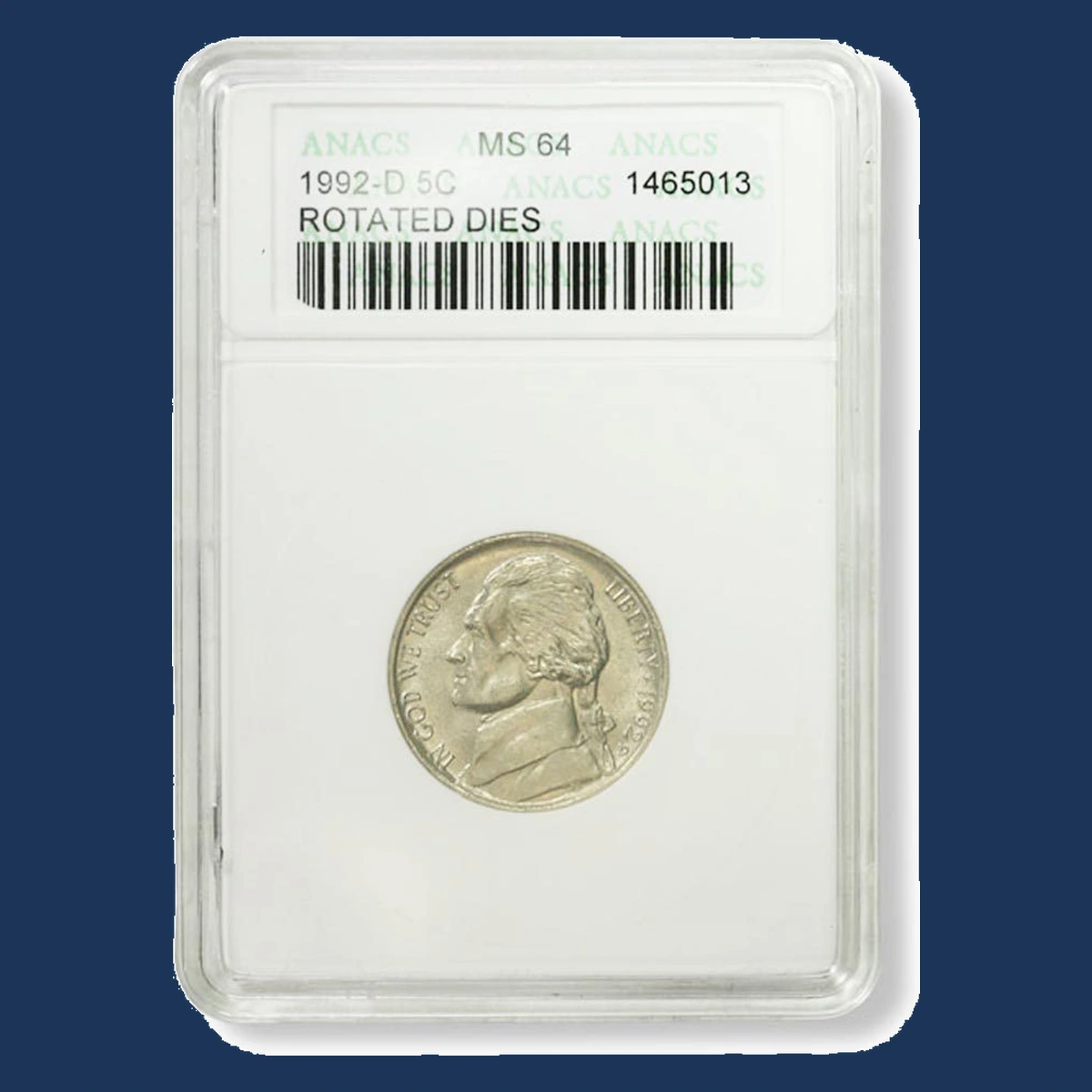
Hold Jefferson upright, then turn the nickel from top to bottom without twisting it sideways. Monticello normally appears upright after that motion.
A rotated stamping tool changes the relationship between the two designs. Both faces can look individually normal while the building tilts after the same controlled turn.
A year report describes a 1992-D example graded ANACS MS64, an unworn grade with some marks. It does not establish a specific angle for that specimen.
General examples such as ninety or one hundred eighty degrees should not be assigned to it without examining the actual coin.
Estimated Value
For a genuine 1992-D rotation, estimate $25–$150 for modest angles and $150–$500 for strong rotations on attractive coins. These are estimates, not a sale of the reported ANACS example.
As a comparison, a 2015-D nickel with a documented ninety-degree clockwise rotation sold for $79 in October 2021. Its measured angle belongs to that different coin.
The size of the rotation must be demonstrated rather than inferred from separately arranged photographs.
How to Identify
Practice turning an ordinary nickel from top to bottom without adding a sideways twist, then repeat the motion with the candidate. Start with Jefferson upright and observe where Monticello points after the turn.
Repeat the test and record a short video, since separately arranged photographs can hide the real relationship between the two faces. Use a 10× magnifier to read the date and D and check the plain edge for a seam from joined coin parts.
For a loose coin, record weight and width with a scale and calipers against 5 grams and 21.21 millimeters. Measure the angle seen on this specimen rather than borrowing the ninety-degree figure from the different-year comparison.
9. 1992 Jefferson Nickel A Twenty-Percent Off-Center Strike
The Denver example was not fully between the stamping tools when the press delivered its blow. Its design moved toward about seven o’clock, leaving part of the blank without an impression.
The catalog describes roughly twenty-percent displacement and an ANACS MS63 grade, meaning an unworn coin with some visible marks. That direction belongs to this particular specimen.
It appeared alongside 1999 and 2001 nickels with different directions and percentages. Their descriptions should not be transferred to the 1992 coin.
A shift on only one face would need to be distinguished from this displaced whole strike.
Estimated Value
Estimate $40–$150 for a clear twenty-percent example and $150–$600 for especially attractive or more dramatic off-center coins. These are individual-coin estimates, not the total price of the mixed-year auction lot.
The cataloged 1992-D coin was sold with two other nickels. A 2000-P off-center example sold separately for $52 in April 2022, offering a different-year comparison.
A readable date and undamaged surfaces matter when placing a particular coin within the range.
How to Identify
Start with a full photograph showing the date, D, and entire outline. With Jefferson upright, compare the cataloged coin’s displacement toward seven o’clock rather than using the directions of its lot companions.
Check the back to see whether the same strike left a corresponding unstruck area. The two faces should explain one displaced blow.
A loose nickel ordinarily weighs 5 grams; use a scale to see whether metal is missing. Calipers can record the changed outline against a normal 21.21-millimeter coin, and a 10× magnifier can inspect the plain edge.
Follow the boundary between struck and unstruck metal. Fresh cuts or grinding marks there would suggest an altered coin rather than the untouched surface left by a missed strike.
10. 1992 Jefferson Nickel Jefferson Struck over a Lincoln Cent
Look for Lincoln cent details beneath Jefferson rather than judging this error by its copper color. The Philadelphia nickel was struck over a cent that already carried its own 1992 design.
The later nickel blow left recognizable pieces of that earlier image. An unused cent blank would not supply those underlying letters or portrait details.
NGC graded the example MS63 Red and Brown, describing an unworn coin with some marks and mixed copper color.
This is a single coin bearing designs from two denominations. The earlier cent and later nickel impressions are not two separate objects glued together.
Estimated Value
The 1992-P overstrike sold for $630 on November 6, 2020. Its surviving cent details and sharp nickel strike were noted in the auction description.
Estimate $400–$1,000 for recognizable examples with comparable preservation and $1,000–$2,000 for particularly attractive, clearly displayed combinations. Those upper figures are estimates, not additional recorded sales of this specimen.
Treat both denominations as parts of one error; adding the face values does not explain its collectible price.
How to Identify
Find a letter or portrait fragment that belongs to a cent and cannot be explained by the nickel design. Use a 10× magnifier to trace that fragment beneath the newer impression before reading either date.
A 1992 cent starts near 2.50 grams, compared with a normal nickel’s 5 grams. For a loose candidate, use a scale and measure its outline with calipers against the cent’s original 19.05 millimeters and the nickel’s 21.21.
The later blow can spread the smaller host. Inspect the plain edge for a seam or added coating that might explain an imitation.
If no cent design survives, a wrong-blank strike may still be possible, but copper color and low weight alone do not prove an overstrike.
Conclusion
The most useful question for a 1992 nickel is often what changed: its design, its metal, or its position in the press. Estimated values across these types span $10–$2,000.
A small blocked area belongs near the lower end, while a clearly identified nickel-over-cent error can bring much more. Copper color deserves special care because heating and a cent host produce different objects.
Keep those explanations separate when comparing photographs, measurements, and prices.