1796 Liberty Cap Cent Error List with Pictures

Liberty’s cap and pole identify the last year of this early cent design. Among 1796 Liberty Cap cent errors, a faint mark can hide on a very expensive coin.
The Cardinal Collection cent with delicate clash marks sold for $223,250 in January 2013. Its exceptional condition drove the price.
The examples below span estimated values of $500–$225,000, from worn coins with missing metal to that rare quality level. Read on to separate a damaged blank, a broken tool, and a second strike.
1. 1796 Liberty Cap Cent Clipped Blank
A small crescent is missing near two o’clock on a recorded 1796 Liberty Cap cent. PCGS graded that worn example F12, and collectors identify its tools as S-89.
The missing part began in the blank, the round piece of metal used to make the coin. A cutting punch overlapped an existing hole in the copper strip, leaving an incomplete circle.
This is a curved clip. Another reported example belongs to S-88, a different pair of stamping tools.
An edge dent instead pushes metal aside after striking; it does not begin with an incomplete blank.
Estimated Value
Allow an estimated $500–$5,000 for worn 1796 Liberty Cap cents with genuine clips, depending on remaining detail and surface damage. Large, clear gaps can attract more interest than barely visible ones.
A later large cent offers a modest comparison: an 1852 clipped example graded NGC MS63 sold for $384 in June 2024. That unworn coin has a different design and date.
The older Liberty Cap coin’s underlying scarcity also affects its price.
How to Identify
Photograph the edge before deciding that its missing crescent is a mint error. Saw marks, file lines, or a sharp fresh cut suggest later damage.
The 2018 Stack’s Bowers example has its small gap near two o’clock when Liberty stands upright. A 10× magnifier helps reveal how the struck surface meets each end of that gap.
For a loose coin, compare its weight on a scale with the normal 10.89 grams. Calipers should show roughly 28 millimeters across the surviving round outline, with a plain edge.
A tiny clip may cause only a small weight loss. Look for smooth metal flow into the gap rather than demanding a dramatic reading on the scale.
2. 1796 Liberty Cap Cent Peeling Metal
The bottom of the T in LIBERTY looks damaged on one S-83 cent, with a shallow hollow continuing into the hair. A thin layer of copper separated there.
Collectors call this lamination. Weakness inside the original metal allows part of its surface to lift or fall away.
PCGS labeled the example AU Details, Planchet Flaw: it retains considerable detail but has a blank defect. The coin is not two fully separated halves.
It also carries a raised line across LIBERTY from a damaged stamping tool, a different feature on the same cent.
Estimated Value
An estimated $500–$7,500 covers worn examples through sharper coins with a well-defined missing layer. Attractive copper and readable lettering matter; a large ugly hollow may reduce demand.
The S-83 coin was offered for $6,250 in the Rucker fixed-price list of May 2022. That figure was a dealer’s asking price, not a confirmed auction result.
Its raised tool crack is included in that same price, so the two features do not create two separate values.
How to Identify
Do not lift a loose flap or scrape inside the hollow. A delicate layer can break off during handling.
On this S-83 example, follow the defect from the lower T down into the hair using a 10× magnifier. The shallow loss belongs to the copper itself, while the nearby crack across the lettering stands above the surface.
If the coin is loose, a scale can compare it with 10.89 grams and calipers with about 28 millimeters. Check the plain edge for a separate cut or a deeper split.
A light surface loss need not change the weight much. Tilt the coin under a lamp to distinguish the hollow’s thin layered boundary from scattered corrosion pits or a scraped channel.
3. 1796 Liberty Cap Cent Off-Center First Strike and Flipover Double Strike
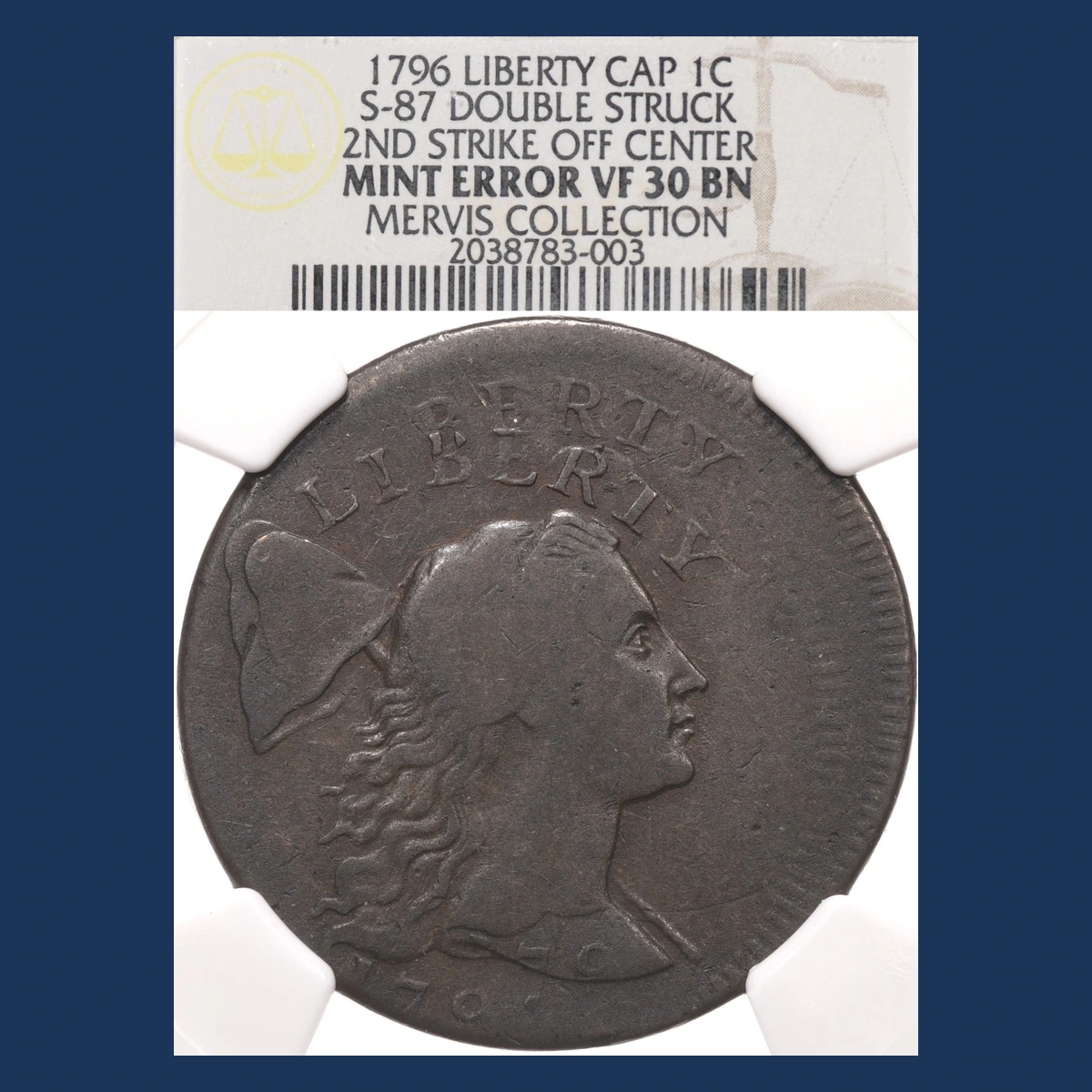
A date on the wreath side gives this cent away. The coin was struck off-center, turned over, and struck again, leaving parts of each face mixed together.
Heritage described the first impression as about 15% off-center toward three o’clock. A later blow brought a fresh portrait and wreath over the earlier designs.
On its PCGS F15 example, the old digits 796 survive near STA on the back. Part of the earlier fraction remains near the upper right of the front.
The cent therefore records both a misplaced first blow and a second blow after turning over.
Estimated Value
The Heritage example sold for $5,287.50 in September 2014. F15 means a circulated coin with noticeable wear but readable major details.
Estimate $3,000–$12,000 for comparable worn flipover double strikes, with clear old lettering supporting the stronger prices. Corrosion or very faint overlapping designs can lower appeal.
That range prices the complete compound error. The first off-center strike does not add a second, separate price to the same coin’s flipover result.
How to Identify
Find the older design before tracing the newer one. In Heritage’s example, look near STA for 796, then find the earlier fraction near one-thirty on the front.
Use a 10× magnifier and photographs of both faces at the same scale. These separated design fragments must fit the earlier face of a cent, not merely resemble random bumps.
Check that the extra designs rise from the surface. A deeply sunken, mirror-image transfer from another coin raises a different question.
For a loose example, measure weight against 10.89 grams and width against roughly 28 millimeters with a scale and calipers. Examine the plain edge for squeezing or joined pieces.
The later centered design can hide the first blow’s missing area. Its surviving old digits reveal what happened before that second strike.
4. 1796 Liberty Cap Cent Cracked and Broken Stamping Tools
A long raised line runs over LIBERTY on the S-83 cent. It starts above the I and passes across ERTY before reaching the rim ahead of Liberty’s nose.
The die, a steel tool that stamps coins, cracked along that path. Copper entered the opening during striking and formed the raised line.
The Rucker catalog also describes a very rare later break within the area bordered by the crack. This produces a cud, a raised patch connected to the rim.
Its illustrated S-83 coin shows the earlier crack, before that large piece of steel broke away.
Estimated Value
For cracked examples, use an estimated $500–$7,500 across heavily worn coins and attractive pieces with stronger detail. The Rucker S-83’s $6,250 asking price also includes its peeling-metal flaw.
A genuine example of the large later cud merits a separate estimated $2,500–$20,000 range. That is an estimate for the broken-tool stage, not a sale price borrowed from the earlier coin.
The raised patch’s completeness and the cent’s remaining detail strongly affect buyer interest.
How to Identify
First decide whether you see a thin line or a broad raised patch. They represent different stages of the same tool’s failure.
A photograph of the Rucker S-83 cent helps trace the earlier line above I, across ERTY, and toward the nose. Magnify it 10×; the upper R is partly filled too.
Then examine the area inside that path. A true later cud fills an area against the rim; the thin line alone does not establish one.
For a loose copper cent, use a scale for the normal 10.89 grams and calipers for about 28 millimeters. Inspect its plain edge beside the raised area for a later blow that pushed metal inward.
A cut running below the original surface is a scratch rather than this raised crack.
5. 1796 Liberty Cap Cent Clashed Design Traces
The Cardinal Collection S-91 cent has very faint extra outlines near Liberty’s throat and around the wreath. They came from contact between the two stamping tools.
When those tools met without copper between them, each could pick up parts of the opposing design. Later coins then received those extra marks along with the normal design.
This is a die clash. Repeated tool contact can leave several faint traces without the coin itself being struck several times.
The Cardinal coin shows delicate traces on both faces rather than the bold mixed designs of a flipover double strike.
Estimated Value
The Cardinal cent sold for $223,250 in January 2013 at Stack’s Bowers. PCGS graded it MS66, an exceptionally well-preserved, unworn coin.
For worn examples with recognizable clashes, estimate $500–$10,000. An exceptional coin approaching that celebrated example belongs in a much higher estimated $100,000–$225,000 tier.
The auction price reflects the entire rare, high-quality cent. Faint clash marks alone do not turn a worn coin into a six-figure piece.
How to Identify
Place photographs of the normal front and back beside the suspected clash. You are looking for a faint piece of the opposite design in an unexpected place.
For this S-91 pattern, use a 10× magnifier ahead of the throat and within and around the wreath. Low light from the side can reveal the shallow lines without touching the copper.
Weight and size help establish the coin before judging those faint details. A loose example should be compared with 10.89 grams and about 28 millimeters using a scale and calipers; the edge is plain.
Do not count every stray line as another clash. Follow a recognizable shape into the surrounding open area, and reject isolated scratches that do not match any opposing design.
Conclusion
The five groups cover estimated values of $500–$225,000, but the highest prices require far more than an unusual mark. The Cardinal cent’s condition explains its place at the top.
On your coin, compare the cap and pole before checking the flaw. A raised line, a missing layer, and a date struck onto the back tell different stories.
Leave fragile metal untouched, and keep photographs of both faces together.