1827 Cent Error List with Pictures

A raised area below the date and a dent beside UNITED can occur on the same cent for completely different reasons. An 1827 example with that combination brought $264, including the buyer’s fee, in May 2025.
This 1827 Coronet Head cent error list separates mint-made features from later damage, with estimated whole-coin values of $25–$20,000.
Read on for cracks, missing copper, reported letter doubling, and a repeated strike that landed far off center.
1. 1827 Coronet Head Cent Clipped Planchet — Estimated Up to $1,000
A section of the edge is missing from the reported circulated example. A clip forms when the original copper disc is cut incompletely before it enters the coining press.
The prepared disc is called a planchet. Its rim and nearby design then form around the missing section during striking.
An 1827 clip has been reported with Very Good to Fine detail, but its specific size and position must be judged on the coin. A general percentage used in a price example should not be treated as a measurement of that piece.
Estimated Value
Estimate $60–$1,000 for genuine clips, depending on the missing area, remaining detail, and surface quality. A worn small clip may be modestly priced, while a clear larger gap can draw stronger interest.
A 1939 clipped cent graded MS64 Brown brought $180 in January 2023. That later small-cent result provides a basic comparison only; the much older 1827 large cent needs its own allowance for condition, copper surfaces, and the strength of the clip evidence.
How to Identify
Follow the rim into the gap before weighing the coin. Under a 10× magnifier, look for naturally formed transitions rather than sharp cuts that slice through an already-struck border.
Inspect the gap’s face and the surviving plain edge for file marks. Weakness on the opposite rim can help, but wear alone can also erase border teeth.
Use calipers across intact sections to compare a normal diameter around 28 mm. A scale can compare the actual weight with 10.89 grams, allowing for wear and missing copper.
Check that the design formed naturally beside the missing section; low weight by itself does not distinguish an original clip from a later cut.
2. 1827 Coronet Head Cent Reported LIBERTY Doubling — Estimated Up to $1,200
Extra outlines are reported in LIBERTY on the headband. The N-4 and N-5 varieties share the same front stamping tool, so their different backs do not create two separate kinds of front doubling.
The report calls the feature a doubled die. That term means the repeated design was already present in the steel tool used to stamp the coin.
On early cents, repeated individual letters also need to be distinguished from hand reworking of the tool. Flat doubled edges caused during striking are another possibility, separate from two complete strikes.
Estimated Value
For an authenticated repeated-letter variety, estimate $40–$1,200, depending on wear and how clearly the doubling survives. A normal N-4 or N-5 coin does not automatically deserve a doubling premium.
As a later confirmed doubled-die comparison, an 1887 Indian cent graded PCGS MS63 Brown sold for $1,380 in June 2025. That different design and better-defined variety cannot establish the cause of the 1827 letters, so its price is only a broad comparison.
How to Identify
Use a clear photograph of the correct N-4 or N-5 front as your starting point. Examine LIBERTY under a 10× magnifier and compare each extra outline with the same letter in that photograph.
Flat shelf-like edges can result from movement during striking. A single rough lump or damaged letter is not enough to identify a repeated design in the tool.
Check a loose coin with a scale against 10.89 grams and calipers against roughly 28 mm. Inspect the plain edge for signs of a cast or altered piece.
Look for the same repeated letter shapes in the same places on an identified example, rather than accepting any doubled-looking edge as a match.
3. 1827 Coronet Head Cent Planchet Flake — Estimated Up to $1,500
A shallow piece of copper is missing near the border teeth to the right of star seven. The documented N-2 coin also has faint pin scratches inside that area and similar marks below star eight.
The original flake is a metal defect. The fine scratches are later damage, and they should not be treated as part of the mint-made feature.
ANACS described EF40 detail with the note Fields Tooled, meaning someone altered the surface around the design. The auctioneer’s lower net assessment reflects those problems rather than changing the location of the original flake.
Estimated Value
Use an estimated $25–$1,500 for genuine flake defects across varied conditions. A tooled example belongs below an otherwise similar coin with original surfaces, even if both retain the same amount of visible detail.
An 1842 large cent with a small border-layer flaw brought $750 in September 2021. That nearby-year result offers a metal-flaw comparison, but it does not erase the effect of later scratches and tooling on the documented 1827 N-2 cent.
How to Identify
Find star seven first, then look toward the border teeth on its right. Use a 10× magnifier to separate the shallow missing flake from the thin scratches within it.
Inspect below star eight as well. Similar scratches there help show why a surface problem can affect more than the original copper flaw.
Keep caliper jaws away from the shallow opening when comparing the roughly 28 mm diameter. A scale checks the normal 10.89 grams, though a small flake may cause little measurable difference.
Examine the plain edge for additional alteration.
Trace the flake’s original boundary separately from the later lines cut across it; those two features should not be given the same cause.
4. 1827 Coronet Head Cent Die Cracks and Retained Cuds — Estimated Up to $2,000
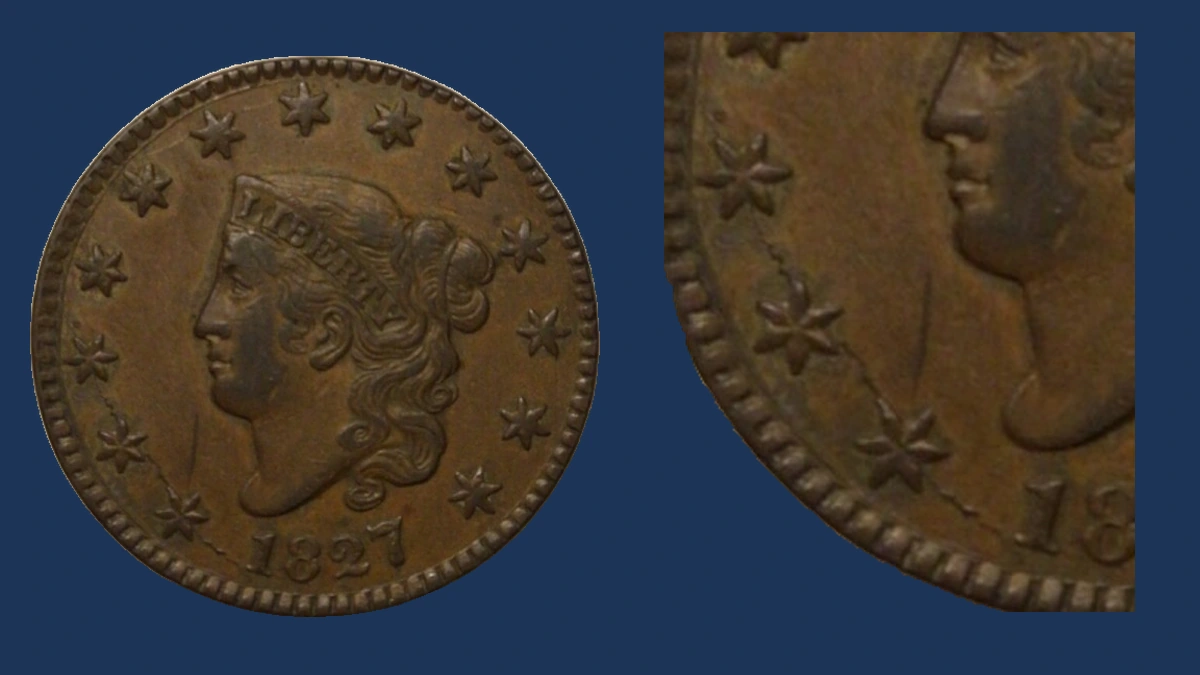
A raised line can run upward between the date’s 1 and 8 toward Liberty’s ear on an 1827 N-12 cent. Strong examples continue across the front, but not every N-12 coin shows the same fully developed crack.
The N-6 variety has a different feature below the date: a broken section of the stamping tool remained in place and shifted. This is called a retained cud.
Some design can remain within that area. A separate dent at ED in UNITED on the recorded N-6 coin is later damage, not another cud.
Estimated Value
The N-6 example, described as VG8, sold for $264 including the buyer’s fee in May 2025. Its retained break and separate rim dent must both be considered when comparing another coin.
Estimate $30–$2,000 for varied cracks and retained breaks, with fine lines near the lower end and desirable pronounced features potentially higher. Scarcity of a particular stage and overall preservation can matter as much as the size of the visible raised area.
How to Identify
Begin at the date to choose the correct visible path: N-12 has the raised line between 1 and 8, while N-6 has the retained break below. These belong to separate coins.
At 10×, distinguish a raised line from a scratch cut into the copper. For the retained break, examine the whole boundary and any surviving design rather than expecting a completely blank lump.
Compare 10.89 grams and about 28 mm using a scale and calipers on a loose coin. Inspect the plain edge, then follow the original break below the date without confusing it with the separate dent at ED.
5. 1827 Coronet Head Cent Off-Center and Repeated Strikes — Estimated Up to $20,000
The two 1827 examples show different striking mistakes. An N-3 cent is recorded with a strike about 30% off center, leaving part of its disc unstamped.
Another cent received two strikes, with one impression about 50% off center at one o’clock. Its overlapping design records the extra blow as well as the displacement.
The ANACS label on the repeated-strike example notes cleaning and Fine detail. Cleaning is later surface damage; it does not cause the shifted design, and that coin’s angle should not be transferred to the separate N-3 example.
Estimated Value
Estimate $400–$6,000 for readable-date off-center pieces and $500–$20,000 for clearly repeated strikes, depending on displacement and condition. The two effects on one combined-error coin are not separate prices to add.
An 1854 off-center large cent brought $1,527.50 in 2016, while an 1811 double strike brought $16,200 in September 2025. Those different-year sales frame the estimates; neither is a realized price for the two 1827 examples discussed here.
How to Identify
Check for a second recognizable impression before calling the coin merely off center. Two portraits or repeated lettering can survive where the strikes overlap, whereas a single misplaced strike has only one design impression.
At 10×, read 1827 and trace the surviving design beside the original unstruck copper. Keep the N-3 30% example separate from the double strike with a 50% displacement at one o’clock.
Weigh against 10.89 grams and measure the actual outline with calipers relative to roughly 28 mm. Inspect the plain edge for cutting or flattening.
Find either one displaced design beside untouched copper or two genuine overlapping impressions; that distinction separates the two striking stories.
Conclusion
For 1827 cents, a mint-made feature can sit beside later damage without sharing its cause. The flake near star seven and the retained break below the date make that distinction especially useful.
Estimated values run from $25 to $20,000, depending on the error and the whole coin’s condition. Compare the correct variety and visible feature, and count a double strike with an off-center impression as one combined-error coin.