1855 Cent Error List with Pictures

A cup-shaped 1855 large cent once became part of the minting press itself. Stuck to a stamping tool, it struck incoming blanks while its own rim curled upward.
Mint Error News reports a $20,470 auction result for that die cap. Smaller features, including the Knob on Ear, offer very different comparisons in this 1855 Braided Hair cent error list.
Estimated whole-coin values span $20–$40,000. Follow the differences below to separate damaged tools, flawed copper, and mistakes made while striking the coin.
1. 1855 Braided Hair Cent Misaligned Die — Estimated Value $25–$750
One face can appear shifted while the other stays more evenly centered. A die, the steel tool that stamps the design, moved away from its proper position relative to the other tool.
The collector’s example is described as having a misaligned front die. It carries an ANACS EF45 Details description, indicating a worn coin with much detail remaining and a condition problem.
The report does not name that problem. It also does not establish a particular direction or distance of movement.
The useful distinction is between the two faces, rather than the width of one isolated rim.
Estimated Value
Estimate $25–$750 for a genuine misaligned-die example, with stronger displacement and better preservation supporting higher comparisons. A small shift may add little to the large cent’s value.
The reported EF45 Details coin needs a price comparison that accounts for its condition problem. No sale amount is assigned to that specimen here.
A worn 1855 coin with a larger, two-sided off-center strike sold for $1,092.50 in January 2009. That different mechanism should not set the price of a slight one-face shift.
How to Identify
Photograph both faces at the same size and keep the date upright. Compare the distance from the design to the rim around the entire front, then repeat the check on the back.
The reported example should show the front shifted relative to the more centered back. If both designs are cut off beside a bare crescent, examine it as an off-center strike instead.
Use a magnifier along the plain edge to look for grinding or added metal. A loose copper cent normally measures 27.5 mm and weighs 10.89 g; check with calipers and a scale.
Before comparing prices, read the holder’s condition wording. EF45 Details does not mean a problem-free example merely because most of the portrait survives.
2. 1855 Braided Hair Cent Clipped Planchet — Estimated Value $50–$1,500
A gap in the edge may have existed before the coin was struck. If so, the press formed the design on an incomplete blank, producing a clipped-planchet error.
The reported 1855 N-3 example was described by its owner as an unusual blank or a clip. That wording leaves the cause of its outline open.
The physical edge must settle the question. A later cut can remove a similar piece of copper but leaves different marks where the cut crosses the struck design.
No specific gap shape or clock position should be assumed from the N-3 variety name.
Estimated Value
If the opening proves to be a mint-made clip, estimate $50–$1,500 for the whole 1855 coin. This conditional range does not certify the owner’s unusual-blank example.
A same-series 1852 clip graded NGC MS63 Brown sold for $384 in June 2024. That unworn coin provides a useful comparison with a different date and known grade.
Wear, surface damage, and how the design meets the opening affect the result. A later cut belongs outside the range even when the shape looks dramatic.
How to Identify
An owner called this N-3 coin an unusual blank or clip, leaving two explanations to investigate. Do not choose between them from an incomplete silhouette alone.
For a loose coin, weigh it against the original 10.89 g standard and measure surviving spans with calipers against 27.5 mm. Examine the remaining plain edge before enlarging the opening with a 10× magnifier.
Look at how the struck rim meets the gap: soft formation can support an incomplete blank, while saw lines or filed grooves point toward later cutting. A weak opposite rim sometimes accompanies a curved clip, but its absence does not decide the issue.
The missing metal’s weight cannot settle the cause either. Both a mint-made clip and later cutting remove copper.
3. 1855 Braided Hair Cent Lamination — Estimated Value $25–$1,500
A thin layer of copper can separate from the rest of the blank. A weak area inside the metal allows a flake to lift or detach, leaving an uneven surface.
The documented 1855 N-4 example has a thin lamination at the bottom rim of the back. It is a local defect, not a coin split into two complete halves.
The same coin also has a raised rim break above E in STATES. That second feature came from a broken stamping tool, while the lamination belongs to the copper itself.
Raised metal and peeling metal therefore need different explanations.
Estimated Value
The N-4 coin cataloged as MS62 sold for $460 before the buyer’s fee in January 2011 at Goldberg. Its price included the coin’s condition and accompanying rim break.
Estimate $25–$1,500 for 1855 laminations across worn and better-preserved coins. A small peeling area can reduce eye appeal rather than add a premium.
Do not add another $460 for the cud on the same specimen. The auction recorded one coin, not separate purchases of its two features.
How to Identify
Leave any loose flake in place. Picking at it can remove the evidence that distinguishes a metal separation from a scrape.
Examine the lower back rim under a 10× magnifier and light from the side. A thin lifted edge or layered surface fits the reported N-4 feature better than a smooth dent with pushed-up metal.
Check whether the defect stays local; this example does not establish a full split coin.
For a loose cent, use a scale and calipers to compare 10.89 g and 27.5 mm, and inspect the plain edge. A tiny flake may cause no useful measurable weight change.
The raised patch above E in STATES is a different clue. Its solid extra metal points to the broken tool instead of peeling copper.
4. 1855 Braided Hair Cent Die Cracks, Cuds, and Knob on Ear — Estimated Up to $3,000
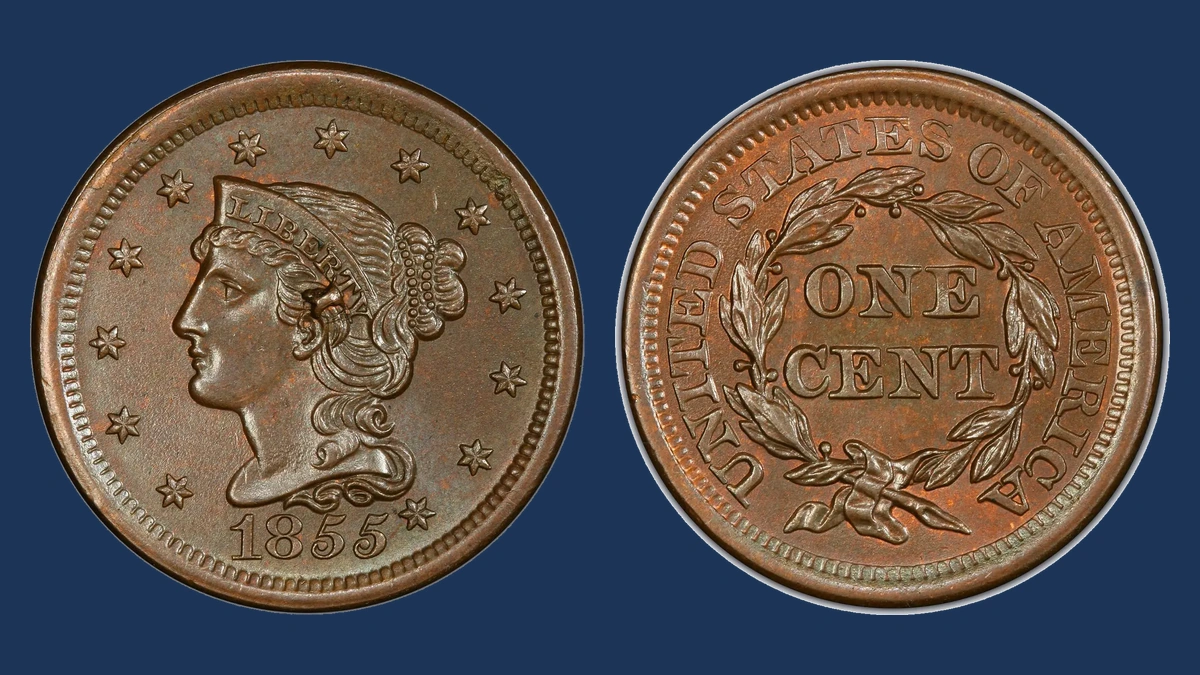
A rounded lump above Liberty’s ear gives one Slanting 55 variety its Knob on Ear name. A piece broke from the stamping tool, and copper filled the opening on later strikes.
Other 1855 tools developed different damage. Upright 55 examples show a raised crack joining the bottom of the last S in STATES to O in OF.
A larger break at the rim can leave a raised patch called a cud. One documented example sits above E in STATES.
The internal ear knob and the rim-connected cud are different forms of tool damage, not matching marks required on one coin.
Estimated Value
For ordinary cracks, estimate $20–$500; identified Knob on Ear or stronger cud examples can range around $75–$3,000. These amounts include the underlying coin and its condition.
The Upright 55 N-4 with a cud above E and a small lamination sold for $460 before the buyer’s fee in January 2011. That is a combined whole-coin result.
The Slanting 55 ear knob is a different variety. Its size and clarity must be compared without borrowing the N-4 specimen’s grade or price.
How to Identify
Identify the date style before choosing a close-up. The Knob on Ear belongs to Slanting 55, while the crack and cud examples discussed here belong to Upright 55.
For a loose cent, check the usual 10.89 g weight and 27.5 mm size with a scale and calipers. The edge should be plain.
Use a 10× magnifier above the ear, near the area below T in LIBERTY, to inspect the knob. Compare its raised shape with the recognized variety, rather than accepting an attached lump.
On the back examples, trace the raised S-to-O line or examine the solid patch where it meets the rim above E. A recessed scratch or folded rim does not reproduce those features.
5. 1855 Braided Hair Cent Off-Center Strike — Estimated Value $150–$5,000
An off-center strike leaves some of the blank unused while part of the design falls beyond its edge. The result can range from a modest bare crescent to a strikingly incomplete portrait.
The recorded 15% example is an Upright 55 cent graded NGC VG10 Brown. Its available description does not fix a direction of movement.
A separate PCGS Fine 15 example is 70% off center toward 10:30, with the date still complete. Both are worn coins, but the amount of missing design is very different.
Their percentages and positions belong to their own photographs.
Estimated Value
The 70% example sold for $1,092.50 on January 7, 2009 at Heritage. Its full date made the dramatically shifted design easy to assign to 1855.
Estimate $150–$5,000 for genuine dated examples, allowing for different amounts of displacement and preservation. The 15% VG10 coin should not automatically receive the 70% specimen’s price.
A readable date and surfaces help collectors compare examples. More blank space is not a guarantee of greater value, particularly when the remaining design is weak or damaged.
How to Identify
Find the boundary between the struck area and the blank crescent. Then follow the lettering toward the opposite edge, where some intended design should have missed the disc.
The known 70% coin has its date intact despite a large shift toward 10:30. Keep that separate from the 15% example, whose direction must come from its actual image.
An intact blank need not lose weight during an off-center blow. For a loose specimen, compare a scale reading with 10.89 g and use calipers to record the outline beside the normal 27.5 mm size.
Inspect the plain edge for grinding. If the back is centered while only the front is shifted, compare the coin with the misaligned-die category instead.
6. 1855 Braided Hair Cent Die Cap — Estimated Value $15,000–$40,000
This coin’s rim rose around a stamping tool until the penny resembled a cup. After its first strike, it stuck to the front die instead of leaving the press.
New blanks entered beneath it. Repeated blows spread the stuck coin’s back and wrapped its edge farther around the tool.
The documented Upright 55 example is graded NGC AU58 Brown, indicating only slight wear. Liberty’s portrait remains sharply formed inside the cup, while the back is flattened and enlarged.
The cap was the coin stuck to the tool, not one of the later coins that received its transferred design.
Estimated Value
Mint Error News reports a $20,470 auction result for the AU58 example. A separate published $40,000 valuation is an estimate, not another realized price.
An estimated $15,000–$40,000 frames a genuine 1855 cap of this importance and quality. The depth, surviving portrait, and natural surface condition are central to that assessment.
A penny bent into a bowl after minting does not qualify. Its unusual shape must be explained by repeated contact with the stamping tool and incoming blanks.
How to Identify
A side view matters as much as the face photographs. Look for a rim that wrapped around the tool, surrounding a sharply stamped portrait inside the cup.
Do not try to flatten it.
Compare the spread-out back with the clear inner portrait under magnification. Those different surfaces reflect repeated contact with fresh blanks on one side and the steel tool on the other.
Keep a certified example sealed. A loose coin can be weighed against the original 10.89 g, but calipers must record the cap’s altered width and height rather than demand a flat 27.5 mm disc.
Examine the former plain edge for cuts, joins, or later bending marks. A bowl shape without the expected design changes is not enough to establish a die cap.
Conclusion
An ear knob, a peeling rim, and a deep cup record different failures in making an 1855 large cent. The first involves a damaged tool, the second flawed copper, and the third a coin trapped in the press.
Estimated values range from $20 to $40,000. Keep normal Upright and Slanting 55 date styles separate, and price combined features on the same coin only once.
For the unusual clip candidate, the edge evidence must establish when its metal disappeared.