1950 Penny Error List with Pictures

The last zero nearly reaches the edge of one silver-colored 1950 penny. Struck on a dime blank, it sold for $3,840 in May 2022.
That unusual piece is only one place to start. This 1950 penny error list covers affordable peeling layers and extra mintmark strokes too, with estimated values from $2 to $6,500.
The following checks explain which details to inspect and why similar-looking marks can have different causes.
1. 1950 Lincoln Penny Grease-Filled Design (Estimated Up to $100)
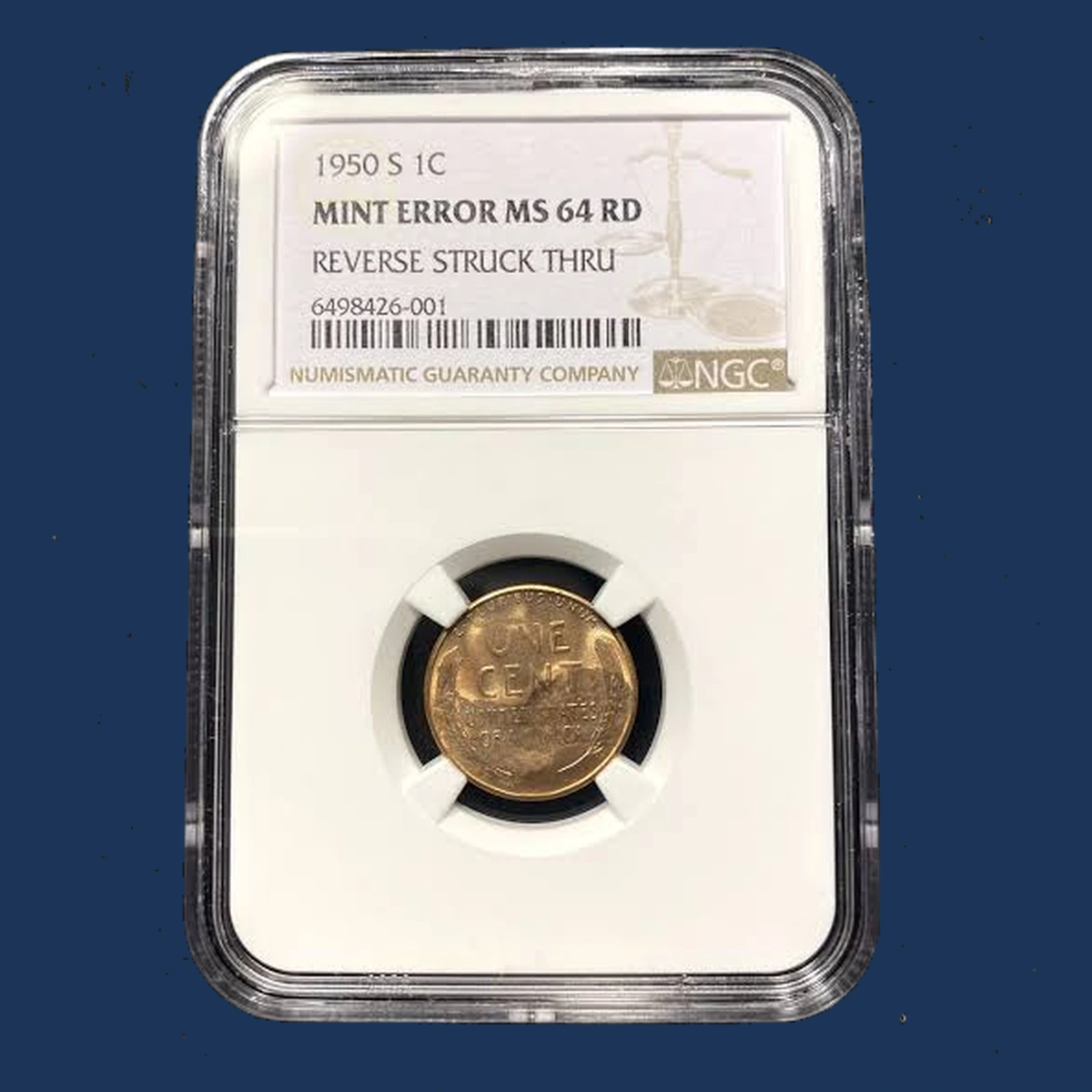
Some front details may look faint even when the surrounding design is sharp. Grease or packed debris can fill a recess in the stamping tool and stop the metal from taking its shape.
A 1950-D example is reported as struck through grease, with the front portrait mentioned in its description. That report does not identify a particular missing letter that should appear on every example.
The effect can change as the blockage moves or clears. A worn portrait, a weak strike, and a polished patch can also lose detail, so the surface needs examination.
Estimated Value
For a genuine localized blockage, use an estimated $2–$100. A small faint patch may add little to an ordinary cent, while a larger clear interruption can be more appealing.
This range compares similar blocked designs on Wheat cents. It is not a completed sale price for the reported Denver piece or proof that a particular missing letter was caused by grease.
Original surrounding detail matters more than an ambitious seller’s description.
How to Identify
Compare Lincoln’s soft areas with nearby letters and the normal high points of the portrait. General rubbing across exposed details may explain ordinary wear.
A 10× magnifier under side lighting can reveal a polished patch or lines where someone removed detail. Look at the transition into the better-formed surface, rather than only at the blank-looking center.
Check the D below the date when matching the Denver report. Do not fill in a missing-letter location from another year’s photograph.
With a scale and calipers, an accessible cent should compare with 3.11 grams and 19.05 millimeters. Inspect its plain edge too, since later metal removal can change both the design and physical measurements.
2. 1950 Lincoln Penny Repunched Mintmark (Estimated Up to $150)
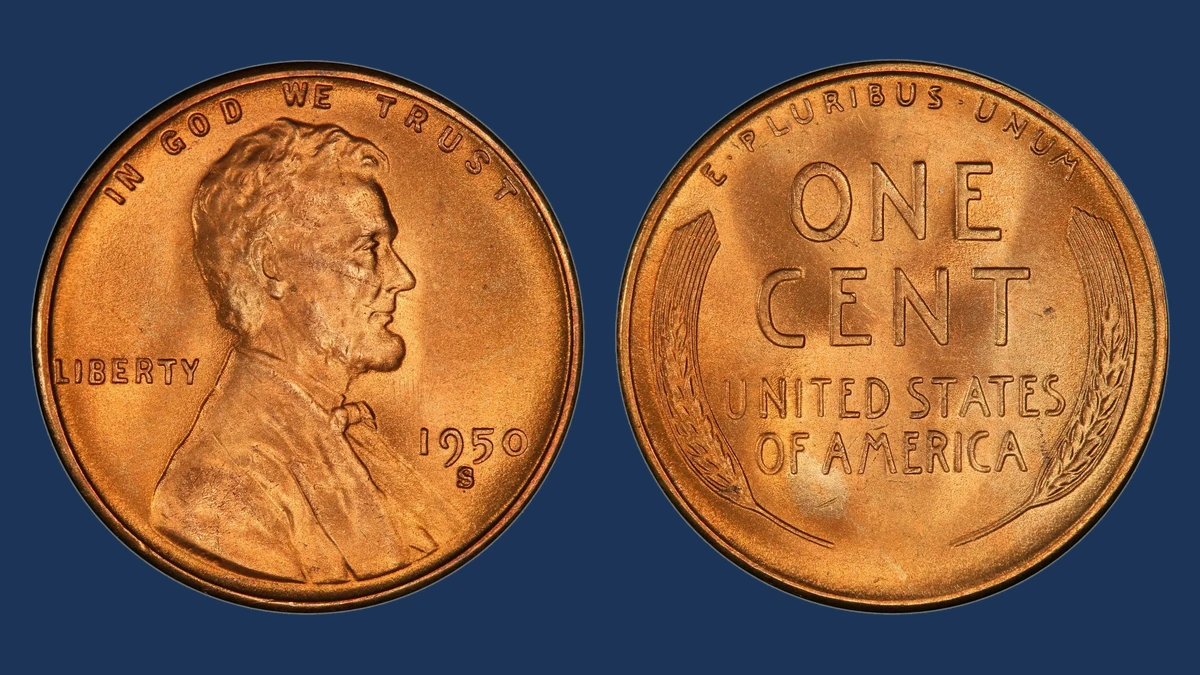
An extra curve below the date may belong to an earlier mintmark impression. Workers punched the small D or S into the steel tool by hand.
If the punch landed again in a shifted position, traces of the first letter could remain. Later coins reproduced those overlapping strokes.
A named 1950-S repunched-S variety appears in PCGS records, and a Denver collector example is also reported. They need separate comparisons because the letter shape and extra-stroke positions differ.
A stain or a blob of raised metal can imitate a second letter at first glance.
Estimated Value
Estimate $5–$150 for identified modest repunched mintmarks, with the clearest unworn examples compared toward the stronger end. Wear can hide the small extra strokes that make the variety recognizable.
The range uses comparable mid-century Wheat-cent mintmark varieties rather than a recorded sale for either reported 1950 piece. A matching letter outline supports more than an unexplained bump.
Cleaning and corrosion should be assessed along with the strength of the repunching.
How to Identify
Place a normal D or S beside the close-up before choosing a variety name. Under a 10× magnifier, trace the main letter’s curves and its small end strokes.
The extra metal should fit another position of that same letter. If it ends as a shapeless lump, compare a chipped tool or later damage instead.
The normal weight is about 3.11 grams, with a 19.05-millimeter diameter and plain edge. A scale and calipers help check the coin, although those readings cannot identify a punch pattern.
Now align the date upright in both your photograph and the reference image. Compare the extra stroke’s direction without rotating one picture until unrelated marks happen to overlap.
3. 1950 Lincoln Penny Lamination (Estimated Up to $200)
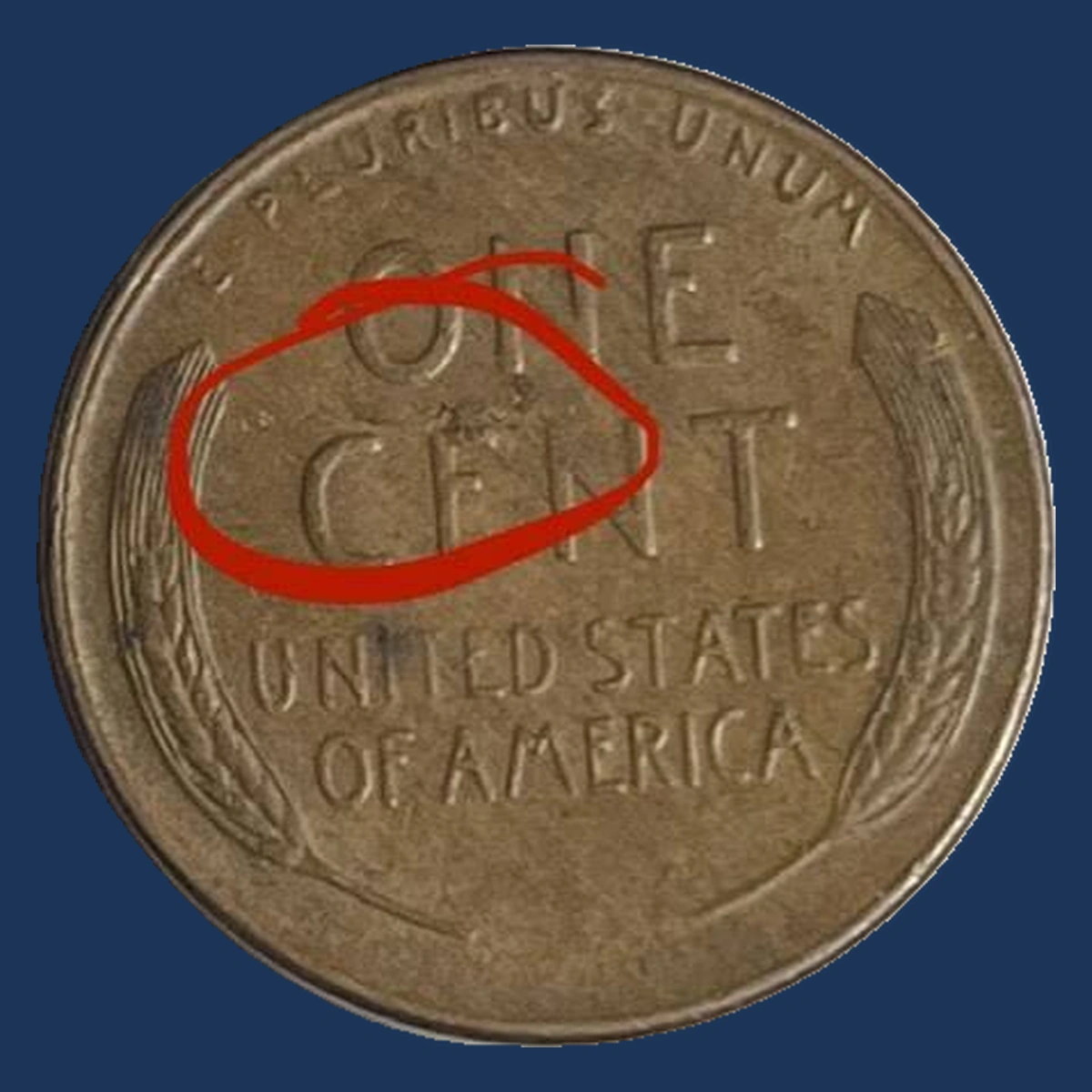
A thin layer can separate from the penny’s solid copper alloy. The weakness may leave a flap, a seam, or a shallow patch where metal has fallen away.
A Philadelphia collector example is described as removed back lamination and graded AU53 Brown. A Denver example has front lamination and an AU50 Brown grade; both grades describe circulated coins.
San Francisco peeling is also reported, without a fixed location supplied here. Its shape should come from the actual specimen.
These cents have no modern zinc core. The separation occurs within the alloy rather than between a copper coating and zinc.
Estimated Value
A working estimate of $5–$200 covers genuine laminations of differing size and preservation. A broad natural peel usually shows the mechanism more clearly than a tiny rough spot.
For comparison, a 1958-D front-lamination cent graded XF45 Brown sold for $24 in September 2012. That later Wheat cent is a historical comparison, not a sale of the 1950 examples.
Preserve an attached flap, since removing it can make the cause harder to establish.
How to Identify
An attached layer should stay exactly where it is. Photograph its raised edge with side lighting instead of pulling it up to expose the underside.
Inspect the visible seam through a 10× magnifier. A shallow sheet separating along the surface differs from scattered corrosion pits or a deep gouge that pushes copper aside.
When metal is already missing, examine the transition from intact design into the exposed patch. The Philadelphia report concerns the back, while the Denver report concerns the front.
A scale can document loss against the normal 3.11 grams. Compare width with 19.05 millimeters using calipers only where safe, and inspect the plain edge if the separation reaches it.
4. 1950 Lincoln Penny Reported Doubled Die Reverse (Estimated Up to $250)
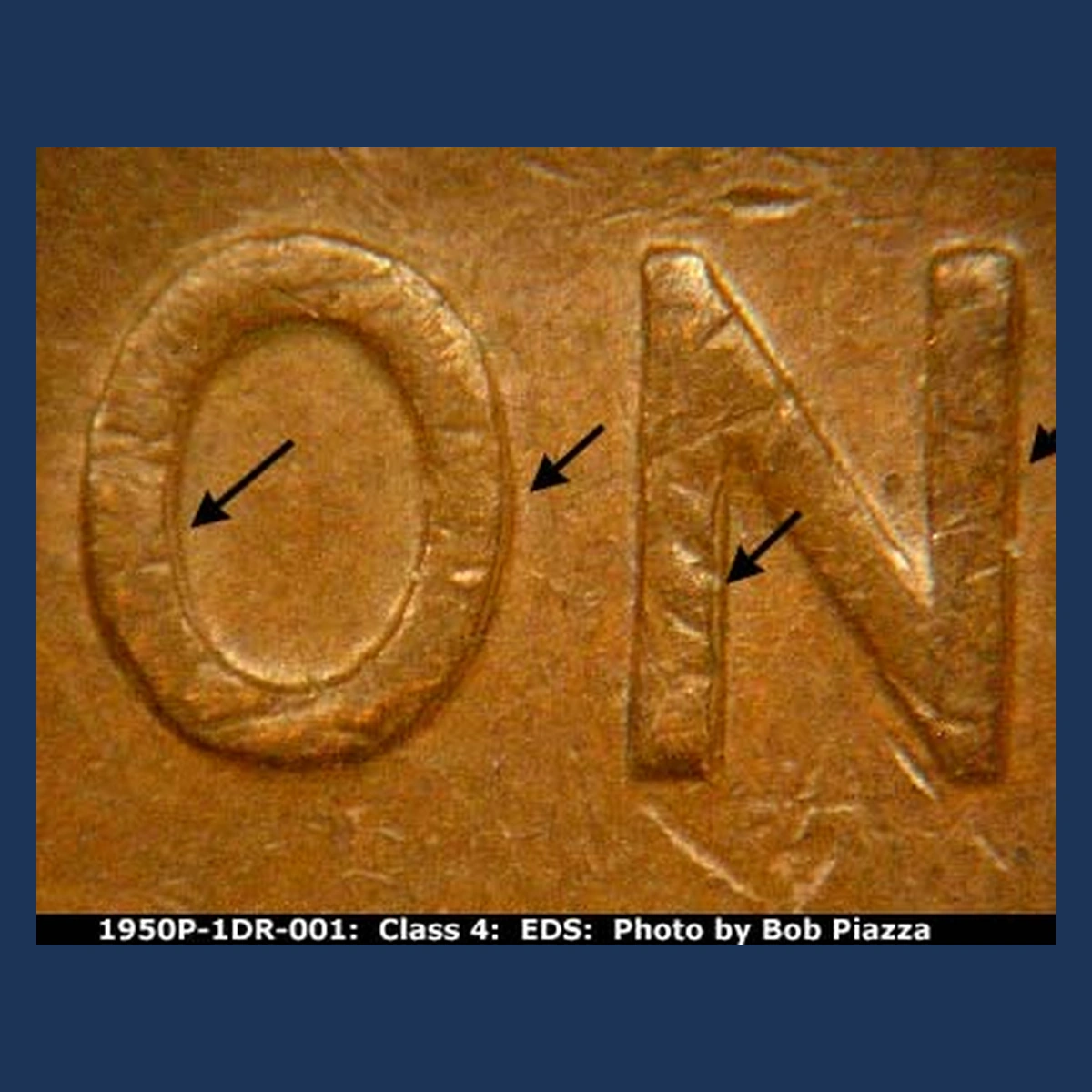
An extra outline on the back may have originated in the stamping tool. A tool with a doubled design can repeat that feature across coins it makes.
Collectors call this a doubled die reverse, with reverse meaning the back. A year-by-year error list reports the type for 1950, without establishing one mint or exact doubled feature here.
The back lettering and Wheat details are therefore places to inspect, not a promise that every named area is doubled. A specific variety must be matched on the actual coin.
Blurred letters and flat extra ledges can have other causes.
Estimated Value
For a genuinely matched minor doubled-back variety, estimate $10–$250. This conditional range compares similar small Wheat-cent design varieties rather than claiming a known 1950 auction result.
The premium depends on visible repeated shapes, the exact variety, and the coin’s preservation. A general listing label cannot supply those missing details.
Do not use prices for famous major doubled-front pennies to value a thick-looking word that has not been matched.
How to Identify
Photograph the back at an angle that shows the height of the letters. Use a 10× magnifier to locate a specific raised extra outline before choosing a reference picture.
Compare that outline’s shape and direction letter by letter. A flat shelf beside a reduced-looking letter may result from movement during striking, while worn lettering can simply look broad.
The reported category does not fix a mint, so retain a clear front photograph showing the date and any D or S. Do not transfer a diagnostic mark from a different mint.
General checks remain 3.11 grams, 19.05 millimeters, and a plain edge, measured with a scale and calipers when accessible. Normal readings cannot establish doubling by themselves.
5. 1950 Lincoln Penny Broadstrike (Estimated Up to $400)
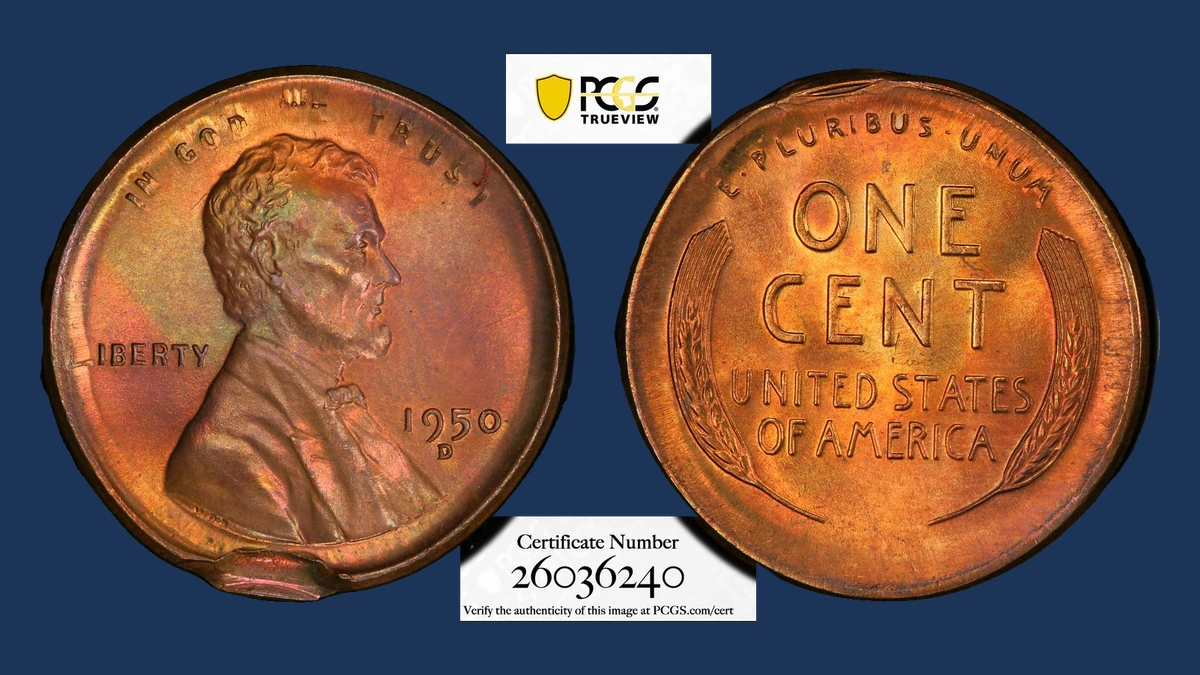
The ring around a blank normally limits its outward spread as the tools strike. That ring is called the collar.
If the blank is not contained normally, the finished penny can be wider than intended. This is a broadstrike, with the intended design remaining inside the expanded outline.
A 1950-D example graded ANACS MS64 Red and Brown appears in an auction record. Its grade indicates an unworn coin with some marks and mixed copper color.
Broadstriking can also accompany a second blow, but the single broadstrike discussed here should not acquire that other coin’s extra impression.
Estimated Value
The ANACS MS64 Red and Brown broadstrike sold for $53 in January 2023. An estimated $30–$400 allows for different amounts of visible spread and preservation.
The result is for the ordinary broadstrike, separate from the Denver double-struck combination described later. A second tiny strike does not belong on every wide 1950-D cent.
An undamaged expanded edge is important, since hammering can make a normal penny wider without creating a Mint error.
How to Identify
Measure the widest and narrowest points with calipers, comparing them with the normal 19.05-millimeter diameter. A complete blank can still weigh near 3.11 grams despite the extra width.
Now trace the outer letters on both faces. Missing intended design beyond the blank calls for checking off-center striking, whereas an uneven expanded border can still contain a full design.
A 10× magnifier helps inspect the plain edge for joins, attached metal, or later flattening. Look across Lincoln’s portrait for crushed details that could accompany hammer damage.
Confirm the D below the date when matching the documented coin. If a second design fragment appears at the edge, use the multiple-strike checks as well.
6. 1950 Lincoln Penny Chips, Cracks, and Cuds (Estimated Up to $600)
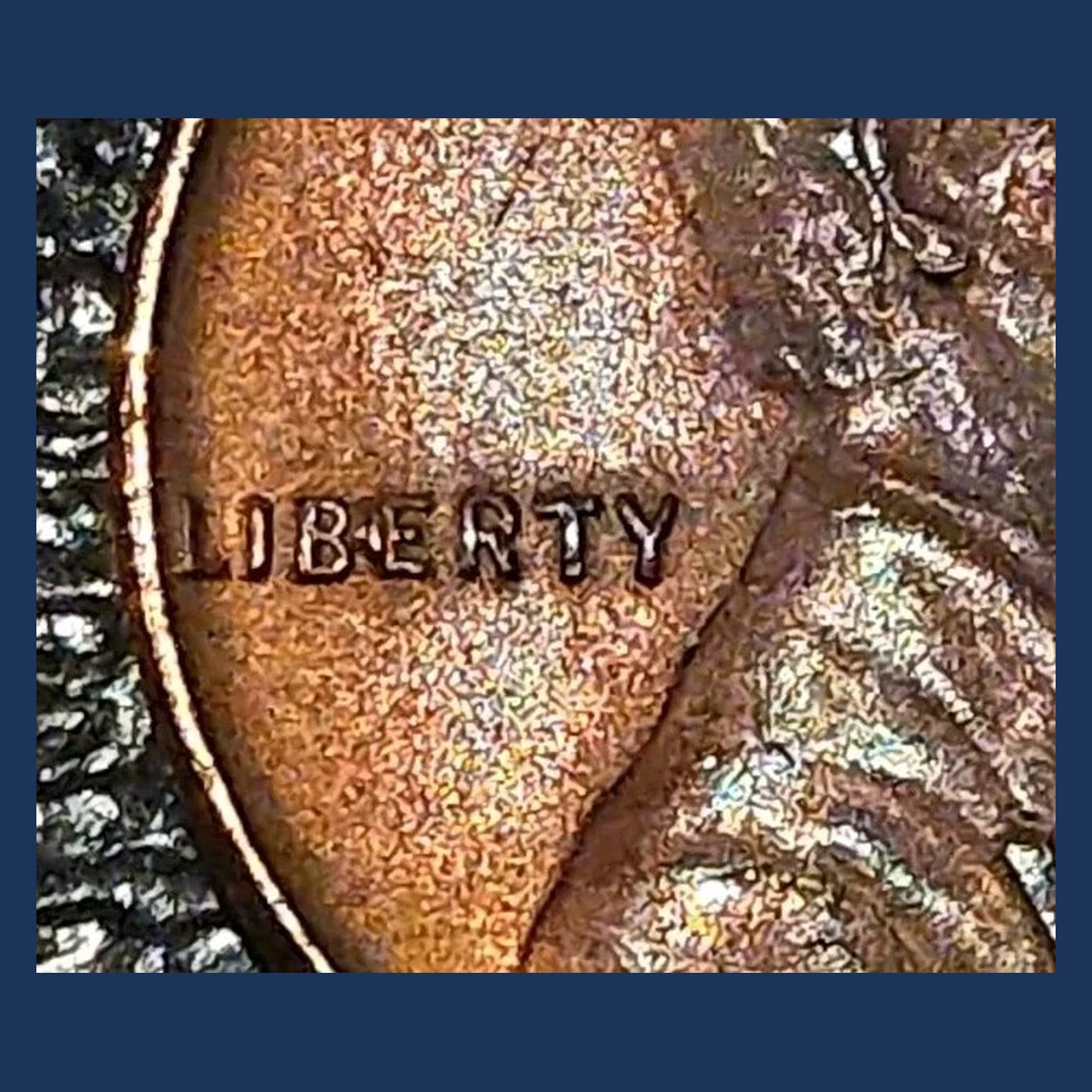
A thin raised line can trace a crack in the stamping tool. A small piece breaking away leaves a lump where coin metal fills the new opening.
Between B and E in LIBERTY, such a lump may resemble an extra I. This is the familiar BIE chip.
A larger missing tool area at the rim produces a cud, replacing normal design with raised metal. A recorded 1950-D example has a front cud near six-thirty and a VF30 Brown grade.
That worn coin’s rim break should stay separate from small interior chips or cracks reported elsewhere on 1950 cents.
Estimated Value
Small cracks and BIE chips have an estimated range of $2–$50. For a clearly identified rim cud, allow roughly $50–$600, depending on its size and the coin’s preservation.
A 1958-D front cud graded MS64 Brown sold for $312 in March 2021. That unworn later-year example provides a comparison for a substantial break.
The recorded 1950-D VF30 coin has more wear, and a tiny raised line should not inherit a major-cud price.
How to Identify
At six-thirty on the Denver front, check whether the raised patch actually joins the rim. A large interior lump needs a different name even when it looks equally dramatic.
For a suspected BIE, read the letters beside it. A chip between other letters is not the same B-to-E feature.
A scale and calipers should compare the cent with 3.11 grams and 19.05 millimeters. Inspect the plain edge for squeezing or added metal before treating a blob as original.
Now move a lamp across the line or patch and examine it at 10×. A tool crack leaves raised metal; a scratch cuts downward, often with disturbed copper along its sides.
7. 1950 Lincoln Penny Clipped and Elliptical Blanks (Estimated Up to $900)
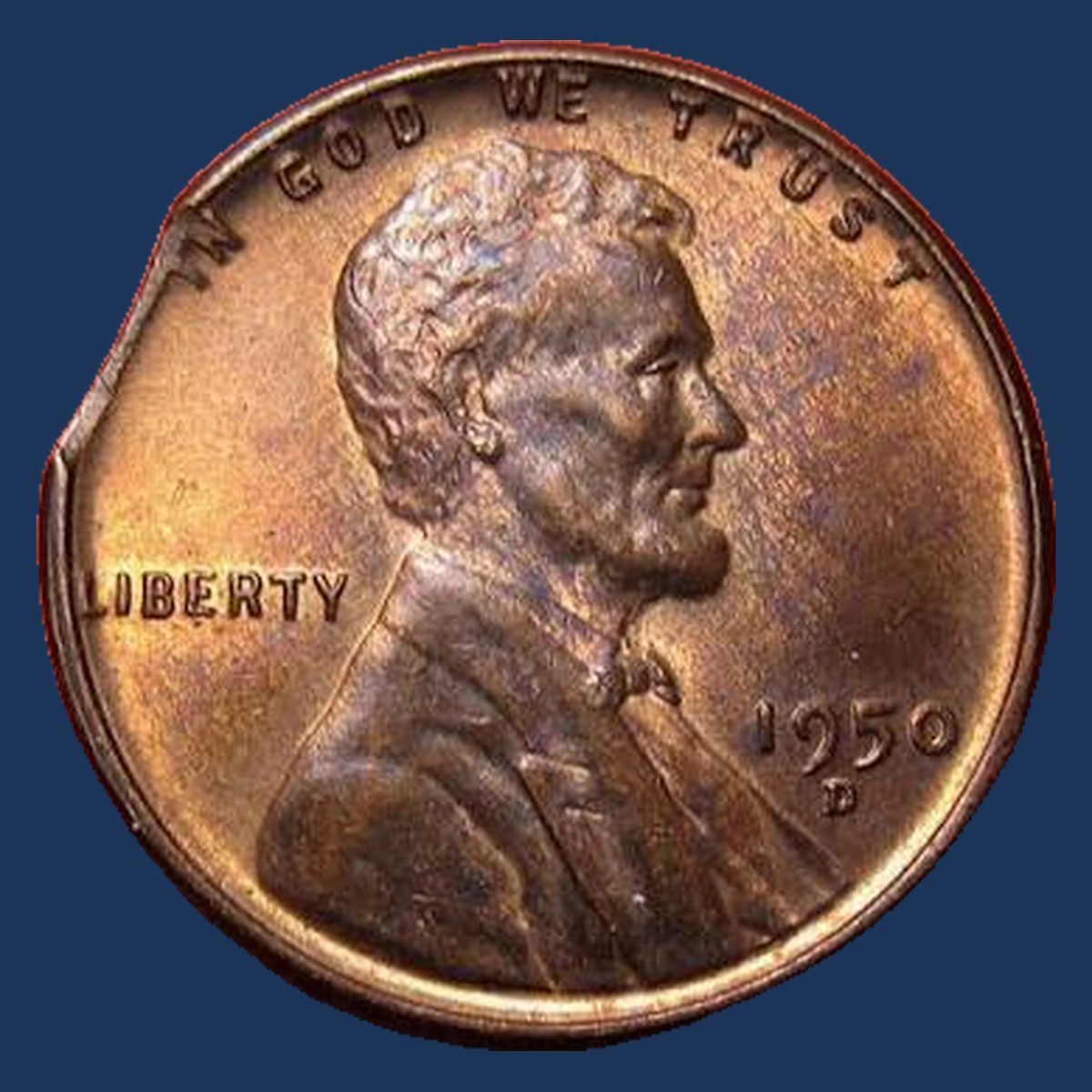
An incomplete blank can produce several different penny shapes. A small missing edge and a narrow lens-shaped piece can both begin during blank cutting.
A Philadelphia example has a 4% straight clip near ten o’clock. Denver collector records include a 13% curved clip and a separate 10% ragged-end clip.
Another Philadelphia cent was struck on an elliptical blank and graded PCGS MS64 Brown. Its overall lens-like outline differs from a nearly round disc with a small notch.
The clipped blank was incomplete before striking. Later sawing or corrosion can remove metal from a finished penny instead.
Estimated Value
The PCGS MS64 Brown elliptical example brought $576 in July 2022. Estimate $15–$350 for ordinary straight, curved, or ragged clips and $150–$900 for comparable elliptical pieces.
These ranges account for different shapes and condition, not four premiums to add to one coin. A readable date and natural strike at the missing edge help support the identification.
A later cut receives no mint-error premium, even if its outline looks unusual.
How to Identify
The PCGS clipping guide shows the small straight gap on the Philadelphia example. Keep that outline separate from the curved, ragged, and elliptical forms.
Use a scale to record missing metal against 3.11 grams. Calipers can compare intact spans with a normal 19.05-millimeter circle, but should not be used to invent a round diameter for a lens-shaped piece.
Under a 10× magnifier, follow each boundary where it meets the struck rim. Look for filing, saw lines, or cuts across completed letters.
Opposite-rim weakness can support a small clip without appearing equally on every specimen. For the elliptical blank, compare the long curved sides and surviving date rather than expecting one isolated notch.
Photograph the plain edge from the side so its original texture remains visible.
8. 1950 Lincoln Penny Off-Center Strike (Estimated Up to $1,000)
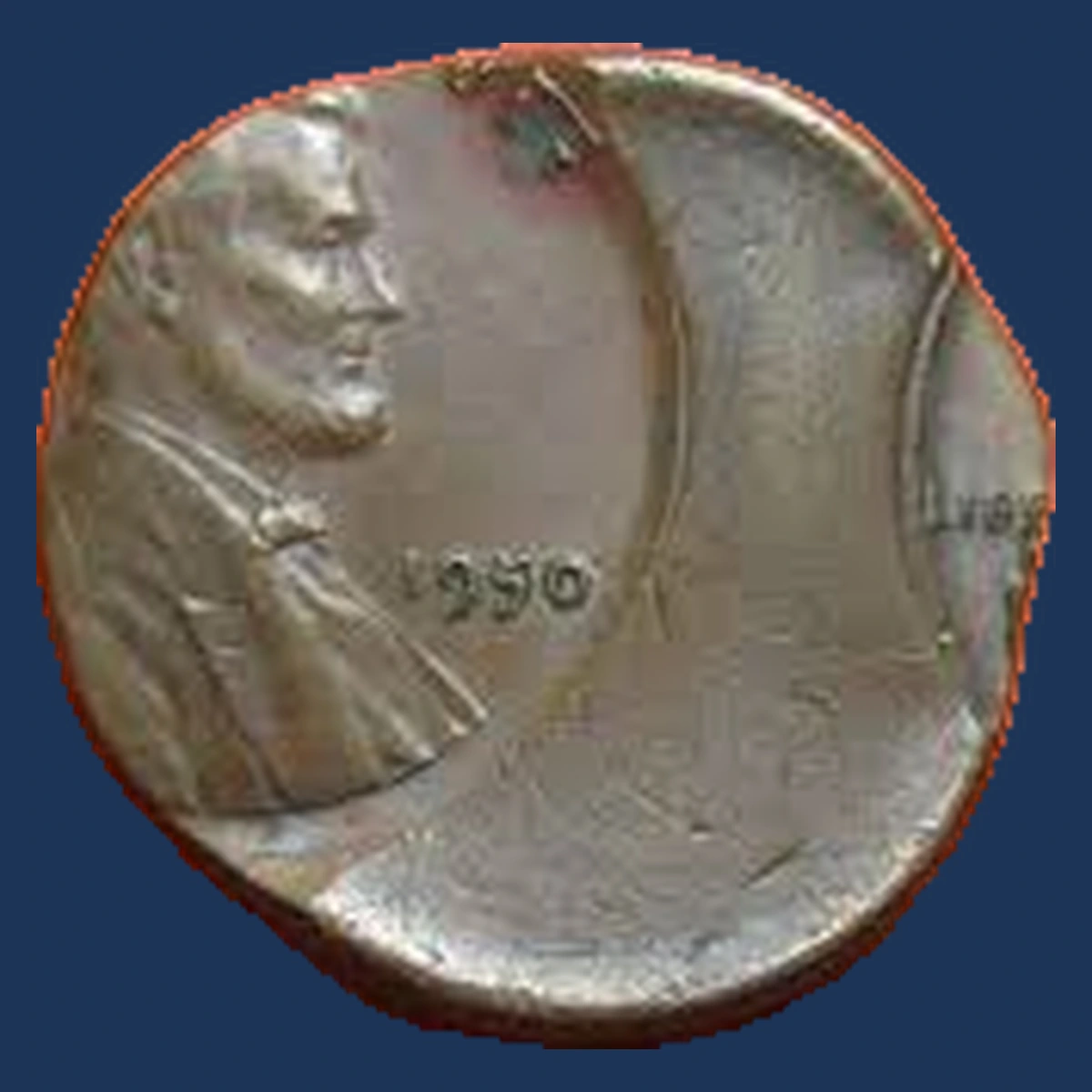
An off-center blank receives only part of the intended design. Metal outside the striking area remains blank, forming a plain crescent beside the portrait and lettering.
Denver records include separate 35%, 65%, and 80% off-center cents. San Francisco has a reported 5% example graded AU55, indicating light wear.
Those percentages describe different coins. They do not form a sequence of changes on one penny, nor establish one shared direction.
A coin with a complete design surrounded by extra width may instead be a broadstrike. Both faces help show which position the blank occupied in the press.
Estimated Value
A 1950-D 35% off-center coin graded NGC MS63 Brown brought $192 in October 2021. A separate 65% PCGS MS63 Brown example sold for $264 in July 2022.
Use an estimated $20–$1,000 across different shifts and conditions. The two results concern unworn coins with noticeable marks.
A readable date helps buyers collect the year. Greater displacement does not guarantee more money when it removes important digits or accompanies damage.
How to Identify
Read all four date digits before judging the size of the blank crescent. The date may be the part most affected by an extreme shift.
Put front and back photographs beside each other. Both incomplete designs should fit the same displaced metal disc; a shifted front opposite a centered back points toward a different tool-alignment problem.
Weigh an accessible example against 3.11 grams and record its outline with calipers against the normal 19.05 millimeters. A full off-center blank can retain its original weight.
Under a 10× magnifier, inspect the plain crescent and edge for grinding or erased design. Check the D or S against the particular comparison photograph before borrowing its stated percentage.
9. 1950 Lincoln Penny Struck Through a Late-Stage Die Cap (Estimated Up to $1,200)
One penny can stick to a stamping tool and cover it like a cap. Later blanks receive an impression through that trapped coin instead of directly from the tool.
As repeated blows thin the cap, the underlying design may begin to show through weakly. The resulting face can look broad, blurred, or ghostlike.
A Philadelphia 1950 collector example is described as a late-stage die-cap strike and graded MS63 Brown. The grade indicates an unworn coin with marks and brown copper color.
It is the newly struck coin being described, not necessarily the cap that caused the soft image.
Estimated Value
Estimate $100–$1,200 for a genuine 1950 late-stage cap strike, depending on the affected design and preservation. A clear contrast between the faces can make the error easier to understand.
A 1952 front cap-struck cent graded MS63 Brown sold for $89 in November 2020. That different-year example offers a historical comparison.
The estimate is not a sale assigned to the reported 1950 coin, and ordinary wear or polishing does not qualify.
How to Identify
Compare the two faces before zooming in. A cap can interfere with the impression on one face while the other receives a more direct strike, so uniformly rubbed surfaces need a different explanation.
Record an accessible coin’s weight with a scale and width with calipers, using 3.11 grams and 19.05 millimeters as normal standards. Examine the plain edge for later flattening, then use a 10× magnifier across the affected face.
Look for weak design that fits pressure through a covering layer, rather than scratches that remove completed detail. Keep the whole-face photograph with the close-ups; a small isolated weak letter cannot by itself establish the late-stage cap described in the record.
10. 1950 Lincoln Penny Indent with a 95% Off-Center Strike (Estimated Up to $1,500)
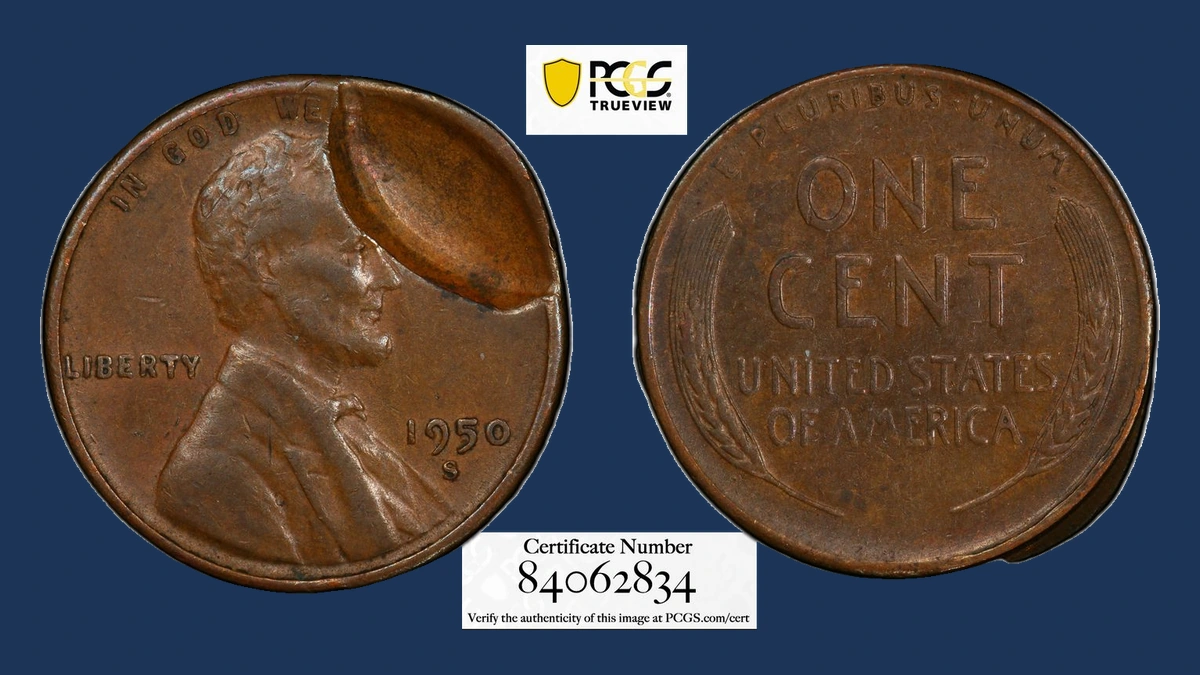
Only a small part of the design reached one 1950-D blank during an extreme off-center strike. Its collector record also describes an indent on the back.
An indent can form when another blank overlaps the coin and blocks part of the stamping tool. The overlapping piece presses a depression into the metal beneath it.
This example is listed as 95% off center and graded MS63 Brown. Its surviving design, blank area, and back depression belong to one coin.
The description does not identify an attached second blank or a matched pair. Those would require separate evidence.
Estimated Value
For an authenticated example of this combination, use an estimated $150–$1,500. A readable date and a clearly original back depression help explain what buyers are considering.
A 1964 broadstrike with a 7% indent sold for $54 in March 2025. That later, less extreme combination is a related mechanism comparison, not the price of the 1950-D piece.
The off-center strike and indent need one whole-coin assessment rather than added top-end estimates.
How to Identify
Find the surviving 1950 date and D before turning to the back depression. On a 95% off-center strike, very little design may be available to establish the year and mint.
Record the scale weight against 3.11 grams and caliper dimensions against a normal 19.05-millimeter cent. Those comparisons describe the metal that remains, not the percentage of design impressed.
At 10×, follow the depression’s border and look at how struck detail meets it. A later punch may push copper into a sharp lip or cut across an already formed design.
Inspect the plain edge and untouched areas for separate damage. Keep the face views together so the off-center impression and the back indent can be checked as features on the same coin.
11. 1950 Lincoln Penny Double Strike (Estimated Up to $3,500)
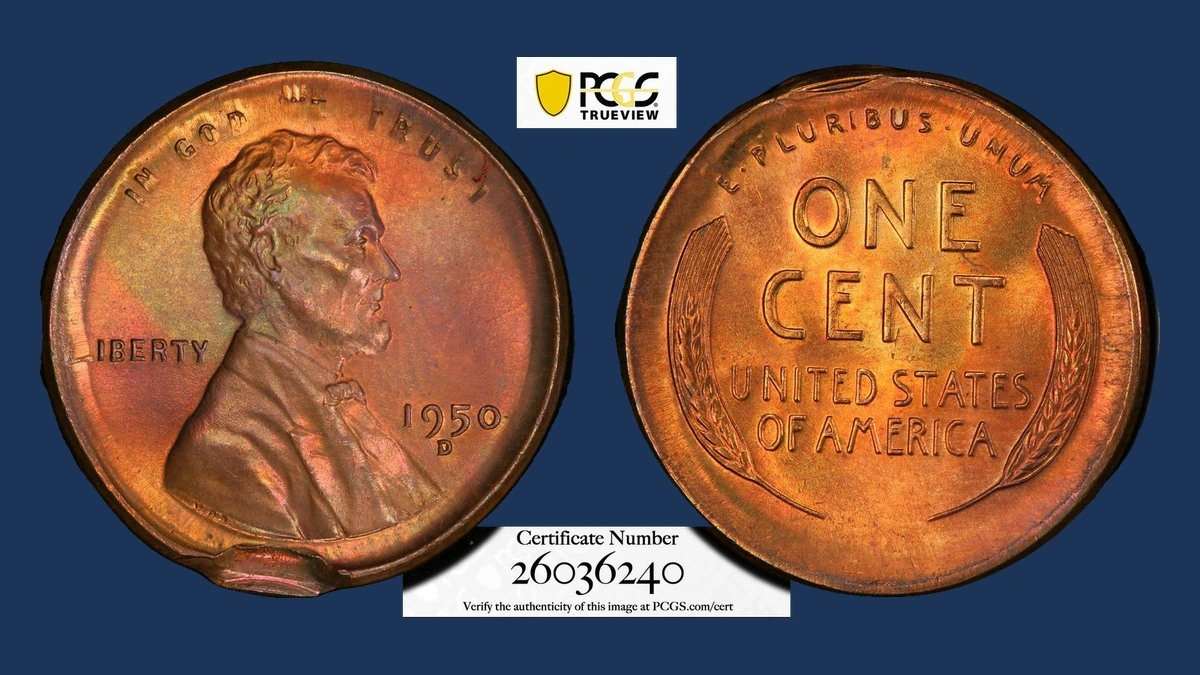
A second press blow can leave another date or a small new design fragment. The amount showing depends on how the coin moved after its first strike.
A Philadelphia example has a second strike 75% off center. A Denver broadstrike instead received a tiny second contact 98% off center.
Another Denver collector coin was struck twice inside the collar, with a reported 75-degree turn between blows. The collar is the ring surrounding the blank during striking.
The abbreviation D/S in that collector description means double strike. It does not identify a D mintmark punched over an S.
Estimated Value
The Philadelphia PCGS MS64 Red and Brown example brought $2,280 in May 2022. The Denver broadstrike with a 98% second strike, graded MS65 Red and Brown, sold for $95 in November 2020.
Estimate $75–$3,500 for these different double-strike forms. The contrast shows how much the visible overlap matters.
A percentage alone does not set value. The in-collar rotated example must be compared using its own surviving impressions and wear.
How to Identify
For the Philadelphia coin, locate the first design outside the second blow, then trace the shifted second lettering. Use a 10× magnifier to check another feature for the same movement.
The 98% Denver second strike leaves only a narrow extra contact. Do not expect a full second portrait.
On the in-collar example, look for two design positions turned within the same surrounding outline. A front-to-back alignment check alone cannot prove that the coin received two blows.
Compare weight with 3.11 grams on a scale and width with 19.05 millimeters using calipers. Repeated striking can change the outline without adding copper.
Inspect the plain edge for later pressing or joins. Photograph the separate date or letter positions instead of counting every ridge as another strike.
12. 1950 Lincoln Penny Struck on a Wrong Blank (Estimated Up to $6,500)
A smaller silver blank can leave outer cent lettering beyond the available metal. On a Philadelphia 1950 example, the date survives but its final zero approaches the edge.
PCGS graded that silver-dime-blank coin MS64. Separate Denver examples include a lightly worn AU53 piece and a cleaned coin with XF45 detail.
One other Denver listing says quarter blank but gives a 2.5-gram weight. That figure fits the silver dime standard rather than the 6.25-gram quarter standard.
The conflicting record needs its original coin and label checked. It should not establish a new quarter-blank rarity from the title alone.
Estimated Value
The Philadelphia MS64 dime-blank cent sold for $3,840 in May 2022; the Denver AU53 example brought $1,440 that month. Estimate $700–$6,500 for comparable authenticated wrong-blank pieces.
The conflicting quarter-title listing realized $1,800 in January 2022. That sale does not resolve its blank identity.
A buyer should use the coin’s measured metal, dimensions, and correct attribution before choosing a comparison within the range.
How to Identify
A precise scale can separate a normal 3.11-gram cent from the 2.50-gram silver dime standard. Calipers provide another comparison: 19.05 millimeters for a cent versus 17.91 millimeters for a dime before any spreading.
On the Philadelphia example, inspect the complete date, distorted L, and cropped top of E PLURIBUS UNUM with a 10× magnifier. These features belong to that coin and should not be transferred to a Denver specimen.
Check the edge for a coating and obtain professional metal testing where needed. For the quarter-title record, request the original label and actual measurements rather than assuming either title or weight is the corrected answer.
Conclusion
One penny can have both a broadstrike and a second tiny strike; another may show only a small raised bar in LIBERTY. Judge the features actually present on the coin rather than adding separate top-end estimates.
The estimated $2–$6,500 range includes modest finds and identified wrong blanks. For unusual metal, measurements and composition matter more than color.
Keep clear photographs of both faces and the edge, and protect any loose layer.