1850 Dollar Coin Error List with Pictures

A second curve beneath the date’s zero can be easy to miss on an 1850 dollar.
A Proof is a specially made collector coin. One with a repunched date sold for $49,200 in December 2025.
This 1850 Liberty Seated dollar error list looks at repeated date details and raised cracks, with estimated whole-coin values of $1,000–$75,000. Ordinary strikes and specially prepared Proofs need separate comparisons.
Read on to follow the lines across the date and lettering without mistaking scratches for Mint-made features.
1850 Liberty Seated Dollar Raised Cracks through Letters or the Date
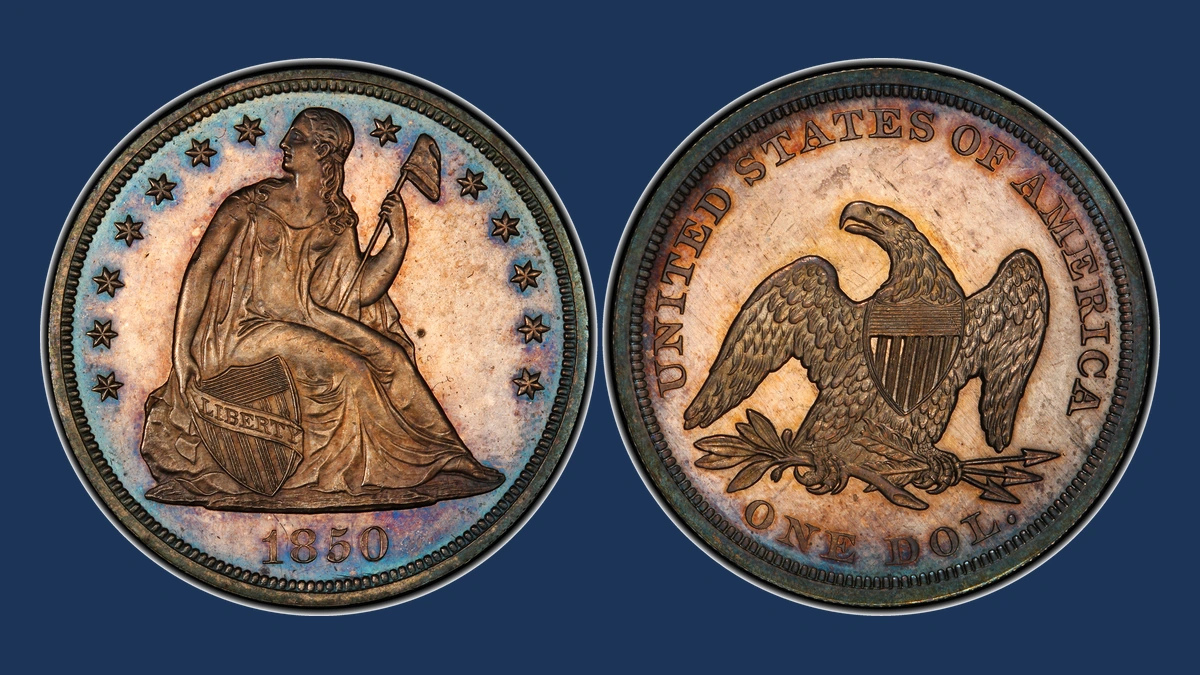
A raised line can pass through the lower part of the O in ONE and reach the border teeth beneath N. Another reported route crosses the tops of UNITED and returns to the border above ST in STATES.
These are cracks in a die, the steel tool that stamps the design. Silver entering the cracks forms raised lines on the coin.
Some Proofs have a different crack along the base of the date. Proofs are specially prepared coins, and that front-side line should not be confused with the ordinary dollar’s back patterns.
Estimated Value
For ordinary Philadelphia dollars with matching cracks, estimate $1,000–$35,000 across worn through highly preserved unworn conditions. Much of that value comes from the scarce date itself.
An ordinary MS64 sold for $32,200 in May 2003, according to PCGS. That is a general whole-coin comparison, not a stated sale of a particular cracked example.
For an authenticated Proof with the reported date-base crack, use $15,000–$75,000. Its Proof identity and surface preservation require separate assessment.
How to Identify
Under a magnifier, locate the O in ONE near the bottom of the back. Follow the reported raised line through its lower part toward the border teeth beneath N, keeping both letters in view.
Now inspect the tops of UNITED and the border above ST in STATES. Move the lamp from side to side to check whether the line rises above the silver, rather than joining unrelated scratches into a route.
A recognized Proof needs a separate examination along the base of its date. That front-side crack can help identify a tool pattern, but cannot by itself establish whether the Proof was made in 1850 or later.
1850 Liberty Seated Dollar Extra Curve beneath the Zero
An extra curved remnant can sit at the bottom of the zero. The date punch entered the stamping tool more than once, leaving part of its earlier position visible.
An ordinary-strike example is cataloged as OC-1, while the Proof variety is identified as OC-P1. Those names distinguish particular tool combinations; they are not grades.
The resulting feature is called a repunched date. It does not mean the whole dollar was struck twice.
Keep the two kinds of coins separate even when their extra date curves look similar. A reflective ordinary dollar is not automatically a Proof.
Estimated Value
Estimate $1,000–$35,000 for ordinary-strike examples and $15,000–$75,000 for recognized Proofs. These are whole-coin ranges across differing grades and surface quality.
The CACG Proof-64 Cameo OC-P1 brought $49,200 in December 2025, as recorded by PCGS. Cameo describes frosted designs standing against reflective backgrounds.
That sale prices a scarce, specially prepared coin. A matching curve on an ordinary dollar does not give it the same value, and cleaning still reduces collector appeal.
How to Identify
Focus a magnifier on the lower edge of the zero. The earlier punch should leave a small curved remnant that follows the numeral’s shape.
Change the light angle to separate raised silver from a dark stain or shadow. A straight cut crossing the zero does not match a second curved stroke.
Compare the complete date with a close-up of the same ordinary-strike or Proof variety.
The opening in the neighboring 5 is not evidence of repunching by itself. Its shape needs to be distinguished from extra strokes beside the zero.
Keep both full faces in your photographs so a specialist can assess the coin’s manufacture as well as its date. A reflective crop alone cannot identify a Proof.
Conclusion
The 1850 dollar’s raised lettering cracks and repeated zero offer specific places to check. Follow the reported paths and compare ordinary strikes with ordinary strikes, keeping Proofs in their own group.
Estimated values span $1,000–$75,000, while the $49,200 result belongs to one Proof-64 Cameo. A small repeated date curve is part of the identification, not a substitute for judging the complete coin.