1971 Dollar Coin Error List with Pictures

A copper-colored Eisenhower dollar may be missing metal—or may have been struck on something entirely different. One specially prepared 1971-S Proof collector coin struck over a finished Assay Office medal brought $40,800 in August 2022.
These 1971 Eisenhower dollar errors span an estimated $20 to $60,000. Tiny doubled details sit at one end, while unusual metal and overlapping designs can reach the other.
Use the examples below to check what you can actually see on your coin.
1. 1971 Eisenhower Dollar Peeling Surface Metal
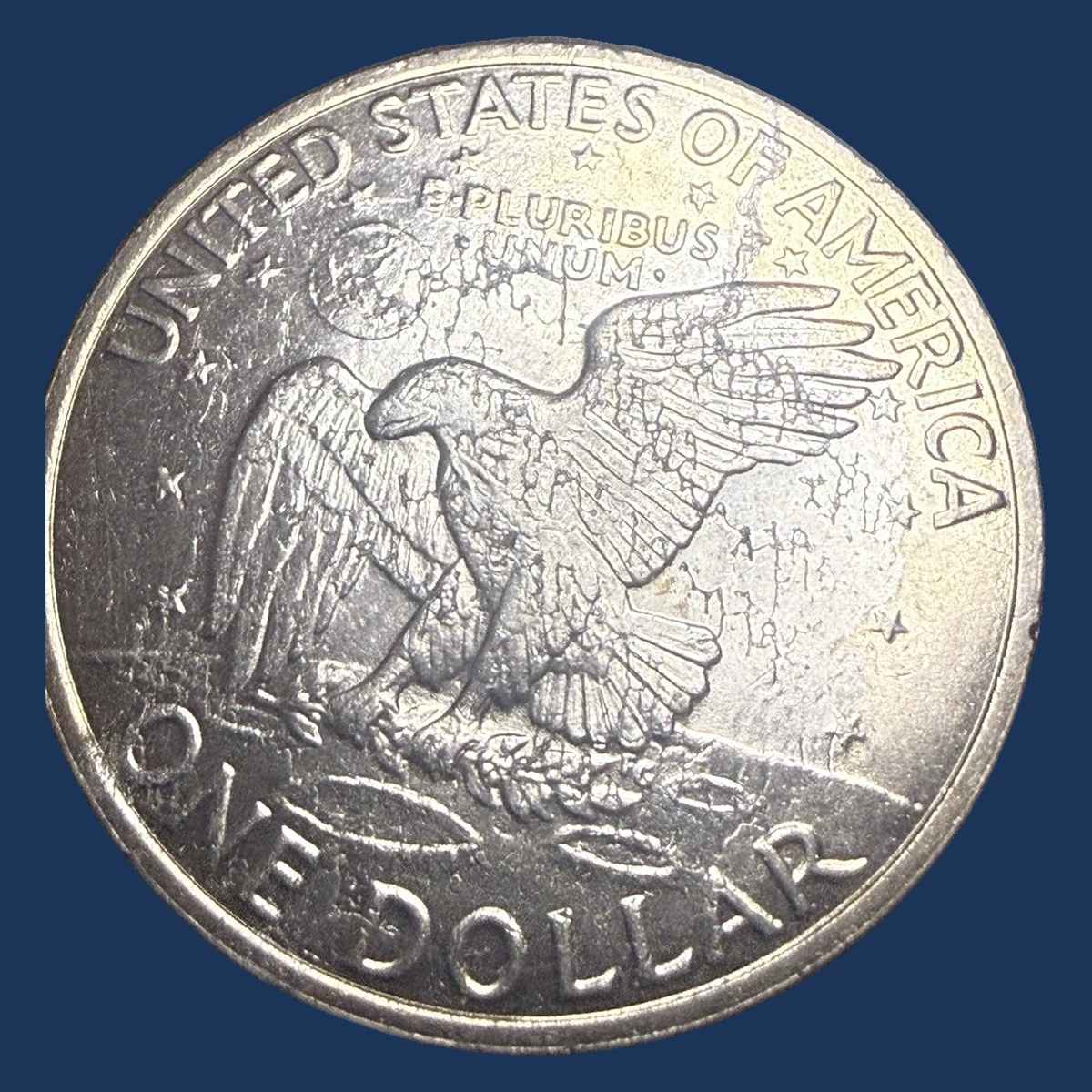
A split or peeling patch can interrupt Eisenhower’s portrait side. When metal fails to hold together, a thin piece may lift or break away from the surface.
Collectors call this a lamination. The ANA museum list records Denver examples with front laminations, but does not place every defect at one exact point on the portrait.
The surrounding stamped details help show how the separation formed. This local peeling differs from a missing outer layer across an entire face, even though both problems can expose a different-looking surface beneath the original one.
Estimated Value
The size and visibility of a peel usually matter more than a dramatic nickname. Estimate $25 to $750 for authenticated ordinary Denver examples, from minor patches to conspicuous separations.
As a same-series comparison, a 1976 Type 1 front-lamination dollar sold for $37 in August 2021. That different-year result shows the affordable end; large original peels with attractive surrounding surfaces can bring considerably more.
How to Identify
Protect any flap that is still attached. Lifting it to look underneath can break it away and remove useful evidence.
With a magnifier and low angled light, follow the boundary between intact design and separated metal. A genuine peel may leave stamped detail on a thin flap or an irregular torn area beside it.
Compare that boundary with scratches, corrosion, and impact damage. Scraping tends to leave directional marks, while corrosion can produce scattered pits beyond the main patch.
Photograph both the surface and the flap’s profile without touching the loose section. The Denver museum reports establish front laminations, so identify the actual location from the coin instead of assuming a standard cheek or forehead position.
2. 1971 Eisenhower Dollar Doubled Dies
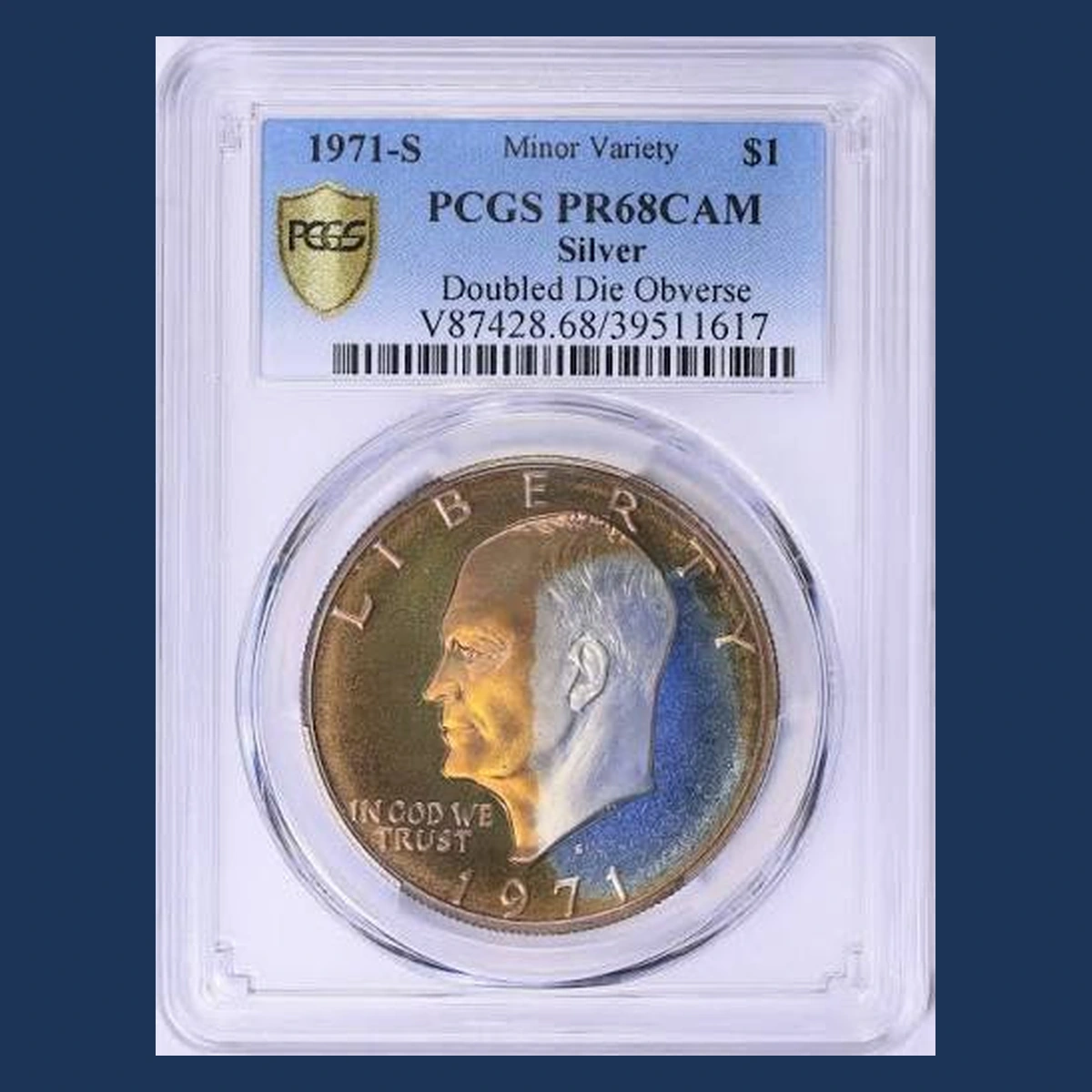
Extra raised edges in letters can be copied from a doubled die, the steel tool that stamps coins. Some 1971 dollars show doubling in the motto, date, or back lettering.
The varieties span Philadelphia and Denver ordinary coins, plus ordinary and Proof silver coins from San Francisco. Proofs are specially prepared collector coins, so their patterns need separate comparisons.
Some repeated details came from shared earlier tools used to make many stamping tools. That common background does not automatically make every doubled-looking dollar a scarce variety with a large premium.
Estimated Value
Allow an estimated $20 to $2,500 across minor and stronger identified varieties. Clear separation on a well-preserved coin can support more interest than faint thickness visible only under difficult lighting.
This comparison-based range covers different mint and finish combinations, rather than one interchangeable variety. Common inherited doubling may add little to the ordinary coin’s value, while an attractive example of a recognized stronger pattern can command substantially more.
How to Identify
Select a comparison with the same mint and finish before matching any small lines. A San Francisco Proof’s lettering cannot identify an ordinary Denver dollar.
On the front, examine IN GOD WE TRUST, the date, and LIBERTY under a 10× magnifier. Look for separated raised tips or repeated outlines instead of a low, flat shelf beside a letter.
For a back variety, follow the lettering, stars, and nearby eagle or branch details. The strong S Proof variety called FS-801 includes separation in the outer words, stars, and the ending of DOLLAR.
Some coins have doubling on both faces. Compare the paired patterns together rather than assigning two full coin prices to the same dollar.
3. 1971 Eisenhower Dollar Broadstrike
The border can spread wider when the metal ring around the blank fails to contain it. That ring, called the collar, normally controls diameter and forms the edge grooves.
A silver 1971-S example graded MS66 by NGC, meaning unworn with few marks, has an almost evenly expanded outline. The spread is slightly greater below the portrait and above the eagle.
The intended design remains on the coin, which distinguishes a broadstrike from a strike that misses part of the blank. This recorded silver example is an ordinary collector issue, rather than a Proof with specially prepared mirror-like surfaces.
Estimated Value
Estimate $100 to $2,500 for an authenticated silver broadstrike of this kind. Expansion that is obvious beside a normal dollar makes the error easier to appreciate.
A nearly even spread with a complete picture can be an attractive display coin. The MS66 example provides a high-condition comparison, but scratches, flattened details, or damage along the expanded edge can lower the appeal of another coin with a similar outline.
How to Identify
For a loose coin, measure across several directions with calipers. A normal dollar is 38.1 millimeters wide, so an expanded outline gives you a useful starting point.
Next, follow the outer words all the way around both faces. A broadstrike keeps the intended design on the metal even though the border has spread.
The recorded S example spreads farther below the portrait and above the eagle. Compare those areas with photographs of a normal dollar, using the lettering to judge the extra space.
Silver composition normally weighs about 24.59 grams. That distinguishes this example from a normal 22.68-gram copper-nickel dollar.
Inspect the expanded edge for flattened details and hammer marks. Later blows can widen a coin while crushing a design that was already there.
4. 1971 Eisenhower Dollar Rotated Designs
The eagle on the back should stand upright when an upright portrait is flipped from top to bottom. A rotated stamping tool can change that relationship without adding a second picture.
A 1971-S silver Proof was certified with medal alignment. On that coin, the two designs line up like a medal instead of following the usual American coin arrangement.
NGC graded the example PR68 Ultra Cameo, describing a very well-preserved Proof with strong contrast between its frosted design and reflective background. The alignment is a separate feature from that attractive finish.
Estimated Value
The PR68 Ultra Cameo example sold for $900 in January 2025. An estimated $200 to $3,000 covers authenticated rotated-design Proofs, depending on the alignment and condition.
A clearly demonstrated large rotation is more compelling than a small tilt in a photograph. Clean reflective surfaces also help, while scratches or haze can reduce the value even when the two designs retain the same unusual relationship.
How to Identify
Practice with a normal dollar first: hold the portrait upright, then flip it directly from top to bottom. The eagle should finish upright without any sideways twist.
Repeat that motion with the candidate, keeping the turning axis fixed. The medal-alignment example puts the eagle upside down after this flip, showing that the two designs have a different relationship.
A photograph of each face is useful only if you know how the coin was turned. Rotating either photograph afterward can make a normal dollar appear wrong, so photograph the turning sequence as well.
Watch for movement inside a holder before judging a small tilt. Also separate this error from two overlapping portraits: those would require a second strike on the same face.
5. 1971 Eisenhower Dollar Missing Front Outer Layer
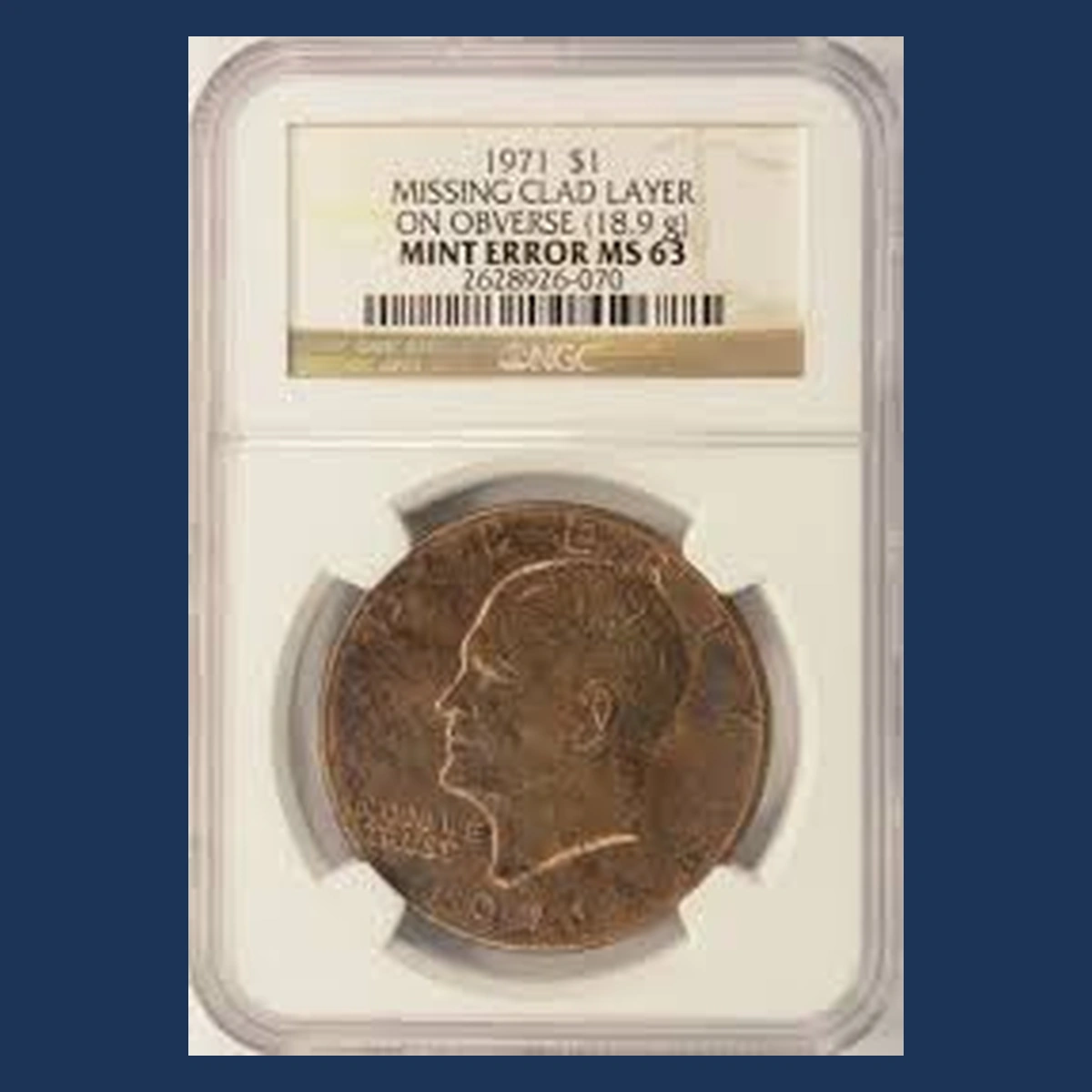
A normal Denver dollar has silver-colored outer layers around a copper center. If the front layer is absent, the portrait can be struck directly into the exposed copper.
The documented 1971-D example lost that layer before striking. Its outer design also shows weak pressure where the thinner blank did not fully fill the stamping tools.
This sequence differs from metal stripped off a finished coin. A copper-colored face alone does not establish the error, since staining, chemical treatment, and grinding can also change the color or expose the copper underneath.
Estimated Value
The PCGS MS63 example brought $1,150 in August 2001. For comparable authenticated front-layer losses, the estimated range is $400 to $3,500.
A clear portrait struck into the copper provides an appealing contrast with the normal back. Original surfaces matter greatly: heavy scratches or cleaning can reduce demand, even when the missing layer itself is genuine and the coin remains an interesting example of the Mint’s error.
How to Identify
If the coin is loose, weigh it before studying its color. A normal Denver dollar weighs 22.68 grams; a missing outer layer should reduce that weight.
The recorded coin has a copper front and a normal back, so compare both faces and the edge together. Look for the remaining layer at the back rather than treating any brown face as proof of missing metal.
Now study how the portrait and letters formed on the exposed copper. On this example, the front layer was absent before the strike, which left weak details near the outside.
Grinding away a finished layer can also reduce weight, but it leaves damaged design and scraping marks. Check the letter edges for that damage before accepting the color and weight as a match.
6. 1971 Eisenhower Dollar Indents from Additional Blanks
An extra blank can press into a dollar while the press stamps it. The covered area receives a depression instead of its complete intended design.
The records include a small front indent on a silver S dollar and a Denver back indent attributed to a dime blank. Another Denver example also has a stepped edge from partial collar contact.
Museum reports include a cent-sized obstruction and another small blank of unresolved identity. Those descriptions do not establish a clear mirror picture in every depression, so a simple indent should not automatically be called a reversed coin impression.
Estimated Value
The Denver partial-collar and indent combination sold for $408 in August 2020. A separate Denver dime-blank indent brought $3,120 in August 2018.
Use an estimated $100 to $6,000 across authenticated examples, with the size, clarity, and combination of features affecting the price. These amounts belong to whole coins; adding an indent price to a separate collar-error price would overstate the value of a single combined mistake.
How to Identify
Find the depression’s boundary and follow where the normal design stops. An unused obstructing blank can leave a smooth recessed shape without supplying any recognizable second coin picture.
On the silver S example, the reported indent affects about 5% of the front. The Denver dime-related example is on the back, while the partial-collar combination needs an edge view as well.
Use angled photographs to compare the depression with its surrounding metal. A later impact can create a hollow, but it often crushes existing details or pushes up a damaged edge.
Do not identify an obstructing denomination from size alone. The museum’s less specific small-blank reports need their own full-face and edge comparisons, rather than borrowing the dime example’s identity.
7. 1971 Eisenhower Dollar Clipped Blanks
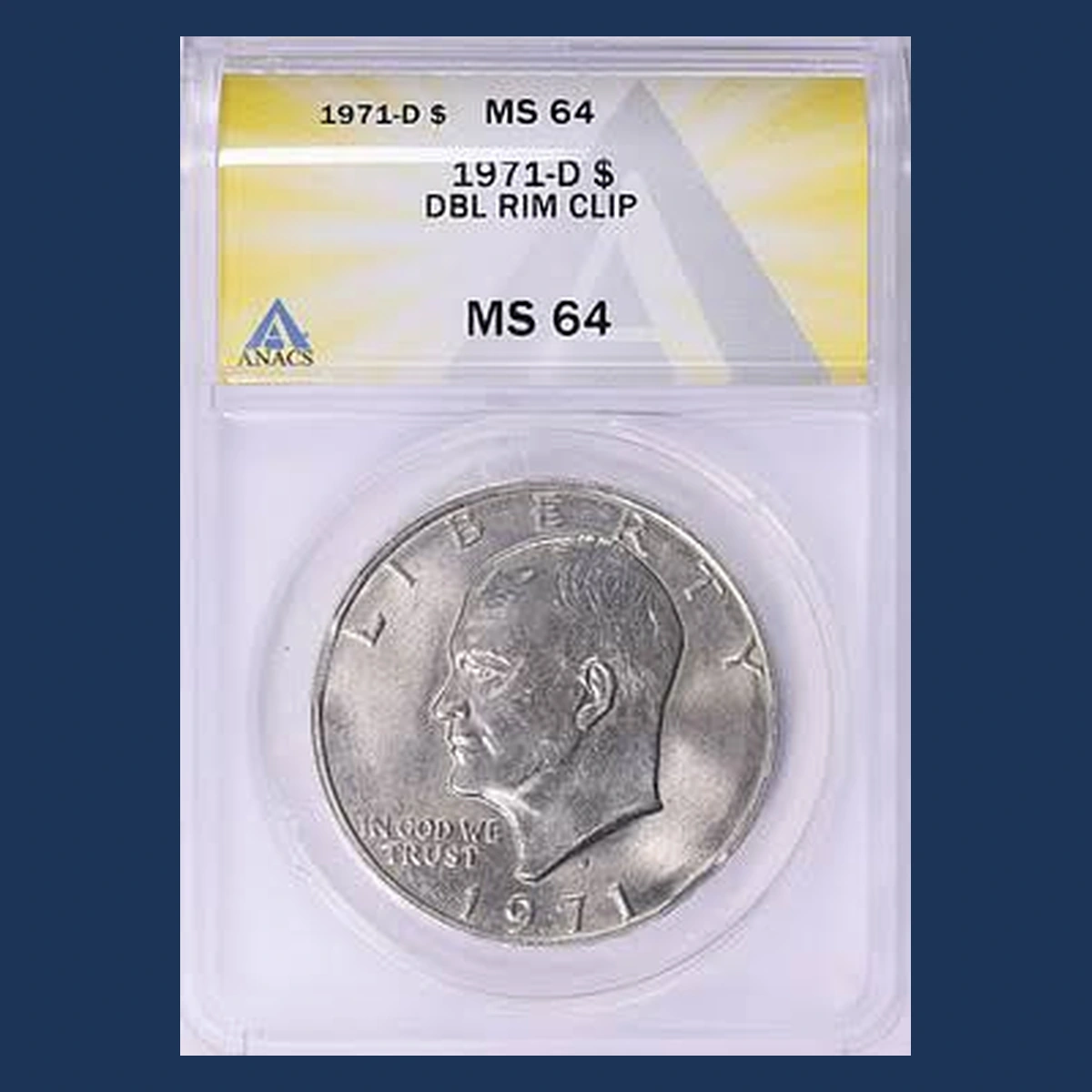
A blank cut from incomplete metal can have one missing section or several. The dollar design is then stamped beside those gaps.
Denver records include curved clips, a ragged-edge clip, and a coin with three curved gaps. Those are different outlines of the same basic blank-making problem.
A silver S Proof has a much larger curved clip, extending from about 9:30 to 1:30 above Eisenhower’s cheekbone. That particular coin weighs 16.1 grams and retains its mirror-like fields and frosted design; the weight should not be transferred to the smaller Denver clips.
Estimated Value
An estimated $25 to $10,000 spans minor ordinary clips through dramatic Proof examples. The large 45% silver Proof clip sold for $2,880 in August 2022.
A small Denver clip generally sits much lower than a large missing section on a well-preserved Proof. Original borders, readable dates, and an attractive surface help; later cutting or damage does not qualify simply because it removes a similarly shaped piece of metal.
How to Identify
Map every missing section on photographs of both faces before estimating its size. The museum-listed triple clip has three gaps of different sizes, while the large Proof has one deep curved loss.
Examine the surface inside each gap with a magnifier. Fresh saw marks, scraped edges, and squeezed metal suggest later removal.
The nearby rim may fade and lettering may stretch toward a genuine clip. A weak rim opposite the missing section can support the identification, but is not always obvious.
Weigh a loose candidate without assuming that all clipped dollars share one target. The Proof’s 16.1 grams relates to its specific silver blank and large loss, not to ordinary copper-nickel pieces.
8. 1971 Eisenhower Dollar Repunched Mintmarks
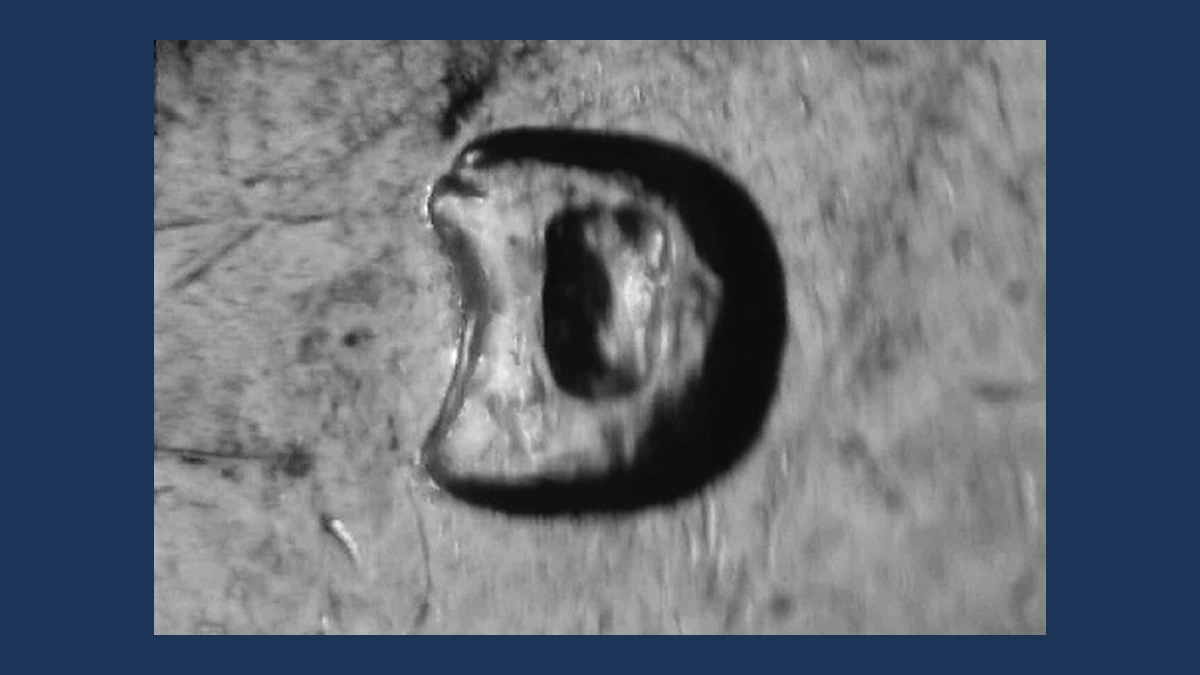
An extra part of a D or S can survive when the mintmark punch is used twice at slightly different positions. That produces a repunched mintmark, often shortened to RPM.
Denver varieties include tilted or turned earlier D shapes. On ordinary silver S dollars, documented patterns include remnants above the letter or toward its upper left.
The well-known S variety called FS-501 has the upper-left pattern. A damaged punch can also leave a bump near an S, so not every odd-looking mint letter represents two separate punch impressions in the stamping tool.
Estimated Value
Ordinary circulated examples have estimated values of $20 to $500, while exceptional high-condition FS-501 coins can reach $5,000 to $10,000. The exact mintmark and whole coin’s preservation both matter.
PCGS records an MS67 FS-501 at $8,812.50 in January 2016. That unusually well-preserved coin is a different comparison from worn or heavily marked pieces with the same small extra letter shape.
How to Identify
Two small line segments help check FS-501: one is near the T of TRUST, and another sits above the date’s first 1. Find them in a clear comparison photograph before looking at the tiny extra S.
Enlarge the mint letter below Eisenhower’s neck with a 10× magnifier. FS-501 shows an earlier S above and to the left of the main letter.
Trace the curved remnants against the main S rather than following every nearby line. Flat shelves caused by movement during striking can resemble an extra letter at first glance.
Other S and D patterns need their own photographs. The northward S and tilted Denver marks do not share all the same shapes or nearby lines, even when part of their extra lettering points similarly.
9. 1971 Eisenhower Dollar Mirror Impressions from Smaller Struck Pieces
A dollar can carry a recessed mirror image after another struck piece gets between it and the stamping tool. This transferred picture is called a brockage.
One Denver dollar received its back impression from a thin dime blank already carrying a dollar design. Distorted portrait and motto details remain in the recessed area, along with edge-groove traces.
A separate museum report describes contact with a dollar struck on a quarter blank. The large receiving dollars remain dollar-sized coins; their unusual smaller partners explain the impressions but are not automatically present alongside them today.
Estimated Value
An estimated $1,000 to $12,000 reflects the complexity of these authenticated mirror-impression combinations. A readable backward portrait or motto makes the sequence easier to understand than a vague recessed patch.
The value also depends on how clearly the smaller object’s boundary survives. A receiving coin alone should not be priced as a complete matched pair when its partner is absent, even if specialists can explain what kind of object created the impression.
How to Identify
Look inside the recessed area for backwards design rather than starting with the whole coin’s weight. On the dime-related example, traces of the portrait and IN GOD WE TRUST help identify the transferred dollar picture.
Follow the grooved boundary at the left side of the impression. It helps explain how a thin smaller object expanded while pressing into the larger dollar.
Now compare the receiving coin’s ordinary outer shape and its normal struck details. A depression in a full-size dollar does not mean that the dollar itself was made from a dime blank.
Use photographs of the real surfaces, not an enhanced drawing, to check the match. Without the smaller partner in hand, the impression cannot establish a newly found matched pair.
10. 1971 Eisenhower Dollar Off-Center Strike with Clashed Designs
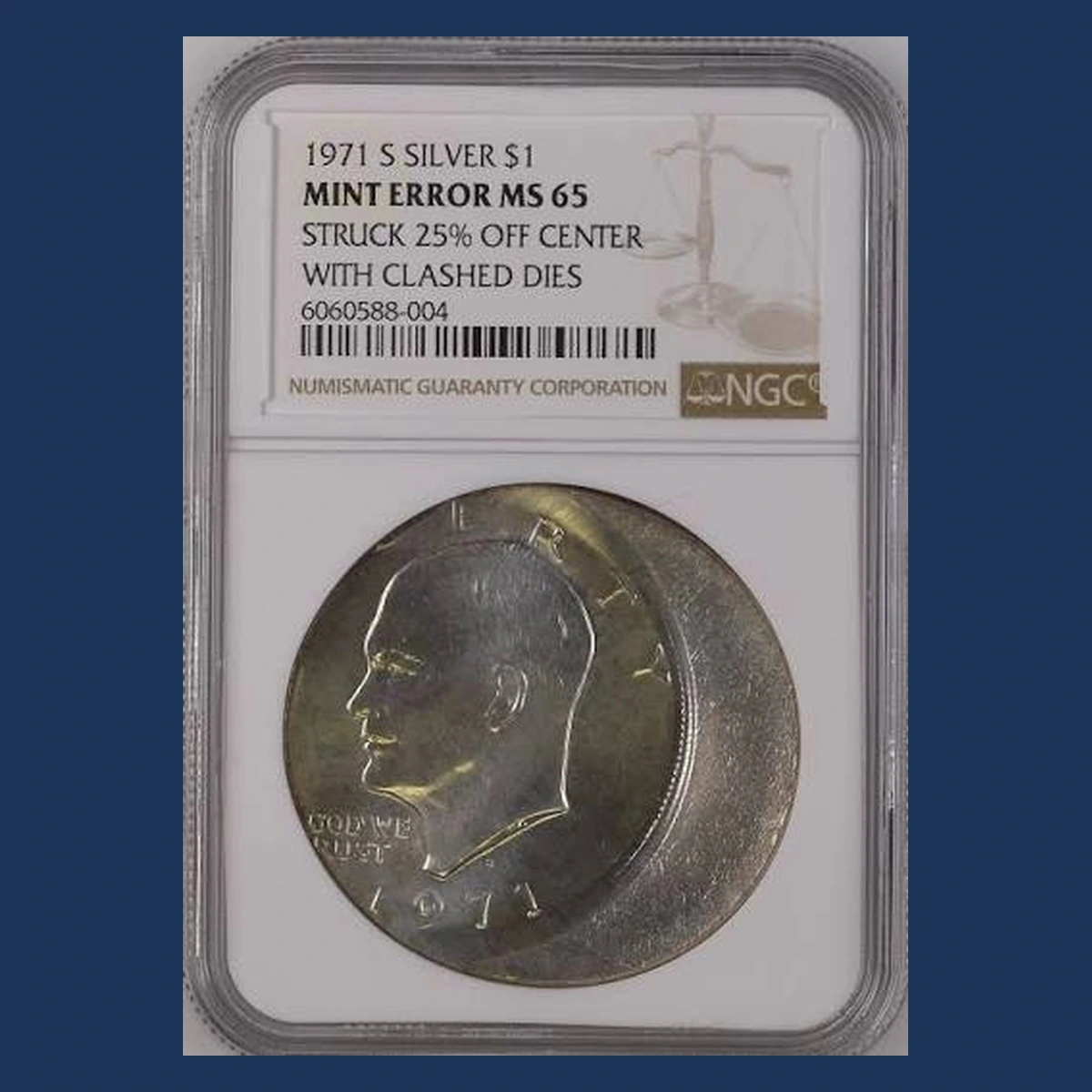
This silver dollar combines a shifted strike with faint details from the opposite design. The blank was struck about 25% off center toward 9:30, leaving parts of the outer words absent.
Its stamping tools had also hit each other without a blank between them. That contact, called a die clash, transferred faint outlines which later appeared on the coin.
The back carries traces of the portrait and front lettering. On the front, a curved part of UNUM’s U appears beside the E of WE, while the date and S remain readable.
Estimated Value
The NGC MS65 example brought $9,000 in August 2022. For a similarly authenticated off-center silver dollar with clear clash details, estimate $500 to $15,000, depending on condition and visibility.
The unusually readable extra outlines help explain that particular coin’s appeal. A slight displacement with faint traces would make a weaker comparison, and a clash mark alone should not receive the complete price paid for this combined error.
How to Identify
Begin on the eagle side, where faint front-letter shapes appear among the normal design. The recorded coin shows parts of ERTY and GOD WE TRUST, along with outlines from the portrait.
Use low angled light to trace those faint marks without confusing them with the strong main design. Then turn to the front and find the U-shaped trace beside the E of WE.
These marks identify contact between the two stamping tools. A separate check establishes the off-center strike: the main design sits toward the upper left, leaving part of the blank untouched.
Locate the full date and S, then follow the outer lettering. Parts of UNITED and ONE run off the metal; that loss belongs to the shifted strike rather than to the faint transferred outlines.
11. 1971 Eisenhower Dollar Multiple Strikes
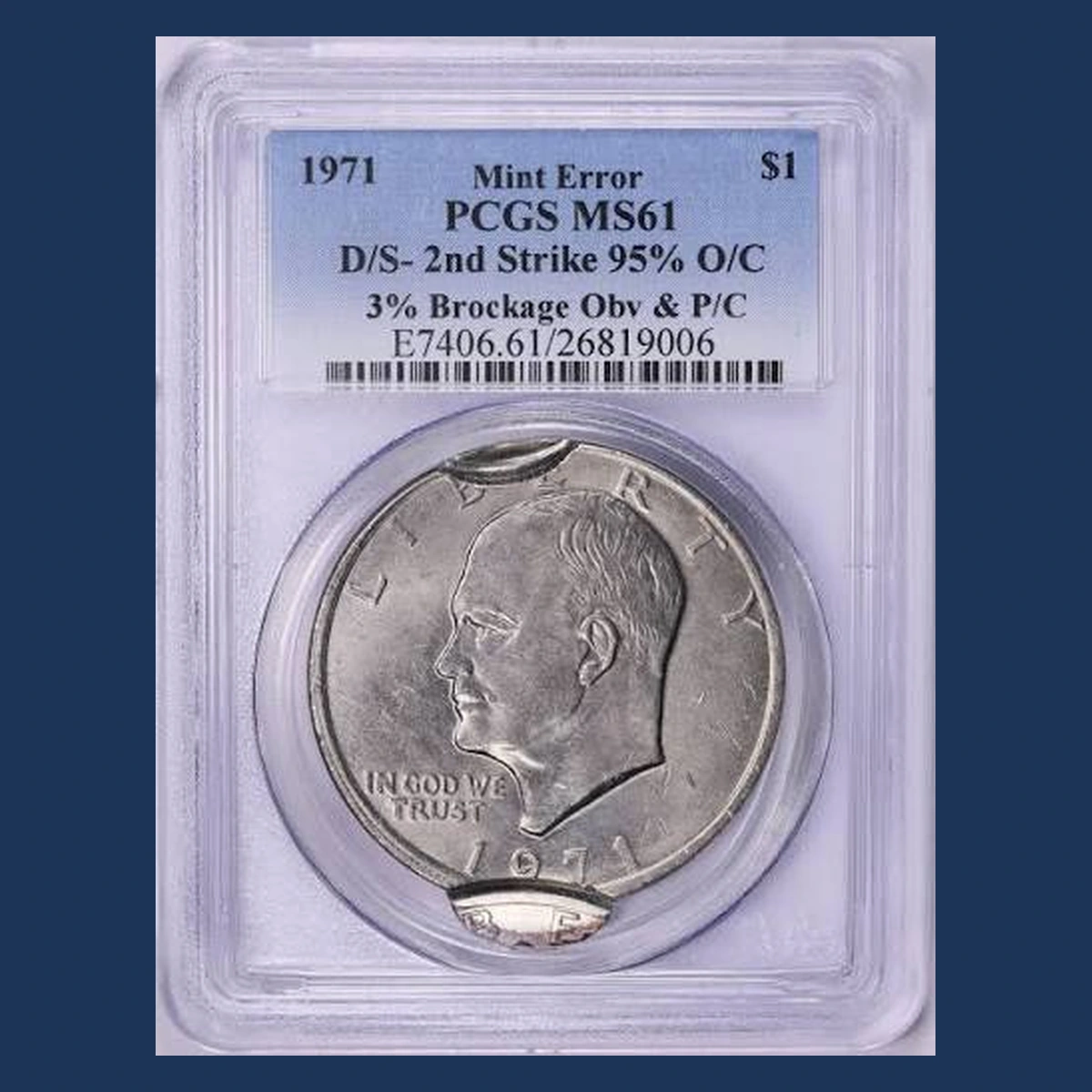
A dollar that fails to leave the press can receive another blow in a new position. The resulting impressions can overlap or sit far apart on the same piece.
A Philadelphia example combines a 95% displaced second strike with a small contact impression and tilted collar marks. That small impression preserves an edge, grooves, and plain area rather than a clear mirrored portrait.
A separate silver S dollar received two off-center strikes, roughly 60% and 65%, both toward 10 o’clock. The silver example is an ordinary collector issue, not a Proof made with specially prepared tools and blanks.
Estimated Value
The Philadelphia compound-error dollar sold for $480 in June 2023. The much more dramatic silver S double strike brought $10,219.20 in August 2022.
An estimated $300 to $20,000 covers comparable authenticated multiple strikes. Separation, readable identity, and preservation make large differences.
The silver coin has strong condition and two displaced impressions. Its price should not apply to every dollar with a small additional edge mark.
How to Identify
The two examples need different checks. On the silver S dollar, find 971 from one impression and 71 with the S from the other.
Follow the design connected to each date fragment to map the two strikes toward 10 o’clock. A single bright doubled letter edge cannot explain these widely separated pictures.
The Philadelphia dollar instead has a small contact impression near 11 o’clock. Examine its edge grooves and plain field before tracing the much farther displaced second strike.
Its back was partly blocked during that later blow, so part of the second design is missing. The tilted edge grooves also fade downward, providing another clue to how this particular coin sat during striking.
Keep those blocked areas with the Philadelphia example. They are not required features of the silver dollar’s two clear displaced impressions.
12. 1971 Eisenhower Dollar Wrong Metal and Medal Blanks
A different metal blank can enter the dollar press and receive Eisenhower’s design. A documented S Proof was struck on a copper-nickel blank intended for a Liberia dollar and weighs 18.2 grams.
Museum records also list Denver dollars on bronze presidential-medal blanks. Those blanks are not described as already carrying a finished medal design.
Other year reports describe a Denver silver blank and an S copper-nickel blank without certified specimens established. Those candidates require composition testing, because ordinary 1971-S dollars are normally 40% silver, while Denver and Philadelphia issues are copper-nickel clad.
Estimated Value
The Liberia-blank Proof sold for $8,700 in August 2022. Estimate $3,000 to $15,000 for comparable authenticated foreign or medal-blank strikes.
For authenticated Denver silver or S copper-nickel candidates, allow an estimated $2,000 to $30,000, depending on finish and condition. These are conditional comparison ranges for the reported metal mix-ups, not claims that either report has an established 1971 auction record or a newly confirmed certified specimen.
How to Identify
For a loose candidate, compare weight and width with the appropriate normal dollar: 22.68 grams for copper-nickel, 24.59 for silver, and 38.1 millimeters across. Establish the mint and finish before choosing that comparison.
The Liberia-blank Proof weighs 18.2 grams and spread into an oval. Its date’s lower portion and some back lettering are incomplete, with collar contact at the top.
A metal-composition test is needed for suspected silver and copper-nickel swaps. A silver-colored edge alone does not prove the alloy, and silver-clad metal can still show coppery color within its structure.
Search a bronze piece for older medal lettering. Clear surviving words would indicate a finished medal struck again, rather than an unused medal blank.
13. 1971 Eisenhower Dollar Struck over an Assay Office Medal
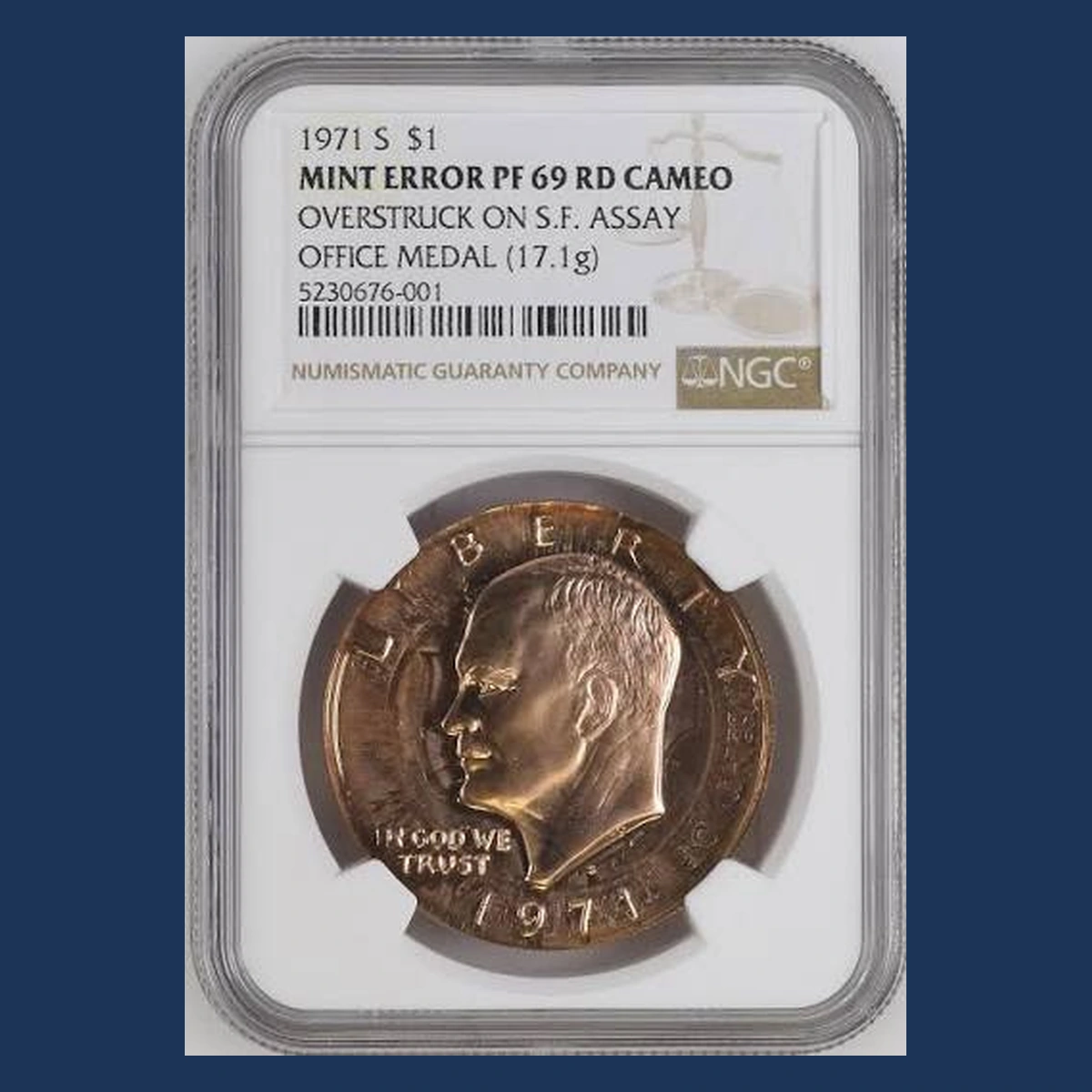
TREASURY and 1789 do not belong beneath Eisenhower’s portrait. Those surviving details identify a dollar struck over an already finished San Francisco Assay Office medal.
The copper medal received the 1971-S Proof dollar designs and still retains parts of its earlier lettering. On the back, SAN and CAL remain beside the dollar’s eagle.
The specimen weighs 17.1 grams and was graded PR69 Red Cameo by NGC, describing a nearly flawless Proof with reddish copper color and contrasting design. It differs from a dollar struck on an unused bronze medal blank.
Estimated Value
This medal overstrike sold for $40,800 in August 2022. An estimated $20,000 to $60,000 reflects its unusual host, high condition, and readable older design.
The price concerns the complete authenticated object. A copper-colored dollar without the medal’s surviving features is not the same rarity, while damage or cleaning on a comparable piece could substantially reduce its value despite the unusual combination of designs.
How to Identify
Read the faint words beneath the portrait before relying on the copper color. TREASURY and 1789 are direct clues to an earlier medal design.
On the eagle side, look beside the downward-pointing wing for SAN and CAL. Their positions should agree with the documented medal underneath the dollar design.
Photographs under low light help separate the strong later strike from the older lettering. The dollar’s outer words also show outward stretching as the smaller host spread.
For a loose candidate, its measured weight can be compared with the documented 17.1 grams. Matching weight alone is not enough: the earlier medal details must survive in a believable relationship with the 1971-S Proof design.
Conclusion
The same copper color can come from missing cladding, a foreign blank, or an older medal beneath the dollar design. Each needs a different physical check.
Estimated values run from $20 to $60,000. Identify the mint and finish first, then use the letters, edge, and metal to narrow the cause.
Preserve loose fragments and original surfaces so the features that explain the coin remain available for examination.