1973 Dollar Coin Error List with Pictures

Three dime blanks can carry pieces of one dollar design. A comparable undated Eisenhower set sold for $105,000 in 2021; the dated 1973 set is a separate object.
This 1973 dollar error list ranges from small doubled details to matching pieces from the same striking accident. Estimated values run from $25–$150,000, with the highest figures applying to complete rare combinations.
Read on to distinguish those combinations from ordinary silver issues, collector finishes, and later damage.
1. 1973 Eisenhower Dollar Doubled Front Designs
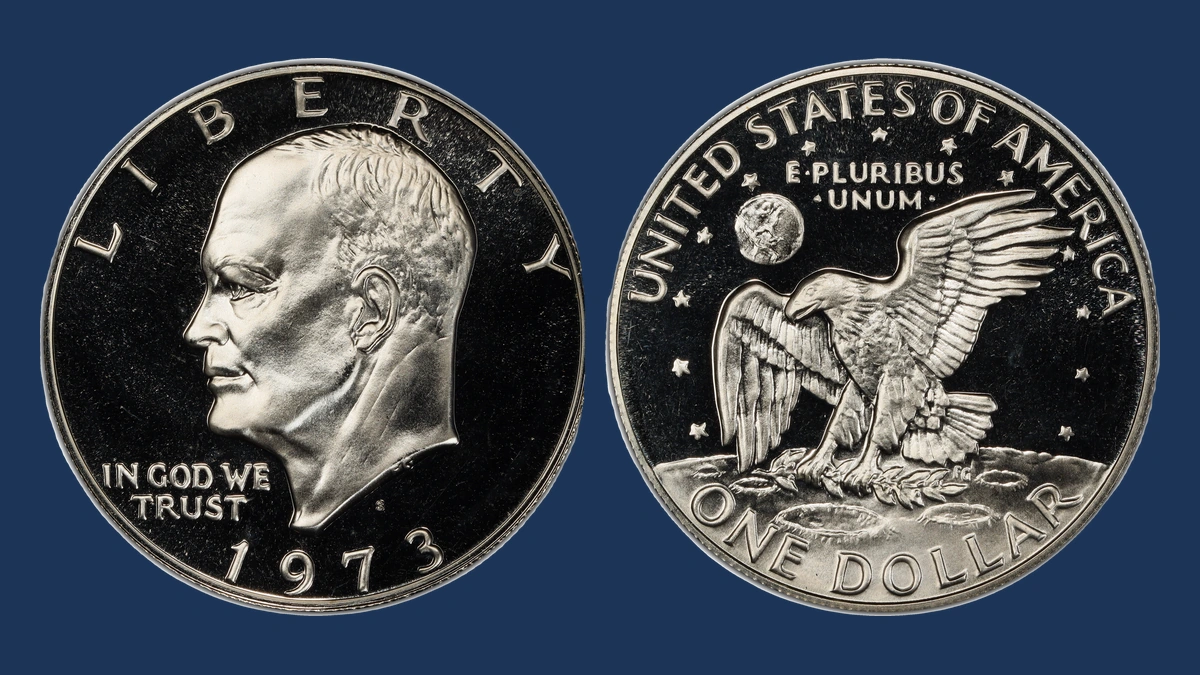
A raised extra edge beside a letter can be built into the stamping tool itself. That tool is called a die, and a repeated design in it produces a doubled-die coin.
A cataloged 1973-S silver Proof variety is separate from an ordinary silver issue with front doubling. Proofs are collector coins made with special preparation.
NGC also found the ordinary variety on a dollar struck with the wrong metal. That unusual coin needs a separate material assessment.
These examples share a general mechanism, but their finishes and exact doubled patterns must not be interchanged.
Estimated Value
For doubled designs on the correct metal, estimate $25–$500, depending on clarity and condition. PCGS records a $255 eBay result in June 2019 for a silver Proof graded PR69.
PR69 indicates very few visible imperfections. That price does not establish the value of an ordinary-finish example with a different pattern.
A coin that also uses the wrong metal belongs with the wrong-blank comparisons below; its metal error must not be priced as mere doubling.
How to Identify
Choose a comparison with the same finish before inspecting the letters. A silver Proof photograph is not a reliable pattern match for the separately reported ordinary silver variety.
Under a 10× magnifier, follow the raised outlines across the front lettering and date. Look for the same shape and direction in the specific documented variety, without assuming every letter must show an identical extra edge.
Move the light to rule out reflections from the bright surface. A flat shelf from movement during striking differs from a raised copied outline.
If the coin is the ordinary S issue, keep its metal identification separate from this lettering check. A matched doubled pattern alone does not tell you whether it used silver or copper-nickel material.
2. 1973 Eisenhower Dollar Clipped Blank
An incomplete disc can receive a normal coin design while keeping a gap in its outline. The blank cutter may overlap an earlier hole in the metal strip.
Collectors report a small 1973 clip of about three percent near four o’clock and another around fifteen to twenty percent. These are separate examples, not competing measurements of one coin.
The small example was described as NGC MS64, an unworn coin with noticeable marks. The larger one was described as worn.
The reports do not establish a mint letter for every example, and later cutting can imitate either gap.
Estimated Value
Estimated values of $75–$750 allow for differences in gap size, condition, and clear identification. A larger original clip generally creates a stronger visual effect than a tiny missing section.
A collector recalled passing on the larger worn example at $200 in 2010. That was an offered price, not a reported completed auction sale.
The coin’s surviving date matters too. A heavily marked large clip need not sell for more than a smaller, attractive example.
How to Identify
Compare the two ends of the gap with the surrounding struck rim. The rim and nearby design should show how the incomplete blank behaved when the picture was added.
Inspect the boundary from the side for sawing grooves, file marks, or a freshly exposed surface. A photograph looking only straight down can hide those signs.
The opposite rim may be weak, which can support a blank-cutting explanation. It is an extra clue, not a substitute for examining the gap itself.
For a loose ordinary copper-nickel dollar, compare its weight with the normal 22.68 grams. The missing area can reduce weight, but cutting metal away later can do the same thing.
3. 1973 Eisenhower Dollar Incomplete Blank-Cutting Mark
A curved cutting trace can survive even when no large section of the coin is missing. The blank-making punch started a cut but did not finish separating that boundary.
The later strike left the trace visible within the finished dollar. This differs from a clip, where part of the original disc is absent.
A 1973-D example was recovered from a Mint Set and graded PCGS MS65, an unworn grade with relatively few marks. Its curved trace needs examination together with the nearby edge.
A circular scratch from later handling is a common source of confusion.
Estimated Value
The documented Denver MS65 example sold for $1,680 in March 2024. Its original Mint Set history accompanies the unusual blank-cutting feature.
Use an estimated $300–$2,500 for a comparable authenticated incomplete punch, with a clear original trace and attractive surfaces supporting the upper portion. A faint arc without a secure explanation needs a different assessment.
The cut’s relationship to the struck design matters more than its resemblance to a simple circle in a photograph.
How to Identify
Use low-angle light to follow the curved trace through its full visible length. Note whether the surrounding coin design was formed over or around the existing mark.
Then examine where the trace approaches the edge. A blank-cutting explanation must fit both the surface and the disc’s boundary, rather than only one short arc.
Compare it with a normal Denver dollar and check for fresh displaced metal beside the line. A later circular scratch can cut across already completed details and leave small pushed-up edges.
Do not bend the coin or try to open the incomplete cut. Ask an error specialist to explain how the cutting trace survived the later strike while leaving the disc substantially intact.
4. 1973 Eisenhower Dollar Opposite Face Turned Halfway Around
Hold the portrait upright and turn the dollar over from top to bottom. On this error, the eagle appears upside down instead of upright.
One stamping tool faced halfway around from the normal position. Collectors call the resulting relationship medallic alignment because both faces read upright when turned sideways like a medal.
A documented 1973-S copper-nickel Proof was graded NGC PR69 Ultra Cameo. The added term describes strong contrast between the bright background and frosted design.
Separate photographs rotated for attractive display cannot establish this error; the physical relationship of the faces matters.
Estimated Value
The NGC PR69 Ultra Cameo example brought $1,200 in January 2025. That result combines a strong alignment error with an exceptionally well-preserved collector coin.
Estimate $500–$2,500 for comparable authenticated examples. Scratches, haze, and fingerprints can lower the value of an otherwise clear rotation.
A small tilt should not receive the same comparison as this half-turn. The coin must keep a fixed orientation during examination so the apparent rotation is not introduced by handling.
How to Identify
Take a short video with the portrait upright before making the flip. Turn the coin or its sealed holder over top to bottom without also twisting it sideways.
A normal dollar’s eagle should now be upright. The reported medallic-alignment coin instead presents the eagle upside down.
Repeat the motion once to check that your hands did not add a turn. A sideways flip produces a different result and must not be mixed with the top-to-bottom test.
After recording that relationship, identify the S and the Proof finish from close photographs. Keep both faces in the same video, since two separately rotated still images can make an ordinary coin appear to have this error.
5. 1973 Eisenhower Dollar Off-Center Strike
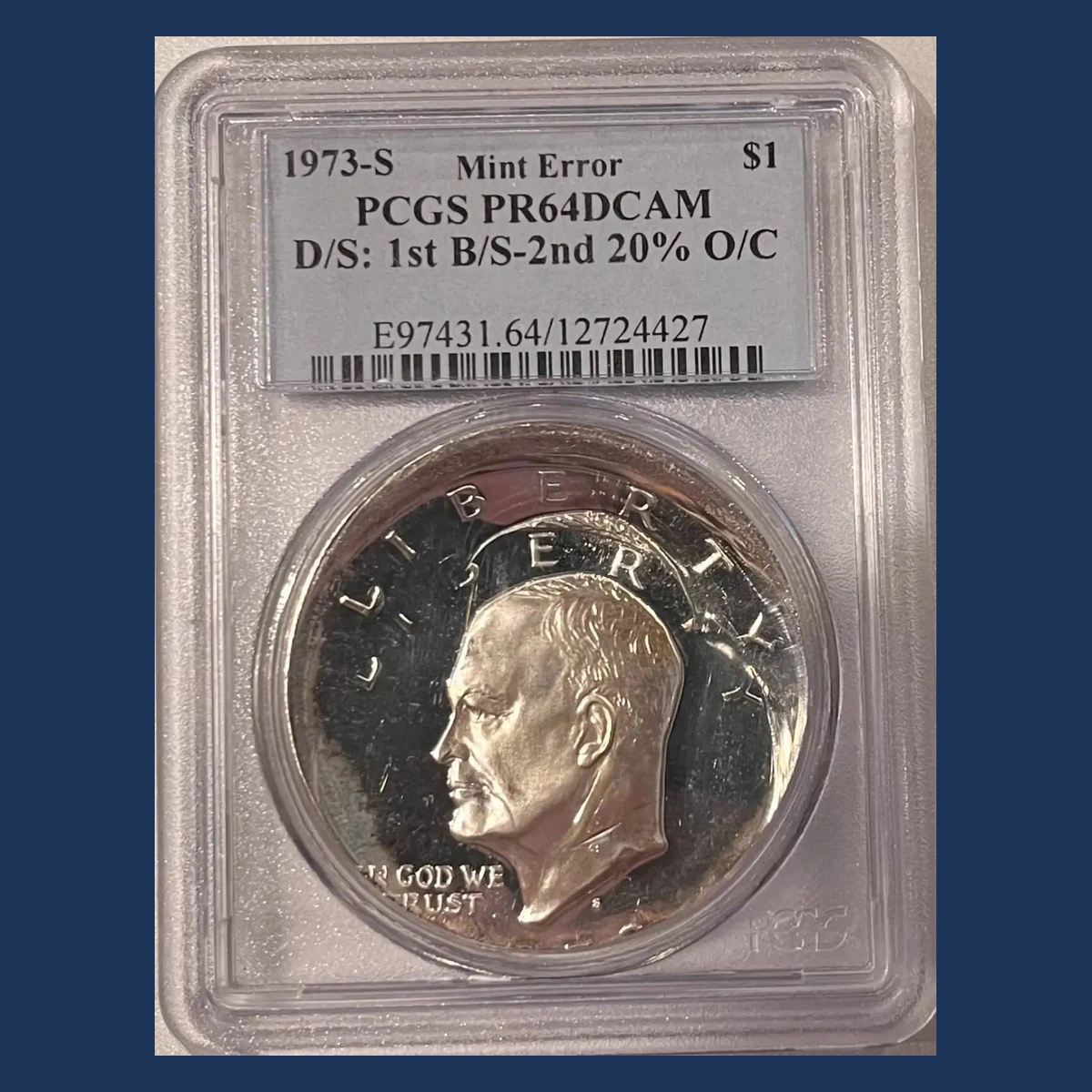
A blank crescent beside a picture that runs off the opposite edge points toward an off-center strike. The blank did not sit fully beneath the stamping tools.
The 1973 year listing reports this error, mainly for ordinary Philadelphia and Denver dollars. It does not establish one specific percentage or a particular San Francisco Proof example.
Both faces need to fit the same misplaced blank. A shift on only one face can have a different cause.
The complete 1973 date is especially useful because some dramatic Eisenhower errors have no readable year.
Estimated Value
Allow an estimated $100–$3,500 for a confirmed ordinary 1973 off-center dollar, depending on displacement, condition, and surviving date. The upper end favors a clear major shift.
As a later-year comparison, a 1978 dollar struck thirty percent off center sold for $1,680 in March 2023. That is not a 1973 sale.
A small uneven rim is a much weaker feature. Damage or a missing date can also make a dramatic-looking coin harder to identify and price.
How to Identify
Find the date before measuring the apparent shift. A design shared across several Eisenhower years cannot by itself establish 1973 when the date has disappeared.
Look for both parts of the error: untouched blank on one side and intended design lost beyond the opposite boundary. A fully contained picture on expanded metal instead suggests broadstriking.
Turn the coin over to check that the second design fits the same struck area. One shifted face with a centered opposite face calls for a different alignment explanation.
Record the edge and both faces in one set of photographs. Avoid using an unrelated undated Proof’s appearance or auction price to fill in details missing from your own coin.
6. 1973 Eisenhower Dollar Repeated Strikes with Outward Spread
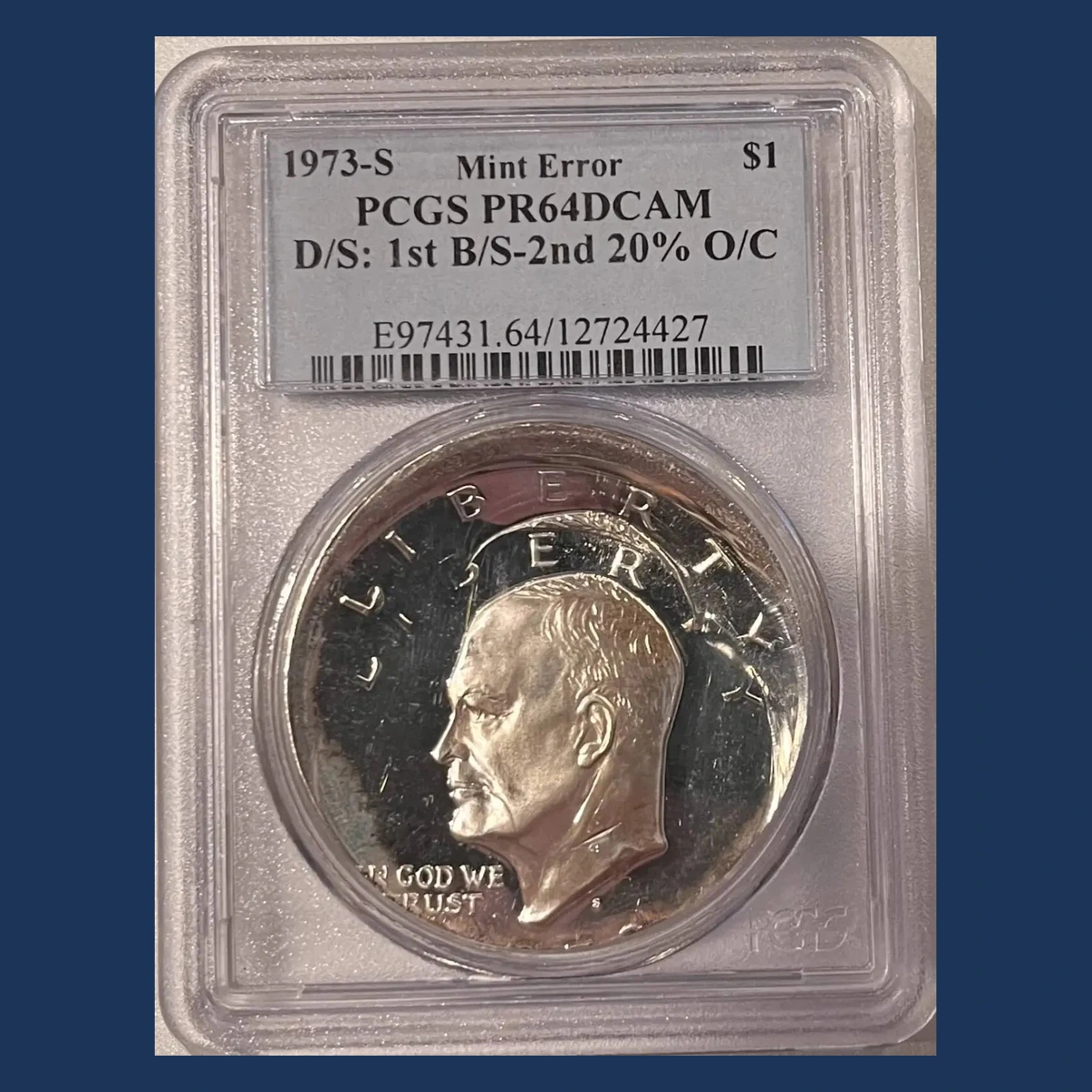
Overlapping pictures outside a widened rim show that the coin moved between blows. The surrounding collar, which controls the edge, did not contain a later strike.
A copper-nickel Proof example retains evidence of a first strike inside the collar before a later blow spread the metal. Other copper-nickel Proofs show several impressions.
A separate silver Proof has faint earlier details outside the main picture. These different metals need their own comparisons.
Proof production normally uses repeated blows in place, so the number of blows alone is not the error. Displacement or abnormal outward spreading is what matters.
Estimated Value
Recent copper-nickel Proof results include $1,920 and $2,880 in January 2025 for different double-struck examples. A multiple-struck example also brought $2,880 that month.
Estimate $1,000–$20,000 across authenticated examples, reserving the higher portion for especially dramatic combinations, including silver Proofs. Small overlapping details should not borrow the strongest coin’s price.
The complete pattern, metal, and preservation determine the comparison. Extra blows are not separate amounts to add to one dollar’s value.
How to Identify
Start at the edge where the original grooves survive, then follow the metal that spread beyond them. That can separate an earlier contained strike from a later unsupported blow.
Trace a repeated letter or portrait outline back into each picture. Faint older details may lie outside the stronger later impression, especially on the reported silver Proof.
Check both faces for the same sequence and look for later flattening that could imitate a wide coin. Normal Proof manufacture does not create displaced pictures merely because the press delivered more than one blow.
Confirm the metal before comparing prices: ordinary copper-nickel dollars normally weigh 22.68 grams, while forty-percent-silver dollars weigh about 24.59 grams. Use existing grading measurements for sealed pieces.
7. 1973 Eisenhower Dollar Designs Blocked by Thread or a Separate Metal Layer
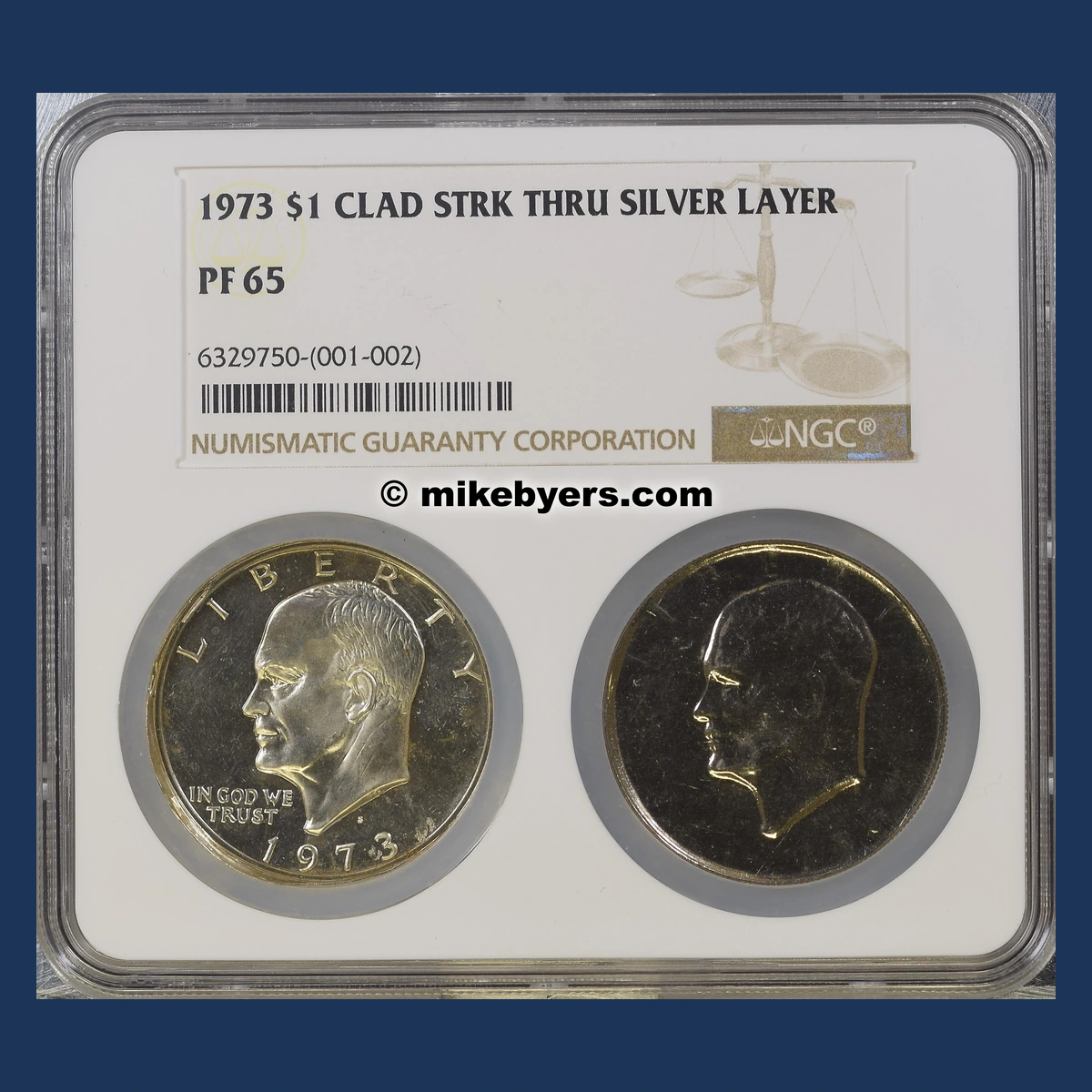
Material between the blank and stamping tool can block details or leave its own impression. A silver Proof is described with a mass-of-thread impression; a separate ordinary silver dollar has a back-surface obstruction mark.
Another event involved a loose silver-rich outer layer from a different blank. It lay over a copper-nickel dollar during striking, and both pieces survived.
The dollar has a blurred front and normal back. The thin layer has a normal front image and a sunken reversed front image underneath.
That pair records an obstruction, not a dollar made entirely from the loose layer.
Estimated Value
Estimate $75–$1,000 for the separate ordinary or Proof obstruction marks, depending on size, recognizable texture, and preservation. A clear thread pattern generally tells more than a small smooth patch.
The silver-layer matching pair occupies a different level: estimate $10,000–$20,000 for both pieces. Mint Error News reports a Heritage result of $13,200 for that pair.
The loose layer is part of the same event. Its value must not be added again as an unrelated wrong-metal dollar.
How to Identify
For the matching pair, first label photographs by object: dollar front, dollar back, thin layer front, and thin layer back. Confusing those four views hides how the pieces met.
The dollar’s blurred front should correspond to the layer that blocked it. The layer’s underside carries a sunken reversed portrait, while the dollar’s back remains normally struck.
Leave the thin metal protected. Do not flex it or press it against its partner.
For the separate thread-mark coin, look for a fine textured impression rather than assuming every depression came from fabric. On the ordinary silver example, inspect the back mark without naming an object that its shape does not reveal.
Check each depression for later scraping or impact damage, using the surrounding undisturbed design as a comparison.
8. 1973 Eisenhower Dollar Smaller Blanks Pressed into Dollar Blanks
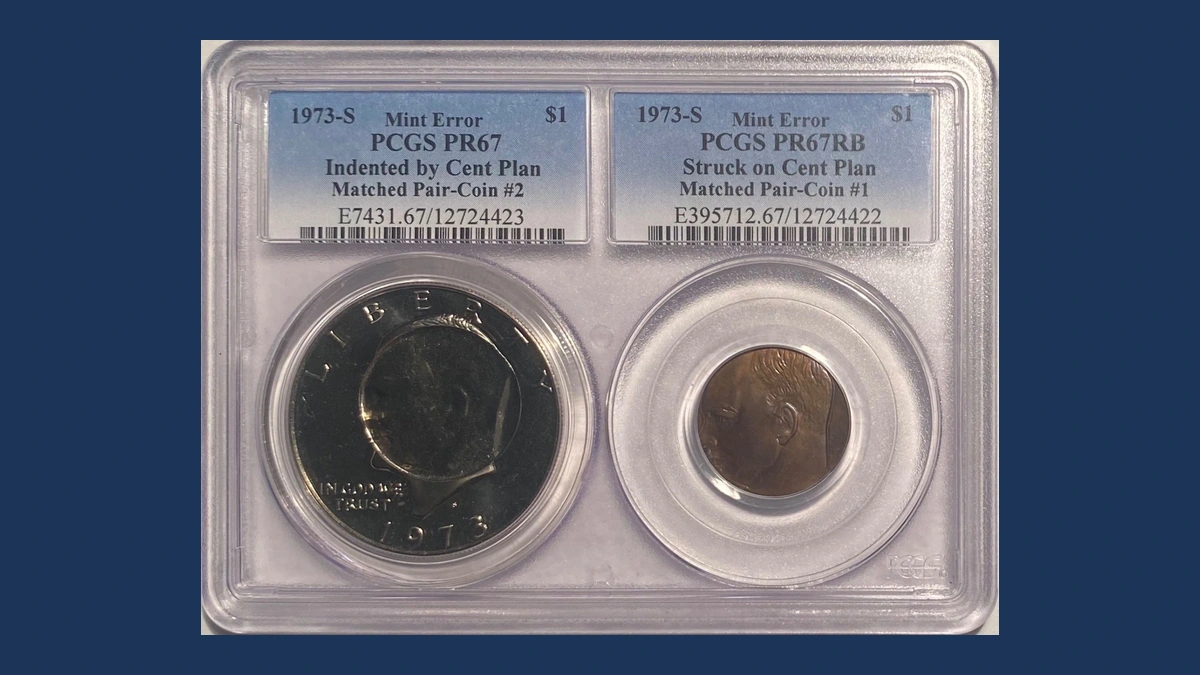
A smaller blank can cover part of a dollar blank when the tools close. The covered area becomes a rounded depression instead of receiving its normal design.
One matching pair preserves the indented dollar and a 1.73-gram copper-based piece. The depression covers most of Eisenhower’s head, while the dollar’s back is largely unaffected.
The small piece carries a portrait and a faint ear image underneath. Its original denomination is not established by its weight.
A separate forty-percent-silver Proof is reported with a dime blank still attached. That object must not be confused with the detached copper-based partner.
Estimated Value
The dollar and 1.73-gram partner sold together for $40,250 in January 2008. Estimate $25,000–$55,000 for that complete authenticated pair.
For the separately reported Proof retaining a dime blank, use a conditional estimate of $5,000–$25,000. Attachment, original surfaces, and a convincing minting relationship are essential to that comparison.
Neither range is a price for a loose unidentified disc. Keeping the original pieces and their documented relationship together is central to collector interest.
How to Identify
An attached piece should stay attached. Do not pry beneath its edge or apply liquid to test for glue; have the join examined professionally.
For the detached copper-based pair, compare the dollar’s rounded depression with the small piece’s shape. Then check the portrait on the piece and the faint ear underneath against the area blocked on the dollar.
Its recorded weight is 1.73 grams, much less than a normal 1973 cent’s 3.11 grams. Do not assign a country or denomination from copper color alone.
The retained dime-blank report concerns a different silver Proof. Examine the contact boundary and surrounding struck design, without assuming that an unstruck blank must leave reversed Roosevelt letters.
9. 1973 Eisenhower Dollar Struck on the Wrong Blank
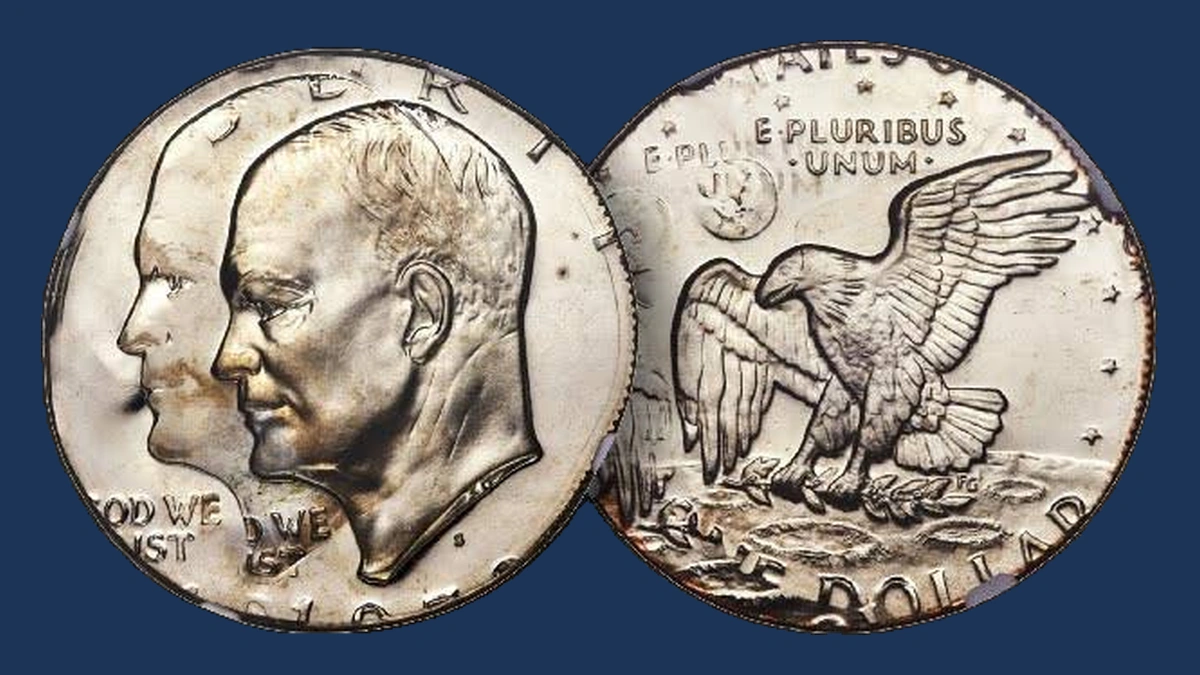
The wrong prepared disc, called a planchet, changes the metal or available space beneath the dollar tools. Half-dollar blanks truncate the design; one double-struck Proof weighs 11.3 grams.
A cent-blank Proof has overlapping designs on 3.1 grams of copper-based metal. A separate broadstruck bronze Proof weighs 26 grams and spreads to about forty millimeters.
Another mistake looks ordinary: San Francisco used copper-nickel material for an ordinary silver issue. NGC found one in its original blue package.
That last error is different from a normal copper-nickel San Francisco Proof, which is correctly made in that metal.
Estimated Value
Estimated ranges are $10,000–$25,000 on half-dollar blanks, $12,000–$30,000 on cent blanks, and $20,000–$60,000 for the bronze example. The ordinary S issue on copper-nickel is estimated at $10,000–$50,000.
Published Heritage results include $20,400 for the cent-blank double strike and $19,200 for an 11.1-gram half-dollar-blank example. The latter is separate from the 11.3-gram coin.
Condition and the precise blank determine which comparison applies.
How to Identify
Identify the finish first for a normal-sized S coin. A copper-nickel Proof is legitimate, while the ordinary silver issue should use silver-bearing material.
For a loose coin, compare 22.68 grams for copper-nickel with about 24.59 grams for normal silver. Combine weight and edge appearance with professional finish identification, rather than trusting packaging alone.
Small wrong blanks need their own measurements and a natural struck boundary. The reported cent example weighs 3.1 grams; separate half-dollar examples have different recorded weights of 11.1 and 11.3 grams.
The bronze piece is heavier, at 26 grams, and expanded to about forty millimeters. Its original intended use is not established.
Have the composition checked without scratching the coin. Copper plating or a cut-down dollar can imitate color or size without reproducing the correct material and strike.
10. 1973 Eisenhower Dollar One Design Struck Across Three Dime Blanks
Three separate discs received portions of one Eisenhower design at the same time. Dime blanks lay side by side beneath the dollar tools, touching without overlapping.
Two pieces sat above a third, forming a clover-like arrangement. The lower piece carries the S and nearly all of 1973, missing only the lower half of the first digit.
Most of Eisenhower’s profile appears on the upper-left piece. Parts of the eagle spread across all three backs.
PCGS graded the set PR65, a Proof grade allowing some visible imperfections. The pieces record one simultaneous event.
Estimated Value
Estimate $75,000–$150,000 for the complete authenticated three-piece set. A comparable undated clover set sold for $105,000 in 2021, as described in the Heritage account reproduced by Mint Error News.
That result is not a sale of the dated 1973 set. Heritage listed the latter as unsold in January and May 2025.
Preserving all three matching pieces matters. The estimate describes the combination, not three independent dollar prices.
How to Identify
Arrange photographs in the documented clover position without removing the pieces from their holder. Begin with the lower piece’s S and nearly complete date to establish the issue.
Follow the portrait into the upper-left piece, then compare the eagle’s parts across the three backs. The distributed design should explain one shared position beneath the dollar tools.
Look closely at the meeting edges in the original photographs. The blanks touched but did not overlap, so a construction involving one disc lying on another describes a different event.
Keep the three-piece holder and its records together. Three unrelated off-center strikes cannot become this set simply by arranging their photographs into a clover shape.
Conclusion
These errors range from an estimated $25 to $150,000, with the largest figures reserved for complete rare combinations. A doubled letter and a three-piece clover set need very different comparisons.
For an S dollar, identify its ordinary or Proof finish and its metal before calling the blank wrong. When several pieces survived one strike, preserve their relationship instead of pricing each piece as an unrelated coin.