1974 Dollar Coin Error List with Pictures

Roosevelt’s small portrait appears inside Eisenhower’s neck on one remarkable dollar error. The dollar design was struck over a finished dime, and the coin sold for $14,100 in January 2014.
1974 Eisenhower dollar errors also include subtler letter shapes and missing metal. Their estimated values span $2–$25,000, with common inherited doubling near the low end.
Read on to match the design, mintmark, and metal before judging an unusual feature.
1. 1974 Eisenhower Dollar Shifted Front Design
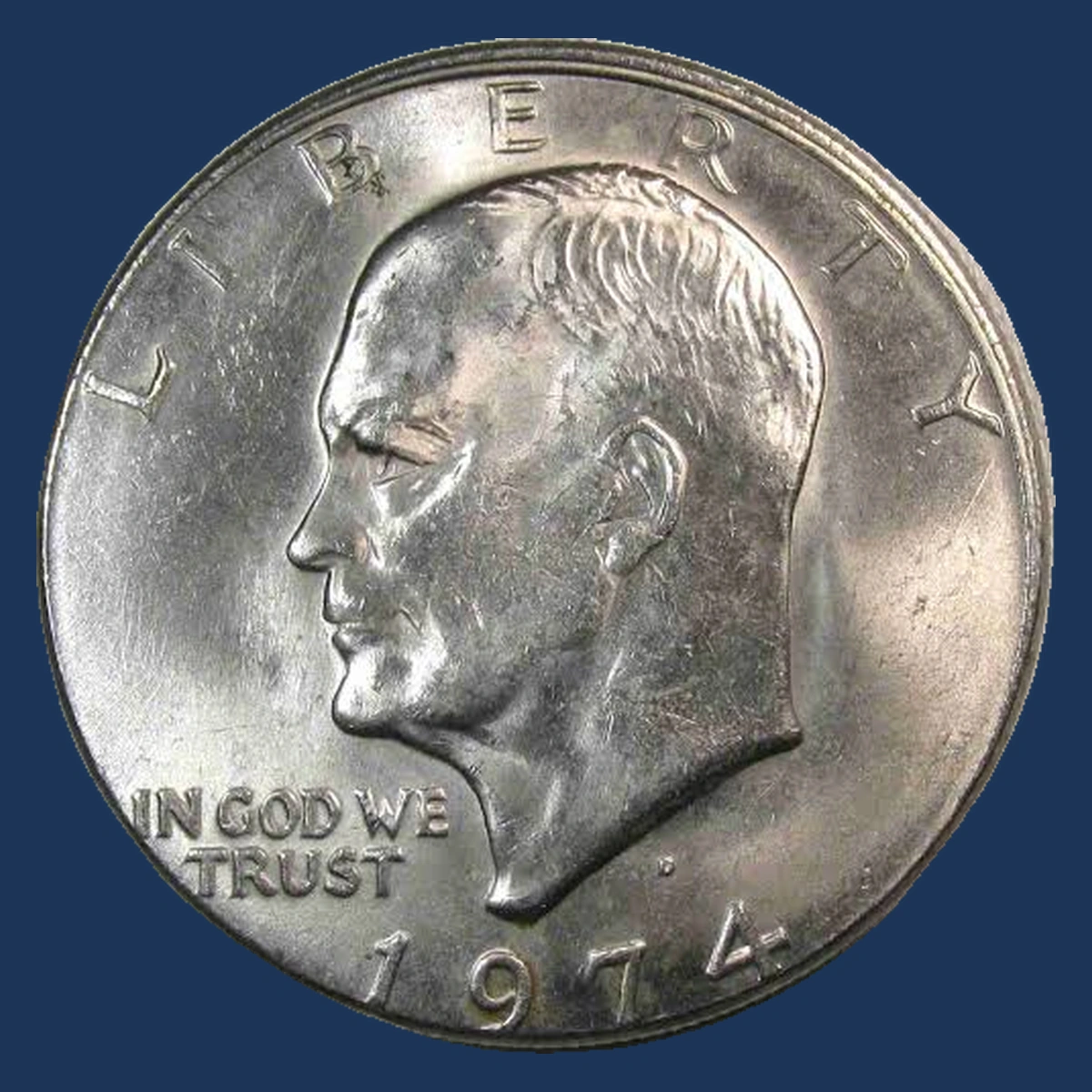
The portrait and lettering on one face can sit closer to the rim while the opposite design stays centered. One stamping tool moved sideways relative to its partner.
That tool is called a die, so the error is known as a misaligned die. A 1974-D example graded NGC MS64 has been described with its front affected.
The feature is the difference between the two faces. An uneven border on a photograph taken at an angle is not enough.
An off-center strike involves a misplaced metal disc, called a blank, instead. It affects both faces and can leave an unstruck crescent.
Estimated Value
For a clearly visible front misalignment, estimate $10–$150. A very small shift may add little to an ordinary Denver dollar.
The upper end suits an obvious difference between the front and back, with original rims that make the error easy to see. Heavy rim damage makes that comparison less useful.
This is a minor alignment-error range, not the value of a major off-center strike. The strength of the one-sided shift matters more than a dramatic seller description.
How to Identify
Photograph each face square to the camera so its whole rim remains visible. A tilted view can make one border seem narrower than it really is.
Compare the spacing around LIBERTY and the date, then repeat the examination around the eagle and outer back lettering. The reported error concerns a shift on the front.
A dent should affect a small area of rim, not move the whole portrait and surrounding words together.
If both faces lose design beyond the same edge of the metal, investigate an off-center strike instead. Compare several opposite border widths on each face to see whether only the front design has shifted.
2. 1974 Eisenhower Dollar Repeated Shape in the S Mintmark
A small raised bulge beside the upper loop of S can come from the punch used to make the mintmark. The upper-right tip may also look split.
The Ike Group identifies this shape as a doubled mintmark punch, with several stages of appearance. A punch is the small tool that placed the mint letter into a coin-stamping die.
The reported type occurs on silver collector strikes and on silver or copper-nickel Proofs. Proofs are specially prepared collector coins.
This differs from punching the same letter twice into one die. Several dies could inherit the shape from the same imperfect punch.
Estimated Value
An estimated $10–$200 covers identifiable doubled-punch examples, with the coin’s metal, finish, and condition forming much of its value. This estimate concerns the whole coin.
A stronger split or bulge can make the feature more collectible than a faint early appearance. It should still match the documented S shape.
The figure is not an automatic extra payment above every silver or Proof dollar’s normal price. A common mintmark form may contribute only a modest premium to an otherwise attractive coin.
How to Identify
Inspect the left outside edge of the S’s upper loop with a magnifier. Look for the raised bulge, then compare the upper-right tip for the documented split.
The stronger reported stages show the outline more clearly than the earlier one. Use photographs of the matching stage instead of expecting every S to look equally doubled.
Determine whether the coin is a silver collector strike or a Proof before choosing a comparison. The mintmark feature does not prove either its metal or its finish.
A random scratch near S cannot establish a doubled punch. Compare the bulge and split tip together with the Ike Group’s mintmark images, keeping the surrounding surface visible.
3. 1974 Eisenhower Dollar Repunched D Mintmark
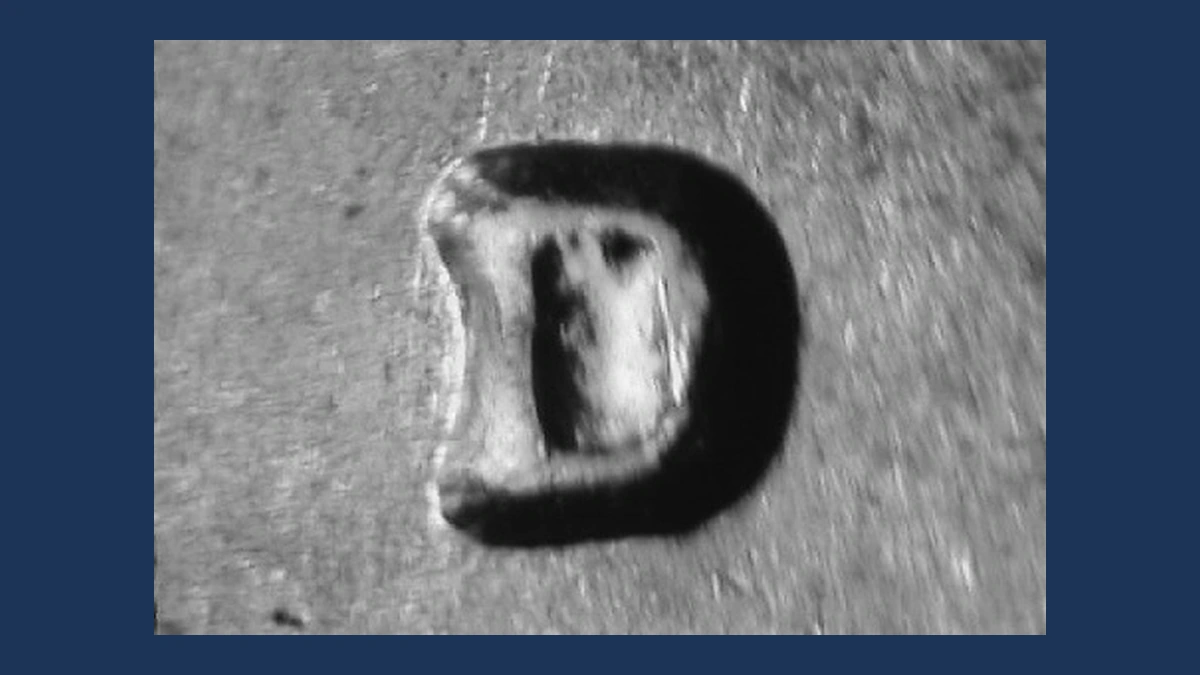
Traces of an earlier D can remain if the mintmark punch was applied again in a slightly different position. The resulting letter may have an extra raised curve or separated edge.
Collectors call this a repunched mintmark. A collector display identifies a 1974-D/D example as RPM-002.
The coin’s numerical grade does not by itself confirm that specific mintmark identification. Its visible D must match a reliable example of the claimed pattern.
This is a local feature beneath Eisenhower’s neck. Doubling elsewhere in the motto or LIBERTY belongs to a separate examination of the larger stamping tool.
Estimated Value
For a confirmed repunched D matching the reported type, estimate $20–$300. Strong separation on an otherwise attractive coin can support the higher portion.
This is an estimate for the mintmark feature, not a claim that the displayed specimen sold within the range. A collector’s label should be checked against the actual D.
Wear or contact marks can hide a small secondary outline. Coins with clear original surfaces are easier to identify and compare than heavily polished or damaged examples.
How to Identify
Locate the D below the neck and inspect its entire outline under a magnifier. An extra curve should be distinguishable from normal thickness or metal pushed by a nearby hit.
Tilt the coin to examine whether the extra feature is raised, then photograph it with the main D in focus. Avoid a crop so tight that its relationship to the letter disappears.
A flat shelf caused during striking can look like doubling without recording two punch positions. Compare the complete shape with a reliable RPM-002 image, and have a variety specialist check the mintmark before assigning the named repunched-D premium.
4. 1974 Eisenhower Dollar Peg Leg R Varieties
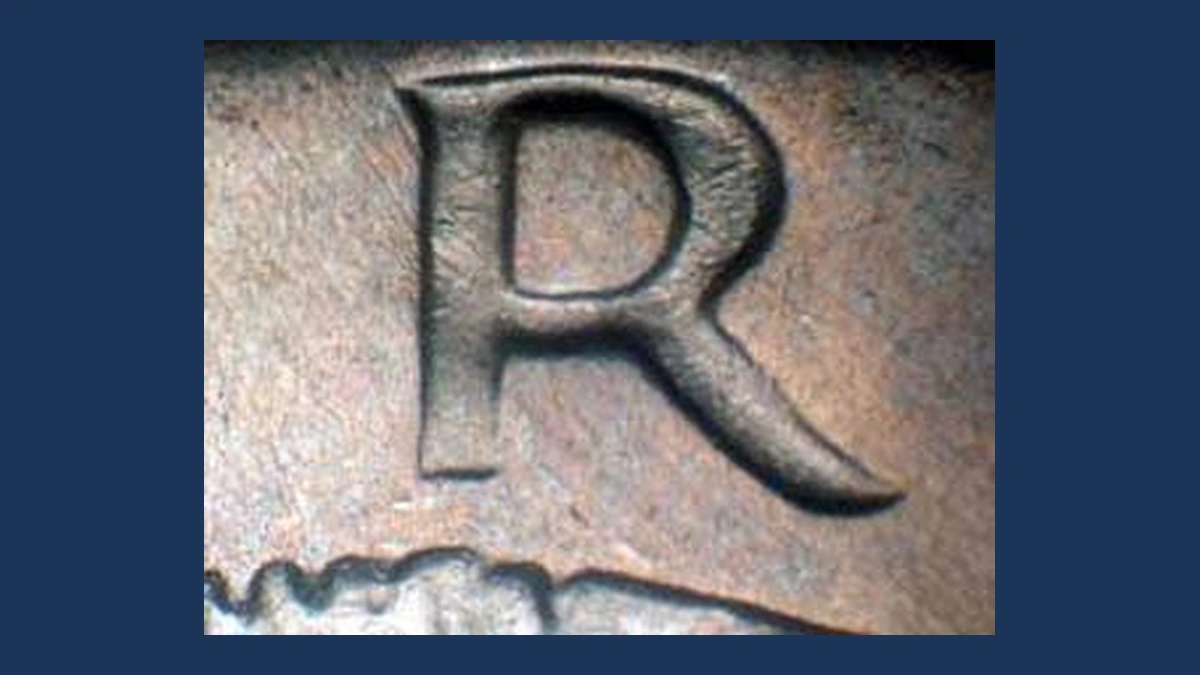
The bottom of LIBERTY’s R can lose the tiny projecting feet normally found at its base. Tool polishing can weaken those details, leaving a plain-looking leg.
The Denver version is cataloged as FS-401. Philadelphia ordinary strikes and San Francisco silver collector strikes also have reported Peg Leg forms.
San Francisco Proofs have a distinctive form sometimes called Eskimo Boot. Its lower-left corner is rounded; a small surviving pointed foot indicates a different, less complete appearance.
These shapes belong to the stamping tool, not a missing piece of the finished coin. Wear and damage can imitate a shortened or softened letter.
Estimated Value
Across the reported Peg Leg forms, estimate $5–$400 for ordinary through attractive identified examples. Metal, finish, preservation, and the strength of the R shape all matter.
Denver FS-401 should be compared with that named variety, while the rounded-foot Proof form needs its own comparison. An almost-matching R is not automatically equivalent.
The estimate is for the whole coin, including any normal silver or Proof value. A weak letter on a worn dollar can contribute little beyond the coin’s usual worth.
How to Identify
Choose the correct comparison before enlarging the R: Denver FS-401, Philadelphia ordinary strike, San Francisco silver collector strike, or the appropriate Proof. Their appearances should not be mixed.
Inspect both tiny feet at the bottom of R under low light. Compare the letter’s base with the surrounding lettering to decide whether wear has simply softened the whole area.
On the Proof boot form, focus on the lower-left corner and check whether a small pointed tip remains.
Do not scrape or polish the letter to make its outline clearer. Match the entire foot shape to a documented example with the same mint, metal, and finish.
5. 1974 Eisenhower Dollar Doubled Letters and Shared Design Doubling
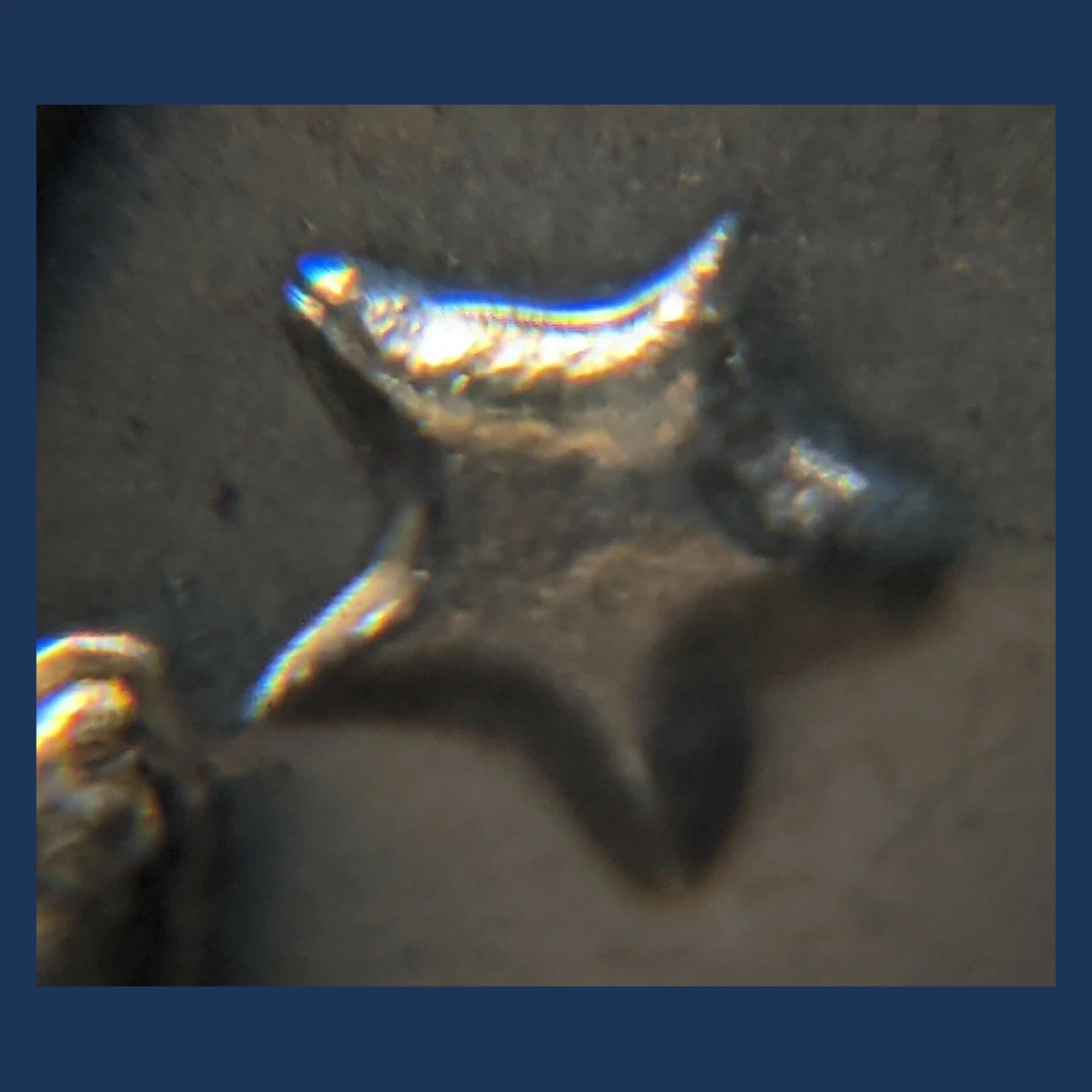
Extra raised outlines can appear on LIBERTY, the motto, or the back lettering. Some were formed on individual stamping tools; others were copied from earlier tools used to make many dies.
Philadelphia examples include LIBERTY doubling, while two Denver patterns affect the motto and selected letters. San Francisco Proofs have additional LIBERTY patterns.
Shared forms include motto doubling, back lettering and Moon details, and features on the silver collector-strike back. A copper-nickel Proof form also affects the crossbar of 4.
These are different patterns. Widely inherited doubling does not automatically make every coin a scarce individual-die variety.
Estimated Value
Common inherited doubling may leave an ordinary coin within an estimated $2–$100, depending on its issue and condition. Clearly identified individual-tool varieties may be estimated at $20–$500.
The overall group range is $2–$500, including the normal value of silver or Proof examples. A magnified extra line is not automatically a large error premium.
Match the specific pattern before comparing prices. Good preservation helps, but even sharp doubling can be common when many working tools inherited the same feature.
How to Identify
Check the mint and finish first, then use the matching variety photographs. Philadelphia WDDO-001 affects LIBERTY and has a small raised marker inside the ear.
Denver WDDO-001 involves IN, TR in TRUST, and the lower ends of LIB. WDDO-002 affects the motto, with supporting tool lines near the dot right of UNUM’s M.
San Francisco WDDO-001 is a silver Proof, while the separate Proof WDDO-002 report does not establish its alloy. Compare LIBERTY on each without borrowing the other’s metal identity.
For shared doubling, examine the specified motto, back words, Moon craters, or the copper-nickel Proof’s 4 crossbar. The silver collector back has its own broader pattern.
Match several raised details within one listed pattern, rather than calling every extra outline a rare doubled die.
6. 1974 Eisenhower Dollar Clipped Blanks
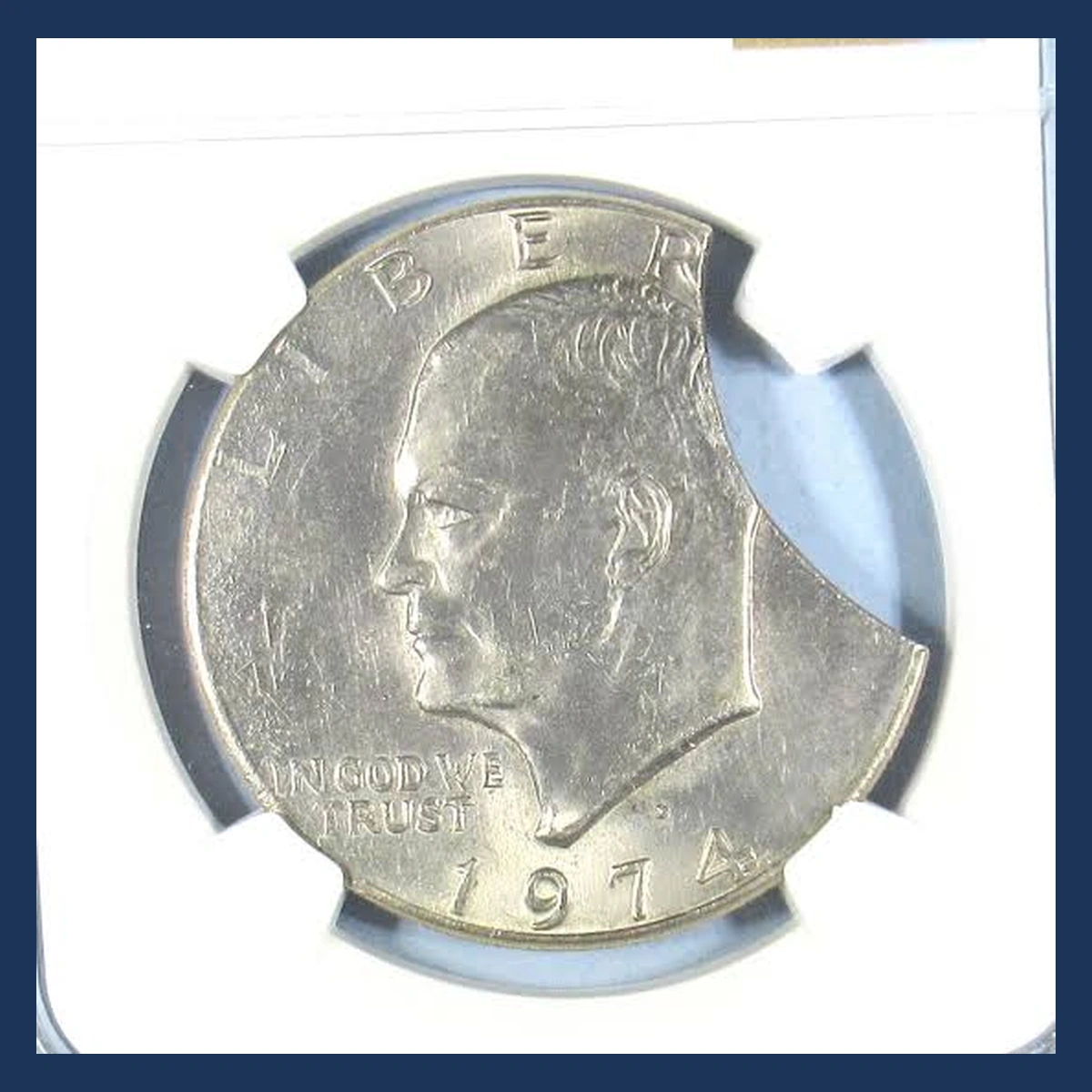
A curved bite or missing edge can begin when a blank is punched from an already incomplete area of metal strip. The coin’s design is later struck onto the remaining disc.
Denver examples include a curved clip, an eleven-percent end-of-strip gap, and a thirteen-percent triple clip. Philadelphia has a recorded two-percent clip.
A Denver four-clip specimen has two groups of overlapping gaps. Those intersecting outlines belong to one incomplete blank.
The percentages describe the named examples rather than fixed requirements. In particular, a thirteen-percent triple clip does not mean that each of its three gaps removes thirteen percent.
Estimated Value
A 1974-D dollar with a thirteen-percent triple clip, graded PCGS MS65, sold for $384 in March 2023. That is a price for one coin with three missing sections.
Estimate $30–$750 for authenticated clips, from small gaps to clear overlapping shapes. The original rim and surviving design help explain how each incomplete blank was struck.
The percentage belongs to the complete example. Do not multiply either the missing percentage or its sale price by three.
How to Identify
Count the separate curved boundaries rather than the number of large open spaces. The four-clip Denver specimen combines its gaps into two overlapping groups.
At each intersection, follow how the original rim and nearby lettering meet the missing metal. Use a magnifier to look for gradual weakness or stretching instead of a fresh cut.
A clipped ordinary copper-nickel dollar should weigh less than the normal 22.68 grams, but weight loss also follows later cutting.
Look for saw lines, sharp burrs, or filed surfaces before treating a gap as original. Compare every overlapping boundary with the same specimen’s whole-coin photograph instead of assigning the error from its outline alone.
7. 1974 Eisenhower Dollar Missing Back Outer Layer
A copper-colored back can appear when the normal silvery outer layer is missing. Ordinary Denver dollars use clad metal, meaning different metal layers bonded together.
The copper center becomes visible where an outer layer separates. One 1974-D example graded NGC MS64 weighs 18.3 grams, compared with the normal 22.68 grams.
Another report describes a Denver dollar whose back layer was missing before striking. That does not establish the same timing for every example.
Surface color alone cannot identify this error. Chemical changes can also turn a complete coin brown without removing an entire bonded layer.
Estimated Value
An estimated $250–$1,500 covers clear, authenticated missing-layer examples. The 18.3-gram NGC MS64 dollar sold for $493.50 in January 2015.
An intact design on exposed copper, a clear layer boundary, and attractive surfaces make the error easier to appreciate. Severe scratches or later corrosion reduce its appeal.
The sale gives a same-year comparison within the range. Coins with only a small missing patch or with damage after leaving the Mint need a different assessment.
How to Identify
Weigh a loose coin before relying on its brown color. The recorded example is 4.38 grams below the normal copper-nickel dollar weight, a substantial loss of metal.
Next, compare both faces: the affected back should show exposed copper while the remaining front layer retains its usual metal. Inspect the edge under a magnifier for the boundary between them.
Look closely at the eagle and lettering on the copper surface. Filing leaves scratches and removes design unevenly; a coating can change color without explaining the missing weight.
A coin inside a holder cannot be weighed accurately with its plastic included. Match the brown back, reduced weight, and missing edge layer before seeking an error specialist’s confirmation.
8. 1974 Eisenhower Dollar Mirror-Image Impression and Partial Collar
A sunken, backward design on the front is a brockage. It forms when an already struck coin transfers its design to another coin under striking pressure.
One 1974-D dollar also has a step around its edge. The collar, a ring that controls the coin’s width, caught only part of the edge during striking.
The two features appear together on the recorded NGC MS63 coin. Its face and edge therefore tell different parts of the same striking accident.
A backward impression pressed into a coin later can imitate a brockage. The original surface and edge must support a Mint-made error.
Estimated Value
The recorded combination sold for $276 in December 2009, according to the PCGS auction record. Estimate $150–$2,000 for comparable authenticated examples.
A clear backward design and an obvious edge step make both parts of the error easier to recognize. A faint impression offers less visual appeal.
The range values the complete coin rather than adding separate brockage and collar prices. Heavy wear, corrosion, or later squeezing can sharply reduce what a collector will pay.
How to Identify
Turn the coin slowly to examine its edge. A partial collar can leave a step between the portion held inside the ring and the portion that spread beyond it.
Now examine the front impression in low-angle light: it should sink below the surface and run backward. Photograph the recognizable letters or design features beside unaffected areas.
Check whether the impression was produced by another coin’s design, rather than random dents. A later squeezed-coin mark may also be backward, so this feature cannot stand alone.
The normal dollar is 38.1 millimeters wide, although an unrestricted part of this error may spread farther. Have an error specialist examine the stepped original edge together with the sunken front design to rule out later pressing.
9. 1974 Eisenhower Dollar Struck-Through Impressions
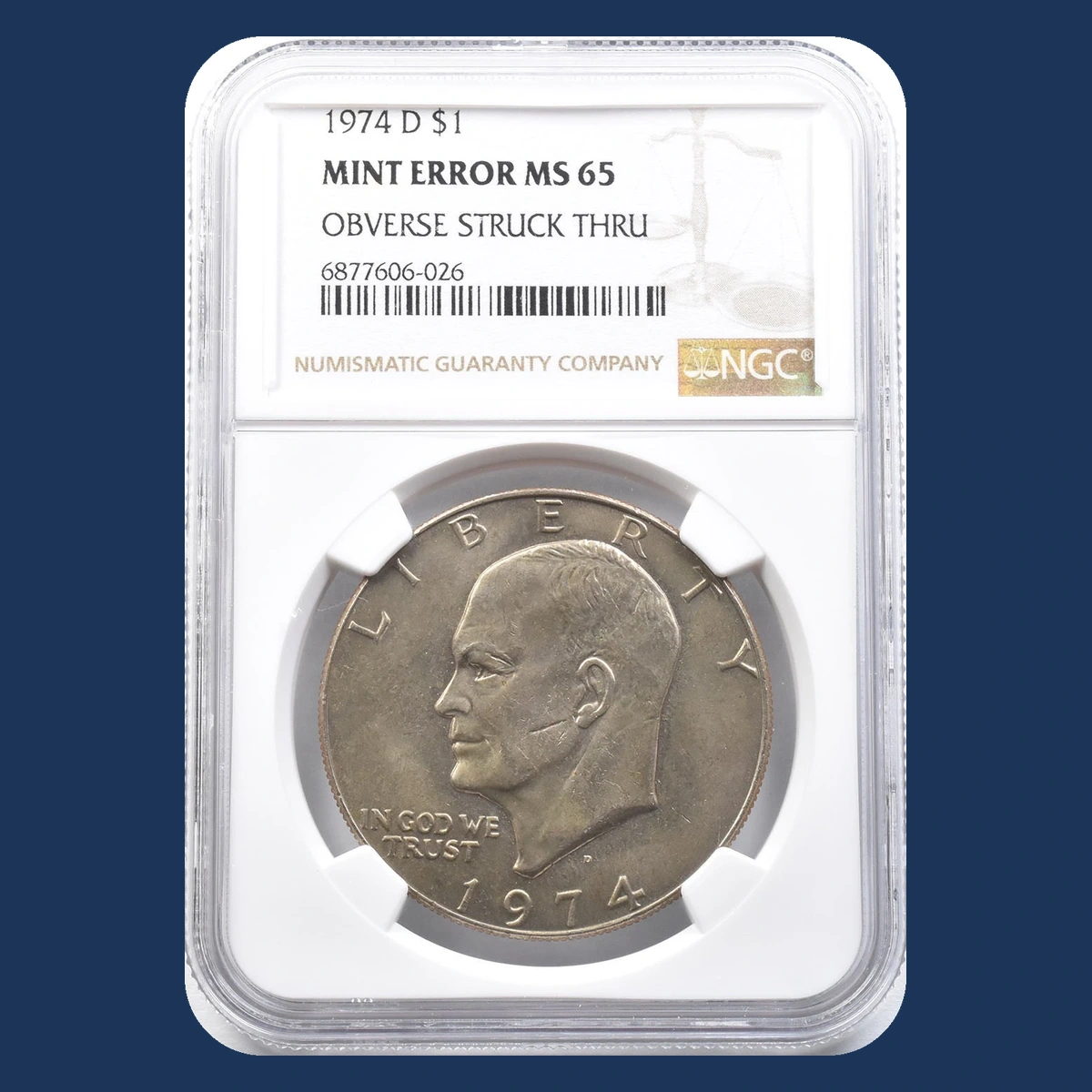
The edge of one silver 1974-S dollar has a depression where an intervening piece blocked the stamping tool. BE remains visible inside the affected area, along with impressed edge grooves.
The depression extends roughly from ten o’clock to twelve-thirty. This PCGS MS67 example is a silver collector strike, not a Proof.
The broader struck-through category also includes weak details caused by grease trapped between the tool and coin. Such soft areas need careful comparison with wear.
Grease and a solid piece leave different surfaces. Neither should be identified merely because a letter looks incomplete or a coin has a dent.
Estimated Value
Estimate $15–$2,500 across this group. A minor, clearly identified grease-related weakness may fall around $15–$150, while a substantial shaped impression can merit $200–$2,500.
The silver collector dollar’s normal metal and condition value are included in its overall estimate. Its recognizable groove pattern offers more information than a vague shallow patch.
Deep scratches or cleaning can obscure that detail. Compare the size, location, and retained design rather than treating every missing letter as equally valuable.
How to Identify
For the silver example, begin at BE in LIBERTY and follow the depression toward the upper rim. Look for the recorded groove pattern within that same depression.
Keep the rest of the face in view so a close photograph does not hide its position.
The visible BE separates this particular appearance from a completely blank upper area. Inspect any sharp gouge for pushed-up metal along its edge.
For a possible grease strike, compare the weak area with nearby protected detail. Ordinary wear should affect exposed high points, while trapped grease can block selected parts of the tool.
Examine the silver coin’s impressed grooves under low light, or compare a possible grease-weakened letter with the same area on an unworn coin.
10. 1974 Eisenhower Dollar Off-Center Strike
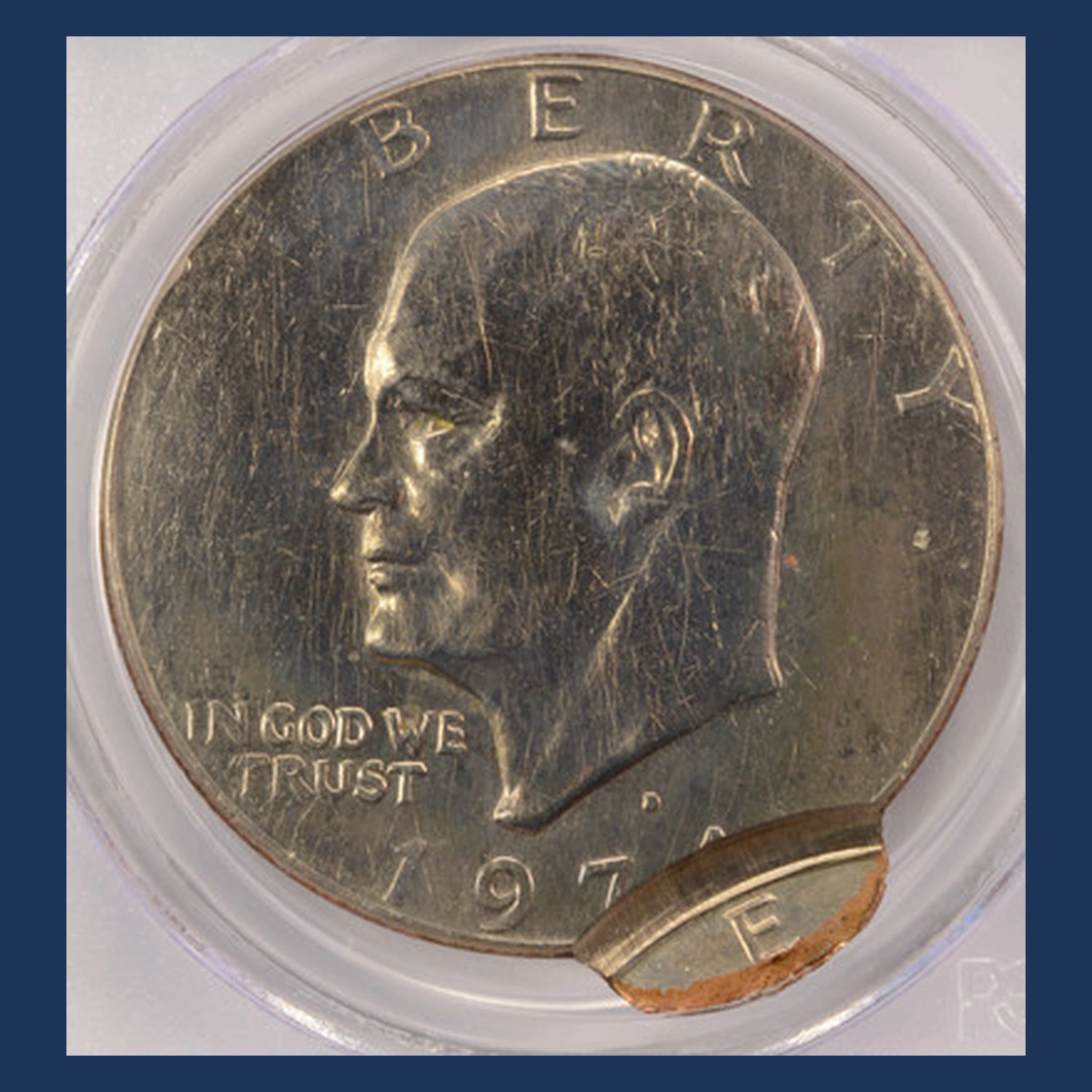
A smooth crescent beside the dollar’s design shows that part of its metal missed the stamping tools. The blank, or unstruck metal disc, was not centered when the press came down.
The portrait and eagle designs shift together relative to the disc. This separates an off-center strike from a sideways shift of only one stamping tool.
A 1974-D example graded NGC MS66 is described as ten percent off center. The percentage measures its displacement, not the amount required for every error.
The date and mintmark help identify an off-center coin. Greater displacement can push important details completely beyond the metal.
Estimated Value
An estimated $150–$3,000 covers modest through dramatic authenticated off-center Eisenhower dollars. A readable date and an attractive balance between struck and blank metal can increase interest.
For a different-year comparison within this series, a 1978 dollar struck thirty percent off center sold for $1,680 in March 2023. NGC graded it MS66, a high unworn grade.
That larger shift is not the ten-percent 1974 example. Compare the actual displacement, original surfaces, and surviving identity before applying the result.
How to Identify
Look at both faces before estimating the percentage. Each should show its design displaced relative to the same piece of metal, with an unstruck area outside the impression.
Find the date and D mintmark, then record how much of each remains visible. Do not infer a missing mintmark from the part of the design that fell off the disc.
Examine the smooth crescent where the original blank escaped the strike. Its boundary should join the struck surface naturally, without a filed channel or an added metal extension.
A coin with complete designs and only an uneven border may have a different alignment problem. Compare front and back photographs side by side to verify matching displacement and genuine unstruck metal.
11. 1974 Eisenhower Dollar Second Strike near the Edge
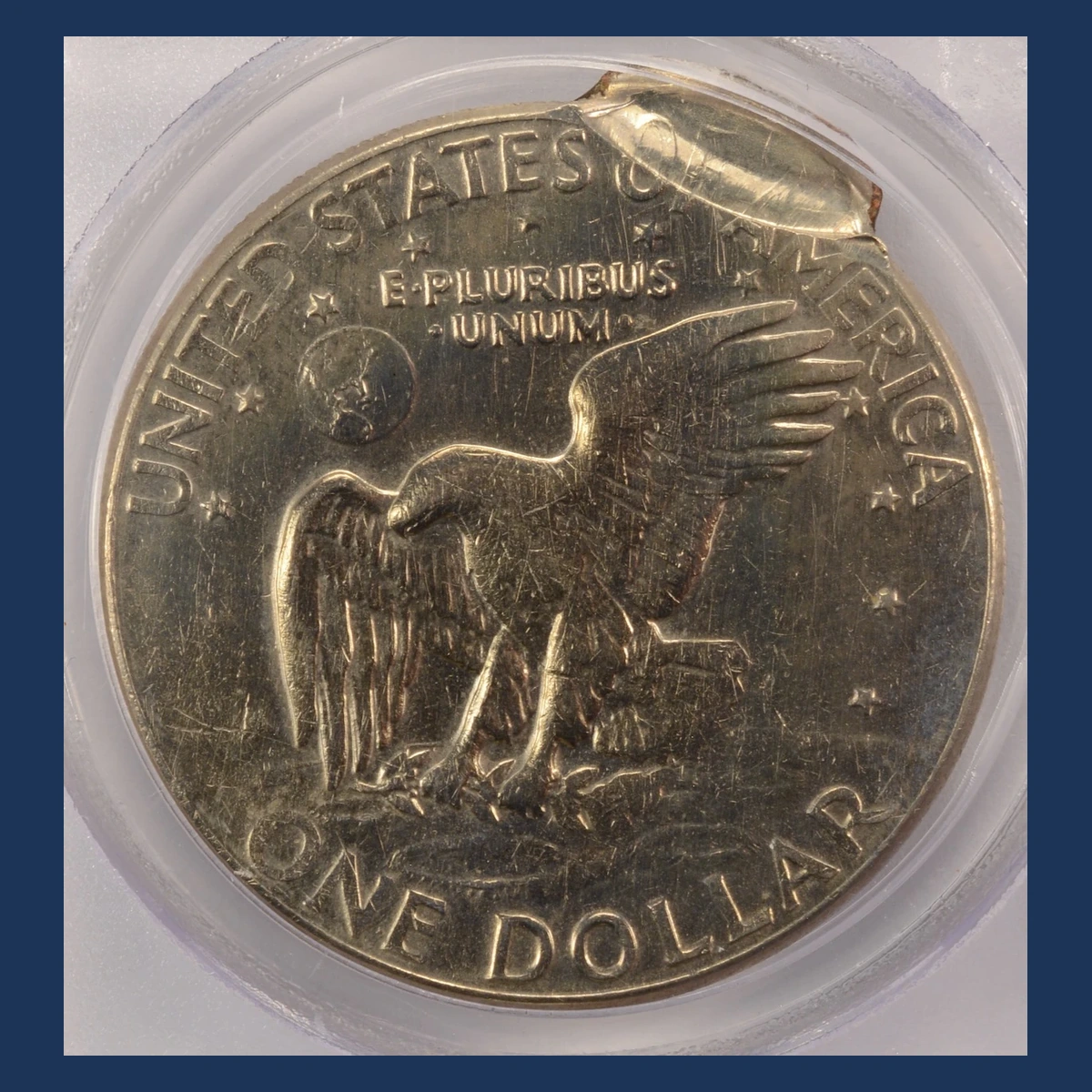
A second patch of dollar design near the edge can record another strike after the coin moved. Most of the coin missed that blow.
A PCGS AU53 example received a second strike ninety percent off center. Its back was blocked during that strike, so it lacks the matching new back design.
Another recorded type has a second strike ninety-six percent off center, with fresh tool impressions on both faces. A CACG MS64 example illustrates this appearance.
These coins share repeated striking, but the affected backs differ. The tiny second patch should not be mistaken for a clipped or damaged edge.
Estimated Value
Estimate $300–$3,000 for authenticated examples, depending on the second design’s clarity and the coin’s condition. A small readable second strike can be more interesting than a featureless distortion.
A dealer offered the ninety-percent PCGS AU53 example for $500 and a ninety-six-percent CACG MS64 example for $550. These are asking prices, not auction results.
The dealer also noted cleaning lines on the AU53 coin. Such surface damage should be included when comparing its price with an untouched example.
How to Identify
Find the small second impression first and identify a fragment that belongs to the dollar design. A flattened edge without recognizable struck detail is not enough.
Turn directly to the corresponding area on the back. The ninety-percent example has no new back design there because another object blocked that face.
On the AU53 example, tilt both faces in light to reveal the cleaning lines noted by the dealer. Inspect where the later patch flattens or overlaps the first design.
The ninety-six-percent type has impressions on both sides. Compare the edge patch on each face to see whether the second strike added new back detail or left a blocked area.
12. 1974 Eisenhower Dollar Wrong Coin Blanks
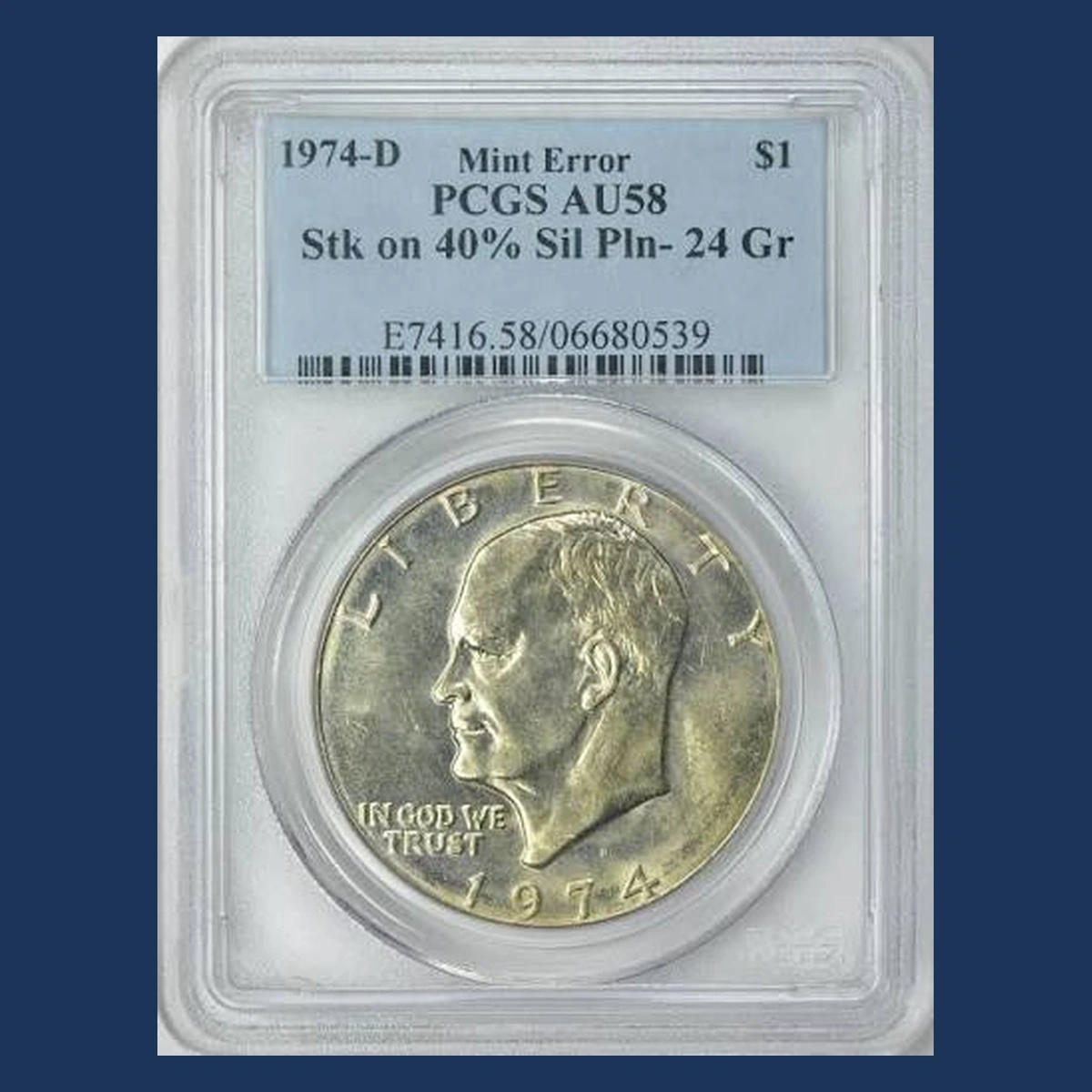
A Denver dollar made from forty-percent-silver metal uses the wrong material for its issue. Denver’s regular 1974 dollars should be copper-nickel clad, while San Francisco silver collector dollars are normal.
A PCGS MS63 example confirms the Denver silver error. Silver color alone does not prove that metal was used.
Another Denver dollar was struck on a Philippine one-piso blank and graded PCGS MS64. Its smaller disc cuts off parts of the large dollar design.
The two coins illustrate different wrong blanks: one changes the intended metal, while the other changes the metal disc’s intended denomination and size.
Estimated Value
Estimate $1,000–$20,000 for this group, including $6,000–$20,000 for an authenticated Denver silver-blank dollar. The metal must be identified before that higher range applies.
A separate Philippine-piso-blank example graded NGC MS65 sold for $1,260 in March 2023. Its recorded weight is 14.5 grams; the earlier PCGS MS64 example is a different comparison.
Allow $1,000–$5,000 for the Philippine-blank type. These whole-coin estimates depend on the actual blank, surviving design, and preservation rather than surface color alone.
How to Identify
Read the mintmark before testing a silver-looking dollar. An S identifies an issue that can normally contain silver; the wrong-silver example requires a genuine D.
For a loose suspected silver error, record its weight and request a nondestructive metal test. About 24.6 grams is the normal silver-dollar standard, not a measured weight for the recorded MS63 error.
The Philippine-blank coin needs a different check: compare its cropped outer design and smaller diameter with the certified example. Use calipers without scraping the edge, and record the actual weight.
Later cutting can make a normal dollar smaller without explaining its original struck boundary. Ask an error specialist to match the metal, measurements, and natural design cutoff to the specific wrong blank.
13. 1974 Eisenhower Dollar Struck over a Finished Dime
Roosevelt’s small profile survives inside Eisenhower’s neck because this piece was a finished dime before the dollar strike. The large dollar design then covered only the small disc beneath the tools.
The NGC MS65 coin retains a sharp dollar D and the upper halves of its four date digits. The dime’s D is faint; its 197 is clear, while the final digit is weak.
Most of Eisenhower’s face extends beyond the available metal, although his chin and ear remain visible. These overlapping raised designs distinguish the coin from a dollar struck on an unused dime blank.
Estimated Value
This coin brought $14,100 in January 2014 at Heritage Auctions. Estimate $10,000–$25,000 for a similarly clear, authenticated dollar-over-dime error.
The recognizable Roosevelt portrait, surviving dollar date, and readable mint information help explain its appeal. Two different coin designs remain visible on a very small piece.
This range applies to the combined error as a whole. It should not be used for a blank dime-sized disc that lacks any earlier dime design.
How to Identify
Start with the small portrait inside Eisenhower’s neck. Roosevelt’s surviving outline should belong to the earlier dime design, rather than a backward dent pressed into the coin later.
Trace the dime’s faint D and readable 197, keeping its weak final digit distinct from the clearer dollar date. The dollar’s D is sharper, and only the upper portions of its date fit.
Check the surviving Eisenhower chin and ear against the design that falls beyond the little disc. These fragments should occupy positions consistent with the same dollar impression.
A normal dime weighs 2.27 grams, but that standard is not a recorded measurement for this specimen. Locate raised remnants of both coin designs before distinguishing an overstruck dime from an unused small blank.
Conclusion
Estimated values range from $2–$25,000, but an unusual-looking letter and a dollar struck over a dime belong to very different price levels. Shared doubling can add little by itself.
Identify the coin’s mint and finish first, especially when silver or Proof manufacture changes what is normal. Then follow the check for the specific feature.
Keep surfaces untouched and compare both faces before turning a small visual difference into a major-error claim.