2009 Presidential Dollar Error List with Pictures

Zachary Taylor belongs to the 2009 presidential series, yet NGC authenticated one dollar with “2010 D” on its edge. This date mismatch is more than an upside-down inscription.
Other 2009 Presidential dollar errors have missing, shallow, crowded, or shifted letters. A Taylor dollar with completely missing edge lettering sold for $432 in December 2020; the estimated range across the types below is $15–$10,000.
Read on to see how the date mismatch differs from the other edge problems and Harrison’s struck-through patches.
1. 2009 Presidential Dollar Shifted Harrison Edge Lettering
The final letters of UNUM may be damaged or absent while the next stars sit unusually close. On reported 2009-P Harrison dollars, this crowded area is followed by a wider gap before the date.
Ken Potter described this pattern as shifted edge lettering. The movement during lettering can leave both an interrupted inscription and scrape marks.
That linked pattern matters more than a scratch alone. It describes letters and spaces displaced during one pass, rather than the two complete inscriptions produced by a second trip through the lettering equipment.
Estimated Value
Use an estimated $20–$150 for a clearly matched Harrison shifted-edge example. The relationship between the damaged letters and altered spacing gives the piece its interest.
As an older comparison, Mint Error News reported a 2009-D Taylor slipped-edge dollar at $16.59 in its October–December 2010 sales survey. That coin was described as ANACS MS65, an unworn grade.
The Taylor is a different president and mint. Clearer displacement and better preservation can support a higher Harrison estimate.
How to Identify
Locate the last two letters of UNUM and continue toward the next stars and date. On the reported Harrison pattern, the second U is largely lost, the M is absent, and the star spacing changes.
Compare that sequence with a normal 2009-P Harrison edge at the same scale. Look for both the crowded section and the enlarged gap afterward, rather than identifying the error from scraping alone.
Then follow the rest of the inscription to check whether a second full set is present. Two independent strings would call for a doubled-edge comparison; interrupted characters tied to changed spacing support a shifted pass.
2. 2009 Presidential Dollar Harrison Struck-Through Patches
An irregular impression can interrupt the bottom of Harrison’s portrait or an area beside a letter. Material caught between the coin and a stamping tool prevented the normal picture from forming there.
In his report on 2009-P Harrison dollars, Ken Potter described affected areas at the portrait base and above and below the W. These locations appeared on separate examples.
The material was not identified. A struck-through impression does not automatically mean grease, cloth, or wire, and its outline should not be used to invent an object.
Estimated Value
An estimated $25–$300 covers genuine Harrison examples with visible interrupted detail. A distinct depression in a recognizable part of the picture is usually easier to display than a faint patch.
A different-year comparison is the 2014-P Native American front strike-through that sold for $31 in October 2016. Its design and affected area were different.
Look at how much detail is interrupted and whether the surrounding surface remains original. Later scratches or cleaning can reduce interest.
How to Identify
Find the bottom of the Harrison portrait, then examine the W and its immediate surroundings. Use those reported locations as starting points, not a requirement that every affected area appears on one coin.
Under magnification, inspect where intact design stops at the impression. Note whether the boundary is pressed into the surface or cut by a later scrape.
Compare nearby high points for wear.
Broad rubbing across the portrait can flatten detail without anything having blocked the strike. Likewise, grinding often leaves directional lines or an unnaturally polished patch.
Keep any material still attached to the surface in place. An undisturbed impression that interrupts the intended design beside sharper detail is the useful feature to document.
3. 2009 Presidential Dollar Overlapping Edge Inscriptions
Crowded edge lettering can contain two versions of the date or the same word. These are separate inscriptions pressed into the metal when a dollar goes through the lettering step twice.
The PCGS registry lists overlapping types for Philadelphia Harrison, Tyler, and Taylor dollars, plus Denver Polk and Taylor examples. Each president and mint needs its own comparison.
This is not ordinary Position A or Position B, which simply describes the direction of one inscription. It also differs from shifted lettering, where slipping interrupts or moves parts of a single pass.
Estimated Value
Genuine overlapping-edge examples fit an estimated $40–$600 range. A readily readable second date or word can be more appealing than an overlap confined to one confusing letter.
For a different-year comparison, a 2007-P John Adams overlapping-edge dollar sold for $59 in March 2010. It was described as unworn.
The president, mint, and extent of overlap affect how useful that comparison is. Damage around the edge can make the repeated letters harder to recognize and reduce their appeal.
How to Identify
Choose a section where the two inscriptions can be read together. Identify a repeated character, then trace its neighboring letters to establish a second sequence rather than a random contact mark.
Both sets should be recessed: cut into the edge by the lettering equipment. Raised dents or isolated scraped lines are not equivalent to an extra word.
Record the president’s name and the surviving mint letter before selecting a comparison. A Denver Polk dollar should not be identified from photographs of a Philadelphia Harrison merely because both have crowded letters.
Rotate the coin without flipping photographs and follow the two sequences. Two distinct strings of correctly shaped characters on the same original edge establish the repeated lettering.
4. 2009 Presidential Dollar Missing or Uneven Edge Lettering
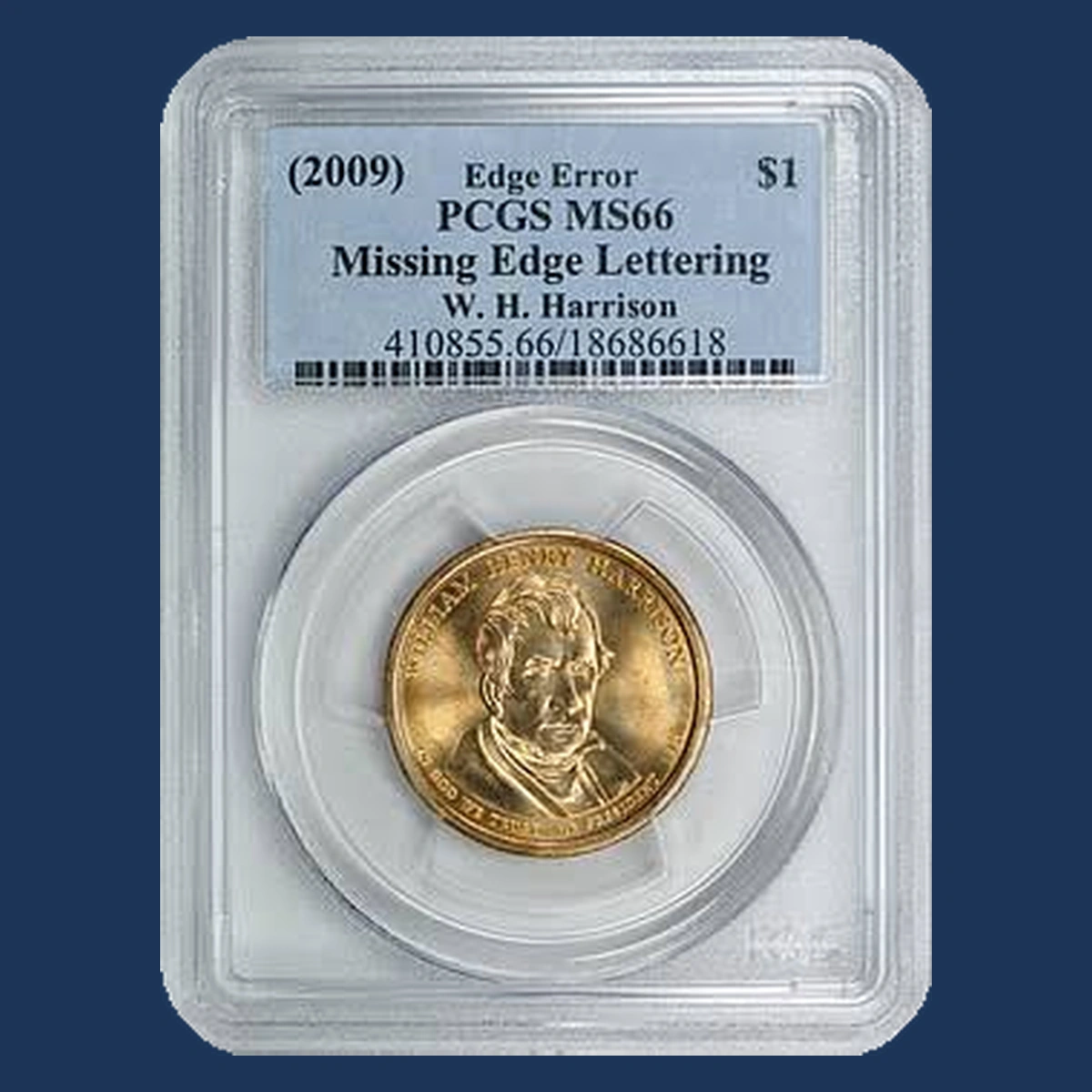
An entirely smooth edge lacks all the expected inscriptions; shallow surviving letters instead show an incomplete impression. Missing-edge types are cataloged for Harrison, Tyler, Polk, and Taylor, with a separate satin-finish Harrison report.
Satin finish means the soft-looking collector surface, not ordinary wear. The finish must match the coin being compared.
Taylor weak-edge examples retain letters. On reported Philadelphia Harrison tilted-edge coins, upper portions are stronger than lower ones, making the P resemble a short D.
That distorted P does not turn a Philadelphia coin into a Denver issue. These effects come from missed or uneven edge lettering.
Estimated Value
Estimates are $15–$150 for weak or tilted lettering and $30–$700 for complete missing-edge examples, giving a combined $15–$700 range. President, finish, and preservation all affect the price.
A Taylor missing-edge dollar graded PCGS MS68 sold for $432 at Heritage in December 2020. MS68 denotes an exceptionally well-preserved, unworn coin.
A worn specimen should not inherit that high-grade price. Likewise, the separately reported satin-finish Harrison needs a finish-matched comparison.
How to Identify
On a suspected tilted Harrison edge, compare the tops and bottoms of the date digits and mint letter. Strong upper cuts above weak lower portions explain the shortened P; look at the whole letter before calling it D.
For weak Taylor lettering, search for surviving cuts under changing light. For a completely missing inscription, inspect every edge section rather than one blank-looking stretch.
A loose normal dollar is about 26.5 millimeters wide. Calipers can help reveal an edge filed smaller, although normal width by itself does not authenticate missing lettering.
Check both rims for polishing or removal of metal. Faint original characters rule out a fully missing inscription, while the president identifies the issue when the edge year is absent.
5. 2009 Presidential Dollar Taylor with a 2010-D Edge Date
Taylor’s portrait and the edge year do not agree on this error. His dollar was issued in 2009, yet NGC authenticated an example bearing 2010 D.
The face designs are struck before ordinary presidential dollars receive edge lettering. A coin reaching equipment set for the next year can therefore receive the wrong date without changing its portrait.
The discovery came from a roll of 2010-D Native American dollars. A Taylor coin left between production steps is one suggested explanation, not a witnessed account of its exact route through the Mint.
Estimated Value
For an authenticated Taylor dollar with the 2010-D edge, use an estimated $1,000–$10,000. This is a rarity estimate, not a quoted sale of the discovery coin.
The mismatch is more distinctive than faint letters or an ordinary overlapping inscription. Both the correct Taylor face and original wrong-year edge need to remain convincing.
Surface condition, readable date characters, and professional confirmation would strongly affect a sale. An altered edge cannot receive the premium estimated for the genuine error.
How to Identify
Read ZACHARY TAYLOR on the portrait side before inspecting the edge. The dates of his presidency on that face are not the date applied by the Mint.
Next locate 2010 and the D on the edge, keeping the same coin in view. Photograph that combination together with the portrait so two different dollars cannot be confused.
Use a magnifier to inspect the date for freshly cut lines, disturbed metal, or traces of an altered digit. The lettering should resemble an original machine-made inscription throughout the edge.
Compare the whole combination with NGC’s authenticated example. A genuine Taylor portrait plus original 2010-D lettering is the decisive mismatch; simply finding a normal 2010 presidential dollar is not.
Conclusion
A misplaced edge year, shifted spacing, and a second inscription tell different stories even on similar-looking dollars. Estimated values extend from $15–$10,000, with the Taylor wrong-year type carrying a much higher estimate than minor edge faults.
Check the president and actual edge pattern together. Keep faint letters and surface marks intact; they can separate a mint-made feature from a later scrape or polished edge.