2013 Presidential Dollar Error List with Pictures

Four presidents appear on 2013 dollars, but the best place to start an error check is often the edge. McKinley and Theodore Roosevelt examples have documented shallow letters, a different problem from a raised line or sunken patch on a face.
Estimated 2013 Presidential dollar error values span $5–$500. For comparison, a different-year Madison dollar with completely missing edge letters sold for $119 in July 2025.
Read on to separate these features and see which details support each estimate.
1. 2013 Presidential Dollar Raised Die Cracks
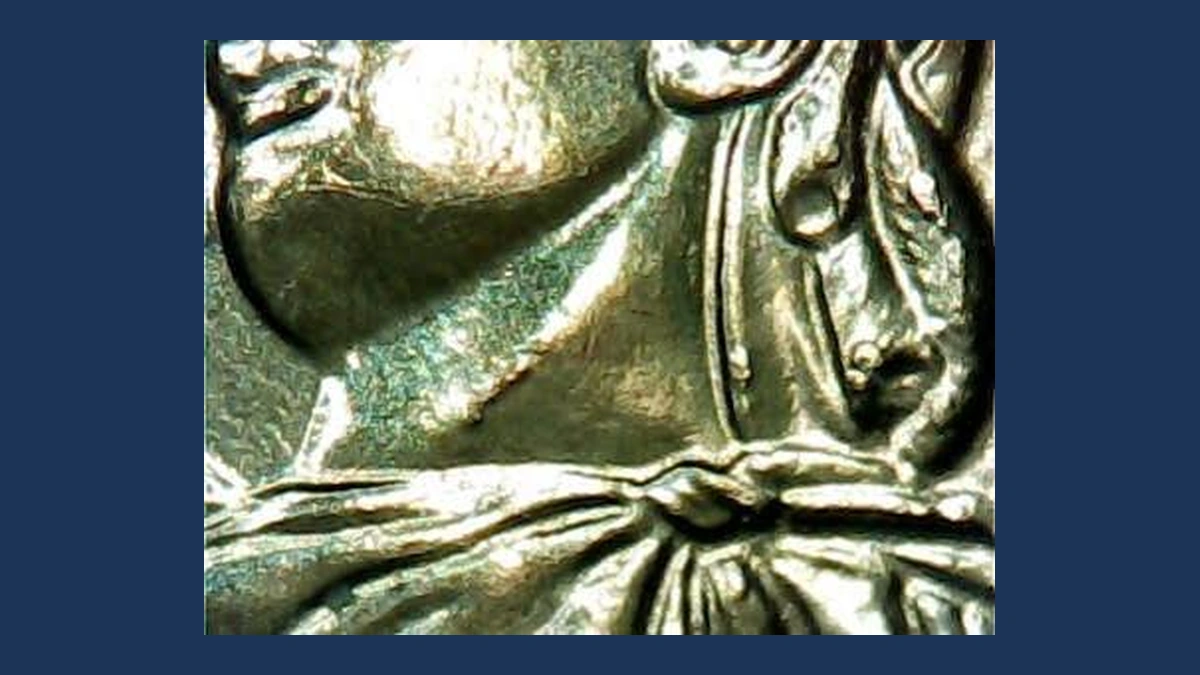
A thin ridge may run across the smooth background or meet a letter. This can form when a die, the steel tool that stamps the coin, develops a crack.
Metal enters the gap during striking and leaves a raised line on the dollar. The line may change as the damaged tool continues to work.
Die cracks are reported for the 2013 series without a specific president or location established. A scratch is different: it cuts into a finished surface, sometimes pushing narrow ridges up along its sides.
Estimated Value
Minor confirmed cracks fit an estimated $5–$100 range. A short, faint ridge generally attracts less attention than a clear line that crosses a recognizable part of the design.
An unworn surface helps preserve these small raised features. Scratches, stains, and heavy wear can hide them or make the cause harder to judge.
The upper estimate assumes a visible original crack, not simply a normal dollar with a bright scratch.
How to Identify
Use angled light before touching a suspicious line. A genuine raised ridge should change its highlight as the coin turns, while a groove may show a darker cut center.
Enlarge a section where the line meets a letter or portrait. Look for metal that rises smoothly from the struck surface, rather than a scratch with pushed-up sides.
Check the same point on an ordinary dollar bearing that president. This keeps a normal engraved line from being mistaken for a crack.
Photograph where the ridge begins and ends.
Another coin with the same raised path can confirm that the stamping tool carried the damage. Match its exact route and intersections, not merely its general direction.
2. 2013 Presidential Dollar Struck-Through Patches
A small area may lack detail even though nearby letters remain sharp. Something between the tool and metal blocked that part of the strike; collectors call this a struck-through error.
Grease can leave weak design, while a harder object may leave a more distinct depression. Those explanations are possibilities, not proof of a particular material on every affected coin.
The 2013 reports do not name a specific president or object. The shape, surface, and surrounding design must show why the patch belongs to the original strike.
Estimated Value
For a genuine 2013 example, estimate $10–$300, depending on how clearly the interruption can be seen. A shallow weak letter belongs near a different price level from a large, well-defined impression.
A 2014-P Native American dollar with a front strike-through sold for $31 at Heritage in October 2016. That is a different design and year.
Use the comparison for scale, then judge the size and condition of the actual 2013 feature.
How to Identify
Compare the affected spot with nearby high points first. General wear usually softens exposed parts of the portrait as well as letters, whereas a small obstruction can interrupt one local area.
Follow the patch boundary under a magnifier, checking for grinding cuts or metal pushed aside by a later blow. A smooth-looking hollow alone is not enough to identify what caused it.
If material remains attached, leave it in place; removing it could destroy the relationship between the object and the struck design. Look for original design that fades into or stops at the same undisturbed impression, beside sharper neighboring detail.
3. 2013 Presidential Dollar Repeated Edge Lettering
Two dates or two overlapping words on the narrow edge would point to a repeated lettering operation. Ordinary dollars receive those edge characters separately from the pictures on their two faces.
If a coin passes through the lettering equipment again, the next set can overlap or face a different direction. The characters should still be pressed into the edge, not raised above it.
Repeated lettering is reported for 2013 without a named president or mint. This remains a type to authenticate, rather than a claim that all four presidential designs have known examples.
Estimated Value
A confirmed 2013 coin with two edge inscriptions is estimated at $40–$400. Clear repeated dates or long overlapping words are easier to appreciate than one confusing extra stroke.
An earlier 2007-P John Adams example with overlapping letters brought $59 in March 2010. That sale covered an unworn coin and provides a different-year comparison.
Keep surface condition in the comparison too. Heavy knocks around the edge can obscure the very feature a collector wants to see.
How to Identify
Read a full edge word before deciding that it is doubled. Continue around the coin until you can separate two strings of letters or identify a genuinely repeated date.
One inscription can face either direction normally. The labels Position A and Position B describe this orientation, so turning one coin upside down does not create a second error.
Place adjacent edge photographs in order, overlapping their ends to avoid counting the same characters twice. In the repeated area, look for two sets of normally shaped recessed letters rather than isolated dents.
Finally, connect the edge year to the president shown on that same coin. Two real letter sequences on its metal, visible together, provide the key check.
4. 2013 Presidential Dollar Weak Edge Lettering on McKinley and Roosevelt Dollars
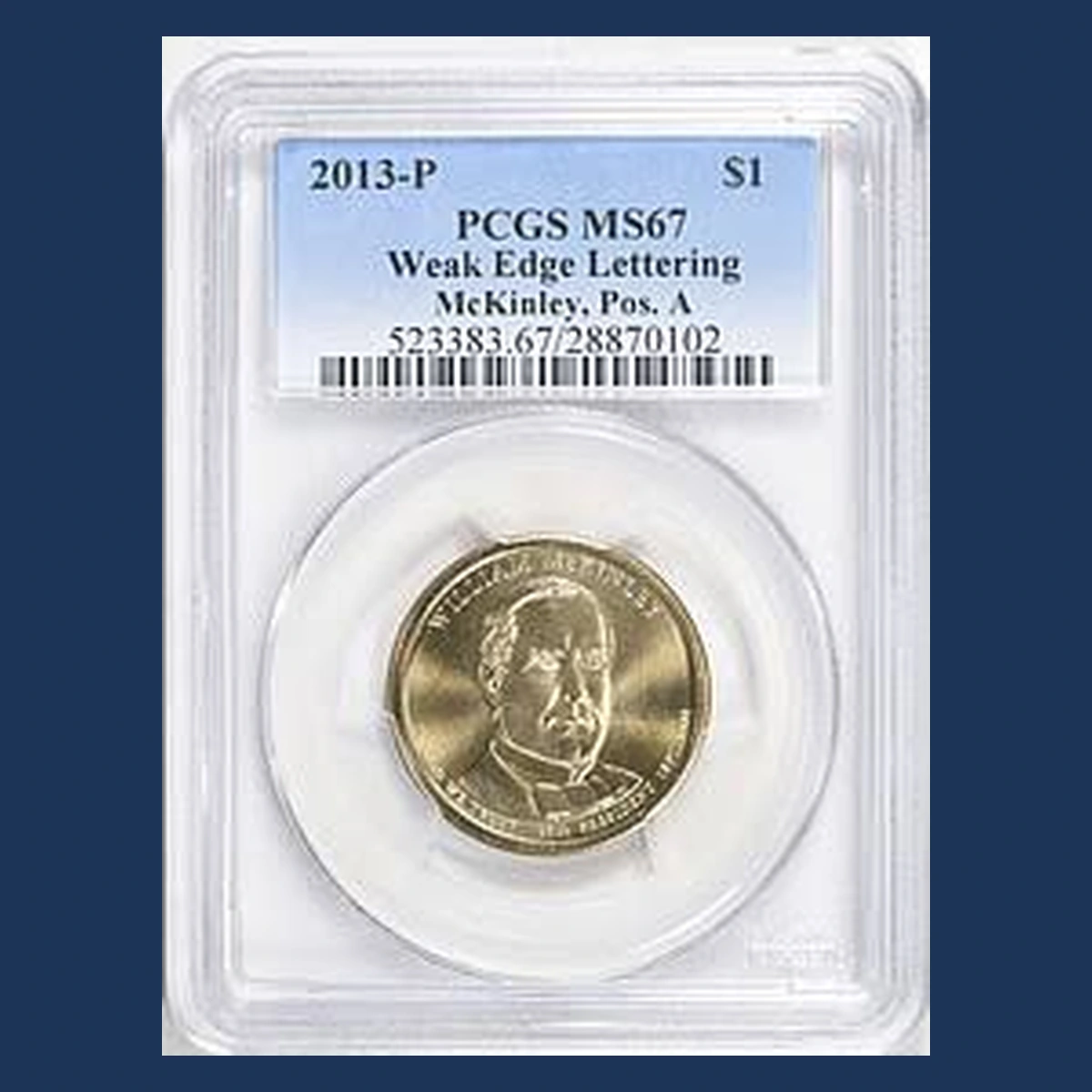
Some letters look much shallower than the rest of the edge inscription. Weak contact during the separate lettering step can leave these faint marks even on an unworn dollar.
A McKinley example was listed by GreatCollections as PCGS MS67 with weak edge lettering. MS67 describes a well-preserved, unworn coin.
PCGS separately lists the 2013-P Theodore Roosevelt weak-letter type. Both records specify Position B, a normal letter direction.
Neither record means that Taft or Wilson dollars automatically have the same defect.
Estimated Value
Estimated values of $40–$500 allow for the strength of the weak-letter effect and the coin’s preservation. A high-grade example can appeal to both condition and error collectors.
As a broader comparison, a 2007 Madison dollar with completely missing edge lettering sold for $119 in July 2025.
That older coin lost the whole inscription. Faint surviving letters are a different appearance, so its sale does not establish a fixed price for either 2013 president.
How to Identify
Compare letter depth under matching light, using a normal dollar and the candidate side by side. Bright glare can hide shallow characters, so rotate both until the cuts become easy to follow.
Read the edge year and P mint letter. The documented McKinley and Roosevelt examples are Philadelphia coins, not automatic matches for a D coin or an S collector Proof.
Check more than one edge section.
Follow E PLURIBUS UNUM and the date around the full edge, recording which characters remain shallow. Look where the edge meets each raised rim for polishing, scratches, or rounding that could have removed metal.
An original edge with faint but surviving letter cuts supports weak lettering. Completely absent characters require a different comparison.
Conclusion
The estimated $5–$500 range covers very different appearances: raised cracks, blocked design, repeated edge words, and weak edge letters. McKinley and Roosevelt each have their own documented weak-letter examples.
Check the edge year before using the price ranges. Keep photographs of the president, both faces, and the complete edge together so a small feature can be matched to the right coin.