1796 Half Dollar Error List with Pictures

A worn 1796 half dollar with branching raised lines sold for $86,250 at Heritage in September 2008. Its rare early design accounts for much of that value.
The 1796 half dollar errors below include peeling metal and marks left by damaged stamping tools. Comparable worn coins have estimated values of $50,000–$90,000.
Count the stars first: this year has fifteen-star and sixteen-star designs. Then use the checks below to find the right feature on the right coin.
1. 1796 Draped Bust Half Dollar Lamination Error (Up to $66,000)
A vertical split in the surface sits beside the eagle’s beak on one sixteen-star 1796 half dollar. This is lamination, where a weak layer of the coin’s metal separates.
The layer can remain attached or fall away. It is a problem within the metal, rather than a raised line copied from a cracked stamping tool.
Heritage also described weight-adjustment marks on the front of this coin. Those are separate features.
Another report describes a small lamination at NI on a fifteen-star special-strike coin. Do not combine the two coins’ flaw locations.
Estimated Value
The sixteen-star example sold for $66,000 in March 2019. PCGS graded it VF25, a worn coin with clear remaining detail.
Estimate $50,000–$75,000 for similar worn examples. That prices the whole rare half dollar, not the peeling layer alone.
This same coin also has the raised border area discussed next. The two features do not represent two separate $66,000 sales, and their values should not be added together.
How to Identify
Find the eagle’s beak, then look immediately to its right. On the sixteen-star auction coin, the surface separation runs vertically there.
Use a 10× magnifier and light from the side. Look for the uneven boundary of a separating layer, rather than a straight cut made by a tool.
The lines on the front need a different explanation. Mint workers removed metal to adjust the blank’s weight; those marks are not this lamination.
Keep both sides of the same coin in your photos. Count sixteen stars before comparing it with the auction example.
A scale and calipers can check a loose coin against 13.48 grams and about 32.5 millimeters; its edge carries lettering. The quickest match is the vertical separation beside the beak in the auction photos.
2. 1796 Draped Bust Half Dollar Retained Cud Error (Up to $66,000)
A raised area beside the first four stars can still show parts of their design. The tool that made it had broken, but the damaged piece stayed in place.
That tool is the die. A border section that breaks but remains in the die can leave a raised patch called a retained cud.
The John Reich Collectors Society records this feature on a sixteen-star 1796 half dollar called O-102. Look along the lower-left front border.
The entire patch matters. A thin line between stars alone does not prove a retained cud.
Estimated Value
The same VF25 coin sold for $66,000 at Heritage in March 2019. Its catalog lists both the lamination and the retained cud beside stars 1–4.
For similar worn coins, the estimated whole-coin range is $50,000–$75,000. Do not add that amount to the lamination estimate.
The rare date, remaining star detail, and surface condition all affect what a buyer pays. One coin with two features still has one total price.
How to Identify
Count sixteen stars on the front. A fifteen-star coin has a different layout and needs a different reference.
At the lower left, inspect stars 1 through 4 and the narrow space between them and the rim. Use a 10× magnifier with light from the side.
Look for a whole area with a clear boundary and a change in height. Some star detail can remain because the broken die piece stayed in place.
Knocks and later flattening can also disturb neighboring stars. Compare the complete patch, not one damaged point.
An unworn coin weighs about 13.48 grams and measures 32.5 millimeters, with a lettered edge; check a loose example with a scale and calipers. Matching the whole border patch to the documented coin is the fastest useful check.
3. 1796 Draped Bust Half Dollar Die Crack Error (Up to $86,250)
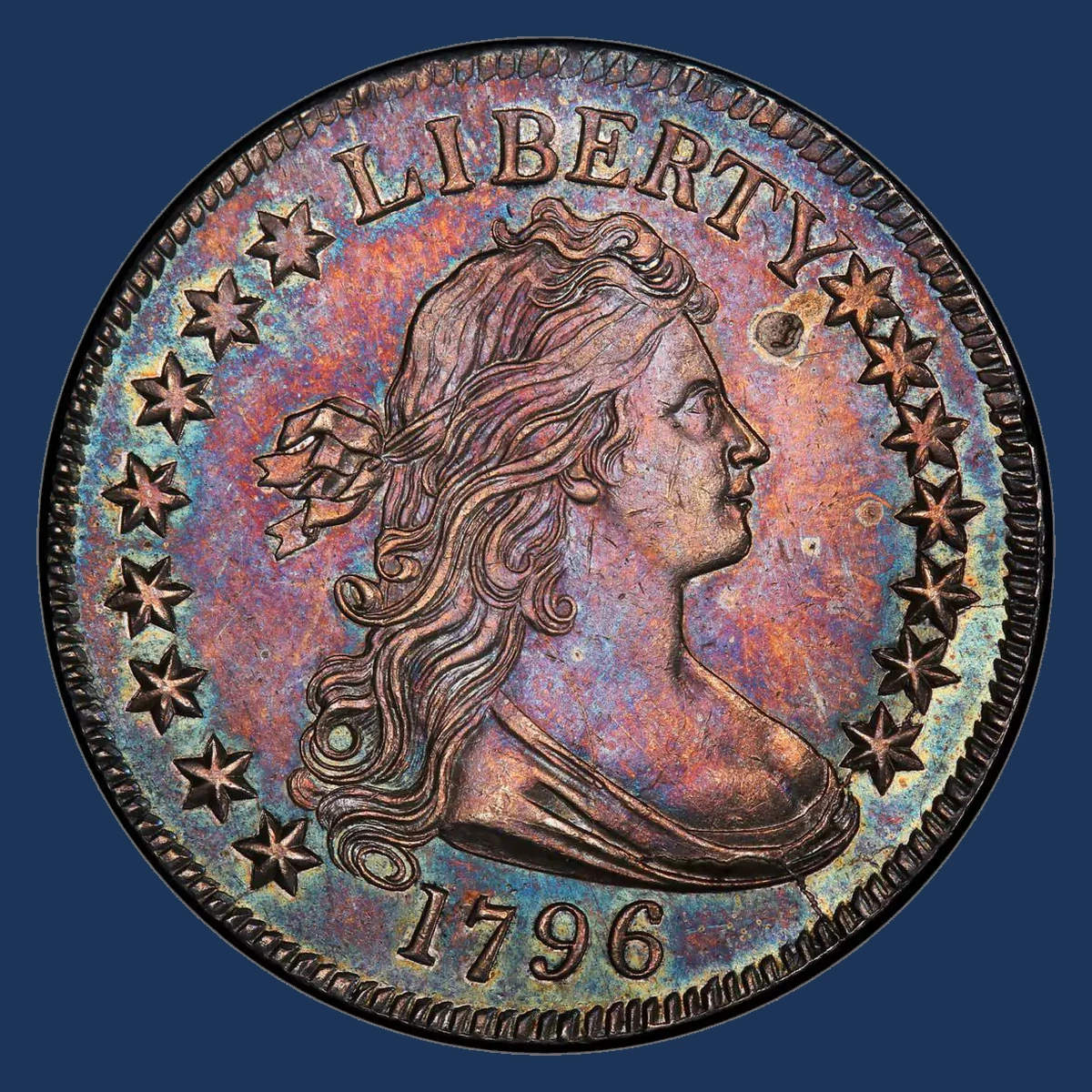
On the fifteen-star example, raised lines run through the right-hand stars into Liberty’s dress. One enters near three-thirty, crosses stars 13, 14, and 15, and reaches a fold.
A branch runs toward the rim at five o’clock. Another curved line lies above Liberty’s shoulder.
Silver entered cracks in the die during stamping and formed these ridges. The coin itself did not split along them.
The sixteen-star design has a different reported path near the date and stars 1–4. Use the star count to choose the right pattern.
Estimated Value
Heritage sold the fifteen-star PCGS VF25 example for $86,250 in September 2008. Similar worn coins without major condition problems have an estimated range of $60,000–$90,000.
The branching lines help identify the coin. Its rare date, Small Eagle design, and surviving detail account for much of the price.
A heavily worn or repaired example needs a different comparison. An extra branch in a crack does not automatically make it more valuable.
How to Identify
Use the stars as landmarks. On the fifteen-star coin, follow the line through the three right-hand stars and into the dress.
Then find the branch toward the lower rim and the curved line above the shoulder. A 10× magnifier helps show whether each line rises above the surface.
Scratches cut into the metal. A split in the coin’s blank is also different from these raised marks copied from a cracked die.
Check the date, star count, and the fraction 1/2 on the back. A loose coin can be measured against 13.48 grams and about 32.5 millimeters, with lettering around its edge.
For the quickest identification, match the full raised pattern to a documented coin with the same number of stars.
Conclusion
The fifteen-star and sixteen-star designs give you a starting point for checking these errors. From there, look for a peeling layer, a raised border patch, or branching ridges.
Estimated values span $50,000–$90,000 for comparable worn coins. The $66,000 example carries both lamination and a retained cud; those features describe one rare half dollar, not two values to add together.