1825 Half Dollar Error List with Pictures

An 1825 half dollar with strong raised cracks on the back sold for $977.50 in January 2006. Graded NGC MS61, it was unworn but had noticeable marks.
The 1825 half dollar errors below have estimated values of $100–$5,000 in the stated conditions. Read on to check repeated edge words, extra denomination lines, tilted designs, and flaws in the coin’s metal.
1. 1825 Capped Bust Half Dollar Seller-Reported Rotated Reverse (Estimated Up to $400 for a VF Example)
The eagle may appear tilted after a straight top-to-bottom flip from an upright Liberty. A seller reports this feature on an 1825 O-114 graded NGC VF20.
That grade describes a moderately worn coin. It does not, by itself, mean the grading service also certified the rotation.
A rotated stamping tool changes how the two sides point relative to each other. Both designs can still look centered.
The listing gives no measured angle or direction. Separate pictures turned upright cannot establish either detail, so the claimed rotation needs a controlled flip of the actual coin.
Estimated Value
The NGC VF20 listing asks $228.99 or Best Offer. A similarly preserved example with a demonstrated modest rotation has an estimated value of $150–$400.
The asking amount is not a completed sale. It also gives no price for each degree of tilt.
Because the listing supplies no angle, it cannot justify a premium for a large rotation. A stronger claim needs a measured coin and a closer comparison.
How to Identify
Hold Liberty upright and flip the coin straight from top to bottom. Keep the support or holder steady instead of twisting it sideways.
The eagle should finish upright on a normally aligned coin. Repeat the flip and use a protractor to measure any consistent tilt.
Inspect the lettered edge with a 10× magnifier for seams or other alteration. For an unsealed coin, compare a scale and calipers with the original 13.48 grams and roughly 32.5 millimeters.
This Philadelphia issue has no mintmark. The quickest confirmation is the same eagle tilt after each controlled flip, rather than two photographs positioned independently.
2. 1825 Capped Bust Half Dollar Repeated HALF A DOLLAR Edge Lettering (Estimated Up to $900)
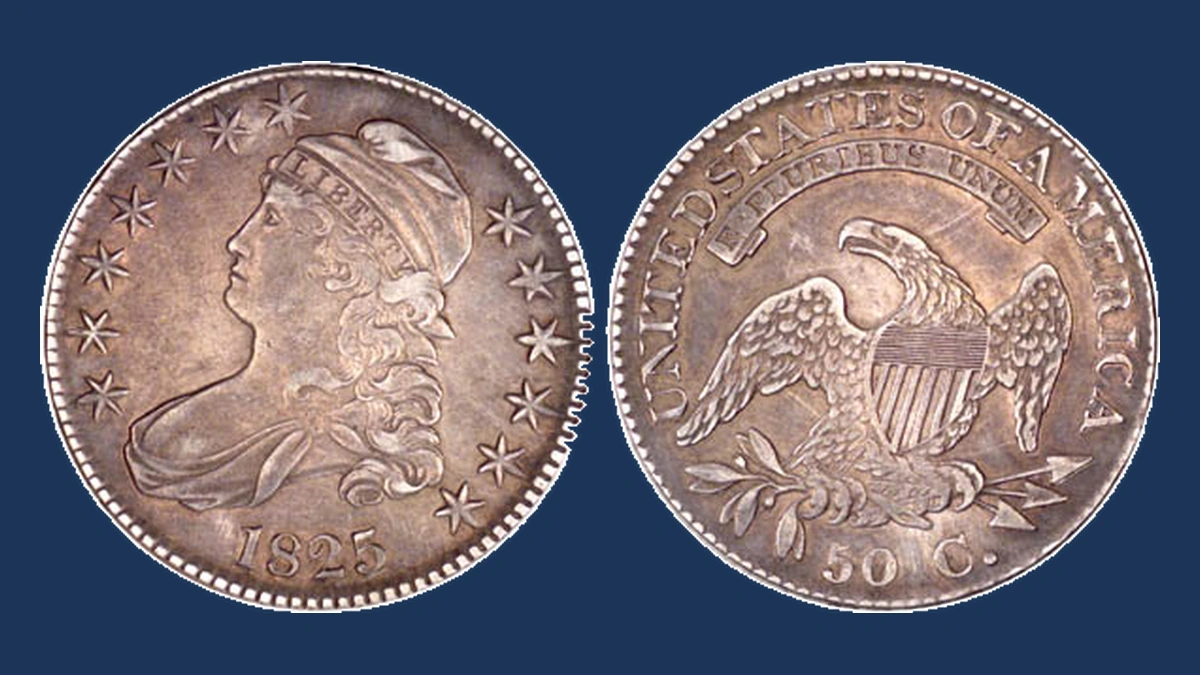
HALF A DOLLAR repeats around part of the edge on the Logan collection’s O-101 example. The description records repeated letters throughout that wording, not just one extra stroke.
Workers added the edge letters before striking the two faces. Repeated contact during that step could leave more than one impression of the same words.
The coin does not need a second portrait to have this edge error. The two operations were separate.
This example also has light polishing and fine scratches. Those later surface problems affect its appeal but do not explain the repeated edge words.
Estimated Value
Circulated examples with clearly repeated wording have an estimated value of $150–$900. No sale price is assigned here to the Logan coin.
A related 1834 doubled-edge half sold for $220 in July 2026. It was graded ANACS Fine Details and had been cleaned.
That different-year result helps compare a worn, impaired example. Sharper letters and natural surfaces may support a higher value, but each repeated letter does not add a separate premium.
How to Identify
Read around the entire edge with a 10× magnifier, using the Logan description to compare HALF A DOLLAR. Follow how the letters overlap instead of isolating one doubled stroke.
A small overlap where normal edge lettering meets is not enough. Look for the recorded extra sequence through the words.
Photograph both faces to match the date and O-101 variety. Calipers should show roughly 32.5 millimeters; a scale comparison starts with the original 13.48 grams, allowing for wear and polishing.
Inspect the edge for later recutting. For the fastest check, trace the repeated HALF A DOLLAR sequence continuously rather than judging one extra line.
3. 1825 Capped Bust Half Dollar Reported Incomplete Edge Preparation (Estimated Up to $900)
Part of the outline looks expanded beside weak or missing border teeth on a reported O-107. Its owner uses the nickname Guido and suggests incomplete edge preparation.
The proposed explanation is that part of the blank, the metal disc, missed its usual edge treatment before striking. That area might then spread differently under pressure.
This is the owner’s interpretation, not an independently certified cause. The nickname alone proves nothing.
Ordinary weak striking, wear, a shifted design, or later hammering can produce similar-looking areas. The expanded section and its edge must be examined together.
Estimated Value
A circulated O-107 with evidence supporting the reported edge-preparation problem has an estimated value of $200–$900. The collector’s account supplies no sale price or independent certification of the cause.
For comparison, an 1825 PCGS AU53 struck three percent off center sold for $600 in June 2024. That lightly worn coin has a different border problem.
Its sale helps compare the year and condition, not prove a price for the proposed Guido feature.
How to Identify
Find the weak border teeth and compare them with the normal teeth immediately beside them. Inspect the matching edge section through a 10× magnifier.
Measure the outline in several directions with calipers and look for thickness changes. Hammering, filing, or a compressed rim would point toward later damage.
A scale comparison starts with 13.48 grams; the usual diameter is roughly 32.5 millimeters. Photograph both sides with the full lettered edge visible.
Missing teeth alone do not establish the proposed cause. For a quick check, compare the expanded section with a matching difference in edge preparation, rather than relying on the informal nickname.
4. 1825 Capped Bust Half Dollar Reported Vertical Shield Die-Defect Line (Estimated Up to $1,000 in Circulated Grades)
A vertical line crosses the upper four horizontal shield bars on the right in the O-112 report. This gives a specific place to look on the eagle side.
A recessed mark in a die, the steel stamping tool, can produce a raised line on the coin. A later scratch instead cuts into the finished surface.
The date reference calls this line a die defect. It does not establish which tool or accident caused the damage.
Focus on the line’s height and position. An unrelated bright stroke somewhere in the shield is not the same feature.
Estimated Value
Circulated O-112 examples with a clear line have an estimated value of $100–$1,000. This prices the whole coin with its identifying feature, not the line by itself.
A different 1825 with raised cracks sold for $977.50 in January 2006. That NGC MS61 example was unworn and belonged to the O-106a variety.
It gives a same-year comparison only. A worn O-112 should not receive that price simply because both coins have an extra raised line.
How to Identify
Inspect the right side of the shield’s upper horizontal bars with a 10× magnifier. Follow the reported vertical line through the top four bars.
Light it from opposite sides to see whether it rises above the surface. A scratch may push silver up along its edges, so inspect the center as well.
Compare both complete faces with an O-112 example. Check the lettered edge, then use a scale and calipers against the original 13.48 grams and roughly 32.5 millimeters.
No mintmark belongs on this Philadelphia issue. The fastest specific check is a raised vertical line through those four right-side bars, matching the confirmed variety.
5. 1825 Capped Bust Half Dollar Repunched 50 C Denomination (Estimated Up to $1,200 in Circulated Grades)
Extra pieces of 50 C sit above the final denomination on the reported O-111. They show where the denomination punch first landed on the steel stamping tool.
The final placement was lower, leaving some earlier strokes visible. Coins made with that tool could repeat the extra lines.
The finished coin did not need a second strike to acquire this feature. The repeated details are limited to the punched characters.
The date reference describes the higher remnants. Their visible position matters more than a guess about why the worker moved the punch.
Estimated Value
Circulated examples with readable extra denomination lines have an estimated value of $150–$1,200. Better detail and natural surfaces support the upper end; heavy wear or damage lowers the comparison.
A different 1825 PCGS AU53 with mild off-centering sold for $600 in June 2024. That is a same-date comparison for a lightly worn coin, not an O-111 sale.
The denomination correction belongs in the whole coin’s value. The unrelated striking error does not establish a fixed premium.
How to Identify
Keep 50 C and the space directly above it in view under a 10× magnifier. Look for pieces of the same characters sitting higher than the main denomination.
Change the light direction to separate raised remnants from scratches or a flat shelf. Compare more than one character wherever enough detail survives.
Confirm the complete 1825 design and inspect the lettered edge. A scale and calipers should be compared with the original 13.48 grams and roughly 32.5 millimeters, allowing for wear.
This Philadelphia coin has no mintmark. To check the repunching quickly, match the higher remnants to the shapes and spacing of the final 50 C.
6. 1825 Capped Bust Half Dollar Collector-Reported Ragged or Split Planchet (Estimated Up to $1,800)
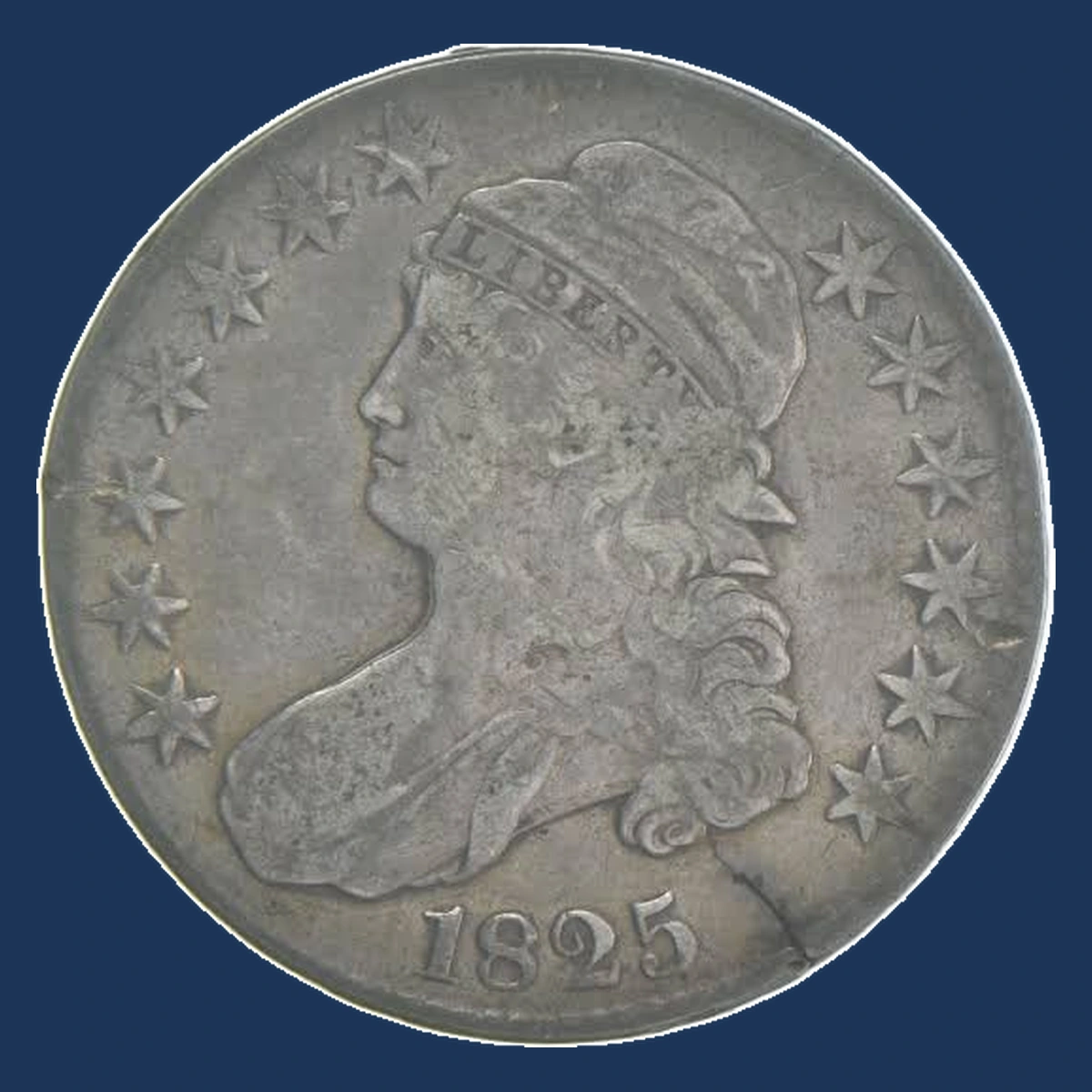
A split enters the edge near star four and extends toward the upper stars and Liberty’s cap on the reported O-113. Its owner believed the disc was damaged before striking.
That timing matters. A design stamped across an existing opening can look different from a finished coin cracked later by bending or cutting.
The account identifies an affected area and an explanation, not an independent error certification. Another seller’s cracked coin may have a different history.
An opening in the coin’s metal also differs from a raised line made by a cracked steel stamping tool.
Estimated Value
A circulated 1825 with evidence of a split present before striking has an estimated value of $250–$1,800. The range depends on how clearly the design supports that timing.
A different 1832 with a small rim defect sold for $263.25 including premium in July 2025. That ANACS XF45 coin was lightly worn.
Its modest flaw differs from the reported 1825 split. A higher price needs stronger visible evidence, appealing surfaces, and interest from collectors.
How to Identify
View the opening from the edge as well as the front. A 10× magnifier can reveal cuts, bending, or disruption of the surrounding edge letters.
The O-113 account starts near star four and continues toward stars five through seven and the cap. Follow how the design meets the split at those points.
Use a scale and calipers against the original 13.48 grams and roughly 32.5 millimeters. Side lighting helps separate a true opening from a raised crack line.
For a quick test of the proposed timing, look for struck detail continuing across the split rather than a fresh cut through completed details.
7. 1825 Capped Bust Half Dollar Mild Off-Center Strikes (Estimated Up to $1,800)
The documented three-percent off-center coin keeps most of its design but has uneven margins. It is an O-113 graded PCGS AU53, indicating light wear.
Its small shift makes complete views important. Wear along one edge or a tightly cropped picture can exaggerate an uneven border.
Both sides should show the effect of the misplaced metal disc. A shift on only one face may instead involve a single stamping tool.
Other 1825 reports describe five- and seven-percent examples. Those are different coins, and their measurements cannot be transferred to the three-percent AU53.
Estimated Value
PCGS records $600 for the three-percent AU53 in June 2024. The same coin sold for $432 in November 2017.
A similarly mild, lightly worn example has an estimated value of $400–$1,000. More pronounced, confirmed shifts in circulated condition have a broader estimated range of $600–$1,800.
Keep the amount of displacement and the grade attached to each comparison. A small uneven border does not automatically justify the higher range.
How to Identify
Compare the centers of both designs with the complete coin outline. Missing or uneven border teeth on one side alone do not establish an off-center disc.
Use a 10× magnifier to distinguish incompletely struck teeth from teeth worn or damaged away. Match the AU53 example before applying its three-percent description.
Measure the remaining outline with calipers against roughly 32.5 millimeters and use a scale against the original 13.48 grams. Inspect and photograph the lettered edge separately.
No direction is specified for that AU53, so do not add one by assumption. The quickest useful check is matching displacement of the two designs relative to the same physical edge.
8. 1825 Capped Bust Half Dollar Reverse Die Cracks (Estimated Up to $2,000 for Comparable Lower Mint State Examples)
One raised path runs from ICA through the base of 50 C on the O-106a back. Another begins below the leaves and continues through UNITED.
Both appear in the description of an NGC MS61 coin sold from the Jules Reiver collection. Together, they give a recognizable pattern to compare.
The steel stamping tool cracked, and metal entered its narrow gaps during striking. That left ridges on the coin rather than openings through it.
Trace each path fully. A short scratch across a letter is not enough to match the recorded pattern.
Estimated Value
The NGC MS61 O-106a sold for $977.50 on January 27, 2006. Comparable coins in lower unworn grades have an estimated value of $900–$2,000.
Circulated examples with readable cracks may fall around $100–$800. A different 1826 cracked example graded PCGS AU58 sold for $1,020 in August 2025.
These are whole-coin comparisons at different grades. The thickness of one ridge does not replace an assessment of wear, original shine, and surface damage.
How to Identify
Begin at ICA on the back and follow the ridge through the base of 50 C. Then trace the second path from below the leaves through UNITED.
A 10× magnifier and low light should show raised lines rather than recessed scratches. A split in the coin itself can reveal an actual opening in the metal.
Photograph the complete front, back, and lettered edge. Compare a scale reading with 13.48 grams and caliper readings with roughly 32.5 millimeters, allowing for wear.
For the quickest O-106a check, match both raised routes through their named letters and denomination, rather than identifying the coin from one isolated line.
9. 1825 Capped Bust Half Dollar Reported Doubled Portrait Profile (Estimated Up to $5,000 for Comparable MS63 Coins)
An extra outline follows Liberty’s face on the reported O-105 graded PCGS MS63. The auctioneer used the words double struck for the profile.
That description does not record two complete dates, two borders, or a matching second back design. A local repeated outline is a narrower observation.
Movement during striking may produce a repeated contour without a full second impression of the coin. The exact cause needs the actual raised detail to be examined.
Other 1825 examples also have repeated-looking profiles. Each should be checked separately rather than assuming the same minting accident explains them all.
Estimated Value
A well-preserved example similar to the PCGS MS63 coin, unworn with noticeable marks, has an estimated value of $2,000–$5,000. Worn coins with a modest repeated outline may fall around $150–$700.
The 2016 catalog identifies the MS63 example but gives no sale price used here. The $977.50 MS61 cracked coin is only a lower-grade, same-year comparison.
Neither surface feature has a fixed separate premium. Preservation and the extent of the visible repetition both matter.
How to Identify
Follow Liberty’s profile through several points with a 10× magnifier. Decide whether the extra outline is rounded, a flat shelf, or metal pushed beside damage.
Then inspect the rest of the front and back for additional impressions. Their absence limits what can be concluded from the repeated face alone.
Change the light to rule out glare or a blurry photograph. Check the complete lettered edge and compare scale and caliper readings with 13.48 grams and roughly 32.5 millimeters.
The issue has no mintmark. For a quick first check, trace the repeated profile’s height and extent before looking for a second complete design elsewhere on the coin.
Conclusion
The estimated $100–$5,000 range covers different grades and different kinds of repetition or damage during minting. Edge words, denomination lines, and a repeated portrait each come from separate questions about how the coin was made.
Check the reported metal split and incomplete edge preparation against their individual examples. For every comparison, keep both faces, the lettered edge, and the coin’s condition together rather than pricing one unusual line alone.