1831 Half Dollar Error List with Pictures

An album can hide the important part of an 1831 half dollar: its edge. An unworn example missing the normal edge words sold for $7,200 in November 2019.
This 1831 half dollar error list also includes unfinished cuts, misplaced designs, and a backward portrait. Estimated values run from $150 to $15,000, depending on the feature and the coin’s condition.
Read on to see why the edge deserves attention and how both sides help explain an unusual mark.
1. 1831 Capped Bust Half Dollar Die Cracks (Estimated Up to $800)
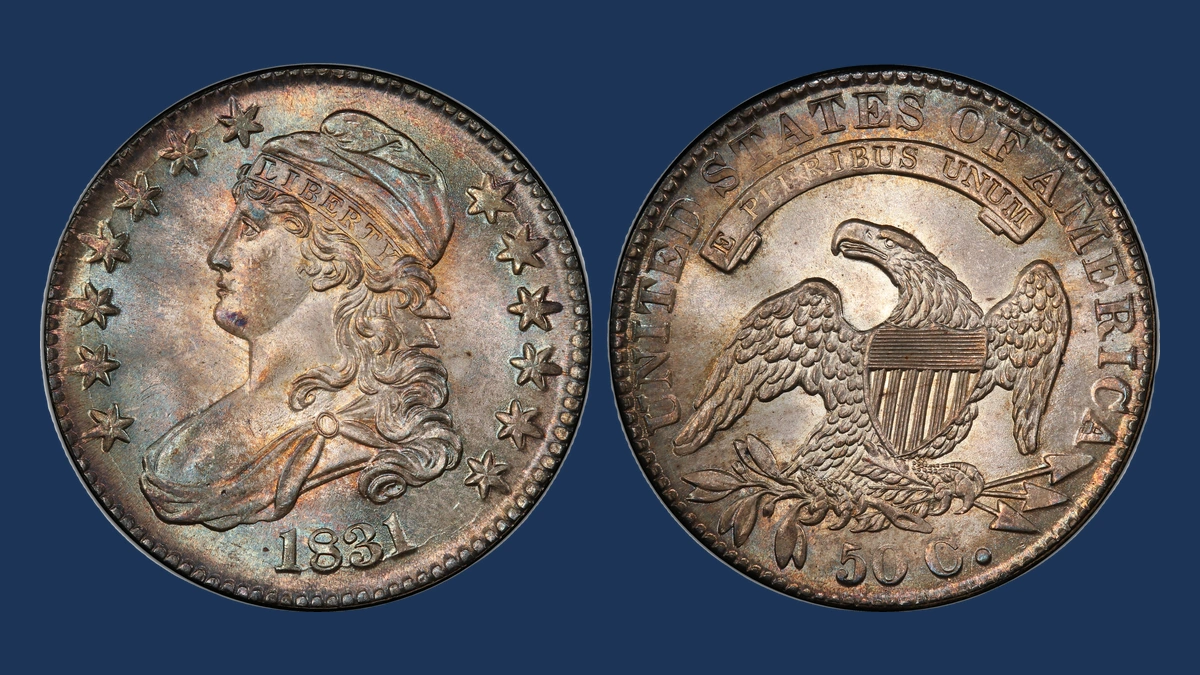
A thin raised line can connect the tops of UNITED on the back. It appears on the 1831 variety cataloged as O-118, a number used to identify its particular design details.
The line came from a cracked die, the steel tool that stamps coins. Silver entered the crack during stamping and formed a ridge on the finished coin.
Another variety, O-103, has a small raised line between the bottoms of the first 1 and the 8. These are different examples.
Do not expect both routes on every coin. Each needs its own matching photograph.
Estimated Value
Allow an estimated $150–$800 for worn coins with these ordinary crack lines. The amount covers the complete half dollar, with much of the difference explained by wear and surface quality.
The O-118 auction listing records $456 for an NGC AU55 in January 2025. That is an almost unworn example of the same variety, not a separate price paid for the small crack alone.
How to Identify
Check the date and lettering around the edge, then measure an accessible coin with a digital scale and calipers. The original standards are about 13.48 grams and 32.5 millimeters across.
Hold a light low beside the back and follow the tops of UNITED with a 10× magnifier. The highlight should move across a raised ridge as you change the light.
A scratch cuts into the metal and may push up uneven edges. Dirt can also imitate a line in a photograph, so inspect from several angles without cleaning.
For O-103, examine the date instead. The matching raised connection between the first 1 and 8 distinguishes that example from the UNITED crack.
2. 1831 Capped Bust Half Dollar Die Clash (Estimated Up to $1,000)
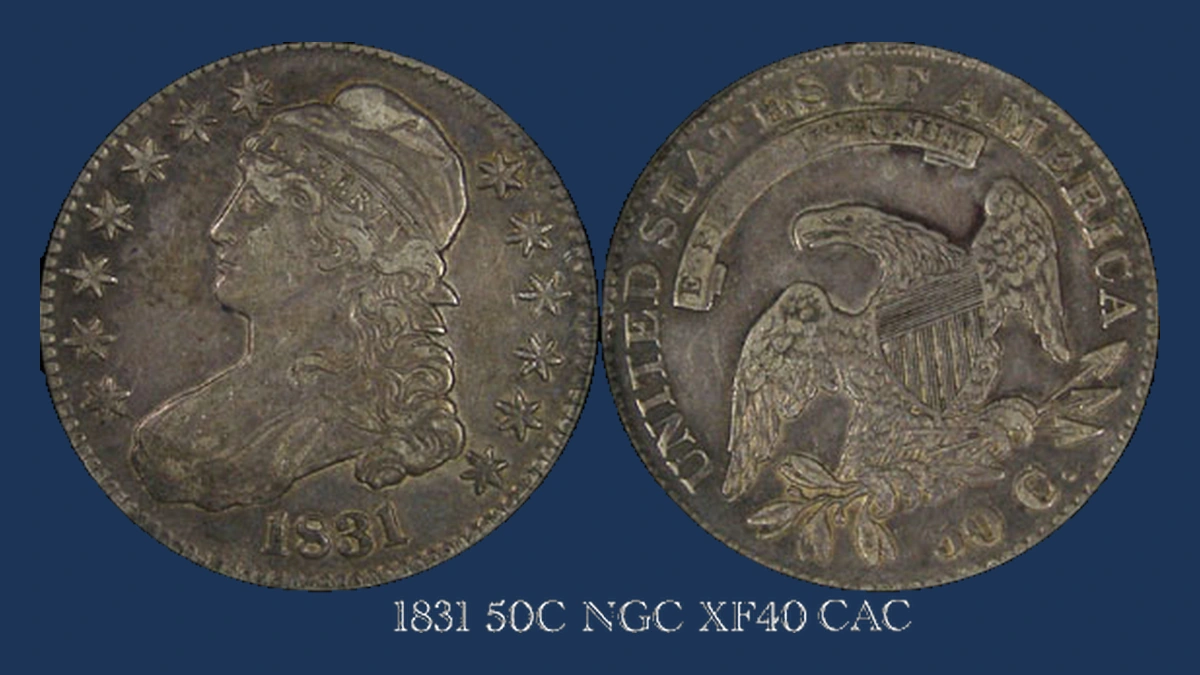
Faint extra shapes can come from the opposite side’s design. When the dies hit each other without a blank between them, they can leave marks that appear on coins struck afterward.
This is a die clash. A blank is the metal disc waiting to receive the design.
A dealer described clashes on both sides of an 1831 half dollar graded NGC XF40, a lightly worn coin. The description also noted a small contact mark near the tenth star.
That mark is a separate feature. It should not be used as the clue for identifying the clash.
Estimated Value
The dealer listed the XF40 coin at $275 and marked it sold in January 2011. This is a historical dealer listing, not an auction result.
A working estimated range is $175–$1,000 for worn examples with recognizable clash shapes. That old listing and more recent ordinary 1831 sales provide context; clear extra outlines and appealing original surfaces support the stronger end of the range.
How to Identify
Examine enlarged photographs of both sides, with one image mirrored to show how the dies faced each other. An extra shape should fit a piece of the opposite design.
Check the lettered edge and, when safely accessible, use calipers and a digital scale against about 32.5 millimeters and 13.48 grams. Keep these whole-coin checks separate from deciding what caused a faint mark.
A 10× magnifier and changing light can help distinguish raised shapes from scratches or cleaning lines. The dealer’s description does not map every clash location.
A recognizable fragment copied from the other side is the useful match. The isolated contact mark near star ten does not prove clashing, even on a coin that has genuine clashes elsewhere.
3. 1831 Capped Bust Half Dollar Off-Center Obverse (Estimated Up to $1,500)
The front design sits toward about 3–4 o’clock on a remarkable 1831 half dollar. Part of the lower-right border lacks the normal small teeth because the design reaches too far toward the edge.
The opposite side has a centered, sunken, backward copy of the front design. That second effect is called brockage and is explained below.
Both features belong to the same PCGS VF25 coin, a worn example. The uneven front describes where its normal design landed.
The backward portrait describes something different. They should not be treated as two coins or two separate purchases.
Estimated Value
Minor displacement alone has an estimated whole-coin range of $150–$1,500 across worn grades. This estimate starts with ordinary 1831 values, including the $456 almost unworn O-118 comparison above.
The illustrated VF25 is much more valuable because it also has a full backward portrait on the other side. Its complete value cannot be assigned to the slightly shifted front alone, and the two estimates must not be added together.
How to Identify
Measure the gap between the design and the edge all around the front. On this example, the design shifts lower right and the small border teeth disappear there.
Photograph the other side at the same scale. Its backward portrait is centered, unlike a large off-center strike that leaves a broad blank crescent on both sides.
Inspect the lettered edge and use a digital scale and calipers on an accessible coin against 13.48 grams and roughly 32.5 millimeters. Edge wear or a knock can erase individual border teeth without shifting the whole design.
The combined shift of the front’s center and loss of the lower-right border teeth identifies the described feature. Missing teeth by themselves do not.
4. 1831 Capped Bust Half Dollar Incomplete Planchet Punch (Estimated Up to $3,500)
A curved cut crosses the coin, but the metal has not fallen away. This can happen when a tool begins punching a blank from silver strip and stops before cutting through.
Later cutting and stamping can leave that unfinished arc visible on a complete coin. Collectors call it an incomplete planchet punch; planchet is another word for blank.
An 1831 example graded NGC XF45 shows the curved cut and a matching feature on the other side. Specialist Henry Hilgard described another variety as well.
The retained metal matters. An ordinary clip leaves a piece of the coin physically missing.
Estimated Value
Use an estimated $1,500–$3,500 for an authenticated worn example with a clear arc. The 2026 Sheridan Downey listing estimated its lightly worn XF45 example at $1,500 and up.
It also cited a similar 1826 error graded VF30 that sold for $2,040 in March 2024. That different-year sale provides a recent comparison for the same kind of unfinished cut; it is not the realized price of the 1831 lot.
How to Identify
Follow the front arc from roughly 10 to 1 o’clock on the described example. Then turn the coin over and look for the matching line on the back.
A 10× magnifier should help show whether the stamped design formed around an existing cut. A later scratch may slice across completed details and leave sharp burrs.
Check the lettered edge and measure an accessible coin with calipers and a digital scale against about 32.5 millimeters and 13.48 grams. An unfinished cut need not cause a large weight loss because the metal remains attached.
The rounded cut, retained metal, and matching evidence on both sides work together. A single curved scratch does not show the same sequence.
5. 1831 Capped Bust Half Dollar Missing Edge Lettering (Estimated Up to $9,000)
FIFTY CENTS OR HALF A DOLLAR normally runs around the edge. On a plain-edge 1831, those words are absent even though the front and back received their normal designs.
The edge words were applied in a separate step. A blank that missed that step could still go on to be stamped.
The known example belongs to the variety labeled O-118. Its normal-looking faces can hide the omission when an album covers the edge.
One smooth patch is not enough. The full edge must be unlettered, rather than simply showing a few weak or worn words.
Estimated Value
An unworn 1831 O-118 plain-edge coin sold for $7,200 in November 2019, as recorded in Sheridan Downey’s Mail Bid 53 catalog. That sale supports an estimated $2,000–$9,000 range from authenticated worn coins to attractive unworn examples.
Original edge surfaces are essential. A normal coin can have the same O-118 front and back details, but it does not receive the added value for missing edge words unless the omission itself is genuine.
How to Identify
View the edge in overlapping sections until you have checked the entire circle. Lettering can be shallow or unevenly spaced, so do not decide from one smooth stretch.
Use a 10× magnifier to inspect its texture and the join with each face’s rim. Filing or polishing may leave lines, rounded borders, or an unnaturally smooth surface.
Calipers and a digital scale can check accessible coins against about 32.5 millimeters and 13.48 grams, allowing for wear. Reduced size can help reveal an edge turned down after minting.
The front and back variety alone cannot confirm the error. Original-looking metal around the full edge, with no letters or signs of removal, is the defining feature.
6. 1831 Capped Bust Half Dollar Full Obverse Brockage (Estimated Up to $15,000)
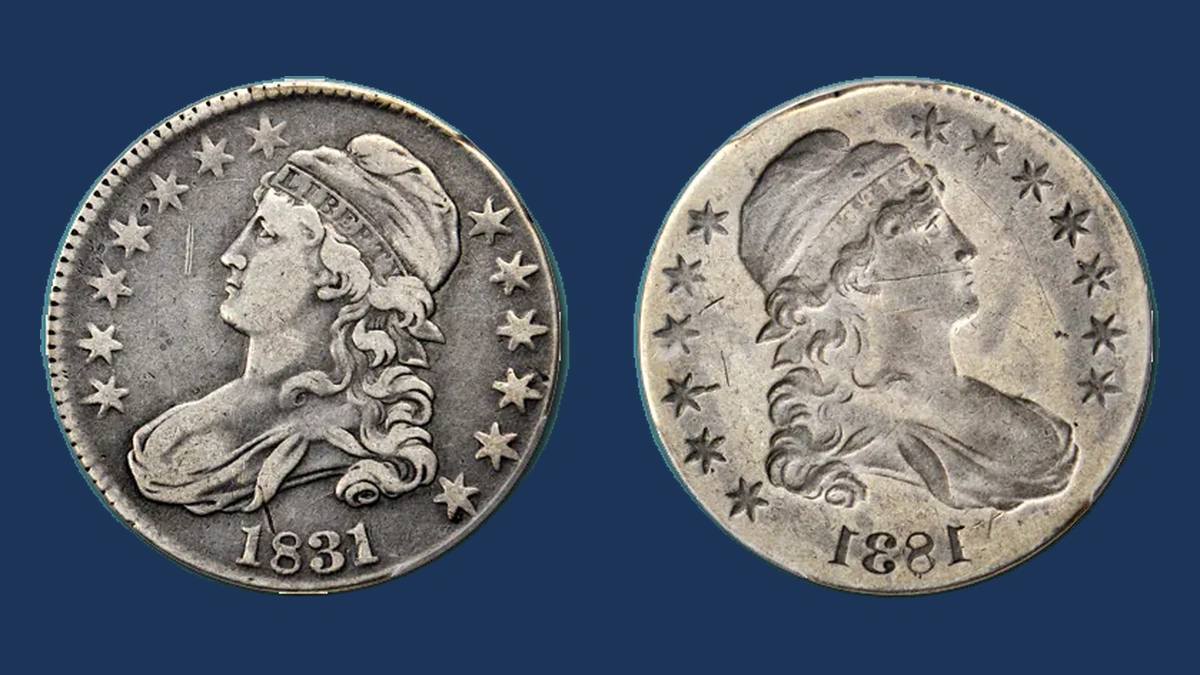
Liberty appears on both sides, but one portrait is backward and sinks into the surface. A finished half dollar stayed in the press and stamped its design into the next blank.
This is a brockage. The trapped coin replaced the normal stamping tool on that side, so a backward portrait appeared instead of the eagle.
Stack’s Bowers featured a PCGS VF25 example in November 2016 and compared it with a more heavily worn specimen. The VF25 also has the shifted normal front described above.
A full backward portrait is much larger than the faint fragments left by clashing dies.
Estimated Value
A full, authenticated 1831 half-dollar brockage has an estimated $3,500–$15,000 range. For comparison, an 1831 large-cent brockage sold for $3,600 including fees in July 2023.
That coin was copper and worth one cent when issued, not a silver half dollar. The wider estimate allows for the silver examples’ scarcity and stronger visible detail, but it is not a recorded auction price for either documented half dollar.
How to Identify
Look at the portrait’s direction and the date. Both should be backward on the affected side, and the design should sink into the surface rather than stand above it.
Compare with the documented VF25 example under broad light, then angle the light to reveal the depth. Use a 10× magnifier to check the smaller lettering.
Inspect the lettered edge and, when safely accessible, compare scale and caliper readings with 13.48 grams and about 32.5 millimeters. Pressing two finished coins together can create damage that imitates part of this effect.
Professional authentication is especially useful before paying for this major error. The key visual combination is a complete sunken mirror image opposite an intact normal portrait.
Conclusion
The edge may hold the answer before you examine the portrait. Missing words, an unfinished curved cut, and a full backward head each tell a different story, while small raised lines need closer comparison.
Estimated values range from $150 to $15,000. The shifted front and backward portrait described here share one coin, so their values are not added; complete photographs help keep that relationship clear when comparing major errors.