1847 Half Dollar Error List with Pictures

An 1847 half dollar showing an old 6 beneath its final date reached $43,125 at auction. That Philadelphia overdate belongs to a different group from New Orleans coins with extra outlines and damaged-tool marks.
Across these 1847 half dollar errors, estimates begin at $250, while the exceptional record reaches $43,125.
The six types below show where to look and explain why ordinary worn examples and top-condition auction coins need separate price comparisons.
1. 1847-O Liberty Seated Half Dollar Clashed Dies (Estimated Up to $800)
The lower-right corner of the shield is the place to inspect on this New Orleans example. An extra trace sits beside the normal design.
It came from a die clash. Dies are the steel tools that stamp coins; sometimes they hit each other without a blank between them.
That contact can transfer part of one picture to the opposing tool. Later coins then receive an unwanted fragment beside their normal design.
The reported example has a large O mint letter. Its faint extra outline needs comparison with the same variety, because scratches and polishing lines can look similar.
Estimated Value
Worn examples with a recognizable shield-area clash have an estimated $250–$800 range. Ordinary New Orleans coins from the same year offer a starting comparison.
Sold listings for 1847-O include $504 in February 2025 and $525 in July 2025. Both had XF45 grades, meaning worn with strong detail remaining.
Neither sale identifies a clash. A clear matching trace may add interest, but the whole coin’s condition remains important.
How to Identify
Use a 10× magnifier on the shield’s lower-right corner while moving the light around the coin. Watch for an extra outline beside or across the normal design.
Compare it with the Large O example in Bugert’s New Orleans reference. One unexplained line is not enough to establish the same clash.
Find O below the eagle and keep the complete date in the photograph. On safely accessible coins, use calipers and a scale against about 30.6 mm and the original 13.36 grams.
Inspect the edge grooves for cuts or seams that could reveal alteration. Return to the lower-right shield: the shape of the transferred trace should match the documented example, not merely look bright.
2. 1847-O Liberty Seated Half Dollar Reverse Cud (Estimated Up to $2,000)
A narrow crack can develop into a much larger raised patch. On this back, the early line reaches the rim near the first S of STATES, above UNITED.
Later, part of the stamping tool’s edge gave way. Silver filled the missing space and left a broad lump joined to the coin’s rim.
Collectors call that completed rim break a cud. It is more than a thin crack.
The 2026 auctioned MS66 doubled-front coin shows the earlier cracked stage. The cud belongs to later use of the tool, so the two surfaces should not be confused.
Estimated Value
Estimate $500–$2,000 for worn examples with the completed raised rim break. Ordinary 1847-O XF45 listings around $500 provide a comparison for the underlying coin.
A large, clear break can add interest beyond that starting point. The $17,080 September 2026 sale concerns a different level of preservation.
That MS66 doubled-front coin is exceptionally well-preserved and unworn. It shows the earlier crack, so its price is not a sale record for the completed cud.
How to Identify
Follow the border above UNITED toward the first S of STATES. Look for a broad raised area that actually joins the rim.
A narrow line reaching that area is only the earlier crack. Compare with a later example showing the completed break, rather than expecting the MS66 auction photograph to prove it.
With a 10× magnifier, inspect the mound and nearby edge grooves. Solder, corrosion, or an impact can create an unusual lump without a broken stamping tool.
A scale and calipers help check safely accessible coins against the original 13.36 grams and about 30.6 mm. Allow for wear.
The distinguishing feature is the broad raised mass connected to the rim in this exact lettering area.
3. 1847-O Liberty Seated Half Dollar Repunched Date (Auction Example $24,675)
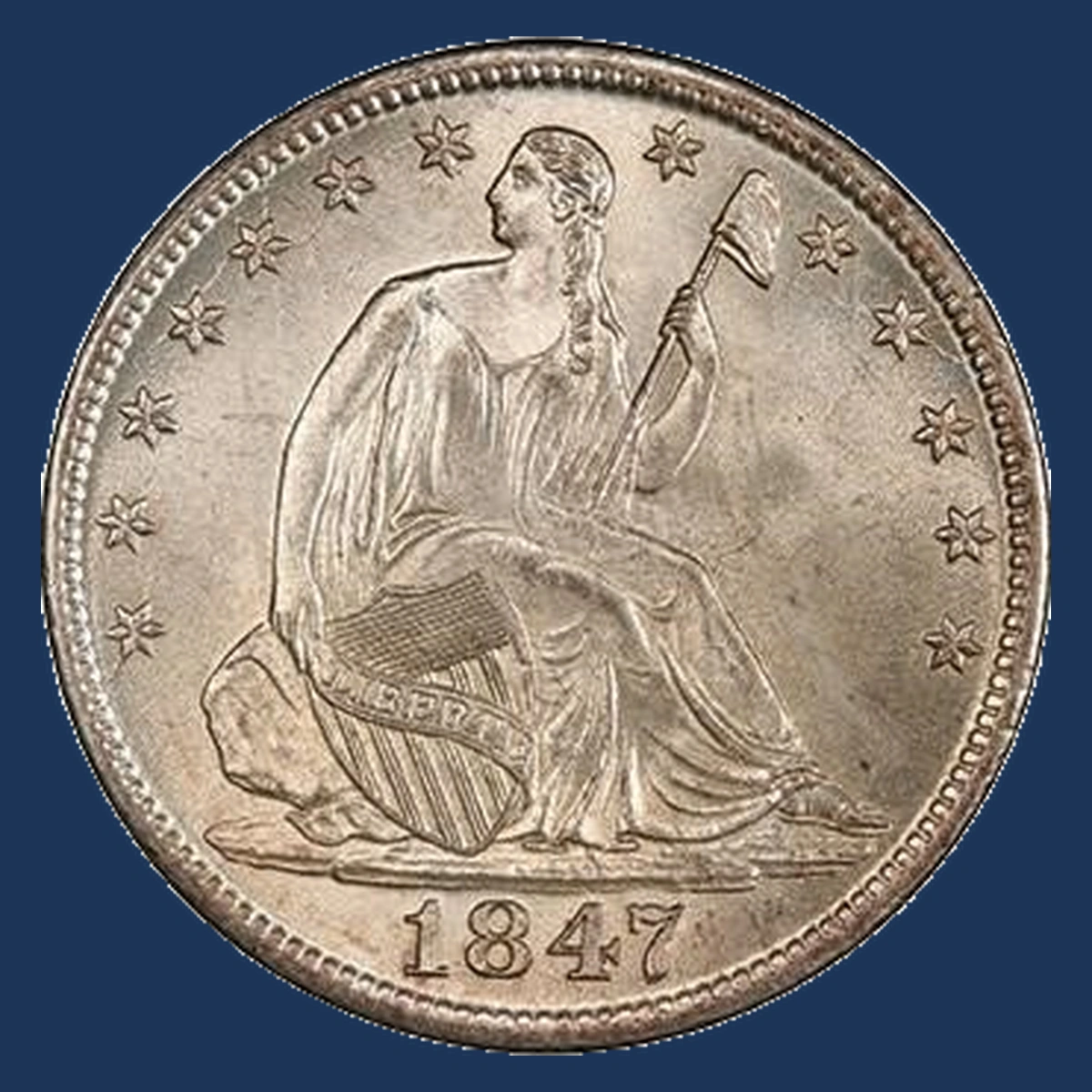
The 7 has a second piece directly below it on the 2021 auction example. An earlier punch impression survived when the date was entered into the stamping tool.
This happened before the tool began making coins. The same example later received extensive raised cracks from damage that developed during use.
Its high grade does not make those two causes the same. The extra 7 records date preparation, while the cracks record wear on the tools.
Another Large O example is described as having a doubled date. Its extra strokes need their own comparison rather than an assumed downward direction.
Estimated Value
The exceptional coin sold for $24,675 in October 2021. It was graded MS65, meaning well-preserved and unworn, with CAC quality approval.
That price includes the whole coin’s rare condition. It is not a separate payment for the extra 7.
For worn examples, estimate $300–$900, using ordinary XF45 sales around $500 as comparisons. A coin matching the auction example’s exceptional preservation belongs in a very different price tier.
How to Identify
Center the final 7 under a 10× magnifier. On the auction example, the earlier impression lies below the main numeral.
Keep the whole date visible when comparing the stroke’s shape and spacing. A nearby crack should not be mistaken for part of the earlier 7.
A low, flat shelf at a digit’s edge can come from movement during striking. Look instead for a formed piece of the numeral that agrees with the photograph.
Confirm O below the eagle and inspect the edge grooves. When safely accessible, use a scale and calipers against 13.36 grams before wear and about 30.6 mm.
The specific match is the clearly shaped extra stroke beneath 7, rather than any doubled-looking date.
4. 1847 Liberty Seated Half Dollar Die Cracks (Auction Example $24,675)
The route of a raised line can tell you which example to compare. On the New Orleans doubled-front coin, one crack crosses Liberty’s rock and ribbon.
On its back, another follows the top of UNITED toward the rim above the first S of STATES. Those paths belong to that tool pair.
Philadelphia overdate examples can instead show cracking along the date’s bottom. Earlier coins need not have the same developed line.
Cracks grew as the tools stayed in use. A later coin may therefore have a stronger ridge than another coin made with the same tools.
Estimated Value
Estimated values of $250–$900 cover ordinary worn examples with visible cracks, excluding the separate rarity value of the overdate. New Orleans XF45 comparisons near $500 help set that tier.
Exceptional coins cost much more. The MS66 doubled-front example brought $17,080 in 2026, while the cracked MS65 repunched-date example reached $24,675 in 2021.
Those prices cover complete high-grade coins with several features. They do not put a separate price on each crack.
How to Identify
For New Orleans, follow the line across the back lettering before checking Liberty’s rock and ribbon. Compare both paths with the cataloged doubled-front example.
For Philadelphia, look along the date’s lower edge instead. The absence of a strong crack does not rule out an early overdate example.
A 10× magnifier and low light should show whether the line rises from the surface. A scratch cuts downward and may leave disturbed metal beside it.
Include the mint area and edge grooves in your inspection. Use a scale and calipers when safely accessible against about 13.36 grams and 30.6 mm.
Follow a continuous raised route through the matching landmarks, rather than joining separate marks into an imagined crack.
5. 1847 Liberty Seated Half Dollar Doubled Die Obverse (Combined-Variety Record $43,125)
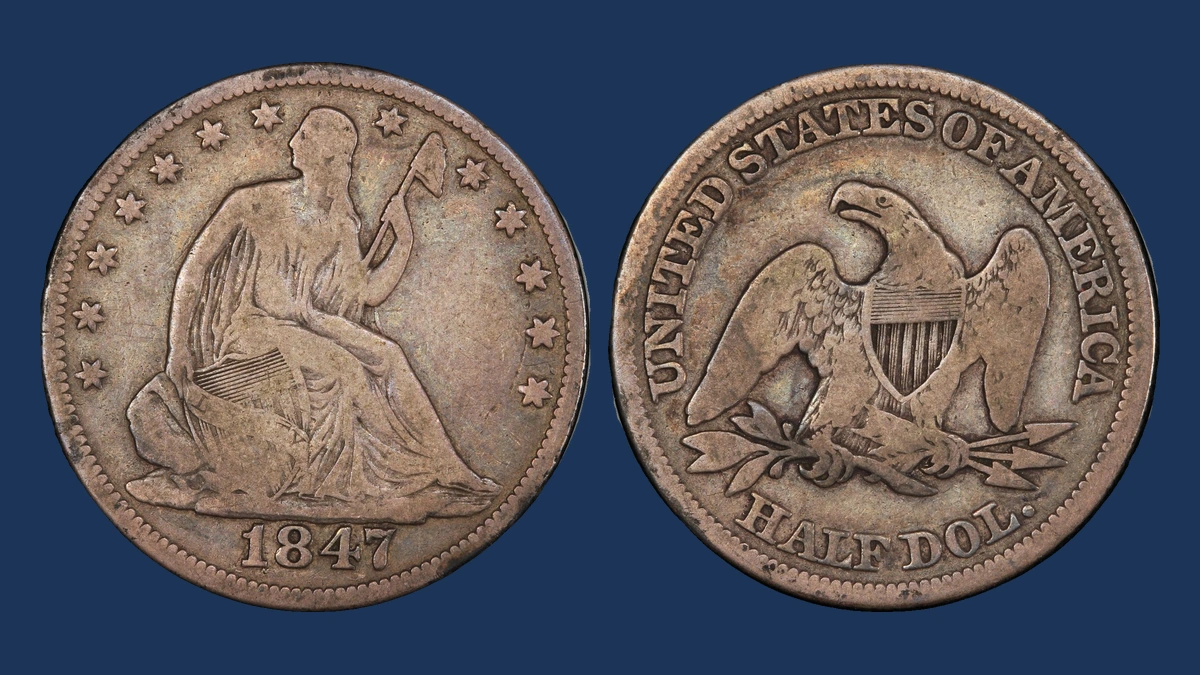
On the Philadelphia overdate, the word LIBERTY has extra outlines, especially around RTY. More doubling appears at the shield’s upper-right edge and nearby gown folds.
The New Orleans pattern is different. It involves Liberty’s fingers, the rock’s left edge, the ribbon end behind the shield, and the first two shield-line groups.
These repeated shapes entered the tools while their designs were being prepared. A coin could receive the doubled picture in one strike.
The Philadelphia tool also carried the altered date. Those two features share a coin, but neither should be copied onto the New Orleans comparison.
Estimated Value
The New Orleans MS66 example sold for $17,080 in September 2026. Attractive worn O-mint examples have an estimated $400–$1,200 range.
Philadelphia’s doubled front belongs to the valuable 1847/6 overdate, whose combined-variety record is $43,125. That result includes the old date and exceptional preservation.
These are whole-coin comparisons. The Philadelphia record should not be applied to an ordinary worn New Orleans doubled-front coin just because both show extra outlines.
How to Identify
Find the mint letter first. With no O, compare Philadelphia RTY and the upper-right shield; with O, use the New Orleans finger and shield-line pattern.
Under a 10× magnifier, follow several extra outlines instead of relying on one suspicious stroke. A scratch or flat shelf can imitate a small piece of doubled design.
Keep the full front and mint area together in your photographs. That prevents a close-up from being assigned to the wrong issue.
Check the edge grooves for cuts or seams. When safely accessible, use a scale and calipers against the original 13.36 grams and approximately 30.6 mm.
Matching extra shapes in several of the correct mint’s locations provide the useful identification, rather than a date stroke alone.
6. 1847/6 Liberty Seated Half Dollar Overdate (Auction Record $43,125)
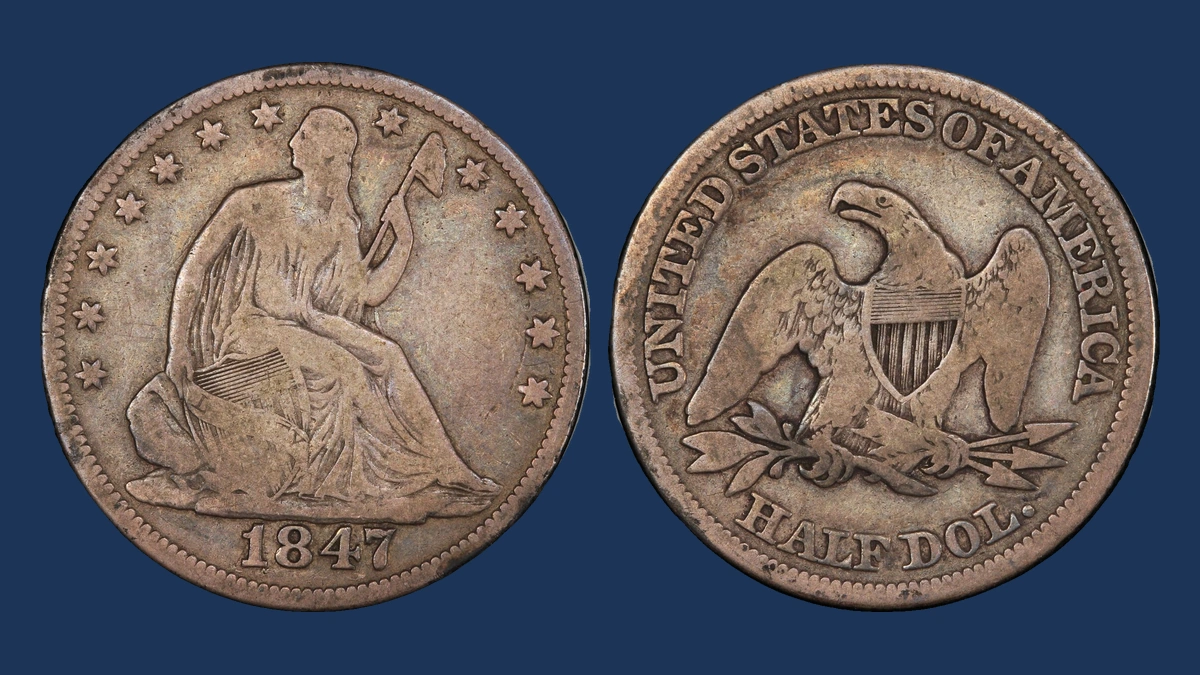
An old 6 survives beneath the final date on this Philadelphia half dollar. Its lower loop is an especially useful clue.
Auction descriptions also note pieces of earlier 1 and 4 impressions. Those older strokes sit lower and left of the final date.
The stamping tool was changed from an earlier date, but the old shapes were not completely removed. Coins made afterward could carry both sets of traces.
Collectors call it 1847/6. Wear can weaken the old loop, and later cracks can cross the same area, so judge the curve within the whole date rather than by itself.
Estimated Value
The auction record is $43,125 for an MS62 example in August 2011. MS62 describes an unworn coin with noticeable marks.
Worn comparisons include $3,360 in 2020 and a $9,500 sold listing in October 2025 for an XF40 coin. That grade indicates wear with substantial detail remaining.
An estimated $3,000–$12,000 covers collectible worn examples. A clear match, remaining detail, and surface quality matter more than treating the exceptional record as a normal price.
How to Identify
Look at the complete date before enlarging the final 7. With a 10× magnifier, find the curved lower loop of the older 6.
Compare the earlier numeral pieces with their lower-left positions in a verified overdate photograph. A line touching 7 is not enough if it lacks the expected curve.
A crack may cross the same area, so change the light and follow each feature separately. Keep the ordinary date digits visible throughout the comparison.
The Philadelphia coin has no O on the back. Inspect the edge grooves and measure safely accessible examples against 13.36 grams and about 30.6 mm with a scale and calipers.
The old 6’s lower loop, in the correct position within the full date, is the clearest starting clue.
Conclusion
The price span runs from estimates near $250 for modest worn examples to the exceptional $43,125 overdate record. That gap reflects rarity and condition as well as the unusual features.
First separate Philadelphia from New Orleans. Then check the old numeral, extra design, or raised break in its proper place; a thin crack above UNITED is not yet the later broad rim cud.