1857 Half Dollar Error List with Pictures

An 1857-O half dollar with a misplaced date sold for $7,200 at Stack’s Bowers in August 2024. Pieces of a number survive above the normal date, where they can be mistaken for rock detail.
The 1857 half dollar errors below have estimated values from $150 to $7,500. Read on to spot those hidden number fragments, extra strokes beside the date, raised cracks, a rim lump, faint transferred shapes, and a turned back.
1. 1857 Liberty Seated Half Dollar Rotated Reverse (Estimated Up to $550)
Both sides can show complete, centered pictures while the eagle points in the wrong direction after you turn the coin over. This is a rotated reverse, meaning the back is turned relative to the front.
The Philadelphia reference reports about twelve degrees clockwise early in the use of one pair of stamping tools. Later coins from that pair show about thirty degrees.
Those measurements do not apply to every 1857 half dollar. They also cannot be judged from separate pictures that a seller has turned upright, because that hides the relationship between the two sides.
Estimated Value
Estimated value is $150–$550 for a worn Philadelphia example with a measurable rotation. Ordinary coins had reported sales of $240 for PCGS XF40 in August 2025 and $338 for PCGS AU50 in September 2025.
The first grade means moderate wear and the second means lighter wear. Neither listing identifies a rotated example, so the range estimates the whole coin’s value rather than assigning a fee for each degree of rotation.
How to Identify
Separate upright photographs cannot show rotation reliably. Keep the coin in a secure protective holder so its position stays fixed while you turn it.
Start with Liberty upright, then flip the holder from top to bottom. A normal eagle will also appear upright after that movement.
Measure any lean with a protractor and repeat the flip. A loose coin moving inside the holder can give a false result.
For an accessible coin, also check the edge grooves with a magnifier. A scale and calipers can compare the usual 12.44 grams and 30.6 millimeters.
The important result is a clockwise lean that repeats without the coin moving in its holder.
2. 1857 Liberty Seated Half Dollar Clashed Dies (Estimated Up to $650)
Faint extra shapes can appear beneath Liberty’s elbow or around the eagle on some Philadelphia halves. The reported back locations are the lower right of the shield and below the right wing.
These are clash marks, pieces of a design transferred from the other side. They begin when the steel stamping tools meet without a blank, the round metal disc used to make a coin.
Later coins can receive those unintended shapes. A separate 1857 cent with half-dollar design traces does not prove that one of these half dollars carries part of a cent design.
Estimated Value
The estimated range is $200–$650 for a worn Philadelphia example with recognizable clash marks. Reported ordinary Philadelphia sales include $381 in March 2025 and $399 in May 2026 for NGC AU55 coins.
AU55 means light wear, giving a useful condition comparison. Those listings do not identify clashed examples, and a clear extra design shape is more meaningful to collectors than a faint line that cannot be matched to the opposite side.
How to Identify
Choose a Philadelphia comparison first: there should be no mintmark on the back. A normal example weighs 12.44 grams and measures about 30.6 millimeters, checked with a scale and calipers.
Now place photographs of the two sides together. Look beneath Liberty’s elbow, at the lower right of the shield, and below the eagle’s right wing.
Use a magnifier and keep the nearby design visible. Try to match each extra shape to a part of the opposite side rather than simply counting unusual lines.
Inspect the edge grooves too. For the clash itself, the useful evidence is a recognizable fragment of the opposite design at a reported location.
3. 1857 Liberty Seated Half Dollar Die Cracks (Estimated Up to $700)
A fine line below the date may continue as a raised ridge rather than a scratch. Philadelphia reports also describe lines around the back lettering and denomination.
The steel tool that stamps a coin is called a die. When that tool cracks, silver can enter the opening and leave a raised line on the finished coin.
A later scratch cuts down into the surface instead. Even so, the line’s path needs a match to the correct example, since ordinary damage can cross the same letters and numbers without having formed during minting.
Estimated Value
Use an estimated $175–$700 for worn examples, depending on the condition and how clearly the raised lines show. Ordinary Philadelphia comparisons include PCGS XF40 at $260 in April 2026 and NGC AU55 at $399 in May 2026.
Those grades range from moderate to light wear. The upper estimate allows for attractive surfaces and obvious marks, while several cracks on one coin still receive one whole-coin valuation rather than separate prices for each line.
How to Identify
Follow the line below the numbers without jumping across gaps to unrelated marks. Do the same around the back lettering and the words showing the coin’s value.
Shine light from opposite sides and use a magnifier to distinguish a ridge from a cut. Corrosion, torn metal, and scratches can interrupt the original surface in different ways.
Inspect the mintmark area and edge grooves. With a scale and calipers, compare the original 12.44-gram weight and roughly 30.6-millimeter diameter, allowing for wear.
A continuous raised line along the documented date or lettering path is the quickest useful check before studying smaller differences between examples.
4. 1857 Liberty Seated Half Dollar Rim Cud Below the Date (Estimated Up to $1,000)
A small raised lump joined to the rim below the date is reported on some Philadelphia examples. Collectors call this type of rim-connected break a cud.
It forms when a piece breaks out of the outer edge of the steel stamping tool. Silver fills the missing space and becomes the raised lump on the coin.
This differs from a small lump isolated inside the design. The reported below-date cud belongs to one tool at a particular stage of use, so its exact shape and position matter more than a generally swollen-looking rim.
Estimated Value
The estimated range is $250–$1,000 for a worn example matching the below-date rim break. Ordinary Philadelphia coins with moderate to light wear provide comparisons around $240–$399.
A clear raised lump connected to the rim can add collector interest, but the upper figure is an estimate rather than a recorded sale of the reference coin. A damaged edge with metal pushed outward is a different problem and does not justify the same price.
How to Identify
Keep the full date and nearby border teeth in your first photograph. A close-up of the lump alone can hide whether it actually reaches the rim.
Under a magnifier, trace its boundary into the border. An edge blow can flatten existing metal, while glue or solder may sit on top of the coin.
The remaining edge should retain its grooves. Use a scale and calipers on an accessible coin to compare 12.44 grams and 30.6 millimeters, allowing for wear.
Then compare the lump with the documented Philadelphia example. Its shape below the date and its natural connection to the original rim are the two features to match.
5. 1857 Liberty Seated Half Dollar Repunched Date (Estimated Up to $1,500)
An extra piece of a number can sit close beside the finished date. It records a repeated punch into the steel stamping tool, which collectors call a repunched date.
Reports cover Philadelphia and New Orleans, while a separate San Francisco auction description places extra detail left of the 1. The direction belongs to that particular mint’s example.
This does not mean two different years appear on the coin. It also differs from a number accidentally punched far above the date into the rock, so the location of the surviving extra stroke is important.
Estimated Value
Estimated value is $250–$1,500 for worn identified examples across the reported mints. A New Orleans PCGS AU50 listing identifies a specific repunched-date coin with light wear.
Ordinary New Orleans AU50 and AU55 coins had reported sales of $780 in December 2025 and $763 in January 2026. Those sales help compare condition, but they are not the listed repunched coin’s sale price, and each mint needs its own comparison.
How to Identify
The mint letter decides which photograph to use. The reported San Francisco coin has extra detail left of the 1; Philadelphia and New Orleans examples need their own comparisons.
Keep all four date digits visible as you examine the extra stroke with a 10× magnifier. A small curved piece or tip should look like part of an earlier number.
A scratch cuts into the silver, while a flat shelf may come from movement during stamping. Neither should replace a match to the documented raised shape.
Check the edge grooves and compare 12.44 grams and 30.6 millimeters with a scale and calipers. Finish by matching the earlier number’s shape and position on the correct mint’s example.
6. 1857 Liberty Seated Half Dollar Misplaced Date (Estimated Up to $7,500)
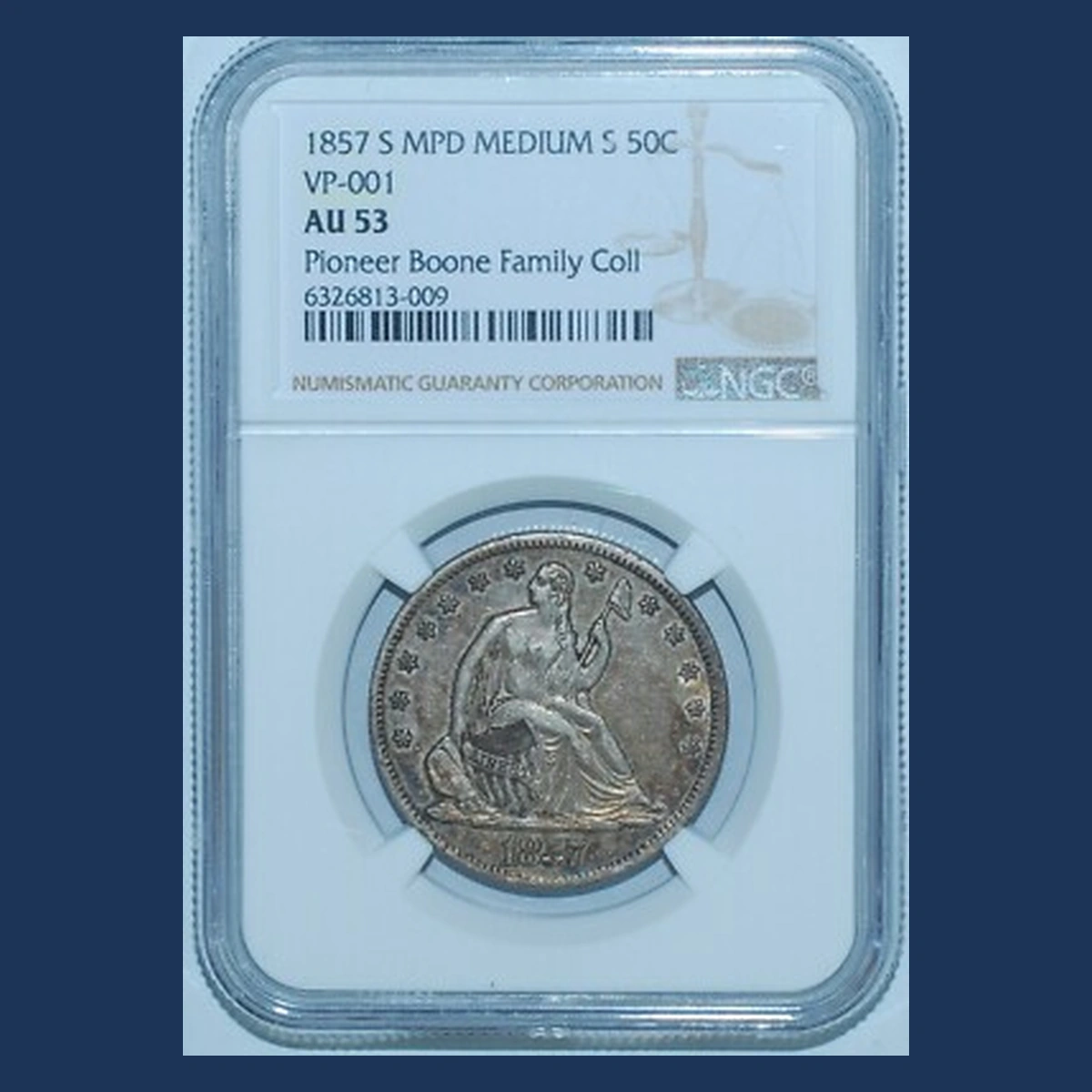
Look in the rock above the date rather than beside the numbers. Bits of a date punch can survive there after a worker placed it too high in the steel stamping tool.
The Philadelphia reference identifies bottoms of numbers in the rock. A New Orleans example has extra number detail above 57.
These small fragments may resemble ordinary rock engraving until their shapes are compared with an identified coin. The two mints do not share one exact pattern, even though both features came from the same basic mistake of punching a date in the wrong place.
Estimated Value
The auction-price archive records $7,200 for a PCGS MS64 CAC New Orleans example in August 2024. That coin had no wear and strong overall quality.
Estimated value is $250–$7,500, spanning worn examples through that finer comparison. An ANACS AU50 Philadelphia example had a reported $425 sale in February 2026, showing how much mint and condition affect value rather than making every small number fragment worth thousands.
How to Identify
Include the rock and complete date in one clear photograph. Check the bottoms of numbers on the Philadelphia reference or the extra detail above 57 on the New Orleans example.
Use a magnifier and place a normal coin beside the candidate. Ordinary rock lines can suggest numbers when seen alone, so compare a fragment’s curve or straight stroke with the identified example.
Confirm the mint, then inspect the edge grooves and use a scale and calipers to compare 12.44 grams and 30.6 millimeters.
A number-shaped fragment in the documented rock position provides the quickest first check for the misplaced-date feature.
Conclusion
Estimated values span $150–$7,500, with the $7,200 New Orleans auction coin representing a much finer example than most worn pieces. First decide what you see: a number fragment, an extra stroke, a raised line, a rim lump, or a turned back.
Then match the feature to the correct mint and location. Keeping those details together prevents one coin’s striking appearance or auction price from being applied to every unusual 1857 half dollar.