1873 Half Dollar Error List with Pictures

An 1873-CC half with fine cracks sold for $42,593.75 in March 2014. Its exceptional MS65 condition, with no circulation wear, mattered far more than the small lines alone.
These 1873 half dollar errors have estimated values from $250 to $50,000. Some have extra shield lines; others were struck twice or became badly distorted.
Check the arrows beside the date first. They are normal design features marking a weight change, and the sections below explain what else to look for.
1. 1873 Half Dollar Quad Stripes Doubled Die (Estimated Up to $1,500)
Look inside Liberty’s shield for groups of four vertical lines instead of the normal three. That extra line gives the Philadelphia Small Arrows variety its Quad Stripes name.
The extra design came from preparation of the die, the steel tool that stamps the coin. Coins made with that tool could repeat the same four-line groups.
Quad means four here. It does not mean the coin was struck four times, or that every line has four separate copies.
The shield is small and easily worn. Clear separation between its lines matters more than a dramatic-looking mark elsewhere on the coin.
Estimated Value
Estimate $250–$1,500 for circulated Quad Stripes examples with readable line groups. Clear lines and better surfaces make the variety easier to appreciate.
A dealer offered a very fine example for $325. The inventory description is an asking-price comparison, not an auction result.
A coin with sharper remaining details may bring more interest. General wear still matters, so a faint extra line on a poor surface should not automatically receive the upper estimate.
How to Identify
Find the small arrows beside the date and check that there is no mintmark on the back. That identifies the Philadelphia type used for this comparison.
Use a 10× magnifier and side lighting to count the raised lines in Liberty’s shield. Dark streaks of color should not be counted as extra metal.
Compare several line groups with an ordinary three-line shield at the same enlargement. A scratch cuts into the coin, while a flat ledge does not create the correct four-line pattern.
Check the ridged edge and use a scale and calipers against the With Arrows standard of 12.50 grams and about 30.6 millimeters. Four separate raised lines in the shield groups are the quick visual test.
2. 1873 Half Dollar Repunched and Misplaced Dates (Estimated Up to $6,000)
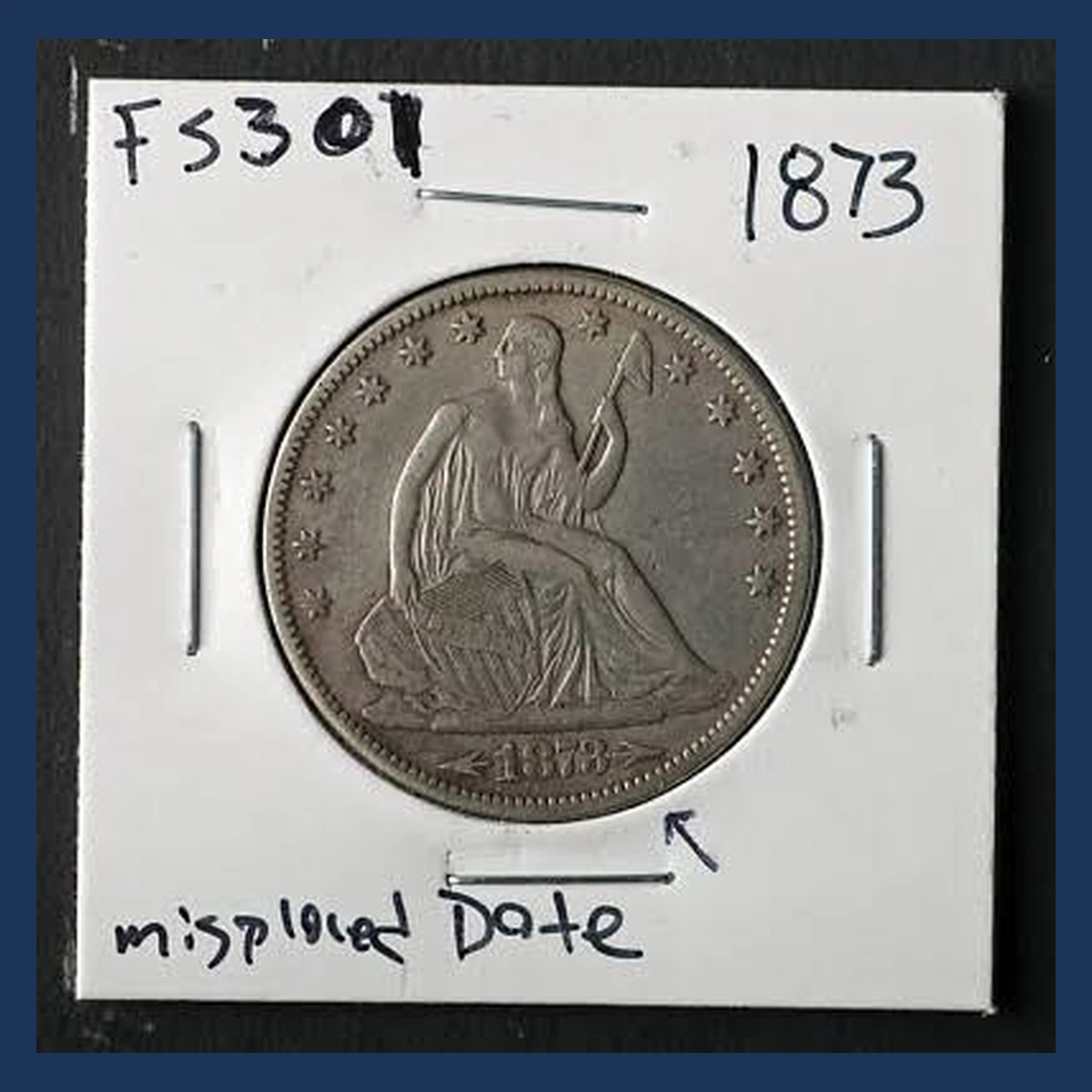
An extra piece of a digit beside the date can show that a punch entered the stamping tool more than once. If a remnant appears farther away, collectors call it a misplaced date.
Open 3 and Closed 3 are normal date styles. Their shapes alone are not errors.
Philadelphia examples include No Arrows Closed 3 and Small Arrows coins, with repunching reported on the latter’s 3. Carson City reports include extra impressions of the 1.
A Carson City With Arrows variety also has a misplaced-date report. These marks occupy different places, so one photograph cannot identify every 1873 date-punching feature.
Estimated Value
Estimated circulated values are $250–$2,000 for Philadelphia and $1,500–$6,000 for Carson City. The Carson City coins are scarcer even before their date marks are considered.
A Philadelphia No Arrows misplaced-date XF45 sold for $252 in March 2018. A Carson City No Arrows repunched-date VF30 brought $2,115 in 2016.
The Carson City record prices the entire coin. It is not an extra $2,115 added for the second impression of its 1.
How to Identify
Record whether arrows appear beside the date, then check the mintmark and the shape of the 3. Choose a comparison photograph with those same features.
A 10× magnifier should reveal pieces shaped like parts of a digit. A fold in Liberty’s dress is not enough to establish a misplaced number.
Inspect the date area for later cuts or altered metal. The extra strokes need to match the same mint and variety, not simply another unusual 1873 date.
On a loose coin, use a scale and calipers: No Arrows began at 12.44 grams, With Arrows at 12.50 grams, both about 30.6 millimeters. Check the ridged edge for filing.
Matching extra numeral pieces to the correct variety photograph is the clearest first check.
3. 1873-CC Half Dollar Double Struck in Collar (Estimated Up to $7,500)
Overlapping dates can appear on a nearly normal-sized coin. A metal ring called the collar can hold it while it turns slightly between two strikes.
An early account describes an 1873-CC With Arrows example with a second date above and counterclockwise from the first. Another STATES OF impression sits lower on the back.
A later Mint Error News illustration identifies a PCGS F12 coin as double struck in the collar. F12 means worn but still recognizable.
The extra designs come from another strike on the coin. That differs from one small extra digit already present in the stamping tool.
Estimated Value
Estimate $2,500–$7,500 for a genuine circulated 1873-CC double strike with readable overlapping designs. The range includes the value of the scarce Carson City coin itself.
For comparison, an 1819/8 Capped Bust half graded PCGS XF45 sold for $2,280 in July 2025. It also had a double strike.
That coin had a different design and less wear than an F12. Its sale provides context, not a recorded price for the reported 1873-CC example.
How to Identify
Trace both date impressions with a 10× magnifier, then examine the repeated letters on the back. They should fit another strike, rather than separate unrelated doubled-looking marks.
For the early published coin, compare the upper, counterclockwise date and the lower STATES OF. Do not assume that exact arrangement appears on every double strike.
Inspect the edge ridges and measure the diameter with calipers against about 30.6 millimeters. A With Arrows coin began at 12.50 grams before wear, which provides the scale comparison.
Later pressing of two coins together can leave sunken copies and crushed rims. A matching shift across both the date and back lettering is the most useful first distinction.
4. 1873 Half Dollar Proof Lamination (Estimated Up to $20,000)
A small oval flaw sits near Liberty’s raised elbow on one Philadelphia Large Arrows half. Heritage cataloged it as an original lamination on a PCGS PR66 coin with CAC approval.
This is a Proof, a specially made collector coin. Even a carefully made Proof can begin with an imperfect metal blank.
Lamination occurs when the alloy separates along a weak layer. It may leave a shallow missing patch or a partly attached flap.
The oval feature concerns separation within silver alloy. It is not the loss of the bonded copper-nickel outer layer found on many modern coins.
Estimated Value
A With Arrows Proof near PR66 with attractive surfaces has an estimated whole-coin range of $12,000–$20,000. A small lamination does not automatically add a large premium.
A dealer inventory asks $17,950 for a different 1873 Arrows half graded NGC PR66. That coin has no stated lamination.
The offer helps compare date and grade. It is not a completed sale or the price of Heritage’s PCGS example with the elbow flaw.
How to Identify
Leave the Proof surfaces untouched. Through a 10× magnifier, direct a narrow light across the small oval near Liberty’s raised elbow.
Compare its boundary with the catalog photograph. A separating layer differs from metal pushed aside by a blow or a sharp cut made later.
Confirm the Large Arrows beside the date and the intact surrounding design. If the coin is sealed in a grading holder, inspect through it rather than removing it to measure.
For a loose example, use a scale and calipers against 12.50 grams and 30.6 millimeters, and inspect the ridged edge. A tiny missing layer may barely affect weight.
The oval separation beside the raised elbow is the fastest place to match this specimen.
5. 1873-CC Half Dollar Die Cracks (Up to $42,593.75)
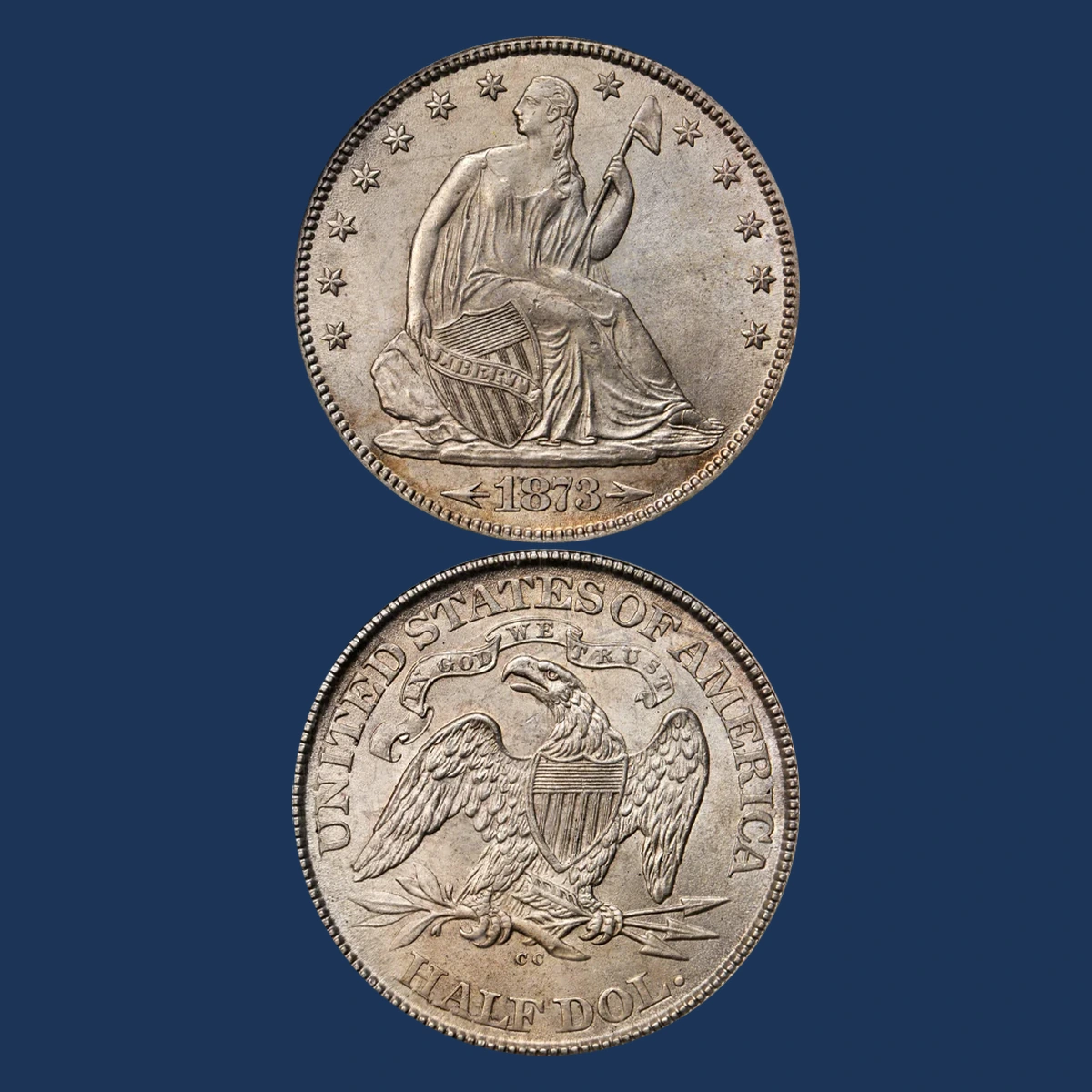
Thin raised lines run from the rock beneath Liberty through stars on the left of an 1873-CC half. Other cracks cross leaves and the final TED of UNITED on the back.
They formed when silver entered cracks in the stamping tools. The finished coin carries those lines as ridges rather than cuts.
Heritage described the paths on an MS65 With Arrows example with the Small CC mintmark. The two small letters identify Carson City.
Such lines help match coins made from the same tools. Their presence does not mean the cracks account for most of this unusually well-preserved coin’s price.
Estimated Value
Circulated With Arrows examples with similar minor cracks have an estimated range of $800–$4,000. Much better preservation calls for a different comparison.
The PCGS MS65 sold for $42,593.75 on March 20, 2014, as recorded in Heritage’s archive.
That buyer paid for a rare Carson City half in exceptional condition. The cracks help identify the tools that struck it, but they do not explain the full price by themselves.
How to Identify
Begin at the rock beneath Liberty and follow the line into the left stars. A 10× magnifier helps you trace the ridge through both flat and raised parts of the design.
On the back, check the leaves and TED under light from the side. A scratch may have a cut channel with pushed-up metal beside it, unlike the raised crack itself.
Compare the Small CC mark and date arrows with the documented coin. Photograph the paths before relying on a bright or dark line in one view.
Check the edge ridges, then use a scale and calipers against 12.50 grams and about 30.6 millimeters. The rock-to-stars ridge, supported by the back’s matching cracks, gives the quickest useful comparison.
6. 1873 Half Dollar Die Caps and Brockage (Estimated Up to $50,000)
A backward design pressed into a coin is called a brockage. It can happen when a previously struck coin sticks to a stamping tool and presses its design into another blank.
The stuck coin may spread and form a cap around the tool. Two 1873 halves show parts of this process.
A privately held PCGS XF45 has a full backward eagle design and a greatly expanded outline. Early descriptions also call it a front-side die cap.
A 2010 report links it to Carson City and a separate PCGS AU58 reverse cap in the Nevada State Museum. They are different coins.
Estimated Value
Comparable rare nineteenth-century silver caps and brockages have an estimated range of $20,000–$50,000. This is not a sale quotation for the museum’s coin.
The June 2025 Mint Error News guide values Barber quarter front-side caps at $20,000 in extremely fine condition and $50,000 without circulation wear. Those are different-series guide figures.
The 1873 halves still need individual comparisons. Their shape, wear, identification, and ownership history can each affect a market estimate.
How to Identify
A brockage should show a backward design pressed down into the surface. A die cap also needs the stretched, cup-like shape of a coin that stuck to a tool.
Use a 10× magnifier on both faces and the edge. Keep the private XF45 and museum AU58 separate when comparing photographs.
Calipers can record spread beyond the normal 30.6 millimeters. A scale records the weight, but first check the arrows: No Arrows began at 12.44 grams and With Arrows at 12.50 grams.
Inspect the remaining edge ridges for later bending or crushing. The museum account explains the two identities.
Backward sunken design and genuine cap-shaped stretching are the main visible clues to check together.
Conclusion
The estimated range for these 1873 errors is $250–$50,000. Four shield lines, repeated dates, and a backward design each need a different check.
First identify the arrows and mintmark so you compare the correct coin and weight standard. Then match the visible feature.
The $42,593.75 MS65 sale, the dealer’s Proof offer, and the cap estimates are different kinds of price evidence, each tied to its own condition and example.