1916 Half Dollar Error List with Pictures

Look below IN GOD WE TRUST on the front of a 1916-D half dollar. Part of a second D can appear beneath the main mintmark.
A coin with this feature, graded MS65, brought $5,246 at Heritage in July 2026, according to PCGS.
This guide to 1916 half dollar errors explains the extra D and the estimated $1,600–$5,300 range for that grade. Read on to see what to check.
1916-D Walking Liberty Half Dollar Repunched Mintmark Error (Up to $5,246)
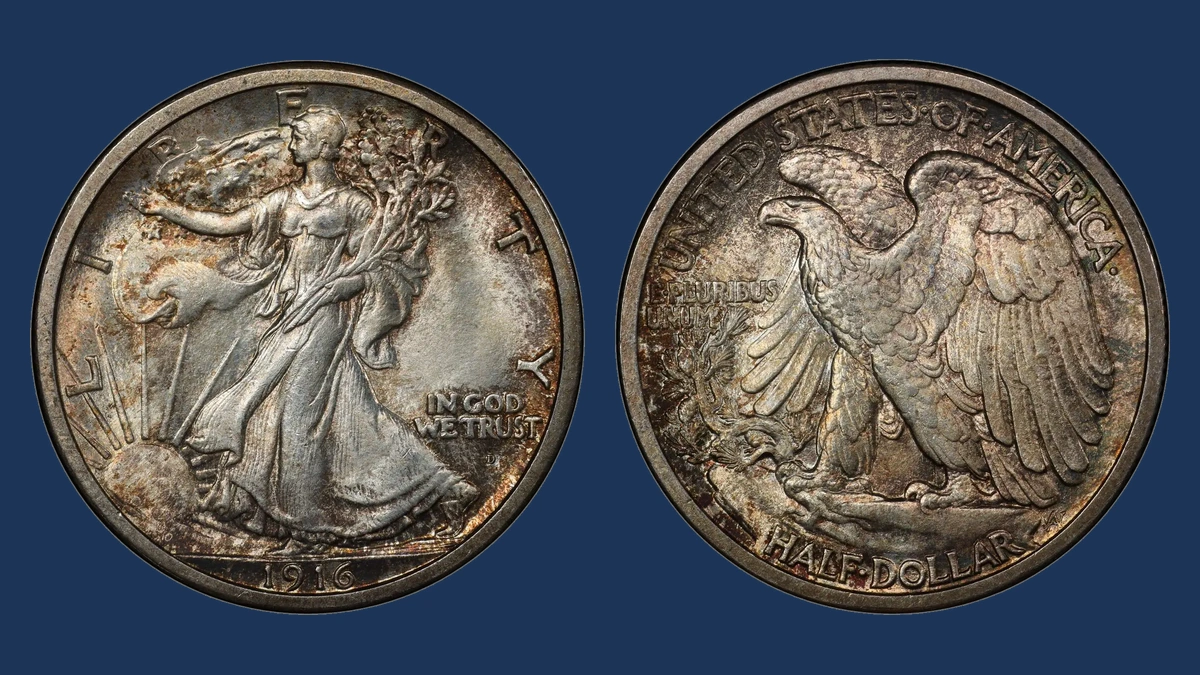
The small D below the motto identifies the Denver Mint. On this variety, part of another D shows beneath it, making the letter look doubled.
This is a repunched mintmark. The letter was punched twice into a die—the steel tool that stamps coins—and both marks appeared on the finished coins.
For 1916, look on the front. Later Walking Liberty halves have their mintmarks on the back, but that is the wrong place for this date.
Collectors call this variety FS-501. The older names FS-008 and VP-001 describe the same extra D, not separate errors.
Estimated Value
A PCGS MS65 example sold for $1,620 at Heritage in March 2019. PCGS also records a July 2026 Heritage MS65 sale at $5,246.
Estimate $1,600–$5,300 for certified MS65 coins, a grade for well-preserved pieces without circulation wear. Their marks and original shine can still differ.
The grade is not the whole story. These prices include the value of the 1916-D coin itself, and auction demand can change the final result.
How to Identify
Find the D on the front, below IN GOD WE TRUST. Use a 10× magnifier to inspect its lower edge, where the earlier letter should form part of another D.
Thickness alone is not enough. Compare the shape with a normal mintmark and watch for a flat shelf, corrosion, or signs that someone added the letter later.
For a coin outside a holder, use a digital scale and calipers to check its size. The normal weight is 12.50 grams, the diameter about 30.6 mm, and the edge has grooves called reeding.
Wear can lower the weight. A close match to the lower D in an FS-501 reference photo is the quickest check of this variety.
Conclusion
The extra D belongs below the main mintmark on the front of the coin. That small shape identifies this 1916-D variety, also called FS-501.
For certified MS65 examples, the estimated range is $1,600–$5,300, supported by sales at $1,620 and $5,246. Compare the marks and original shine too; two coins with the same grade can still attract very different bids.