1921 Half Dollar Error List with Pictures

A double-struck 1921 half dollar graded ANACS MS61 appears at $16,100 in a historical Heritage auction compilation. Another dealer record describes a coin whose first strike was off center before it received a second blow.
The 1921 half dollar errors below have estimated values from $100 to $25,000. Read on to compare overlapping pictures, peeling metal, repeated details, and missing edge pieces while keeping the coin’s already valuable date in mind.
1. 1921 Walking Liberty Half Dollar Rim Die Crack Error (Estimated Up to $600)
A seller described a worn Philadelphia half dollar as having a crack near the rim. PCGS graded the coin G06, meaning heavy wear, but that grade does not confirm the seller’s added error description.
A crack in a steel stamping tool can fill with coin metal and leave a raised line. A scratch made afterward instead cuts the finished surface.
The listing does not establish which side or clock position carries the mark. The actual line needs to show that it formed with the design, rather than simply being metal pushed up by a rim impact.
Estimated Value
Estimated value is $100–$600 for a worn Philadelphia example with a genuine visible rim crack. Much of the amount comes from the scarce 1921 coin itself.
No reliable final sale price is available for the listed G06. A larger break on a 1976-D Kennedy sold for $256 in June 2026.
That unworn NGC MS65 is from a different series. It offers only broad comparison for tool damage, not a direct price for this worn Walker.
How to Identify
Inspect the line where it meets the rim with a magnifier. A hit may compress the border and push a lip inward, imitating extra raised metal.
Confirm the 1921 date and the Philadelphia back without a mintmark. A scale and calipers can compare 12.50 grams and 30.6 millimeters, allowing for heavy wear.
Follow the edge grooves and trace the line to both ends under changing light. Wear can soften a raised line but should not turn it into a sharp cut.
Look for a continuous original ridge reaching the rim, rather than a groove or metal pushed inward by an impact.
2. 1921-S Walking Liberty Half Dollar Obverse Lamination Error (Estimated Up to $800)
A patch to the right of Liberty shows where a metal layer separated on the ANA’s illustrated 1921-S. The back remains unaffected.
Collectors call this lamination. A weak bond inside the silver alloy can release a thin layer without splitting the entire coin.
Look along the edge of the affected patch. A thin layer separating from the coin is different from a scratch cut across it.
For the 1921-S, the useful contrast is simple: the front shows the separated layer, while the normal back preserves the eagle and the S identifying San Francisco.
Estimated Value
Estimated value is $100–$800 for a worn 1921-S with clear lamination. The amount of wear and surviving original surface both matter.
The ANA teaching example supplies no grade or sale price. A dealer lists a different 1947 front-lamination coin, NGC MS65, at $275.
That is an asking price for an unworn, more available date. It does not determine the 1921-S price, whose condition and visible separation need their own assessment.
How to Identify
Compare the area right of Liberty with the ANA picture. Use a magnifier at the opening to look for a layer within the alloy, not cloth texture or a second design.
Photograph the S and the normal eagle side. A scale may show less than the normal 12.50 grams if metal is gone, while an attached flap may leave little change.
Calipers can compare intact widths with 30.6 millimeters. Inspect the edge grooves for cutting and leave any loose layer in place.
The natural opening beside Liberty, joined to the surrounding original surface, is the immediate feature to look for.
3. 1921 Walking Liberty Half Dollar Clipped Planchet Error (Estimated Up to $1,500)
A genuine clip begins with metal missing before the design is stamped. The incomplete blank, or round metal disc, can develop unusual rim shapes as it passes through production.
The nearby design should form around that existing gap. A piece cut away afterward has a different history even if the outline looks similar.
No confirmed 1921 Walking Liberty double-clip example is identified in the reference material. Check the actual half dollar before assigning a number or shape to its missing pieces.
Keep its date and mintmark visible. A photograph of a clipped coin from another series cannot identify this one.
Estimated Value
Estimated value is $150–$1,500 for a genuine clip on a worn 1921 Walker. The scarce date’s value and the original missing edge both contribute.
A 1942-S rim clip graded ANACS MS62 sold for $81.90 including buyer’s premium in May 2025. MS62 means no wear but noticeable marks.
That more common-date Walker gives an affordable comparison. It does not establish a 1921 specimen, a double clip, or a separate fixed price for every missing section.
How to Identify
Weigh the coin against the original 12.50 grams and compare intact widths with 30.6 millimeters using calipers. The missing amount should help explain the weight difference, with wear considered too.
Use a magnifier on each gap separately. Follow the edge grooves and the way nearby letters or design flow toward the missing section.
A weak rim opposite a gap can support a clip, but it is not equally obvious on every example. Keep the full date and actual mintmark visible in photographs.
A naturally incomplete edge around which the design was struck distinguishes a genuine clip from metal removed later.
4. 1921 Walking Liberty Half Dollar Doubled Die Obverse Error (Estimated Up to $2,500)
A letter or number can show an extra outline when the steel stamping tool already contains repeated design detail. Coins made from that tool can then share the same pattern.
This is called a doubled die. The 1921 material suggests checking Liberty, the date, and the nearby words, but it does not establish a named example at a particular spot.
A heavy-looking letter needs careful comparison. Wear, reflections, or movement during striking can make an edge appear thicker.
Those effects do not mean the tool carried a repeated design. One broad number alone cannot confirm a valuable variety.
Estimated Value
Estimated value is $200–$2,500 for genuine identified front doubling on worn 1921 coins. Better-preserved scarce-date examples need their own normal-coin price assessment.
A known 1939-D FS-101 sold for $2,160 in April 2025, graded NGC MS67+. That is a much later, very well-preserved Walker.
It provides a comparison rather than evidence of a named 1921 doubled die. Ordinary thick lettering should not receive extra value just because an older-date coin is already scarce.
How to Identify
Choose a normal 1921 of the same mint for comparison. Under a magnifier, examine the same letter or number in similar lighting rather than comparing unrelated enlarged pictures.
Record the whole front and its wear before looking at one tiny detail. Inspect the edge grooves, then use a scale and calipers to compare 12.50 grams and 30.6 millimeters.
Move the light to see whether an extra rounded shape remains present. A shallow flat shelf beside a reduced letter suggests movement during striking instead.
The convincing match is the same raised separation on an independently identified coin made from that particular front stamping tool.
5. 1921 Walking Liberty Half Dollar Doubled Die Reverse Error (Estimated Up to $2,500)
The eagle’s feathers contain many normal crossing lines. They can make one edge look doubled when it is simply part of the intended design.
True back doubling begins with repeated shapes in the steel stamping tool. It can occur independently of anything visible on Liberty’s side.
The 1921 source names no particular coin or set of doubled letters. Start with a normal back for comparison.
An extra outline should follow a recognizable part of the design. Random wear, contact marks, or reflections that move with the light are different clues.
Estimated Value
Estimated value is $200–$2,500 for genuine identified back doubling on worn 1921 examples. The valuable early date is included in that whole-coin range.
A known 1946 doubled-back variety sold for $2,040 at Heritage in November 2024. NGC graded it MS65, meaning an attractive unworn coin.
That result belongs to the later variety. Subtle doubling may add less, while a much better-preserved 1921 can already exceed the stated range without any error.
How to Identify
Find the mintmark area at the lower left of the back and record the entire design. Check the edge grooves and compare the normal 12.50 grams and 30.6 millimeters with a scale and calipers.
Then work across the eagle and letters with a magnifier. Compare each suspected extra line with the same place on a normal back before deciding it is new detail.
Correct weight and size cannot prove doubling. A second blow affecting large parts of the picture would also require a different explanation.
Look for one repeated raised back-design pattern matching a reliably identified example, rather than extra feather edges selected from unrelated areas.
6. 1921 Walking Liberty Half Dollar Repunched Mintmark Error (Estimated Up to $2,500)
Only a coin with a D or S has a mintmark to inspect for repunching. On a 1921 half dollar, that letter is on the back, unlike some early Walking Liberty issues.
A worker could punch the letter more than once into the steel stamping tool. Part of the earlier impression might remain beside the final letter.
The 1921 discussion uses another year’s example and does not establish an exact direction or named 1921 variety. A normal thick D or S is not enough, and a Philadelphia coin without a mintmark cannot show this feature.
Estimated Value
Estimated value is $200–$2,500 for genuine identified repunching on worn Denver or San Francisco coins. The scarce date can account for much of that amount.
A 1939-D/D graded PCGS MS64+ sold for $1,292.50 in September 2017. Its grade describes a well-preserved unworn coin.
That historical Walker sale provides a comparison. It does not prove a 1921 variety or give the same added value to both 1921 mints, whose condition still matters.
How to Identify
Locate the D or S below the branch at the lower left of the back. Use a magnifier to compare the letter’s normal shape with the suspected earlier curve or small tip.
Check the adjacent surface for an added or altered mintmark. These scarce-date coins need the correct mint identity before any extra value is considered.
Inspect the edge grooves and use a scale and calipers to compare the original 12.50 grams and roughly 30.6 millimeters. Do not borrow a direction from the other-year example.
A genuine second letter fragment matching an identified 1921 coin of the same mint supplies the clearest positive check.
7. 1921-D Walking Liberty Half Dollar Broadstrike Error (Estimated Up to $15,000)
A wider-than-normal outline with a complete design can indicate a broadstrike. The metal ring that normally holds the disc failed to limit its spread during striking.
A later-year value discussion mentions a 1921-D example, but the account does not fully identify a traceable coin. The actual candidate must show the physical evidence.
Both pictures should remain on the metal even if they sit unevenly within the widened shape. Hammering a finished coin can also make it wider, so size alone does not prove that the spreading happened at the mint.
Estimated Value
Estimated value is $3,000–$15,000 for a genuine worn 1921-D broadstrike. The scarce Denver coin’s own condition is central to that estimate.
The 2025 specialist guide puts ordinary-date broadstruck Walkers around $3,000–$7,000 across moderately worn and unworn examples. Those are guide figures.
The larger allowance is not a recorded sale of a confirmed 1921-D. An off-center coin needs its own comparison, even if another description uses both names loosely.
How to Identify
Measure several widths with calipers against the normal 30.6 millimeters. A scale should stay near the original 12.50 grams, allowing for wear, because spreading itself does not remove metal.
Check that Liberty, the eagle, and outer lettering all remain on the coin. Missing design beside untouched metal suggests a different striking error.
With a magnifier, inspect the edge for missing or uneven grooves and look for later pressure marks. Photograph the D and whole outline, not just its widest point.
A full design inside naturally widened metal, with an edge formed without normal restraint, gives the practical first check for a broadstrike.
8. 1921 Walking Liberty Half Dollar Off-Center Strike Error (Estimated Up to $20,000)
The documented 1921 coin received its first strike off center. It was then struck again, changing some of the visible design.
That sequence matters because the second picture can cover the edge of the first. The final shape should not be read as if the coin received only one misplaced blow.
The dealer described an NGC MS62, meaning no wear but noticeable marks. This same coin appears under double striking below.
No percentage or direction is supplied for its first shift. Those details cannot be borrowed from another Walker.
Estimated Value
Estimated value is $500–$20,000 for genuine off-center 1921 examples, from worn coins to stronger pieces. Condition of the scarce-date coin has a large effect.
A 1918 struck ten percent off center sold for $10,575 in April 2013. PCGS graded that unworn example MS65.
The dealer’s $21,850 listing for the 1921 MS62 includes its second strike as well. It does not price a simple off-center error or prove a final negotiated sale amount.
How to Identify
Find pieces of the first design before measuring any shift from the final outline. The later strike may cover where the first picture ended against blank metal.
Use a magnifier to follow those crossings on both sides. Keep the date visible and separate original metal movement from later scrapes.
A scale and calipers can compare the intact 12.50 grams and usual 30.6 millimeters. Photograph the edge grooves to show how they relate to the surviving impressions.
Do not assign a percentage unsupported by the coin. A recognizable earlier design cut off at its original blank boundary directly shows the first off-center strike.
9. 1921 Walking Liberty Half Dollar Double Strike Error (Estimated Up to $25,000)
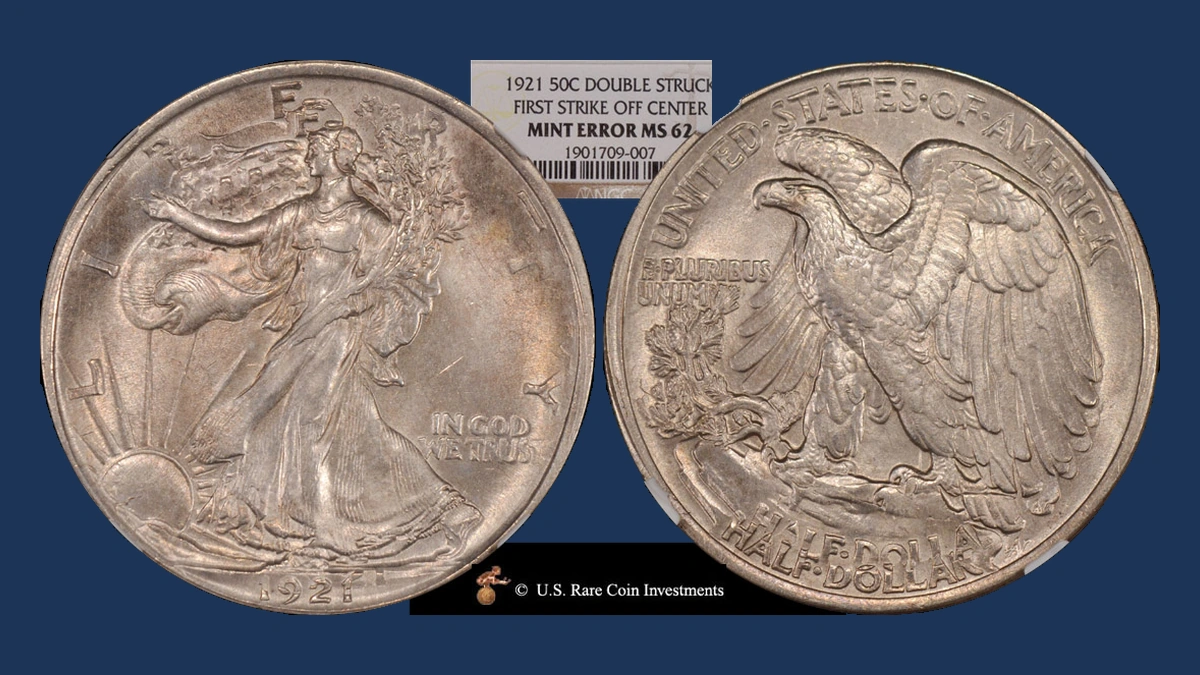
Two blows affected the same piece of silver on the dealer’s Philadelphia 1921 double strike. The listing says its first impression was off center and grades it NGC MS62.
A historical auction compilation also shows an ANACS MS61 double-struck 1921. Both grades describe unworn coins with marks.
The different holders and grades do not prove that the records show two coins. They also do not prove that one coin was regraded.
Keep the records separate while studying how the impressions overlap. The visible sequence matters more than assuming a history from the labels alone.
Estimated Value
The historical auction compilation records $16,100 for the ANACS MS61. The NGC MS62 dealer page displays $21,850 and was marked sold in May 2015.
That listing does not independently prove the final negotiated amount. Estimated value is $10,000–$25,000 for substantial genuine examples.
Remaining design and condition affect the comparison. Two catalog appearances should not automatically be counted as two coins, and prices should not be added for features sharing one coin.
How to Identify
Follow where a later picture crosses or flattens a recognizable part of the first. Use a magnifier and check that several surviving features agree with the same sequence.
Here the documented first strike was off center. Do not reverse the order because another coin has an off-center second blow.
Use a scale and calipers to compare 12.50 grams and the normal 30.6 millimeters, recording the changed outline. Inspect how the edge grooves changed as the coin moved.
A single thick letter is not enough. Intersecting parts of two separately positioned designs are the quickest convincing evidence of a genuine double strike.
Conclusion
The estimated $100–$25,000 range includes the value of the scarce 1921 coin as well as its unusual feature. A peeling layer beside Liberty and two overlapping strikes tell very different stories.
Use both sides and the edge to check those stories. For the double-struck coin, remember that its first strike was off center.
Keep seller descriptions and completed sales separate when comparing prices.